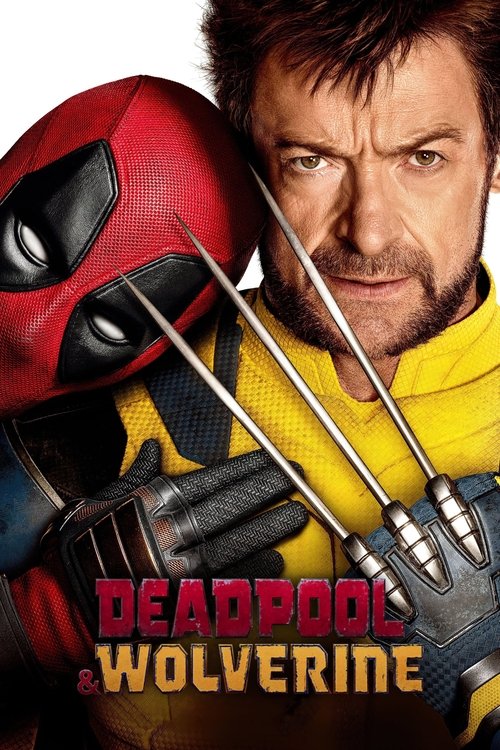
Deadpool & Wolverine
2024 · Shawn Levy
For a rowdy night when you want to laugh at big, dumb, gory spectacle — ideally with friends and some fluency in twenty years of superhero movies, since half the jokes are about them. Zero challenge, maximum sugar rush.
What it's about
Wade Wilson has hung up the Deadpool suit and is grinding through civilian life when he learns his whole world is slated for erasure by the bureaucrats who police the multiverse. His only shot at saving it means dragging a bitter, damaged Wolverine — a variant with everything to atone for — into a reluctant partnership. Cue a road trip through discarded universes, two men who can't die beating each other senseless, and jokes about the very studio releasing the film.
The experience
A two-hour riot — profane, hyper-violent, and relentlessly self-aware, with gag-a-minute pacing, needle-drops played for maximum absurdity, and a surprising streak of sincerity about legacy and washed-up heroes underneath the snark. Exhausting in the fun way.
Performances
Ryan Reynolds runs his motormouth shtick at full throttle, but Hugh Jackman is the surprise: returning to Wolverine after a definitive goodbye, he plays this broken variant with real self-loathing and gravity, giving the comedy something to push against.
The craft
The film's craft is its comic engineering — fourth-wall demolition, cameo construction, and fight choreography staged as slapstick set to pop songs — built by Shawn Levy and a Reynolds-led writing room into an affectionate wake for an entire era of superhero movies. The R rating is used with cheerful abandon.
Why it matters
The first R-rated Marvel Studios release and a box-office giant that proved raunch and four-quadrant scale could coexist — at once a farewell to the Fox era of Marvel movies and the moment Deadpool joined the biggest franchise on earth.
Snapshot
Deadpool & Wolverine is the third solo outing for Ryan Reynolds' fourth-wall-breaking mercenary and the first Deadpool film produced under Marvel Studios rather than 20th Century Fox — the direct consequence of Disney's 2019 acquisition of Fox's film assets. It is also, notably, the first Marvel Studios release to carry an R rating, a landmark for a company whose brand had been built on the four-quadrant, PG-13 blockbuster. The film's central gambit is a reunion: it lures Hugh Jackman back to Wolverine seven years after Logan (2017) had delivered what audiences understood to be a definitive, mortal farewell. Built as an elegy-cum-victory-lap for the entire Fox-era Marvel canon, the film folds Deadpool's meta-commentary into a multiverse plot policed by the Time Variance Authority (imported from the Disney+ series Loki), and stages a self-aware wake for two decades of X-Men and adjacent films. It became a defining commercial event of the 2024 summer.
Industry & production
The film sits at a precise industrial hinge. When Disney completed its purchase of 21st Century Fox, it absorbed the X-Men, Fantastic Four, and Deadpool screen rights that had lived at Fox since the late 1990s and early 2000s. Deadpool & Wolverine is the first film to metabolize that transfer on screen, functioning simultaneously as a corporate handoff and a eulogy for the studio regime that produced the modern superhero cycle. Reynolds, who had shepherded the R-rated Deadpool brand through Deadpool (2016) and Deadpool 2 (2018) — both surprise hits that proved an adult-rated comic-book film could be enormously profitable — carried the character across the ownership line, retaining producer authority and co-writing credit.
Shawn Levy directed, extending a working relationship with Reynolds forged on Free Guy (2021) and The Adam Project (2022). Levy came out of populist studio comedy and family filmmaking (the Night at the Museum franchise) and television (a producer on Stranger Things), and his selection signaled a film pitched at broad crowd-pleasing entertainment rather than the auteur darkness of Logan. The production folded in a large ensemble of returning Fox-Marvel performers as cameos and supporting turns; the film's marketing and word-of-mouth traded heavily on the surprise of these appearances, and reviewers widely noted the film's reliance on nostalgia and cameo recognition as a structural principle.
Commercially, the film was among the year's largest releases and is widely reported to have become the highest-grossing R-rated film to that point, a milestone that vindicated the premise Reynolds had been arguing for since the first Deadpool. Beyond specific figures — which I'll avoid overstating — its significance is that it demonstrated an R-rated, meta-textual superhero comedy could operate at full tentpole scale within the Marvel Studios machine.
Technology
The Deadpool films have been shot digitally, and Deadpool & Wolverine was produced within the standard high-end digital pipeline of contemporary studio VFX filmmaking; the precise camera package is not something I can confirm without risking invention, so I'll flag that as thin. What is clear is the film's heavy dependence on visual effects: the multiverse "Void" — a wasteland at the edge of time built from the debris of erased realities — is a large digital-environment undertaking, and set-pieces such as the mass Deadpool-variant brawl and the climactic confrontation rely on extensive compositing, digital doubles, and de-aging or continuity effects for legacy characters. Marvel Studios' production was, during this period, the subject of broad public discussion about VFX-artist workload and compressed post-production schedules across the industry; that context is general rather than specific to this title. The film also uses its practical costuming as a technological-cultural statement — most prominently the first live-action rendering of Wolverine in his comic-accurate yellow-and-blue suit, a piece of costume engineering fans had awaited across two decades of screen adaptations.
Technique
Cinematography
George Richmond served as director of photography. Richmond's résumé — including Kingsman films and Rocketman — favors glossy, kinetic, saturated action photography, and that sensibility suits a film built on comic-book primary colors and rapid tonal shifts. The photography has to accommodate two opposed registers: the bright, ironic sheen of Deadpool's world and the desaturated, ruinous palette of the Void, which visually quotes post-apocalyptic wasteland cinema. The camera is generally legible and coverage-driven rather than experimental — appropriate for a comedy whose jokes depend on clean sightlines, reaction beats, and framing that lets Reynolds' direct-address land.
Editing
Cutting is central to the Deadpool mode: the humor runs on interruption, timing, and abrupt tonal pivots, and the editors must sustain a joke-per-beat density while managing large action sequences and a cameo-laden structure. Dean Zimmerman — a frequent Levy collaborator, including on Stranger Things and Free Guy — and Shane Reid are the credited editors. The editorial challenge specific to this film is rhythmic: balancing Deadpool's motormouth asides against Wolverine's taciturnity, and orchestrating the "reveal" architecture so that each nostalgic appearance registers as a discrete audience event.
Mise-en-scène / staging
The film's staging is organized around the buddy-comedy two-shot: Deadpool and Wolverine framed as an odd-couple pairing whose physical and temperamental contrast drives both the comedy and the violence. The Void functions as a scavenger's set — littered with the wreckage of prior franchises (the imagery famously incorporates the remains of Fox-Marvel iconography), so that the production design itself becomes a form of meta-commentary. Fight choreography leans into the R rating with graphic, cartoonishly bloody hand-to-hand combat, staged to be both brutal and comic.
Sound
The film pairs Rob Simonsen's original score with an aggressive, ironic use of licensed needle-drops, continuing the franchise's signature of scoring carnage to incongruously upbeat or sentimental pop. The Deadpool films have consistently used music as a punchline and an emotional lever at once, and this entry sustains that; its opening sequence in particular is built around a music-driven set-piece. The sound design supports the R-rated physicality — the crunch and squelch of combat is foregrounded for comic-grotesque effect.
Performance
Reynolds' Deadpool is by now a fully calcified persona: rapid-fire, self-referential, alternating between mania and unexpected sentiment. The film's performance interest lies in the counter-casting of Hugh Jackman, who returns to a role he had played across nearly two decades and had seemingly retired. Jackman plays a variant Wolverine — a more embittered, failure-haunted version of the character — allowing him to both reprise and revise the icon. Emma Corrin plays the antagonist Cassandra Nova with cool menace, and the film's supporting texture depends heavily on cameo performances by returning franchise actors, whose value is partly extra-textual: the audience's memory of their earlier roles is itself the performance.
Narrative & dramatic mode
The dominant mode is meta-comedy grafted onto a multiverse rescue plot. Wade Wilson, drifting in a deflated civilian life, is conscripted into a cross-reality crisis by the TVA and must recruit a reluctant Wolverine to avert the collapse of his home timeline. Structurally the film is picaresque and episodic — a road-movie through the Void punctuated by set-piece encounters — with the buddy-comedy at its spine. Its most distinctive dramatic feature is the fourth-wall address: Deadpool narrates, comments on the film's own production circumstances, on Disney, on the Marvel machinery, and on the actors' careers. This self-consciousness is the film's organizing principle rather than a garnish, which means the drama runs on two tracks at once — a sincere emotional arc about grief, failure, and second chances (largely carried by Jackman's Wolverine) beneath a continuous ironic commentary that repeatedly punctures it.
Genre & cycle
The film belongs to the superhero blockbuster cycle at a late, self-reflexive stage. By 2024 the genre had reached a point of saturation and audience fatigue was a common critical theme; Deadpool & Wolverine responds not by reinventing the form but by turning the cycle's own history into content — mining nostalgia, referencing the Fox era's triumphs and failures, and treating the multiverse conceit (a dominant device in the period's superhero filmmaking) as license for a clip-show of franchise memory. It is simultaneously an action-comedy, a buddy movie, and a superhero film, and it sits within a specific sub-cycle of self-aware, R-rated comic adaptations that Deadpool itself helped inaugurate.
Authorship & method
The film has diffuse authorship by design. Shawn Levy directs in a mode of amiable, high-energy showmanship, prioritizing crowd response and star chemistry over formal signature. The screenplay is credited to a committee including Reynolds, longtime Deadpool writers Rhett Reese and Paul Wernick, comics writer Zeb Wells, and Levy — a construction that reflects the franchise's collaborative, joke-workshopped development. Reynolds is the effective auteur of the Deadpool voice: his authorship over the character's tone, meta-sensibility, and improvisational texture is the through-line across all three films. Key collaborators include cinematographer George Richmond, composer Rob Simonsen, and editors Dean Zimmerman and Shane Reid. The method is fundamentally a producer-and-star-driven one, with Reynolds' creative control the constant across changing studios.
Movement / national cinema
This is mainstream American studio filmmaking at its most industrial — a Hollywood tentpole in the Marvel Studios model, financed and distributed by Disney, and produced within the transnational VFX and franchise-management apparatus that defines contemporary blockbuster cinema. It belongs to no art-cinema movement; if it participates in any "movement," it is the corporate-nostalgia turn in 2020s franchise filmmaking, in which studios monetize the accumulated memory of their own back catalogs.
Era / period
The film is a document of a very particular moment: the immediate aftermath of the Disney-Fox merger and a period of visible strain and recalibration for Marvel Studios following the mixed reception of several post-Endgame projects. It arrives amid public conversation about superhero fatigue, about the health of the theatrical marketplace after the pandemic disruption, and about the labor conditions of the VFX industry. Its self-referential mode — jokes about corporate ownership, franchise decline, and the machinery of the MCU — is legible only against that specific industrial climate, making the film unusually tied to its exact release year.
Themes
Beneath the comedy the film is preoccupied with failure, obsolescence, and second chances. Both leads are men defined by what they have lost or failed to protect — Wade by aimlessness and self-doubt, this Wolverine by a catastrophe he could not prevent — and their partnership is a mutual redemption. Legacy and mortality run throughout: the film is haunted by Logan's death of Wolverine and stages a return that is also a negotiation with what it means to bring a character back after a "perfect" ending. On a meta level, the film thematizes the nostalgia industry itself — the impulse to resurrect, reunite, and honor the past — while ironically commenting on the commercial motives behind that impulse. Friendship, chosen family, and belonging (recurring Deadpool concerns) supply the sincere emotional core the comedy repeatedly interrupts and then, characteristically, embraces.
Reception, canon & influence
Critical reception was mixed-to-positive: reviewers broadly praised the Reynolds–Jackman chemistry, the energy, and the pleasure of Jackman's return, while a substantial critical strain judged the film overdependent on cameo nostalgia and fan-service, arguing that its meta-commentary served as insulation against genuine dramatic stakes. Commercially it was a major success and is widely reported as the highest-grossing R-rated film to its date, a result that carried real industrial weight: it demonstrated that R-rated, self-aware superhero comedy could function as a top-tier tentpole and reframed assumptions about the ceiling for adult-rated genre films.
The influences on the film are legible and openly acknowledged: the entire Fox-era X-Men and Deadpool cinematic lineage; Logan as the emotional predecessor it both honors and revises; the Loki series and the MCU's multiverse infrastructure as narrative scaffolding; and the buddy-action-comedy tradition. Its self-referential mode extends a lineage of meta-comedy in genre film that Deadpool had already made its own.
Its legacy forward is still forming, but its clearest effects are industrial and cultural rather than aesthetic: it consolidated the R-rated superhero film as a viable large-scale category, modeled the "franchise-nostalgia reunion" as a commercial strategy for studios sitting on deep back catalogs, and served as the on-screen bridge integrating the Fox-Marvel characters into the Disney-owned Marvel enterprise. Whether it inaugurates a durable creative direction or marks a high-water mark of the nostalgia-monetization mode is a judgment the record is genuinely too young to settle.
A Deleuzian reading
A man digs up a grave.
The full Deleuzian reading of Deadpool & Wolverine →
Reception
Landed in summer 2024 as the MCU's designated savior — a billion-plus smash greeted as proof superhero movies still had a pulse — but the afterglow cooled fast, and it's since become the go-to exhibit in arguments about cameo-driven, nostalgia-fueled event filmmaking.
How Deadpool & Wolverine was received, from release to now →
How to watch Deadpool & Wolverine: what to notice on a first viewing
- Watch how the camera holds Deadpool and Wolverine together in one frame. Levy stages them as an odd couple in repeated two-shots, their physical and temperamental mismatch driving both jokes and fights. The pairing itself, not just the dialogue, is where most of the film's comedy and violence come from.
- Listen for upbeat pop songs playing under brutal fight scenes. Rob Simonsen's score keeps giving way to ironic needle-drops, scoring carnage to songs that feel sentimental or celebratory. The gap between the song and the violence is where the film gets both its laughs and its feeling.
- Notice the color shift between Deadpool's world and the Void. George Richmond shoots Deadpool's scenes bright and saturated, then drains color out entirely once the story enters the Void. The palette alone tells you when the film has left comfortable ground for wreckage.
- Watch Deadpool name the plot beat right before it happens. He calls out the reluctant partner, the forced team-up, the studio machinery paying for the scene, and then the beat plays out anyway. Naming the cliché does not stop it here; it is what makes the cliché land.
- Notice how an actor's arrival alone gets treated as a punchline. The film builds recognition itself into its structure, so a familiar face showing up is staged as a designed event. Recognizing a face is doing work that most films leave to plot or dialogue.
The whole guide to watching Deadpool & Wolverine, with the keys for a rewatch →
Influences: the films it descends from and the films it influenced
- Logan (2017) — Established the elegiac, R-rated stripping of Wolverine into a mortal, aging Western hero whose funeral-weight gravity this film both quotes (the opening title card built from Logan's corpse) and deliberately undercuts.
- Deadpool (2016) — Codified Reynolds' direct-address meta voice — talking to camera mid-fight, mocking the studio and the actor's own filmography — as the franchise's structural narration engine.
- Deadpool 2 (2018) — Refined the ironic needle-drop-against-violence gag and the stunt-choreographer's clean action geography that Levy's film inherits wholesale for its fight staging and music cues.
- Blazing Saddles (1974) — Pioneered the genre parody whose narrative literally bursts off the studio backlot as characters acknowledge the film's own production apparatus and the industry paying for it.
- Ferris Bueller's Day Off (1986) — Model for sustained direct-to-camera address as a conspiratorial bond that recruits the viewer as accomplice rather than mere spectator.
- Annie Hall (1977) — Weaponized the fourth-wall break to puncture the film's own artifice and turn the audience into a confidant addressed about the movie-as-object.
- Road to Morocco (1942) — The Hope–Crosby buddy duo who break frame to mock the plot's contrivance and name their own studio — the template for a two-hander comedy that treats its production as material.
- Airplane! (1980) — Set the machine-gun gag density and deadpan cutaway rhythm that Zimmerman and Reid's comic-timing editing reproduces joke-per-second.
- Who Framed Roger Rabbit (1988) — The precedent for a corporate cross-property crossover negotiating rival-owned characters sharing one frame — the industrial deal-making made into on-screen spectacle.
- Kiss Kiss Bang Bang (2005) — A self-aware narrator who interrupts to critique his own film's construction, fused to a buddy-crime frame — the meta-narration-plus-banter DNA of the Reynolds voice.
- The Matrix (1999) — The white 'construct' loading program as a VFX blank stage — the formal precursor to the film's featureless Void environment where characters exist against nothing.
- Spider-Man: No Way Home (2021) — Perfected the nostalgia-reunion strategy of monetizing back-catalog actors returning to prior roles as the film's engineered climax — the commercial playbook this film scales up.
- Bullet Train (2022) — Extends the Deadpool 2 house style Leitch built — stunt-driven set pieces, quippy ensemble banter, and needle-drop scoring over violence — into a standalone action idiom.
- The LEGO Movie (2014) — Turned corporate ownership of licensed IP into both the joke and the plot mechanism, the mashup-as-commentary mode this film runs on cameo economics.
- Spider-Man: Into the Spider-Verse (2018) — Made the multiverse convergence of legacy variants an emotional meditation on inheritance rather than mere plot device — the same use of alternate-selves as theme.
- Everything Everywhere All at Once (2022) — Deployed the interstitial void-space and absurdist cross-reality jumping as a formal device, a parallel exploration of the multiverse-as-editing-logic.
- The Nice Guys (2016) — A mismatched-buddy patter comedy where verbal friction and mutual contempt drive the action beats — the two-hander chemistry model the Reynolds–Jackman pairing extends.
Similar films
- Deadpool (2016) — influence & lineage · same viewing thread
- Logan (2017) — influence & lineage
- Spider-Man: No Way Home (2021) — influence & lineage
- Thunderbolts* (2025) — same viewing thread
- Captain America: Brave New World (2025) — same viewing thread
- Captain America: The Winter Soldier (2014) — same viewing thread
- Iron Man 2 (2010) — same viewing thread
- Good Luck, Have Fun, Don't Die (2026) — same viewing thread
All the films related to Deadpool & Wolverine →
Watch it with: curated runs of related films
- Rogue Heroes, Rigged Systems — A run of slick, propulsive 21st-century spectacle — spies, super-soldiers, sci-fi survivors, and dystopian rebels all squaring off against some vast machine or shadowy apparatus — best watched back-to-back when you want momentum, style, and a lone figure taking on the whole board.