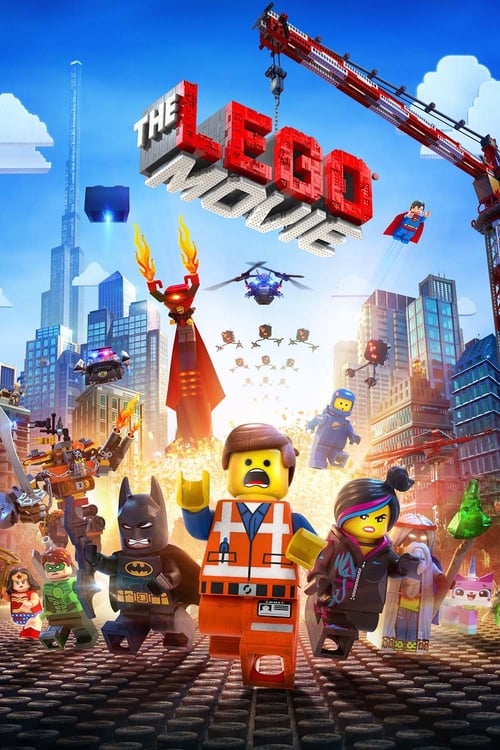
The Lego Movie
2014 · Phil Lord
For when you want to laugh hard with the whole family, or need a jolt of pure creative energy — comfort viewing that rewards a rewatch just to catch the jokes you missed.
What it's about
Emmet, a relentlessly cheerful and utterly ordinary Lego construction worker who follows the instructions for everything, is mistaken for a prophesied Master Builder and swept into a resistance of misfits out to stop a tyrant bent on freezing the universe into permanent, perfect order. The quest hurtles across wildly different brick-built worlds, with a stern warrior, a scene-stealing Batman and a blind wizard along for the ride.
The experience
A joke-a-second rush — anarchic, self-aware and moving almost too fast to catch everything — that sneaks up on you with a genuinely disarming emotional payoff. Few comedies this dense are also this sincere.
Performances
Chris Pratt's guileless enthusiasm makes Emmet impossible to dislike, and Will Arnett's growling, self-obsessed Batman steals the film so thoroughly he got his own spin-off. Morgan Freeman has a ball puncturing his own gravitas.
The craft
The animation is a technical magic trick: CG engineered to look like handmade stop-motion, where every explosion, wave and cloud is built from real Lego elements obeying real brick physics. Lord and Miller's script runs on the same idea the visuals do — instructions versus improvisation — and the maddeningly catchy signature song is the theme weaponized.
Why it matters
It turned a corporate toy commission into one of the decade's best-reviewed animated films, launched an entire Lego film franchise, and cemented Lord and Miller as the era's sharpest smugglers of wit into studio IP — its Oscar snub remains a running grievance.
Snapshot
The Lego Movie is the rare corporate commission that turned into a formally inventive, self-critical work of popular cinema. Directed and co-written by Phil Lord and Christopher Miller — credited as co-directors, though the film is filed here under Lord — it emerged from Warner Bros. Animation's licensing arrangement with the Danish toy company The Lego Group after years of direct-to-video Lego titles had established the brand's screen presence without any theatrical ambition. What Lord and Miller delivered instead was a film that used a plastic construction toy as both medium and argument: a computer-animated feature engineered to look like stop-motion built entirely from real Lego elements, wrapped around a story about the tension between following instructions and improvising.
The film's central figure, Emmet Brickowski (voiced by Chris Pratt), is a construction worker so unremarkable that his defining trait is his total conformity to the instruction manual. Mistaken for the prophesied "Special," he is swept into a resistance against Lord Business (Will Ferrell), a tyrant who wants to freeze the Lego world permanently in place with a superweapon called the Kragle. The joke — that the Kragle is a tube of Krazy Glue with letters rubbed off — is the film's thesis in miniature: the villain's ambition is to stop play. In its final movement, the film breaks its own frame and reveals the plastic universe as the contested basement territory of a boy and his father, recasting everything preceding it as a child's narration.
Released in February 2014, the film was a substantial commercial and critical success and generated a franchise — sequels, spin-offs, and a durable cycle of brand-derived animated features. Its most-discussed absence, its omission from the Academy's Best Animated Feature nominee list, became a minor scandal of that awards season and produced the film's own songwriters' rejoinder at the ceremony. More lasting is its formal legacy: a specific look, a specific comic register, and a demonstration that intellectual-property filmmaking could contain a critique of intellectual property without collapsing.
Industry & production
The film sits at a precise intersection of licensing economics and creative opportunism. The Lego Group had built a screen presence through video games — the Traveler's Tales Lego Star Wars titles from 2005 onward established the comic vocabulary of silent, pantomiming minifigures parodying blockbuster properties — and through direct-to-video animated specials. A theatrical feature had been in development at Warner Bros. for several years before Lord and Miller were engaged; their hiring followed Cloudy with a Chance of Meatballs (2009), itself an adaptation of a picture book with almost no plot, which they had expanded into a densely gagged feature.
Production was a transnational arrangement typical of contemporary animation. Warner Bros. Pictures and Warner Animation Group handled the studio side, with Village Roadshow and Dan Lin's production company among the partners; animation was executed principally at Animal Logic, the Sydney-based house whose prior features included Happy Feet (2006) and Legend of the Guardians: The Owls of Ga'Hoole (2010). Animal Logic's involvement is not incidental — the studio's technical culture, built around bespoke pipeline tools rather than off-the-shelf workflows, was essential to a film whose entire visual scheme depended on simulating a physical toy system at scale.
The Lego Group's participation raised the obvious question of whether the film could be anything other than an advertisement. The answer the finished film gives is unusual: it is emphatically a toy commercial and also a satire of the corporate impulse to control how toys are used. That the brand owner approved a villain whose plan is to glue everything into permanent, manual-approved configurations remains one of the more surprising licensing outcomes in modern studio animation.
Commercially, the film performed strongly enough to establish a franchise immediately: The Lego Batman Movie (2017), The Lego Ninjago Movie (2017), and The Lego Movie 2: The Second Part (2019) followed, with Lord and Miller retaining producing and writing involvement rather than directing. The Lego film rights subsequently moved from Warner Bros. to Universal, a reminder that the underlying asset was always the brand license rather than the studio's creative investment.
Technology
The film's defining technical decision was to make computer animation impersonate stop-motion — and specifically to impersonate the amateur, hand-built brickfilm rather than the polished professional variety. Nearly everything visible on screen is constructed from Lego elements that exist, or could exist, as real molded parts; the production drew on Lego's own digital part libraries so that constructions obeyed the physical logic of studs, clutch power, and available piece geometry. Water, smoke, fire, and explosions are rendered as swarms of transparent and colored bricks rather than as fluid or particle simulation in the conventional sense — a constraint that generates some of the film's most striking imagery, notably ocean waves assembled from cascading blue plates.
Surfacing carried the same discipline. Renders incorporate the wear that real plastic accumulates: scuffing, fingerprints, dust in crevices, slight variation in molded color, minute injection-molding artifacts. The intent was that a still frame should be difficult to distinguish from a photograph of a physical build. Animation was similarly constrained — minifigures have a fixed and famously limited articulation set (rotating head, shoulders, hips, wrist-less claw hands), and the animators largely refused to cheat those joints, so characters move with the stiff, hinged quality of a figure posed by hand.
The stop-motion impersonation extended into camera behavior and frame rate. Movement was often stepped rather than smoothed, and camera work carried the small imperfections of a physical rig — slight jitter, imprecise reframing, shallow depth of field consistent with macro photography of small objects. The result is a film that reads as tactile despite being wholly synthetic, and which quietly flatters the tradition of hobbyist brickfilms that circulated online through the 2000s.
Technique
Cinematography
Pablo Plaisted is credited as director of photography on a film with no physical camera — a credit reflecting the increasingly standard practice of treating virtual cinematography as a discipline in its own right. The governing idea is macro photography: lenses behave as though positioned inches from small plastic objects, with the resulting narrow depth of field, exaggerated perspective on close subjects, and slight optical softening at the edges. Backgrounds fall away into bokeh in a way that constantly signals miniature scale.
Framing is dense. The city sequences in particular pack the frame with legible, buildable detail, rewarding repeat viewing in a manner closer to Richard Scarry than to conventional feature animation. Against that density, the film uses radical shifts in visual register as structural punctuation: the pastel unicorn-kitten excess of Cloud Cuckoo Land, the muted industrial grays of Lord Business's tower, the Western dust of the Old West sequence. Each world is color-keyed within the limited palette of actual Lego molded colors, a constraint that produces a coherence commercial animation rarely achieves.
The final-act live-action material shifts to conventional photography of a suburban basement, and the contrast is the point: warm, naturalistic, human-scaled, with the plastic sets suddenly revealed as objects on a table.
Editing
David Burrows and Chris McKay cut the film at a comic tempo inherited from television and internet-era comedy rather than from classical animated features. Gags overlap; exposition is interrupted; the film frequently cuts away from a joke before it has finished landing, trusting the audience to complete it. The average shot length in action sequences is very short, and the film's construction sequences — in which characters assemble machines from surrounding debris — are edited as rapid montages of parts snapping into place, a rhythm that reproduces the sensation of building.
McKay's role is worth noting: he came from Robot Chicken, the stop-motion sketch series built on toy figures and rapid-fire parody, and he subsequently directed The Lego Batman Movie. The comic grammar of that show — abrupt tonal switches, jokes premised on knowing the source material, sincerity deployed as a punchline — is visible throughout.
The film's most consequential editorial decision is the late structural break. The reveal of the live-action frame is not foreshadowed by conventional means; it arrives as a hard cut upward out of the diegesis, and the editing thereafter shuttles between the two levels so that the boy's play and the plastic characters' actions become mutually causal.
Mise-en-scène / staging
Everything in frame is a Lego object, and this total constraint is the film's richest formal resource. Sets can be dismantled and rebuilt within a shot; characters can pull the floor apart for materials. The "Master Builder" conceit — that certain characters can improvise machinery from whatever is around them — turns the set into a live inventory, and staging frequently depends on the audience tracking what pieces are available in the environment.
Character design is fixed by the toy: minifigures cannot alter their proportions, so expression is carried by printed faces (which can be swapped), by the limited joint set, and by the small repertoire of accessories. The film converts these limitations into comedy — Emmet's double-sided head, Bad Cop/Good Cop's rotating face, Batman's cape.
The Old West, Cloud Cuckoo Land, Middle Zealand, and the Octan tower function as distinct staging regimes, each drawn from a different Lego product line. This is world-building as retail catalog, and the film is candid about it; the sequences read simultaneously as genre parody and as an inventory of the brand's history.
Sound
Mark Mothersbaugh's score works in two registers. The first is straight orchestral heroism — the film takes its chosen-one plot seriously enough for the music to swell without irony at key moments. The second is Mothersbaugh's characteristic synthetic playfulness, the Devo-derived taste for mechanical repetition and slightly wrong-sounding electronics, which suits a world made of interlocking identical units.
The film's most-discussed sound element is "Everything Is Awesome," written by Shawn Patterson with contributions from the Lonely Island and performed by Tegan and Sara featuring the Lonely Island. The song operates as satire — a relentlessly upbeat anthem of enforced conformity, played diegetically as state propaganda in Emmet's city — and simultaneously as an actual, functional earworm. Its double status is the film's method compressed into three minutes: it critiques the thing while fully delivering the thing.
Sound design maintains the plastic conceit throughout. Impacts click; constructions snap; the specific acoustic signature of ABS plastic parts locking together is used as a percussive motif. Vehicles and weapons make mouth-made noises at moments, reproducing the sounds a child supplies while playing.
Performance
Voice performance runs on deliberate mismatch. Chris Pratt plays Emmet with an unguarded, slightly adenoidal enthusiasm that reads as genuine rather than knowing — essential, since the film's emotional payoff depends on Emmet's sincerity being real. Elizabeth Banks gives Wyldstyle a brittle competence that curdles into insecurity. Will Arnett's Batman is a self-serious growl pushed to absurdity, a performance that proved popular enough to generate a spin-off feature. Morgan Freeman's Vitruvius weaponizes the actor's accumulated authority as a narrator-sage, then undercuts it by having him admit the prophecy is invented.
Will Ferrell carries the film's structural pivot: he voices Lord Business and appears in live action as "The Man Upstairs," the father whose basement the film has been occurring in. The doubling is the film's argument made flesh — the tyrant who glues everything down is a parent who cannot let his son play with an expensive display model.
Narrative & dramatic mode
The film runs the chosen-one monomyth with complete structural fidelity: ordinary protagonist, prophecy, mentor, threshold crossing, band of companions, mentor's death, descent, return. It is also, from its first minutes, a parody of that structure — Vitruvius announces the prophecy in a tone of unearned gravity, and the film keeps flagging the machinery even as it operates it.
What distinguishes it from ordinary parody is that the deconstruction is diegetically motivated. When Vitruvius confesses the prophecy was made up, the film is not merely puncturing a cliché; it is preparing the frame-break, in which the entire narrative is revealed as the improvised story of a child playing. The clichés are clichés because a kid assembled them from movies he has seen. The film's genre awareness is thereby converted from authorial smirk into character psychology — an unusually elegant solution to the problem of how a knowing film can also be a moving one.
The final movement completes the inversion. "The Special" turns out to be a designation available to anyone, and the message that reads as a hollow platitude in the first act becomes, in the frame narrative, a plea from a boy to his father. The film's emotional force depends entirely on this retroactive reframing, which is why the ending has drawn both admiration for its construction and objection that it purchases sentiment with a twist.
Genre & cycle
The film belongs to several cycles simultaneously. As a toy-derived feature it sits alongside the Transformers and G.I. Joe films, but inverts their logic: rather than making toys look like weapons, it makes weapons look like toys. As a self-aware animated comedy it descends from Shrek (2001) and the DreamWorks tradition of pop-cultural pastiche, though it substitutes formal invention for that cycle's reliance on celebrity-voice irony.
Its most direct generic ancestors are the Toy Story films (from 1995), which established both the metaphysics — toys as sentient, play as world-making — and the emotional architecture in which a child's growing up threatens the toys' existence. The Lego Movie revises this significantly: where Pixar's toys have an inner life independent of children, Lego's characters are explicitly generated by play, and their reality is the reality of a story being told.
It also participates in the crossover-spectacle cycle: the film's licensed cast (Batman and the Justice League, Star Wars characters, Gandalf, Shaquille O'Neal, Abraham Lincoln) anticipates the assembled-IP mode later formalized in Ready Player One (2018) and Space Jam: A New Legacy (2021). The Lego Movie has a defense those films lack: the mixing is diegetically justified, because a child's Lego bin genuinely does contain all of these things at once.
Authorship & method
Lord and Miller's authorship is a matter of method as much as sensibility. Their working pattern, established on Clone High (2002–2003) and Cloudy with a Chance of Meatballs, involves taking a property widely assumed to be creatively worthless and treating the assignment's absurdity as the film's engine — an approach they repeated with 21 Jump Street (2012) and later, as producers and writers, with Spider-Man: Into the Spider-Verse (2018). The unifying trait is a very high joke density combined with a genuine third-act commitment to feeling, which the jokes are engineered to make earnable rather than to undercut.
The key collaborators are largely animation-industry rather than live-action figures. Chris McKay served as animation co-director alongside his editing role and went on to direct the Batman spin-off. Animal Logic's supervisors carried the technical realization of the stop-motion look. Mark Mothersbaugh, whose scoring career runs from Devo through Pee-wee's Playhouse and Wes Anderson's early features, supplied a musical voice already fluent in the register of adult sophistication delivered through children's-media surfaces. Pablo Plaisted's virtual cinematography and the editing team of David Burrows and Chris McKay complete the core group.
Lord and Miller did not direct the sequels, and the difference is instructive: The Lego Batman Movie under McKay retains the comic velocity but not the frame-breaking formal ambition, while The Lego Movie 2, directed by Mike Mitchell from a Lord and Miller script, keeps the live-action frame but finds the trick harder to re-spring once the audience knows it is coming.
Movement / national cinema
The film resists national placement in the way most large-budget animation now does. It is an American studio production, financed and released by Warner Bros., written and directed by Americans, and grounded in American genre reference — the Western, the superhero film, the office comedy. Its animation labor, however, was Australian, executed at Animal Logic in Sydney, and its underlying property is Danish, originating with Ole Kirk Christiansen's company in Billund and the interlocking-brick system patented in the late 1950s.
If it belongs to a movement, it is the loose international tendency of the 2010s in which computer animation deliberately abandoned photorealism in favor of stylization borrowed from other media — a tendency that includes Laika's hybrid stop-motion work, the Cartoon Saloon films, The Peanuts Movie (2015), and, most consequentially, Spider-Man: Into the Spider-Verse, on which Lord and Miller carried this principle further into comics-derived graphic technique. The Lego Movie's specific contribution was to prove that a mainstream studio audience would accept, and enjoy, animation that visibly refused the smooth default.
Era / period
2014 sits at a particular moment in Hollywood's relationship with intellectual property. The Marvel Cinematic Universe had established the shared-universe model as the industry's dominant structural ambition; studios were systematically mining toy lines, board games, and theme-park attractions for franchisable material. Animation was consolidating around a small number of houses, and the theatrical family film was increasingly a delivery mechanism for consumer products.
The Lego Movie is legible as a symptom of that moment and as a commentary on it. Its villain is a corporate executive who wants a permanently fixed, instruction-compliant world; its heroes are improvisers who violate the manual. That this critique was funded by, and served to sell, the product in question is either the film's central irony or its central compromise, depending on the reading — and the debate over which has followed it since release.
The film also arrives at a moment when internet comedy had reshaped mainstream comic timing. Its density of reference, willingness to break frame, and reliance on the audience's fluency in genre convention reflect a viewership trained on YouTube and viral video rather than on the three-act family comedy.
Themes
The film's overt theme is creativity against conformity, but its more interesting subject is the ethics of instructions. Emmet begins as someone who cannot function without a manual and whose life is genuinely happy for it; the film does not simply mock him. Its resolution rejects the easy binary in which improvisation is good and following directions is bad — Emmet's rule-following turns out to be the skill that saves the day, and the Master Builders' pure improvisation is shown to be chaotic and unproductive without organization.
The father-son material is the film's emotional core and its interpretive key. The Man Upstairs' glued display is not merely tyranny; it is a recognizable adult relationship to a collection, and the film grants him the dignity of a real position before asking him to yield it. The reconciliation reframes every antagonism as a family argument.
A third theme concerns the nature of the special. The film spends its running time interrogating chosen-one narratives and lands on a proposition that is both a genuine democratic claim and, read cynically, a marketing slogan: anyone can build. The film seems aware of this doubleness. Its closing joke — the threatened arrival of the Duplo invaders, the younger sibling's larger bricks — suggests that the resolution of one conflict simply opens the next.
Reception, canon & influence
Critical reception was strongly favorable, with particular praise for the film's visual invention, joke density, and the audacity of its final act. Reviewers repeatedly noted the improbability of the achievement: a feature-length toy advertisement that was also genuinely clever. Dissenting positions existed, chiefly the argument that the film's anti-commercial message was neutralized by its commercial function, and that the frame-break, however skillful, resolved the story by changing the terms rather than by earning the ending within them.
The film's exclusion from the Best Animated Feature category at the 87th Academy Awards was widely treated as a significant omission and prompted extended commentary about the category's voting practices. "Everything Is Awesome" was nominated for Best Original Song, and its performance at the ceremony — with Lego-brick Oscar statuettes distributed to the audience — served as a knowing acknowledgment of the snub. The film was more warmly received by the BAFTAs and by critics' groups in animation categories.
Its backward influences are legible and largely acknowledged. The Toy Story films supply the metaphysics of animate playthings and the child-outgrowing-toys dread. Hobbyist brickfilm culture — stop-motion shorts made with real Lego and posted online through the 2000s — supplies the visual grammar the film simulates. The Traveller's Tales Lego video games supply the comic register of silent minifigure parody and the pleasure of dismantling scenery for parts. Shrek and the DreamWorks pastiche cycle supply the self-aware mode. The chosen-one structure is drawn most directly from The Matrix (1999) and Star Wars (1977), which the film references explicitly and repeatedly. Michel Gondry's handmade aesthetic and Wes Anderson's miniature-forward compositions are frequently cited as tonal cousins, though direct causal claims here rest on stylistic resemblance rather than documented statement.
Forward, its influence has been substantial. It established the Lego feature cycle, and more broadly it demonstrated that brand-derived animation could sustain formal ambition — a lesson visible in The Peanuts Movie, the Trolls films, and the general willingness of studio animation after 2014 to adopt heavily stylized non-photorealistic rendering. Its most direct descendant is Spider-Man: Into the Spider-Verse, produced and co-written by Lord and Miller, which took The Lego Movie's core principle — build the animation to look like the medium the property came from, not like animation — and applied it to comics with results that reshaped the field. The frame-breaking device has been imitated more cautiously; few subsequent films have risked so late and so total a reveal.
Within critical writing on contemporary animation, The Lego Movie now functions as a standard case study in the problem of the commercially compromised critique: it is cited both by those arguing that popular cinema can think against its own conditions and by those arguing that such thinking is precisely what makes the product sell. That it supports both readings without resolving into either is a substantial part of its continued interest.
Reception
Everyone braced for a 100-minute toy commercial and got one of the best-reviewed films of 2014 — then the Academy snubbed it for Best Animated Feature and the outrage became a bigger story than most winners. A decade on it's settled in as the proof that Lord & Miller could spin gold from any premise, en route to Spider-Verse.
How The Lego Movie was received, from release to now →
How to watch The Lego Movie: what to notice on a first viewing
- Watch how far backgrounds blur into soft bokeh. The virtual camera behaves like a macro lens inches from small plastic objects, so depth of field is always shallow and edges soften. This constantly signals that you are looking at a miniature, physical toy world, not a limitless animated one.
- Listen for the click when Lego pieces snap together. The specific acoustic signature of ABS parts locking is used as a percussive motif across impacts, constructions, and gags. Sound keeps the plastic conceit honest even when the images get fantastical.
- Notice each new setting locked to its own color palette. Cloud Cuckoo Land's pastels, the Old West's dust, Lord Business's tower's grays each stay within real molded Lego colors. Color keying does double duty: it orients you geographically and mirrors how the toy is actually sold.
- Watch Emmet's head flip between two different faces. Printed, swappable faces and a limited joint set are the only tools these characters have for expression, as with Bad Cop's rotating head. The comedy and the characterization are built entirely inside real manufacturing limits, not despite them.
- Listen for "Everything Is Awesome" playing as city ambiance. The song returns as diegetic propaganda blaring through Emmet's world, an anthem of enforced sameness that is also genuinely catchy. It satirizes conformity and delivers the very thing it satirizes, at the same time.
The whole guide to watching The Lego Movie, with the keys for a rewatch →
Influences: the films it descends from and the films it influenced
- The Magic Portal (1989) — The founding brickfilm establishes the grammar The Lego Movie digitally counterfeits — minifigures animated pose-to-pose within their four real degrees of articulation, stud geometry left visible in every surface, and camera moves kept short and jerky because a rig had to be nudged by hand between exposures.
- Star Wars (1977) — ILM's 'used universe' method — scuffing, greasing and sun-fading every model so the world reads as inhabited — is what the film's procedural plastic-wear pass reproduces in brick terms (bite marks, scratched clutch power, decal misalignment), and the Falcon's kitbashed-from-spare-parts construction is the literal template for Master Builder improvisation.
- Who Framed Roger Rabbit (1988) — Zemeckis established the technical contract for animated figures sharing a frame with photographed humans — animation lit to the live-action key, matched to a real camera's move and parallax — which is the precondition for the third-act shift from the brick world to the basement.
- Toy Story (1995) — Pixar solved hard molded-plastic shading (Buzz's injection seams, specular rolloff on vinyl) and, more importantly, made articulation limits a performance constraint rather than a defect — Buzz acts within a toy's hinge range, exactly as the minifigure's claw hands and swivel torso dictate every gesture in Bricksburg.
- The Matrix (1999) — Beyond the quoted chosen-one beats, the construct sequences — a blank space in which needed objects rack into existence on demand — are the staging model for Master Builder assembly, where a vehicle materializes brick by brick out of surrounding scenery in a single unbroken move.
- Shrek (2001) — DreamWorks codified the register the film runs on: pop needle-drop as structural punctuation, celebrity voices cast for the friction between star and figure, and a second joke layer pitched over the child's head at the parent — with the sincerity turn withheld until the final reel.
- Team America: World Police (2004) — Parker deliberately kept the strings and the marionettes' incompetent walk cycles in frame, mining comedy from the puppet's mechanical failure — the same bargain as animating minifigures whose legs cannot bend, so running becomes a stiff hinged waddle played for the joke rather than smoothed away.
- Speed Racer (2008) — The Wachowskis' governing rule — build the image to imitate the source medium's own artifacts (anime's flat saturated cel palette, its wipe-based scene transitions) instead of imitating live-action — is precisely the principle the film applies to injection-molded plastic, restricting the palette to colors Lego actually manufactures.
- Be Kind Rewind (2008) — Gondry's 'sweding' insists that an element be represented by a visibly wrong handmade material — cellophane water, cardboard machinery — which is the logic of an ocean rendered as rolling transparent-blue bricks and explosions as expanding orange 1x1 rosettes rather than as fluid simulation.
- Fantastic Mr. Fox (2009) — Anderson shot miniatures with macro glass at shallow depth and refused to digitally suppress the fur ripple between frames, treating photographic evidence of smallness as the point — the same decision the film fakes in CG through razor-thin focal planes, defocused foreground studs and reintroduced inter-frame jitter.
- Cloudy with a Chance of Meatballs (2009) — Lord and Miller's own prototype: caricatured rigs pushed past anatomical plausibility for squash-and-stretch gags, background jokes layered under foreground dialogue at a density that rewards freeze-frame, and a spectacle set-piece built from a single absurd material rule.
- Toy Story 2 (1999) — Extends the consumer-artifact mise-en-scène and brand-pastiche staging — playthings as protagonists in a world built entirely from their own commercial design language.
- The Peanuts Movie (2015) — CG rebuilt to obey Schulz's ink: heads that rotate by cutting to a new drawing rather than turning in space, a wobbling line weight preserved on top of the render, and expressions held on twos — brand animation adopting the source medium's constraints as its rendering spec.
- The Lego Batman Movie (2017) — McKay, animation co-director on the seed film, extends the brick-simulation pipeline he helped build — every effect still assembled from cataloged digital parts — while pushing the silent-minifigure parody register inherited from the Traveler's Tales games to a higher gags-per-minute rate.
- Spider-Man: Into the Spider-Verse (2018) — Lord and Miller carried their rule directly across: render to the source medium, so comics supply Ben-Day halftone dots, misregistered chromatic offset standing in for lens defocus, printed linework over the geometry, and lead characters animated on twos inside a world running on ones.
- The Mitchells vs. the Machines (2021) — Produced by Lord and Miller, it layers 2D doodle overlays, lens flares, chromatic fringing and simulated focus-hunting onto CG — a direct extension of the seed film's insistence that the virtual camera perform the imperfections of a physical one.
- Barbie (2023) — Gerwig builds the doll world from the product line's own material grammar — painted-on water, an accessory-catalog palette limited to manufactured plastic colors, characters who cannot execute actions the toy's joints forbid — and ends by moving a toy across into the photographed human world.
- Project Hail Mary (2026) — Lord & Miller's method of making an unlikely-partners relationship emotionally legible through comic timing, the throughline that primes them for the Grace–Rocky friendship.
- Spider-Man: Across the Spider-Verse (2023) — Lord & Miller's authorial signature — CG engineered to counterfeit a physical medium (brick stop-motion) plus a meta, self-referential narration about who controls the story — is the DNA of Spider-Verse's medium-mimicry and its 'author your own canon' thesis.
- The Super Mario Bros. Movie (2023) — Turned a proprietary toy's construction rules into a total set-design grammar where every object obeys the source material's physics — the iconography-as-mise-en-scène method Mario applies to blocks, coins and warp pipes; also the Fogel brand-comedy screenwriting lineage.
- A Minecraft Movie (2025) — Pioneers the toy-sandbox template: a world rendered entirely from one proprietary modular unit, with building and creativity as the literal plot engine rather than set dressing.
- Captain Underpants: The First Epic Movie (2017) — CG constrained to obey a physical material's rules — brick joints, stepped stop-motion cadence, no simulation cheats — the same non-simulated craft-material logic as flipbook pages and sock puppets, inside the same imagination-versus-institution plot.
- 21 Jump Street (2012) — The same directors' method applied to live action — take a property whose worthlessness is the common assumption, make that assumption the film's explicit subject and comic engine, then cash the accumulated irony for an unironic emotional payoff in the last twenty minutes.
- Wreck-It Ralph (2012) — Moore animated the Nicelanders at a deliberately degraded stepped frame rate so 8-bit characters move like their source hardware while inhabiting a smoothly rendered CG world — the identical trick of encoding a property's native medium into the motion itself rather than only into the art direction.
- The Lorax (2012) — A sibling CG family film built on the same self-aware anti-consumerism satire, weaponizing a manufactured product-world (President Business/Thneedville) against the very toy-and-merch economy that markets it.
- Deadpool & Wolverine (2024) — Turned corporate ownership of licensed IP into both the joke and the plot mechanism, the mashup-as-commentary mode this film runs on cameo economics.
- Transformers One (2024) — Proved a toy-shelf IP could be reinvented as a witty, self-aware animated feature that still earns sincere emotional stakes—the toy-property-to-real-cinema craft One pursues.
Similar films
- The Lego Batman Movie (2017) — influence & lineage
- Spider-Man: Into the Spider-Verse (2018) — influence & lineage
- Toy Story (1995) — influence & lineage
- The Mitchells vs. the Machines (2021) — influence & lineage
- Barbie (2023) — influence & lineage
- Shrek (2001) — influence & lineage
- Guardians of the Galaxy (2014) — shared sensibility
- The Incredibles (2004) — shared sensibility