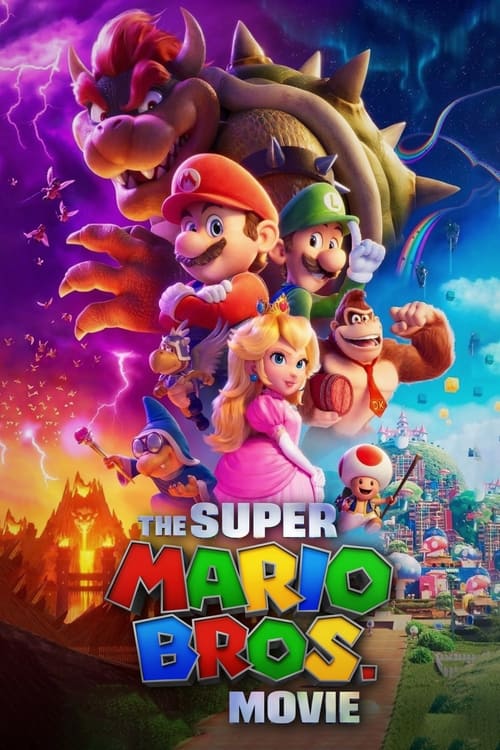
The Super Mario Bros. Movie
2023 · Aaron Horvath
For a zero-effort family movie night, or when you want ninety minutes of pure comfort-food nostalgia that asks nothing of you. All cozy, no challenge.
What it's about
Brooklyn plumber brothers Mario and Luigi get sucked down a mysterious pipe into a candy-colored parallel world — and immediately separated. Mario lands in the Mushroom Kingdom, teams up with Princess Peach and the ever-anxious Toad, and sets out across strange lands to rescue his brother before the monstrous Bowser's conquest reaches everyone. It's an origin-quest built from four decades of Nintendo iconography: power-ups, karts, gorillas and all.
The experience
Fast, bright, and relentlessly bouncy — a sugar-rush of chases, gags, and needle drops that never sits still for long. For anyone who grew up with a controller in hand, it plays like a nostalgia machine firing on every cylinder; for kids, it's pure candy.
The craft
Illumination's animation is the star: the Mushroom Kingdom is rendered in dense, toy-box detail, and the action sequences are staged like playable levels, full of side-scrolling nods and power-up logic that reward anyone who knows the games. The soundtrack weaves decades of familiar game melodies into the score. It's a big, loud, colorful thing that plays best on a good screen with the volume up.
Why it matters
A billion-dollar juggernaut that became one of the highest-grossing animated films ever, redeemed Nintendo's decades-long wariness of Hollywood after a notorious 1993 misfire, and kicked the video-game-adaptation boom into overdrive.
Snapshot
The Super Mario Bros. Movie is a computer-animated adventure comedy adapting Nintendo's flagship video-game franchise, produced by Illumination in partnership with Nintendo and released by Universal Pictures. Credited to co-directors Aaron Horvath and Michael Jelenic (the title prompt lists only Horvath, but Jelenic shares the directing credit), it dramatizes the origin-quest of two Brooklyn plumber brothers, Mario and Luigi, who are pulled through a warp pipe into the Mushroom Kingdom and the parallel worlds surrounding it. The film is significant less as a formal achievement than as an industrial event: it represented Nintendo's carefully managed return to feature film after the notorious 1993 live-action version, and it became one of the highest-grossing animated films ever made, clearing more than a billion dollars worldwide. It is a work best understood at the intersection of brand stewardship, family-animation economics, and the maturing craft of adapting interactive properties into linear cinema.
Industry & production
The production is inseparable from the corporate courtship that produced it. Nintendo, famously protective of its intellectual property and scarred by the commercial and reputational failure of the 1993 live-action film, spent decades declining or tightly restricting screen adaptations. Illumination founder and chief executive Chris Meledandri cultivated a relationship with Nintendo — and specifically with Mario's creator Shigeru Miyamoto — that yielded a genuine co-production rather than a licensing arrangement, with Miyamoto credited as a producer alongside Meledandri. This structure gave Nintendo an unusually direct hand in creative decisions, and the film's fidelity to game iconography reflects that oversight.
Illumination's business model shaped the film's economics. The studio, distributed through Universal, is known for producing broadly commercial family animation at budgets well below those of Pixar or Disney Animation, achieving high margins through efficient pipelines run largely out of its Paris facility (the operation grown from Mac Guff's animation unit). The Super Mario Bros. Movie fits that template: a comparatively lean production cost against enormous global returns. The film opened in spring 2023 and rapidly became one of the year's dominant box-office performers and, by most accounts, one of the highest-grossing video-game adaptations and animated features on record. I will not assign a precise final gross, as reported cumulative figures vary, but its status as a billion-dollar-plus global hit is well established. Its commercial success accelerated Illumination and Nintendo's plans for further collaboration.
Technology
The film was produced as fully computer-generated animation using Illumination's established Paris-based pipeline. Illumination's technical approach has historically emphasized production efficiency — reusable asset systems, streamlined lighting and rendering workflows, and a house style optimized for throughput — rather than the bleeding-edge simulation research associated with some rival studios. For Mario, however, the technical challenge was one of translation: rendering the flat, graphic, deliberately abstract visual language of Nintendo's games (blocky terrain, coin sparkles, power-up transformations, the plumbing-pipe network) into fully dimensional, physically lit CG space while preserving the readability and cleanliness that define the source. The result leans on stylized surfacing and saturated, high-key lighting rather than photorealism. Beyond confirming that it was made with contemporary CG animation and rendering tools within Illumination's proprietary and commercial software stack, the granular technical record — specific renderers, simulation systems, and pipeline particulars — is not something I can detail reliably without inventing specifics, so I flag it as thin here.
Technique
Cinematography
As with all fully animated CG features, "cinematography" here means virtual cinematography — camera placement, lensing, and staging authored entirely within the digital environment. The film's visual grammar is built around recognizability: sequences frequently restage game-world geography so that audiences read the space as a Mario level, then let the "camera" move through it in ways the games' fixed perspectives never could. The most-discussed set piece, a Rainbow Road racing sequence drawn from Mario Kart, is staged for kinetic, roller-coaster spectacle, with the virtual camera swooping along an impossible track. Elsewhere the film alternates between wide establishing views that showcase world-building and tighter comic framing for character beats. I cannot reliably attribute a single director-of-photography credit for the virtual camera work, so I leave that unstated rather than guess.
Editing
The cutting is brisk and efficient in the Illumination house manner — a running time kept tight (well under ninety minutes of story), rapid scene turnover, and montage compression of the "training" and travel passages that would otherwise slow a quest narrative. Set pieces are cut for clarity and momentum rather than sustained tension. The specific editor credited on the film is not something I can confirm without risk of error, so I decline to name one.
Mise-en-scène / staging
Production design is the film's most substantive craft achievement and the locus of Nintendo's involvement. The film assembles a dense catalog of franchise environments — the Mushroom Kingdom, Bowser's fortress, the Jungle Kingdom of the Kongs, the Brooklyn of the brothers' plumbing business — each rendered as a coherent, inhabitable place while retaining the graphic signatures of the games (question-mark blocks, Piranha Plants, warp pipes, power-up items). Staging is engineered around fan recognition: background gags, cameo characters, and game-accurate props reward attentive viewers, functioning almost as an Easter-egg economy layered over the primary action. The Brooklyn sequences deliberately ground the brothers in a lived-in, blue-collar reality before the fantastical transition, echoing the games' own origin lore.
Sound
The sound design foregrounds the franchise's instantly recognizable audio cues — jump effects, coin chimes, power-up stings — deployed as diegetic and quasi-diegetic punctuation. This sonic branding works alongside the score to keep the film continuously legible as Mario even in original scenes. The music is the more notable element and is treated below.
Performance
The voice cast pairs comedy leads with marquee names. Chris Pratt voices Mario and Charlie Day voices Luigi; Anya Taylor-Joy plays Princess Peach, reframed here as an active, capable ruler rather than a captive; Jack Black voices Bowser; Keegan-Michael Key voices Toad; Seth Rogen voices Donkey Kong; and Fred Armisen voices Cranky Kong. The casting of Pratt drew notable pre-release skepticism, with much online discussion over whether a star-driven "everyman" read suited the character; the released performance opted for a relatively understated American delivery rather than the exaggerated Italian accent of the games' Charles Martinet (who appears in cameo capacity). Jack Black's Bowser was the most widely praised performance, combining menace with comic self-pity — a register that pays off directly in the score.
Narrative & dramatic mode
The screenplay, written by Matthew Fogel, adopts a streamlined hero's-journey structure suited to family audiences: an inciting separation of the brothers, Mario's quest through allied kingdoms to rescue Luigi and stop Bowser, a training/alliance-building middle, and a climactic battle that returns the action to Brooklyn. The dramatic mode is comic-adventure with an earnest emotional spine centered on brotherhood — the film repeatedly frames Mario and Luigi's bond as its thematic anchor, and inverts the damsel convention by giving Peach agency and competence. The narrative is efficient to the point of thinness: character interiority is minimal and the plot functions largely as connective tissue between recognizable game-world set pieces. This was, predictably, the crux of critical disagreement — the film prioritizes momentum and iconographic pleasure over narrative depth.
Genre & cycle
The film sits within two overlapping cycles. First, it is a contemporary family CG-animated adventure comedy in the Illumination mold — bright, gag-forward, star-voiced, and briskly paced. Second, and more historically pointed, it belongs to the modern wave of video-game screen adaptations that finally began achieving critical and commercial legitimacy in the late 2010s and early 2020s, reversing decades of the "video-game movie curse." Where earlier adaptations struggled to translate interactive properties into satisfying linear stories, the Mario film — like the Sonic the Hedgehog features and, on television, HBO's The Last of Us — reflected a maturing industrial understanding of how to honor source fandom while packaging it for general audiences. The Mario film is a purer example of the "faithful fan-service" strategy than the more narratively ambitious of its peers.
Authorship & method
Authorship here is corporate and collaborative rather than singular. Co-directors Aaron Horvath and Michael Jelenic came from television animation comedy, having developed Teen Titans Go!, and they bring a gag-density and pop sensibility to the material. Their creative authority, however, was exercised within tight constraints set by Nintendo and Miyamoto, whose stewardship governed characterization and world fidelity, and by producer Chris Meledandri's Illumination house style. Screenwriter Matthew Fogel, whose credits include The Lego Movie 2 and Minions: The Rise of Gru, specializes in exactly this kind of brand-driven family comedy.
The most distinctive individual craft contribution is the music. Composer Brian Tyler built the score by weaving Nintendo composer Koji Kondo's original game themes — among the most recognizable melodies in popular culture — into a full orchestral fabric, so that the score continuously signals the source while functioning as conventional film music. The film also produced an original song, "Peaches," performed in character by Jack Black as Bowser, which became a genuine popular hit and one of the film's most-discussed elements. This musical strategy — canonical themes reorchestrated plus a novelty character song — is central to the film's method of honoring the games while adding value beyond them. As noted above, cinematography and editing credits for the virtual production are not ones I can attribute with confidence.
Movement / national cinema
The film is an American studio production (Universal/Illumination, with Nintendo of Japan as co-producer) physically animated largely in France at Illumination's Paris studio. It does not belong to any art-cinema movement; its relevant "movement" is industrial — the Hollywood family-animation blockbuster as a globally engineered commercial product, here fused with a Japanese gaming IP under joint creative control. The transpacific authorship (American directors and cast, Japanese IP holders and composer, French animation labor) is itself characteristic of how contemporary tentpole animation is made.
Era / period
Released in 2023, the film is a product of a specific post-pandemic theatrical moment in which family animation and pre-sold IP were seen as among the safest paths to reliable box office, and in which the video-game adaptation had newly become a prestige and profit category. It also arrived amid the broader consolidation of nostalgia and franchise recognition as primary drivers of mass entertainment. Its enormous success reinforced the industry's early-2020s conviction that established interactive brands, handled with fidelity, could anchor theatrical event releases.
Themes
The film's explicit themes are modest and family-oriented: brotherhood and loyalty (the Mario–Luigi bond as emotional core), perseverance against self-doubt (Mario as an initially mocked underdog), and the reworking of the rescue narrative to grant Princess Peach autonomy and leadership. Beneath these lies a meta-theme of translation and continuity — the film is largely about affectionately reconstituting a shared cultural memory, converting decades of collective game-playing into a communal cinematic experience. Its emotional claims are sincere but broad, deliberately pitched to a multigenerational audience of parents who grew up with the games and children discovering them.
Reception, canon & influence
Critical reception was sharply divided from audience reception — a now-familiar pattern for fan-service blockbusters. Many critics found the film visually accomplished and affectionate but narratively thin, gag-driven, and overly reliant on reference; the aggregate critical verdict was middling. General audiences and franchise fans responded far more warmly, and the commercial result was overwhelming: the film became one of the highest-grossing animated features and video-game adaptations ever released, a billion-dollar-plus global success. (I avoid citing a single precise cumulative gross, as reported totals vary.)
The influences on the film run backward along two lines. Most directly, it defines itself against the 1993 live-action Super Mario Bros. (directed by Rocky Morton and Annabel Jankel, starring Bob Hoskins and John Leguizamo), a commercial failure and cult curio whose dystopian reimagining alienated Nintendo and is widely cited as the reason the company withheld its properties from film for so long; the animated version's faithful, brightly colored approach is a deliberate correction. More broadly, the film draws on the decades-deep iconographic and musical canon of Miyamoto and Kondo's games, and on the Illumination comedy-animation house style. It also arrived in the slipstream of the Sonic the Hedgehog films, which had recently demonstrated that faithful, fan-conscious game adaptations could succeed theatrically.
Its influence forward is primarily industrial. The film's success validated the Nintendo–Illumination partnership and spurred plans for continued cinematic exploitation of Nintendo's catalog, and it reinforced Hollywood's broader appetite for high-fidelity game adaptations. Within popular culture, "Peaches" achieved a life of its own as a viral hit. The film is unlikely to be canonized on formal or authorial grounds, but as a landmark in the commercial legitimization of the video-game movie and in Nintendo's evolving relationship with cinema, its historical place is secure.
A Deleuzian reading
Underground in Brooklyn, two men in overalls are fixing a water main.
The full Deleuzian reading of The Super Mario Bros. Movie →
Reception
Announced with Chris Pratt's casting in 2021, it was the internet's favorite punchline for two years — then it opened, made over $1.3 billion, and became the highest-grossing video game movie ever, leaving the doubters to quietly delete their tweets.
How The Super Mario Bros. Movie was received, from release to now →
How to watch The Super Mario Bros. Movie: what to notice on a first viewing
- Listen for the jump, coin, and power-up sound stings throughout. These game-audio cues punctuate scenes constantly, deployed as both diegetic effects and background punctuation, even in original moments the games never had. They keep the film legible as Mario even when the story has left the games behind.
- Notice background gags and cameo characters as the camera passes. Every kingdom is layered with fan-recognition props and passing cameo figures riding underneath the main action. This Easter-egg economy is the only part of the game's loop a non-player audience still gets to complete.
- Notice how often Mario's plumbing skills matter to solve problems. The world's architecture, pipes, valves, mechanisms, keeps returning to the brothers' ordinary trade from Brooklyn. This is an imprint: the world and the character shape each other until an accident of design becomes a real dramatic premise.
- Listen for Koji Kondo's original game melodies inside Brian Tyler's score. Tyler's orchestral score keeps reweaving Kondo's classic themes underneath new dialogue and set pieces. The music keeps signaling the source even in scenes that have no equivalent in any game.
- Watch Jack Black's Bowser for menace mixed with self-pity. Black plays the villain's rage alongside a running vein of wounded, comic vulnerability, most obviously in his musical numbers. It cracks open a character who would otherwise be pure force against force.
The whole guide to watching The Super Mario Bros. Movie, with the keys for a rewatch →
Influences: the films it descends from and the films it influenced
- Super Mario Bros. (1993) — The 2023 film is a deliberate formal repudiation: it restores the games' primary-color palette and instantly-readable character silhouettes that the '93 film's dystopian, desaturated body-horror reimagining abandoned.
- Sonic the Hedgehog (2020) — Established the theatrical playbook Mario runs — near-1:1 fidelity to the game's character model (post-redesign) plus mid/post-credits franchise-teaser stingers as fan-service architecture.
- Wreck-It Ralph (2012) — Built its mise-en-scène out of arcade iconography and licensed cameo cabinets, inventing the easter-egg-economy staging Mario inherits — power-ups, blocks and pipes deployed as instantly legible diegetic props.
- The Lego Movie (2014) — Turned a proprietary toy's construction rules into a total set-design grammar where every object obeys the source material's physics — the iconography-as-mise-en-scène method Mario applies to blocks, coins and warp pipes; also the Fogel brand-comedy screenwriting lineage.
- Despicable Me (2010) — Founded the Meledandri/Illumination house style — high gag-density, broad slapstick timing, and rounded caricature rigs — that governs Mario's comic cadence and character animation design.
- Teen Titans Go! To the Movies (2018) — Horvath & Jelenic's own feature and the direct source of their reference-dense, meta-adjacent gag cadence and pop-culture easter-egg cutting brought to Mario.
- Speed Racer (2008) — Its hyper-saturated, candy-colored anti-gravity racetrack with layered translucent depth-planes is the direct formal antecedent of Mario's Rainbow Road set-piece and its non-photorealistic color logic.
- Toy Story (1995) — The origin point of the CG-animated family blockbuster and of rendering beloved toy/licensed characters with tactile material fidelity — the technological and commercial lineage Mario terminates.
- Who Framed Roger Rabbit (1988) — Established on-screen cross-rights-holder character stewardship — negotiating multiple owners' icons into one faithful, canon-respecting frame — the corporate-fidelity method Nintendo/Miyamoto's oversight of Mario extends.
- Minions & Monsters (2026) — Illumination's later feature carrying forward the same broad, gag-forward, dialogue-light comic staging and cost-disciplined production model refined across the Minions franchise.
- A Minecraft Movie (2025) — Greenlit in Mario's commercial slipstream; replicates the faithful-block-iconography plus star-voice-casting and cameo-stunt formula for another blockbuster game IP validated by Mario's billion-dollar gross.
- Detective Pikachu (2019) — Pioneered translating a Nintendo-family creature's design into feature rendering with texture-accurate fur and preserved silhouette, the same 'keep the icon instantly recognizable at feature scale' surfacing mandate.
- Minions: The Rise of Gru (2022) — Same screenwriter (Fogel) and Illumination pipeline; shares the brisk gag-cut editing rhythm and the licensed-pop-needle-drop scoring approach Mario carries over.
- Spider-Man: Into the Spider-Verse (2018) — Legitimized stylized non-photorealistic rendering in mainstream CG animation, the departure-from-Pixar-photorealism surfacing that Mario's stylized textures and aggressive virtual camera exploit.
- Frozen (2013) — Template for the 'Peaches' strategy — an in-character showstopper song engineered as a standalone viral chart hit that markets the film beyond its runtime, the Broadway-style animated single machine.
- Sonic the Hedgehog 2 (2022) — Contemporaneous game-adaptation franchise escalating set-piece spectacle and deep-canon fan service on the same faithful-iconography template Mario runs.
- The Lego Batman Movie (2017) — Same brand-comedy-animation mode of mining a licensed catalog's deep-cut iconography for easter-egg density and franchise-referential staging.
Similar films
- A Minecraft Movie (2025) — influence & lineage · same viewing thread
- The Lego Movie (2014) — influence & lineage
- Spider-Man: Into the Spider-Verse (2018) — influence & lineage
- The Lego Batman Movie (2017) — influence & lineage
- Toy Story (1995) — influence & lineage
- Minions & Monsters (2026) — same viewing thread
- Wonka (2023) — same viewing thread
- Spider-Man: Across the Spider-Verse (2023) — shared sensibility
All the films related to The Super Mario Bros. Movie →
Watch it with: curated runs of related films
- Candy-Colored Other Worlds — A run of maximalist, all-ages spectacles where stuck ordinary lives tumble through into a wholly built, saturated wonderland — watch these back to back when you want production design to do the dreaming for you.