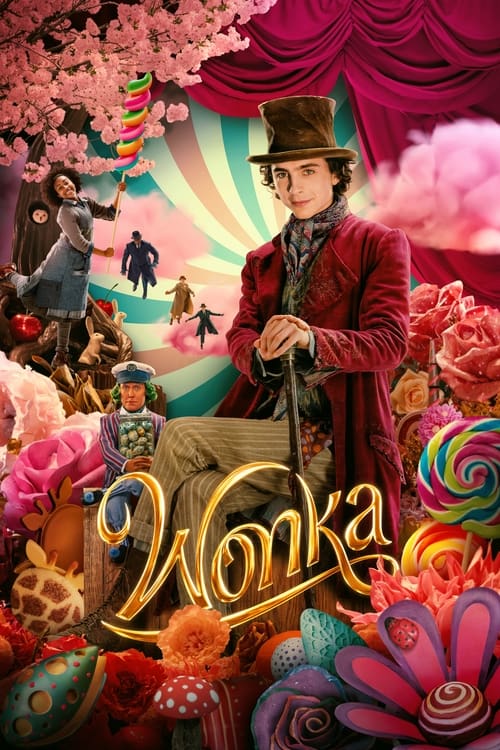
Wonka
2023 · Paul King
For a cozy family night or when you want something purely kind — a film to watch when you need your faith in whimsy restored. Comfort viewing, no edges.
What it's about
Before the factory and the golden tickets, Willy Wonka arrives in a grand old European city as a penniless young dreamer with a suitcase of ideas, determined to open a chocolate shop. Standing in his way: a price-fixing cartel of established chocolatiers and a predatory landlady who traps lodgers in her laundry house. It's a musical about a magician of candy learning how the world actually works — and refusing to accept it.
The experience
Warm, buoyant, and generous, with original songs and jokes pitched to land for adults and kids alike. It has the handmade, storybook glow of a Christmas-season family film, and it mostly earns its sweetness rather than coasting on it.
Performances
Timothée Chalamet carries the whole confection with unforced charm and real song-and-dance commitment, Olivia Colman has a wicked good time as the villainous landlady, and Hugh Grant steals scenes as a haughty Oompa-Loompa.
The craft
Paul King directs with the same meticulous, toy-theater production design and clockwork visual gags that made his Paddington films beloved, and the original musical numbers are staged with old-fashioned studio-musical care. The candy-colored sets and costumes reward a big bright screen.
Why it matters
A major holiday-season hit that confirmed Paul King as the leading maker of warm, craftsmanlike family entertainment in contemporary British cinema, and proved Chalamet could anchor a musical.
Snapshot
Wonka is a musical origin story for Willy Wonka, the confectioner-magician invented by Roald Dahl in his 1964 novel Charlie and the Chocolate Factory. Directed by Paul King from a screenplay he wrote with Simon Farnaby, it imagines Wonka (Timothée Chalamet) as a penniless young dreamer arriving in an unnamed old-European city, determined to open a chocolate shop and immediately thwarted by a price-fixing cartel of established chocolatiers and by a predatory laundry-house landlady. The film is a studio-scaled family musical with original songs, produced by David Heyman's Heyday Films for Warner Bros. and released in December 2023. It became a substantial commercial success and cemented King's reputation, built on the Paddington films, as contemporary British cinema's leading maker of warm, meticulously crafted family entertainment. It is best understood as a prequel and tonal companion to the 1971 and 2005 adaptations rather than a re-adaptation of the novel itself.
Industry & production
Wonka originates in the intellectual-property economics of the Dahl estate. The Roald Dahl Story Company, which controls the author's characters, partnered with Warner Bros. and Heyday Films — the company behind the Harry Potter franchise and the Paddington films — to develop a Wonka feature. Heyman's involvement links Wonka directly to the modern British family-film pipeline he helped standardize. (Notably, Netflix acquired the Roald Dahl Story Company in 2021, but Wonka proceeded as a Warner Bros. theatrical release, a reminder that rights deals and individual productions often run on separate tracks.)
Paul King came aboard as director and co-writer, reuniting with his Paddington 2 collaborator Simon Farnaby on the script. The choice signals intent: Warner Bros. was buying not just a valuable character but a specific house style of comedy — gentle, sincere, formally exuberant, unafraid of sentiment. Casting Timothée Chalamet, a bankable young star with arthouse credibility, as a singing-and-dancing Wonka was the production's central gamble, positioning the film to reach both family audiences and older viewers.
Production was mounted in the United Kingdom, drawing on the country's deep resources in production design, costume, and visual effects. The fictional city was assembled from real English locations — Bath's Georgian architecture, Oxford, Lyme Regis, and the interior of St Paul's Cathedral among the most identifiable — combined with large practical sets. The film was released in the UK in early December 2023 and in the United States shortly after, timed for the holiday corridor. It grossed well over $600 million worldwide, a strong result that ranked it among the highest-earning films of its release window; readers wanting exact figures should consult the studio's audited totals, but the film was unambiguously a major hit.
Technology
Wonka sits within a mainstream digital-production paradigm while consciously foregrounding practical craft. Consistent with King's Paddington method, the film privileges built environments, in-camera staging, and physical performance, using visual effects to extend and sweeten rather than to replace. The most technologically conspicuous element is the Oompa-Loompa, Lofty, played by Hugh Grant: a full human performance shrunk and integrated into scenes through visual-effects work (handled by Framestore, a studio long associated with Heyday productions), combining Grant's face and performance with a digitally reduced body. This "human actor, digitally miniaturized" approach is a lineage descendant of the performance-capture and scale-manipulation techniques refined across two decades of blockbuster VFX.
The film's confectionery magic — floating chocolates, a musical menagerie of edible inventions, a chocolate-flooded finale — mixes practical props and set pieces with digital augmentation. On the precise capture format and lens package, the public technical record is comparatively thin; the visual result is a high-resolution, richly graded digital image whose "filmic" warmth is an aesthetic choice rather than an advertised format. I flag this rather than assert specifics I cannot verify.
Technique
Cinematography
Cinematography is by Chung Chung-hoon (also credited as Chung-hoon Chung), the Korean cinematographer best known for his long collaboration with Park Chan-wook (Oldboy, Stoker, The Handmaiden) and for English-language work including It and Last Night in Soho. His presence is one of the film's most interesting authorship signals: a cinematographer associated with precise, sometimes baroque camera movement and saturated, controlled color, applied to a candy-bright family musical. The images favor storybook symmetry, expressive color blocking, and fluid crane and tracking moves that carry musical numbers, giving the picture a heightened, almost pop-up-book depth. The palette is deliberately jewel-toned and nostalgic, pitched to evoke a timeless mid-century Europe rather than any dated period.
Editing
The film was edited by Mark Everson, who cut Paddington 2 — another element of King's returning creative unit. In a musical, editing is inseparable from choreography and song structure, and Wonka's cutting is built to sustain the legibility of its production numbers: holding wide enough to let staging and dance read, then punctuating with closer inserts on invention and reaction. The comic timing that characterizes King's work — the patient build to a visual gag, the precise beat of a reveal — is an editorial signature as much as a directorial one.
Mise-en-scène / staging
Mise-en-scène is the film's showcase. Production designer Nathan Crowley (a frequent Christopher Nolan collaborator, and an Oscar-nominated designer) builds a stylized old-world city of cobbled squares, a cathedral, an oppressive laundry-house, and the fantastical interiors of Wonka's shop. The visual world is dense, handcrafted, and slightly unreal — a fairy-tale Europe that belongs to no single nation or decade. Costume design by Lindy Hemming (an Oscar winner) codes character through silhouette and color, from Wonka's signature plum coat to the villains' luxuriant tailoring. King stages musical numbers as integrated set pieces in which environment, props, and crowd become choreography, extending the maximalist-yet-controlled staging he developed in the Paddington films.
Sound
The musical dimension is central. Wonka features original songs written by Neil Hannon, the songwriter and frontman of the chamber-pop group The Divine Comedy — a distinctive choice that gives the numbers a witty, literate, melodically old-fashioned character in keeping with the film's tone. The orchestral score is by Joby Talbot, a composer with his own long association with Hannon and The Divine Comedy, ensuring stylistic continuity between song and score. The film also incorporates "Pure Imagination," the song written by Leslie Bricusse and Anthony Newley for the 1971 Willy Wonka & the Chocolate Factory, using it as an emotional touchstone that binds this origin story to the most beloved prior screen Wonka. Sound design supports the confectionery fantasy with a bright, tactile palette of fizzes, pops, and magical flourishes.
Performance
Chalamet anchors the film with a performance that leans into whimsy, vulnerability, and light showmanship rather than the eccentric menace Gene Wilder brought to the 1971 role or the arch strangeness of Johnny Depp's 2005 version; this Wonka is young, hopeful, and not yet closed off from the world. Calah Lane plays Noodle, an orphan who becomes his ally, providing the film's emotional counterweight. The ensemble is stacked with British comic talent: Olivia Colman as the villainous landlady Mrs. Scrubitt, Tom Davis as her henchman, Keegan-Michael Key as a chocolate-corrupted police chief, and Paterson Joseph, Matt Lucas, and Mathew Baynton as the cartel of rival chocolatiers. Hugh Grant's Oompa-Loompa is a deadpan comic cameo pitched to adults. Smaller appearances (including Rowan Atkinson as a chocolate-addicted cleric and Sally Hawkins as Wonka's mother in flashback) round out an ensemble in the tradition of the Paddington films' generous supporting casts.
Narrative & dramatic mode
Wonka operates in the mode of the integrated musical comedy and the origin-story prequel. Its dramatic engine is a classic underdog structure: an idealistic outsider arrives with nothing, is exploited and imprisoned by systems of greed (the landlady's debt-servitude scheme; the cartel's collusion), gathers a found family of fellow outcasts, and triumphs through ingenuity, generosity, and imagination. The narrative deliberately supplies backstory the source novel withholds — how Wonka became a chocolatier, the origin of his secret Oompa-Loompa labor, the loss of his mother that gives his quest its emotional root. It is a "how the legend began" narrative, and its pleasures are those of anticipation: viewers who know the later Wonka watch the myth assemble itself.
Genre & cycle
The film belongs simultaneously to several cycles. It is a family fantasy musical, reviving a form — the original-song, big-set-piece family film — that had grown comparatively rare in a franchise landscape dominated by superheroes and computer-animated features. It is also part of the ongoing cycle of prequels and origin stories that repackage beloved IP by dramatizing a character's youth. And it is a Roald Dahl adaptation, joining a screen tradition that includes Mel Stuart's 1971 film, Tim Burton's 2005 Charlie and the Chocolate Factory, and numerous other Dahl adaptations. Within King's own filmography it forms a loose trilogy of tone with the two Paddington films: sincere, London-adjacent, storybook comedies about kindness confronting cruelty.
Authorship & method
Wonka is strongly an auteur-of-tone production, and that auteur is Paul King working with a returning creative family. King and co-writer Simon Farnaby carry over the Paddington 2 sensibility: a belief in earnest sweetness, immaculate comic construction, gentle satire of greed and snobbery, and the conviction that a family film can be both silly and moving without irony. Editor Mark Everson and (through The Divine Comedy connection) composer Joby Talbot extend that continuity of collaborators. The most notable outside hire is cinematographer Chung Chung-hoon, whose arthouse pedigree lends the film a compositional rigor and color discipline unusual for the genre. Songwriter Neil Hannon supplies an authorial voice of his own — melodic, literate, faintly melancholic — that distinguishes Wonka's numbers from generic film-musical fare. Production designer Nathan Crowley and costume designer Lindy Hemming, both major craft figures, give the world its handmade solidity. Producer David Heyman's method — pairing distinctive filmmakers with valuable IP and backing practical craft at scale — is itself a form of authorship visible across his output.
Movement / national cinema
The film is a product of the British studio-family-film tradition, a distinctly UK strand of large-budget, craft-heavy popular cinema exemplified by the Harry Potter and Paddington films and sustained by Britain's production infrastructure and acting talent. It is not part of any avant-garde movement; rather, it represents mainstream British cinema's confident occupation of the family-entertainment space, made largely with UK locations, crews, and a predominantly British ensemble, financed and distributed by an American major. Chung Chung-hoon's involvement adds a transnational thread, connecting the film to the global circulation of cinematographers between Korean, American, and British productions.
Era / period
Wonka is a film of the early-2020s, released as the theatrical exhibition business sought reliable, four-quadrant hits in a post-pandemic market anxious about the future of moviegoing. Its success helped validate the proposition that an original-song musical built on a well-loved character could still draw large audiences to cinemas, at a moment when the movie musical's commercial viability was frequently questioned. The film's period setting, by contrast, is deliberately unfixed: a storybook Europe evoking the mid-twentieth century without committing to a date, a choice that lets the design nostalgia operate without the constraints of literal history.
Themes
The film's governing themes are imagination as a moral and creative force, generosity versus greed, and the making of family among the dispossessed. Wonka's chocolates literalize the idea that wonder can be shared and democratized, set against a cartel that hoards sweetness and a landlady who monetizes the poor. Class and exploitation run throughout — debt bondage, monopolistic collusion, corruption of church and police by wealth — though the film treats them with fable-like lightness rather than social realism. Grief and memory supply the emotional undertow: Wonka's drive is bound to the mother he lost and a promise attached to her, so that "Pure Imagination" becomes not only a signature but an elegy. Underlying all of it is King's recurring conviction, carried from Paddington, that kindness is a practical power capable of reforming a hardened world.
Reception, canon & influence
Critical reception was broadly warm. Reviewers frequently praised the film's craft, its production and costume design, the wit of its songs, and Chalamet's willingness to commit to old-fashioned musical charm, while some noted the inherent commercial calculation of an origin story for a character who did not obviously require one. The comparison point in most criticism was less Dahl's novel than the 1971 film, whose "Pure Imagination" the movie explicitly honors; critics generally judged Wonka a sincere and skillful entry in that lineage rather than a subversive reinvention. Commercially it was a clear success, a fact that itself became part of the critical story about the resilience of theatrical family entertainment.
The influences on the film are legible and acknowledged: Roald Dahl's original character and world; the 1971 Mel Stuart film as tonal and musical touchstone; and, most immediately, Paul King's own Paddington films, whose method, worldview, and creative team Wonka extends almost seamlessly. The literate-pop songwriting tradition of Neil Hannon and the visual rigor of Chung Chung-hoon's prior work are further inputs.
Its forward influence is still forming, given its recency, and honesty requires acknowledging that legacy claims about a 2023 film are provisional. What can be said is that Wonka's success reinforced two industry propositions: that the original family musical remains commercially viable, and that prestige young stars can headline four-quadrant song-and-dance pictures. It further consolidated Paul King's standing as a maker of high-craft family films and demonstrated, once again, the durability of the Dahl brand on screen. Whether it inspires a broader revival of the theatrical family musical is a question the coming years will answer.
A Deleuzian reading
A young man in a plum coat walks into a cobbled square with nothing in his pockets, and the square starts to move.
The full Deleuzian reading of Wonka →
Reception
The trailer was dunked on relentlessly — everyone braced for a cynical IP prequel — then it opened to warm reviews and $600M+ worldwide, and the discourse flipped almost overnight to 'okay, fine, it's actually charming.'
How Wonka was received, from release to now →
How to watch Wonka: what to notice on a first viewing
- Watch the crowd and props start moving with Wonka during a song. In King's musical numbers, environment, props, and crowd become the choreography around Wonka rather than the other way. The square, not Wonka, drives the motion each time. This is the movement of world: a larger motion passes through the character instead of coming from him.
- Notice the color coding: Wonka's plum coat against the cartel's rich tailoring. Chung Chung-hoon and costume designer Lindy Hemming use saturated color to mark character instantly, plum for Wonka, luxuriant fabric for the men who hoard chocolate. Color here works as a readable moral chart, not just decoration.
- Watch how chocolate visibly corrupts the cleric and police chief. Both men grow softer and more compulsive the more chocolate controls them; their bodies show the appetite the film is really about. Deleuze's fetish names an object charged with compulsive force; chocolate organizes every character's hunger or greed around it.
- Listen for 'Pure Imagination' entering the score. Neil Hannon's original songs carry the film, but Joby Talbot's score keeps folding in the older 1971 melody as a recurring touchstone. The borrowed song ties this young Wonka to the man audiences already know he becomes.
- Notice how long each shot holds during the big dance numbers. Editor Mark Everson keeps numbers wide enough to let full-body staging read, then cuts closer only for an invention or a reaction shot. Holding the wide shot proves the dancers and the space really shared one continuous event.
The whole guide to watching Wonka, with the keys for a rewatch →
Influences: the films it descends from and the films it influenced
- Willy Wonka & the Chocolate Factory (1971) — Supplies the 'Pure Imagination' melodic motif that Wonka literally reprises, and models the melancholic-candy-fable tonal register plus the character-introducing solo number that Wonka's songbook answers to.
- Paddington 2 (2017) — Same director, co-writer Simon Farnaby and editor carry over the 'immaculate comic construction plus earnest un-ironic sweetness' method, and its integrated prison-set-piece choreography and community-of-outcasts structure are rebuilt as Wonka's washhouse ensemble.
- Paddington (2014) — Establishes King's storybook-London grammar — dollhouse cross-section sets, frontal symmetrical framing and practical whimsy — that Wonka scales up into a full musical.
- Chitty Chitty Bang Bang (1968) — Roald Dahl co-scripted; it is the template for a big practical-effects family musical organized around fantastical inventions and staged song set pieces rather than plot-song separation.
- Mary Poppins (1964) — The British-studio 'magical outsider transforms a gray city through song' blueprint whose rooftop chimney-sweep number staging is echoed in Wonka's crane-tracked street ensembles blending practical dance and effects.
- Oliver! (1968) — Dickensian British-studio musical whose massed street-choreography and orphan-underdog plotting are the lineage for Wonka's laundry-house captives and the Noodle subplot.
- Singin' in the Rain (1952) — Codifies the 'musical legibility' Wonka pursues — cutting and camera placement that keep full-body choreography readable rather than fragmenting it, so the dance itself carries the number.
- Amélie (2001) — Saturated fabulist palette and clockwork-city whimsy that King cites as a visual parent of the Paddington/Wonka storybook look and its benevolent-magical-realist tone.
- Oldboy (2003) — Chung Chung-hoon's breakthrough; the lateral tracking, corridor crane moves and rigorous color discipline he developed here are the arthouse camera toolkit he imports into a family film.
- Stoker (2013) — Chung's obsessively symmetrical framing and graphic match-cut transitions — a compositional rigor rare in family cinema — is the discipline Wonka inherits from his prior collaboration.
- The Grand Budapest Hotel (2014) — Centered storybook symmetry paired with overt digital-miniature and scale-shift trickery that King's frontal compositions and Wonka's miniaturization gags directly mirror.
- The Greatest Showman (2017) — The immediate proof-case that a prestige star can headline an original (non-adapted) four-quadrant song-and-dance spectacle with contemporary pop-inflected numbers, the commercial proposition Wonka extends through Chalamet.
- Wicked (2024) — Extends Wonka's demonstrated proposition that the prestige-cast, original-IP theatrical musical remains viable, again telling a 'villain' origin as underdog structure built on integrated star-led song numbers.
- La La Land (2016) — Revived the original-songbook film musical with crane-mounted long-take production numbers cut for readability, the same 'make the dance legible in wide framing' editing logic Wonka adopts.
- Matilda the Musical (2022) — A contemporaneous Dahl-brand British-studio screen musical with large integrated ensemble set pieces, a direct sibling in the Dahl-on-screen revival Wonka is part of.
- Cruella (2021) — Shares Wonka's structural gambit — an origin-prequel for an iconic character who never demanded one — recasting a known figure as a sympathetic underdog before their canonical persona.
Similar films
- Wicked (2024) — influence & lineage · same viewing thread
- Willy Wonka & the Chocolate Factory (1971) — influence & lineage
- Paddington 2 (2017) — influence & lineage
- Mary Poppins (1964) — influence & lineage
- The Grand Budapest Hotel (2014) — influence & lineage
- The Greatest Showman (2017) — influence & lineage
- Amélie (2001) — influence & lineage
- Oliver! (1968) — influence & lineage
All the films related to Wonka →
Watch it with: curated runs of related films
- Candy-Colored Other Worlds — A run of maximalist, all-ages spectacles where stuck ordinary lives tumble through into a wholly built, saturated wonderland — watch these back to back when you want production design to do the dreaming for you.