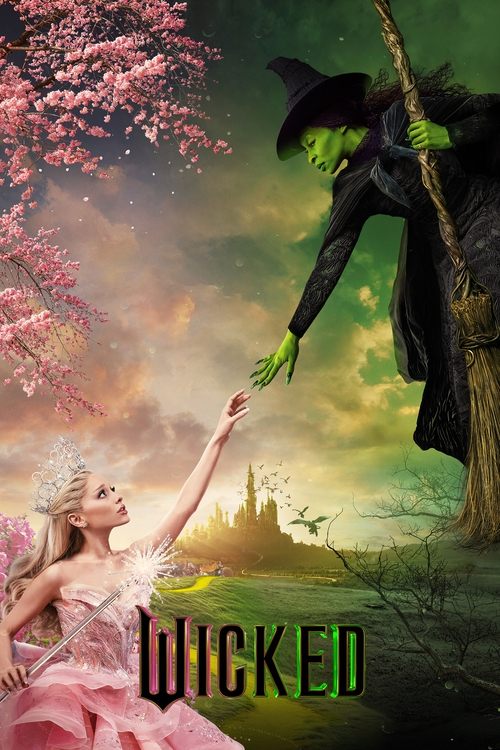
Wicked
2024 · Jon M. Chu
The press tour became the content: "holding space for Defying Gravity," the finger-touching interview, coordinated pink-and-green dressing — a masterclass (or cautionary tale) in sincerity-as-meme, ahead of a two-part box-office triumph.
For a big-hearted night when you want to sing along, feel for the outcast, and leave a little lifted — great with friends or family, and tailor-made for anyone who's ever felt like the odd one out.
What it's about
Before she was the Wicked Witch of the West, Elphaba was a green-skinned girl nobody wanted — until she arrives at Shiz University and gets stuck rooming with Galinda, the most popular girl in school. Their loathing curdles into real friendship as Elphaba's raw magical talent draws the attention of the Wizard himself, and she starts to see what Oz's glittering surface is hiding. It's the untold first act of a very familiar story, told from the villain's side.
The experience
Big, bright, and openly emotional — a full-throated musical that swings from campus comedy to soaring anthem, building to a finale designed to raise the hair on your arms. It takes its feelings seriously, and if you let it, it'll get you.
Performances
Cynthia Erivo gives Elphaba real wounded dignity and a voice that turns the showstoppers into events, while Ariana Grande is a genuine surprise as Glinda — a precise comic performance that finds the insecurity under the sparkle.
The craft
A lavish production built at enormous scale — practical sets, huge choreographed numbers, costume and production design that make Oz feel like a real, lived-in fantasy kingdom. The songs are the engine, and the film stages them as full cinematic set pieces that reward good speakers and a crowd.
Why it matters
It turned a two-decade Broadway phenomenon into a global movie event and proved the big-canvas movie musical could still fill theaters.
Snapshot
Wicked (2024) is the first installment of a two-part screen adaptation of the 2003 Broadway musical, itself drawn from Gregory Maguire's 1995 revisionist novel Wicked: The Life and Times of the Wicked Witch of the West. Directed by Jon M. Chu for Universal Pictures, the film covers the musical's first act: the meeting of the green-skinned outcast Elphaba (Cynthia Erivo) and the golden ingénue Galinda/Glinda (Ariana Grande) at Shiz University, their improbable friendship, and Elphaba's dawning recognition of the Wizard's tyranny — culminating in the levitating anthem "Defying Gravity." It is at once a fantasy melodrama, a coming-of-age campus story, and a political allegory about scapegoating. Positioned as a prestige holiday tentpole, the film was conceived as spectacle and as origin myth: a backward glance at the 1939 Wizard of Oz that reframes its villain as its heart. The concluding half arrived in 2025 as Wicked: For Good.
Industry & production
The project has one of the longer development trails in recent studio memory. Universal held film rights to the stage show — a Marc Platt production that became one of Broadway's highest-grossing titles — for well over a decade, cycling through directors (including, at various points, names associated with Stephen Daldry and others) before Chu boarded in 2021. The decision to split the adaptation into two features, announced during production, was framed by the filmmakers as a refusal to compress the musical's material; it also, not incidentally, doubled the commercial event. That choice invited comparison to other bifurcated finales (the Harry Potter, Hunger Games, and Twilight closers), though Wicked is unusual in splitting a single evening's stage narrative rather than a long novel.
Production was mounted largely in the United Kingdom, with builds at Sky Studios Elstree and extensive location and backlot work; the production's signature publicity fact — a vast field of live tulips planted for Munchkinland — became shorthand for Chu's insistence on practical environments over wholly virtual ones. Marc Platt, who shepherded the stage version, produced the film alongside Chu's collaborators. Universal's marketing campaign, built around the pink-and-green "Glinda/Elphaba" duality and heavy brand tie-ins, was among the most saturated of the year. The film opened in North America in late November 2024 to very strong business, widely reported as a record for a Broadway-derived title, and became a major awards contender; precise grosses and rankings are best confirmed against current box-office records rather than asserted here.
Technology
Wicked is a conventionally photographed, digitally finished studio film that foregrounds practical construction over full virtual production. Where a contemporary of comparable budget might have leaned on LED volume stages, Chu and production designer Nathan Crowley emphasized standing sets — Shiz University, the Emerald City, Munchkinland — supplemented rather than replaced by visual effects. VFX houses handled the flying rig work, the animal characters (notably the goat professor Dr. Dillamond), atmospheric extension, and the "Defying Gravity" broomstick ascent, but the film's texture is dominated by tangible surfaces: real water, real flora, physical crowds. Live vocal capture was a defining technical choice: rather than lip-syncing to pre-recorded studio tracks, Erivo and Grande sang live on set to earpiece accompaniment, a method that shaped both the sound mix and the intimacy of the performances. The film was released in premium formats (IMAX and large-format presentations) suited to its scale.
Technique
Cinematography
Chu's regular cinematographer Alice Brooks, who shot In the Heights and tick, tick… BOOM! for him, lensed the film in widescreen with a preference for sweeping crane and Steadicam moves that keep pace with choreography rather than cutting around it. Brooks favors motivated, often warm key light against cooler environments, and she stages musical numbers as continuous spatial events — the camera travels through the Shiz quad and the OzDust ballroom rather than assembling them from fragments. The film's most-discussed visual property is its color: a comparatively desaturated, atmospheric palette that drew genuine critical debate, some viewers finding it moody and painterly, others finding it muddy for a story so bound to a Technicolor ancestor. That tension — a muted grade for the most chromatically famous fantasy world in Hollywood — is arguably the film's central photographic gamble. The "Defying Gravity" finale is built toward as a vertical, backlit crescendo, the frame opening upward as Elphaba rises.
Editing
Myron Kerstein, another Chu collaborator (In the Heights, tick, tick… BOOM!), cut the film. His task in a live-sung musical is exacting: preserving the integrity of a vocal take while sustaining choreographic legibility and dramatic momentum across very long numbers. The editing generally resists the hyper-fragmentation common to modern musical cinema, holding on performers long enough to register breath and effort, and reserving accelerated cutting for transitional spectacle. The pacing decision that most defines the film is structural rather than shot-to-shot: by adapting only Act One at feature length, the edit lets scenes breathe and interpolated connective material expand, a choice that some reviewers read as generous and others as attenuated.
Mise-en-scène / staging
This is the film's most celebrated dimension, and the one the Academy recognized. Nathan Crowley's production design reimagines Oz as an eclectic, hand-built world — Art Nouveau and Art Deco inflections at Shiz, a spiraling clockwork Emerald City, the tulip-carpeted Munchkinland — conceived at a scale meant to be walked through. Paul Tazewell's costumes organize the whole film around a color-and-silhouette grammar: Glinda's bubblegum pinks and structured confections against Elphaba's austere blacks and eventual witch's hat, the two women's wardrobes charting their divergence. Choreography (Chu came up through dance-driven filmmaking) integrates crowds into the architecture, using the built environments as staging apparatus rather than backdrop. Erivo's green skin, achieved through makeup rather than digital paint, is itself a mise-en-scène decision that anchors the character physically in every frame.
Sound
The live-vocal methodology gives the musical numbers an unusually present, breath-forward quality; the mix privileges the human voice within dense orchestral and crowd textures. John Powell's underscore threads Stephen Schwartz's show tunes into a continuous symphonic fabric, using motifs from the songs as connective scoring. The sound design of flight, wind, and the mechanical Emerald City provides the immersive envelope expected of a large-format release. The film's aural signature is finally its two leads' contrasting instruments — Erivo's belted power and Grande's coloratura brightness — set against each other across the score.
Performance
Erivo plays Elphaba with a coiled interiority that externalizes only in song, making "The Wizard and I" and "Defying Gravity" the character's true monologues. Grande, cast against her pop persona, delivers a broadly comic Glinda tuned to physical bits and vocal ornament, then modulates toward pathos as the friendship deepens. The supporting ensemble — Jonathan Bailey's Fiyero, Michelle Yeoh's Madame Morrible, Jeff Goldblum's Wizard, Ethan Slater's Boq, Marissa Bode's Nessarose, and Peter Dinklage voicing Dr. Dillamond — fills out the campus melodrama. Bode's casting as the wheelchair-using Nessarose brought lived authenticity to a role often played by non-disabled performers. The performances were widely singled out in reception, with Erivo and Grande drawing the bulk of critical and awards attention.
Narrative & dramatic mode
Wicked operates in the mode of the integrated book musical: numbers advance plot and reveal character rather than pausing for divertissement. Structurally it is a two-hander origin story built on dramatic irony — the audience arrives already knowing these women become "the Good" and "the Wicked," so the film mines the gap between reputation and reality. Winnie Holzman's stage book, adapted here with Dana Fox, is a work of revisionist counter-narrative: it retells a canonical story (the 1939 Wizard of Oz) from the perspective of its designated villain, exposing the machinery by which a society manufactures wickedness. The dramatic engine is less plot than moral education — Elphaba's progress from wanting the Wizard's approval to defying it. As Part One, the film is deliberately incomplete, ending on ascent rather than resolution, which shapes its whole rhythm toward a single upward gesture.
Genre & cycle
The film sits inside the intermittent Hollywood cycle of stage-to-screen musical adaptations — a lineage running through Chicago, Dreamgirls, Les Misérables, Into the Woods, and Chu's own In the Heights — and within a narrower recent vein of prestige, live-sung musical spectacle. It is simultaneously a fantasy blockbuster and a "villain origin" narrative, aligning it with a broader 2010s–2020s cultural appetite for sympathetic reimaginings of famous antagonists (Maleficent, Cruella, Joker). Its most specific genre position, though, is as a franchise-scaled adaptation of an already beloved theatrical property, arriving to a built-in audience two decades in the making. That dual identity — musical for the theater faithful, event fantasy for the multiplex — governs both its form and its marketing.
Authorship & method
Jon M. Chu's authorship is defined by dance-literate camera movement, an optimistic populism, and a career-long interest in identity and belonging — from the Step Up films through Crazy Rich Asians and In the Heights. His method is collaborative and repertory: Wicked reunites him with cinematographer Alice Brooks, editor Myron Kerstein, and the musical vocabulary he honed on his prior musicals. Composer and lyricist Stephen Schwartz, author of the stage score, remained integral, with John Powell handling orchestral underscore. Production designer Nathan Crowley (a frequent Christopher Nolan collaborator) and costume designer Paul Tazewell (a Tony-winning theater veteran, including Hamilton) supplied the film's visual identity; screenwriter Winnie Holzman adapted her own stage book alongside Dana Fox. Producer Marc Platt provides continuity with the Broadway production. The governing method throughout was fidelity-with-expansion: preserving the show's songs and emotional architecture while opening its world into cinematic space and adding connective narrative that the stage's economy had elided.
Movement / national cinema
Wicked is a product of contemporary Hollywood studio filmmaking in its franchise-adaptation mode, but it is materially a transatlantic production, shot in Britain with substantial UK crews, facilities, and craft labor — part of the sustained routing of large American productions through British studios. It belongs to no avant-garde or national "movement" in the art-historical sense; its lineage is industrial and generic. If it participates in any current, it is the periodic attempt to prove the theatrical musical commercially viable on screen — a recurring Hollywood project rather than a settled genre health.
Era / period
The film is a distinctly mid-2020s object. It reflects a post-pandemic exhibition landscape hungry for event cinema that could draw audiences back to theaters, and it answers with communal, sing-along-ready spectacle. Its two-part structure mirrors the era's franchise economics; its live-vocal, practical-build ethos reads as a corrective to the fatigue around wholly digital worlds; and its themes of scapegoating, propaganda, and manufactured enemies landed in a politically charged moment that many critics read as pointed. Its very existence — a decades-delayed adaptation finally greenlit at maximal scale — marks the period's willingness to bet nine-figure budgets on pre-sold intellectual property with a devoted fan base.
Themes
At its center is the social construction of wickedness: how difference is coded as evil, and how power launders bigotry into official history. The green skin functions as an all-purpose marker of otherness, and the film's most durable political thread is the persecution of Oz's talking Animals — a slow-creeping campaign of silencing and disenfranchisement that stands in for scapegoating regimes generally. Around this run the film's other concerns: the intimacy and rivalry of female friendship as its true love story; the gap between goodness and reputation (Glinda is "Good," Elphaba is not, and both are lies); ambition and the seduction of belonging; and the cost of dissent, dramatized in the choice to "defy gravity" — to refuse a corrupt order even at the price of exile. The origin-story frame gives all of this a tragic cast, since we know how the persecution ends.
Reception, canon & influence
Wicked was received warmly by critics and enthusiastically by audiences, with particular praise for Erivo and Grande's performances and for its craft — production and costume design above all — even as the muted color grade and the decision to split the story drew reservation. It was a major awards contender at the 97th Academy Awards, where it won for Best Production Design (Nathan Crowley) and Best Costume Design (Paul Tazewell, who became the first Black man to win that category) and figured among the Best Picture nominees; readers should confirm the full nominations-and-wins ledger against the official record, as awards tallies are easy to misstate.
Its backward influences are layered and explicit. The film descends from L. Frank Baum's Oz books; from the 1939 MGM Wizard of Oz, whose imagery it constantly quotes and inverts; from Gregory Maguire's novel, which supplied the revisionist premise; and, most directly, from the Schwartz–Holzman stage musical, whose songs and structure it reproduces. Its dramatic strategy — retelling a canonical tale from the villain's side — connects it to a long revisionist tradition in fiction and, on screen, to the sympathetic-antagonist cycle of the 2010s and 2020s.
Its forward legacy is still forming, and honesty requires flagging that any claim about lasting influence in 2025–26 is provisional. What can be said is that its commercial success reinforced Hollywood's appetite for large-scale stage-musical adaptation and for two-part franchise structures; that its practical-build, live-sung methodology offered a widely cited counter-model to virtual production; and that it consolidated Cynthia Erivo and Ariana Grande's screen standing while extending Jon M. Chu's run as a leading director of the movie musical. The completing chapter, Wicked: For Good (2025), reframes this first film retrospectively as the rising action of a single, split epic — the fuller measure of its influence awaiting the diptych's whole.
A Deleuzian reading
Cynthia Erivo's Elphaba is green, and you knew that before you bought the ticket.
The full Deleuzian reading of Wicked →
Reception
Greeted with two years of skepticism — a two-part split of a stage musical, dodgy-looking trailers — it landed in late 2024 as a genuine event, out-grossing every stage-to-screen musical adaptation before it and riding a wave of good will to ten Oscar nominations. With the second half now out, the consensus has largely settled that Part One caught lightning the sequel couldn't quite rebottle.
How Wicked was received, from release to now →
How to watch Wicked: what to notice on a first viewing
- Watch Glinda's pinks and Elphaba's blacks whenever they share a frame. Tazewell dresses the two women in a consistent color-and-silhouette grammar, bubblegum structure against austere black, that recurs across every shared scene. The costumes chart the women's divergence before the plot admits it.
- Track how the camera moves through musical numbers instead of cutting. Alice Brooks sends the crane and Steadicam traveling through the Shiz quad and the OzDust ballroom, staging each number as one continuous spatial event. This turns choreography into an unbroken world you move through, not a mosaic assembled from fragments.
- Notice how muted and cool the color grade looks throughout. Alice Brooks applies a comparatively desaturated, atmospheric palette to a story built on Technicolor-bright pink and green, a choice reviewers split over. The muted grade is a deliberate photographic gamble, not an accident, applied to Oz's most famous colors.
- Listen for breath and effort audible during the sung numbers. Because Erivo and Grande sing live on set, Kerstein's cut holds shots long enough to register real physical exertion instead of cutting away. Live vocal capture ties the image to a body actually spending itself in front of the camera.
The whole guide to watching Wicked, with the keys for a rewatch →
Influences: the films it descends from and the films it influenced
- The Wizard of Oz (1939) — Supplies the canonical iconography Wicked constantly quotes and inverts — the ruby slippers, the Emerald City silhouette, and above all the witch's green skin — while Wicked's desaturated grade deliberately reacts against this film's saturated three-strip Technicolor.
- Les Misérables (2012) — Established the modern live-on-set vocal-capture method — actors singing in real time to an earpiece piano rather than lip-syncing to prerecorded tracks — which Wicked adopts as its core recording methodology.
- In the Heights (2021) — Chu's immediate prior musical with the same repertory crew (DP Alice Brooks, editor Myron Kerstein), where he honed the dance-literate crane-and-Steadicam choreography that stages entire numbers as sustained camera movement.
- La La Land (2016) — Modeled the unbroken-take musical number — song, blocking, and sweeping crane/Steadicam fused so the cut respects vocal integrity — the long-take-vocal-integrity device Wicked builds its 'Defying Gravity' finale around.
- Chicago (2002) — Revived the commercial Hollywood stage-to-screen adaptation and set the editing-driven template for translating a Broadway song ledger into feature form that Wicked's fidelity-with-expansion approach inherits.
- The Sound of Music (1965) — The benchmark for opening a stage adaptation with a soaring aerial crane and a lush symphonic orchestral underscore — the John Powell scoring register Wicked works in.
- Cabaret (1972) — Demonstrated the cinematic reconception of a Broadway property — reshaping the stage book and staging numbers for camera rather than filming the show — the expansion logic Winnie Holzman's screenplay follows.
- Maleficent (2014) — The direct screen precedent for the revisionist counter-narrative — retelling a canonical fairy tale from the villain's sympathetic perspective — that is Wicked's foundational dramatic strategy.
- Dreamgirls (2006) — Set the modern stage-to-screen template for building a film around a single knockout belted showstopper, the vocal-showcase architecture Wicked hands to Erivo's Act I closer.
- Wonka (2023) — A contemporaneous musical origin-story prequel that, like Wicked, leans on large-scale practical builds and whimsical production design plus symphonic underscore rather than virtual production.
- The Greatest Showman (2017) — An event-cinema movie musical built on maximalist belted anthems and spectacle staging, sharing Wicked's populist showstopper sensibility and reliance on star-vocal charisma.
- Cruella (2021) — Extends the studio sympathetic-villain-origin into musical spectacle, staging defiance-as-self-invention through costume transformation and a two-women rivalry-turned-bond.
- Wicked: For Good (2025) — The completing half of the deliberately split diptych, shot back-to-back with the same practical sets, live-vocal method, and crew, retroactively reframing the first film as rising action.
- Joker (2019) — Extends the same sympathetic villain-origin cycle, dramatizing a scapegoating allegory in which the audience is aligned with the figure a society casts as monstrous.
- West Side Story (2021) — A parallel prestige stage-to-screen adaptation that stages numbers as continuous crane and Steadicam movement through practical locations, expanding the show's world cinematically while preserving its score.
- Interstellar (2014) — Nathan Crowley's practical-set build philosophy — physical environments constructed and shot in-camera as a counter-model to CGI — is the same production-design methodology Crowley brings to Wicked's Oz.
- Beauty and the Beast (2017) — A live-action fairy-tale musical spectacle that similarly expands a beloved score into lavish practical-and-digital production design, sharing Wicked's costume-and-set color-grammar approach to world-building.
- The Hunger Games: The Ballad of Songbirds & Snakes (2023) — Sibling that pairs a sympathetic villain-origin reframing with diegetic song as its narrative engine, extending the same fusion of musical performance and antagonist backstory.
Similar films
- Wicked: For Good (2025) — influence & lineage · same viewing thread
- Wonka (2023) — influence & lineage · same viewing thread
- The Wizard of Oz (1939) — influence & lineage
- The Greatest Showman (2017) — influence & lineage
- The Super Mario Bros. Movie (2023) — same viewing thread
- The Love Witch (2016) — same viewing thread
- "Wuthering Heights" (2026) — same viewing thread
- The Wiz (1978) — shared sensibility
All the films related to Wicked →
Watch it with: curated runs of related films
- Drunk on Design — Watch these together for the rush of maximalist, color-drenched cinema where a woman is made, remade, or consumed by an art form — ballet, fashion, gothic desire — and the production design does half the storytelling.
- Candy-Colored Other Worlds — A run of maximalist, all-ages spectacles where stuck ordinary lives tumble through into a wholly built, saturated wonderland — watch these back to back when you want production design to do the dreaming for you.