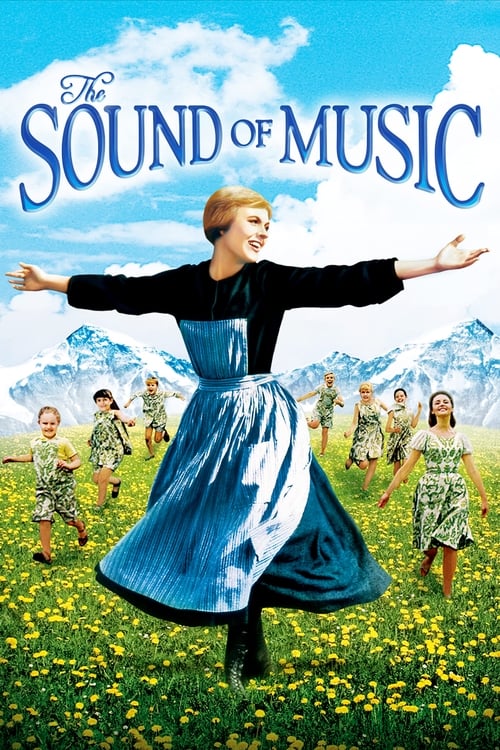
The Sound of Music
1965 · Robert Wise
The definitive comfort watch — for a family afternoon, a holiday, or any day you need your spirits lifted by people singing on mountaintops. Pure warmth, with just enough darkness at the edges to make the warmth mean something.
What it's about
In Austria on the eve of World War II, a free-spirited young postulant named Maria is sent from her abbey to serve as governess to the seven children of a stern widowed naval captain. She wins the children over with music, thaws the household, and complicates the captain's tidy plans — while the shadow of the German annexation creeps toward their mountain idyll.
The experience
Warm, sweeping, and unabashedly sincere, with songs you already half-know even if you've never seen it. It's three hours that glide by on Alpine air, then tightens into real suspense as history closes in.
Performances
Julie Andrews, at the peak of her stardom, carries the whole film — radiant, funny, and in glorious voice — while Christopher Plummer gives the captain a dry reserve that makes his gradual softening genuinely affecting.
The craft
Shot in 70mm on location in and around Salzburg, it's one of the most beautiful travelogues ever wrapped around a musical, from the famous helicopter-shot opening onward. Robert Wise stages the Rodgers and Hammerstein numbers with unfussy confidence, letting landscape and voice do the work. On a big screen with good sound, it still feels like an event.
Why it matters
One of the highest-grossing films in history, it won five Academy Awards including Best Picture, closed out the golden age of the Hollywood roadshow musical, and settled permanently into global culture as a rite of passage and a sing-along institution.
Snapshot
The Sound of Music is the film that closed the golden age of the Hollywood roadshow musical while setting a commercial benchmark it would take a decade to surpass. Adapted from the 1959 Rodgers and Hammerstein stage hit — itself drawn from Maria von Trapp's memoir The Story of the Trapp Family Singers — it transposed the sentimental true-ish story of an Austrian postulant turned governess into a lavish 70mm widescreen spectacle shot on location in and around Salzburg. Directed by Robert Wise fresh off West Side Story (1961), scripted by Ernest Lehman, and anchored by Julie Andrews at the crest of her stardom, the film fused pastoral landscape, family melodrama, and the shadow of the 1938 Anschluss into a package of extraordinary popular appeal. It won five Academy Awards, including Best Picture and Best Director, and for a time stood as the highest-grossing film ever made. Critically it has always been contested — adored by mass audiences, mistrusted by tastemakers who found it saccharine — but its craft, particularly its integration of song and landscape, is more disciplined than its reputation for sweetness suggests.
Industry & production
The film was a 20th Century-Fox production, and its significance to the studio is hard to overstate. Fox had been nearly bankrupted by the runaway costs of Cleopatra (1963); The Sound of Music became the hit that restored the studio's solvency. Producer-director Robert Wise, working through his own Argyle Enterprises arrangement with Fox, took over a project that had passed through other hands — William Wyler was attached at an earlier stage and scouted locations before departing, unpersuaded by the material's sentimentality. Ernest Lehman, who had adapted West Side Story for Wise, wrote the screenplay and is often credited with shepherding the project through its development.
Production unfolded in 1964, split between location work in Salzburg and its surrounding Alpine countryside and interiors built on Fox soundstages in Los Angeles. The Salzburg shoot was famously beset by the region's persistent rain, which stretched the schedule. The film was mounted as a "roadshow" release: reserved-seat, higher-priced engagements with an overture, intermission, and entr'acte, positioning it as an event rather than ordinary programming. That distribution model was in its twilight, and The Sound of Music is frequently cited as one of the last roadshow musicals to fully justify the format commercially — even as the wave of expensive imitators it inspired (Doctor Dolittle, Star!, reuniting Wise and Andrews, and Hello, Dolly!) helped bankrupt the very studios that chased its success.
Technology
The film was photographed in Todd-AO, the 65mm/70mm large-format process, and released in that gauge for its premiere engagements with six-track magnetic stereophonic sound, with 35mm CinemaScope reductions for general release. Color was by DeLuxe. The Todd-AO format — a single-camera 65mm negative printed to 70mm — delivered the sharpness and screen-filling scale that the roadshow presentation demanded, and it was ideally suited to the sweeping Alpine vistas that are the film's signature.
The most technologically notable sequence is the opening: a descending aerial shot that sweeps across mountains and lakes before closing on Maria spinning in a meadow. It was captured from a helicopter, and the downdraft from the rotor repeatedly knocked Julie Andrews to the ground between takes — an anecdote she has recounted often. The six-track stereo mix gave the musical numbers a spatial richness in premiere venues that home formats could only approximate for decades afterward.
Technique
Cinematography
Ted McCord, a veteran whose credits stretched back to the silent era and included The Treasure of the Sierra Madre (1948) and East of Eden (1955), shot the film. His work marries postcard-scale landscape photography with a controlled, unfussy interior style. The exteriors exploit the Todd-AO frame's horizontal breadth — the meadows, the Untersberg massif, the lake behind the von Trapp villa — while keeping human figures legible within the vastness. Indoors, McCord favors clean, evenly modeled light appropriate to the material's warmth, reserving harder chiaroscuro for the film's later, tenser passages as the Nazi threat closes in. The cinematography earned an Academy Award nomination.
Editing
William Reynolds edited the film and won the Academy Award for it. His cutting is essential to the film's reputation for "flow": the celebrated montage set to "Do-Re-Mi," in which Maria teaches the children to sing across a sequence of Salzburg locations and changing costumes spanning implied weeks, is a textbook example of using editing to compress time and geography into a single euphoric musical arc. Reynolds paces the film's near-three-hour length by alternating expansive musical set-pieces with tighter dramatic scenes, and his handling of the concert and escape climax sustains tension through cross-cutting between performance and pursuit.
Mise-en-scène / staging
Wise and his collaborators stage the musical numbers with a strong preference for real space over stylization. Where his West Side Story had embraced abstraction, The Sound of Music roots its songs in tangible locations — the abbey, the villa's grounds, the gazebo, the mountains — so that landscape itself becomes a co-star. The art direction (by Boris Leven, Wise's frequent collaborator) and set decoration reconstruct an idealized pre-war Austria; the film was nominated for its art direction and won the Academy Award for costume-adjacent categories in some tallies — to be precise, it won Best Picture, Director, Adapted Music Score, Film Editing, and Sound, and was nominated in cinematography, art direction, and costume design. The gazebo, built for "Sixteen Going on Seventeen," became one of the most recognizable single sets in the musical genre.
Sound
The film won the Academy Award for Sound (credited to the Fox sound department under James Corcoran and the Todd-AO team). Beyond the technical mix, the film's musical supervision, arrangements, and conducting by Irwin Kostal shaped how the score plays: Kostal's orchestrations expanded the stage arrangements for the widescreen format and won the Oscar for Scoring of a Musical (Adaptation or Treatment). Christopher Plummer's singing voice as Captain von Trapp was dubbed by Bill Lee, a common practice for non-singing leads of the period; Julie Andrews performed her own vocals.
Performance
Julie Andrews's Maria is the film's engine — a performance that balances gawky exuberance with genuine feeling, and that carries the enormous burden of nearly every musical number. Andrews came to the role having just made Mary Poppins (released 1964, for which she won the Best Actress Oscar the same season this film was in release), and her screen persona of brisk, warm competence is inseparable from both films. Christopher Plummer, who has spoken with well-documented ambivalence about the film (his quip nicknaming it "The Sound of Mucus" is widely reported), gives the Captain a needed astringency, resisting the material's sweetness and lending the romance a credible reserve. Eleanor Parker as the Baroness and Richard Haydn as Max supply worldly counterpoint; the seven child performers, led by Charmian Carr as Liesl, are directed to avoid cloying precocity more successfully than the genre often manages. A footnote of note: the vocal arranger Marni Nixon — Hollywood's most famous "ghost singer," who had dubbed leads in West Side Story and My Fair Lady — appears on screen for the first time as Sister Sophia.
Narrative & dramatic mode
The film operates in the mode of the integrated book musical, in which songs advance character and story rather than functioning as detachable numbers. Its structure is bipartite: a first movement centered on the domestic and romantic transformation of the von Trapp household under Maria's influence, and a darker second movement in which the private idyll collides with the political catastrophe of the Anschluss and the family's flight. Ernest Lehman's screenplay tightened the stage book, relocated and reassigned some songs, and heightened the wartime jeopardy of the climax into a suspense sequence — the family hiding in the abbey, the concert-as-cover, the mountain crossing. This grafting of thriller mechanics onto the family-musical body is one of the film's shrewdest structural choices, giving the sentimental first half a stake and a shadow.
Genre & cycle
The Sound of Music is a Rodgers and Hammerstein musical and a family film, and it stands near the end of the great cycle of Broadway-derived roadshow musicals that Hollywood mounted through the late 1950s and 1960s — a lineage including Oklahoma!, The King and I, South Pacific, West Side Story, and My Fair Lady. Within that cycle it is the commercial apex. Its staggering success triggered a cycle of imitation: studios greenlit a series of expensive musicals in the hope of replicating it, most of which failed and collectively contributed to the financial crises of the New Hollywood transition at decade's end. The film is thus a genre endpoint in two senses — the fullest realization of the form and a proximate cause of its collapse.
Authorship & method
Robert Wise is the film's controlling authorial presence, and he is an instructive case for auteurist criticism: a former editor (he cut Citizen Kane and The Magnificent Ambersons for Welles) who became a supremely versatile studio director across noir, science fiction (The Day the Earth Stood Still), horror (The Haunting), boxing drama (The Set-Up), and two Best Picture-winning musicals. His method is craftsmanlike rather than signatory — he serves the material with technical rigor rather than imposing a visible personal stamp — and The Sound of Music rewards that restraint by keeping its sentiment structurally disciplined.
The key collaborators form a recognizable Wise stock company and a Rodgers and Hammerstein legacy. Screenwriter Ernest Lehman (also West Side Story, North by Northwest, Sweet Smell of Success) supplied the adaptation. The score is by composer Richard Rodgers and lyricist Oscar Hammerstein II; crucially, this was the pair's final collaboration — Hammerstein died in 1960, and for the film Rodgers wrote both music and lyrics for two new songs, "I Have Confidence" and "Something Good," replacing stage numbers. Cinematographer Ted McCord, editor William Reynolds, production designer Boris Leven, and musical supervisor Irwin Kostal round out the principal authors of the film's look and sound. Choreography was by Marc Breaux and Dee Dee Wood.
Movement / national cinema
The film belongs squarely to the Hollywood studio system in its late-classical, pre-New-Hollywood phase; it is not the product of any avant-garde or national-cinema movement. Its interest for questions of national cinema is thematic and touristic rather than industrial: it is an American studio's idealized image of Austria, and its relationship to the country it depicts is famously vexed. The film was never especially popular in Austria and Germany, where the von Trapp story is remembered differently and where the wartime material is more fraught; Salzburg's tourism industry nonetheless built an enduring economy around the film's locations, an irony in which an American fantasy of Austrianness became a fixture of the real Austrian landscape.
Era / period
Made in 1964–65, the film sits at a hinge in American film history. It arrived as the Production Code was weakening and the studio system was fraying, one year before the Code's replacement began and a few years before the ratings system and the New Hollywood rupture. It is a product of Hollywood's confidence in the mass family audience and the reserved-seat prestige release — a confidence that its own success would help destroy. Diegetically, the film is set in 1938, on the eve of and during the Anschluss, and its period reconstruction of pre-war Salzburg is central to its appeal and to critiques of its politics.
Themes
The film's dominant theme is the redemptive and liberating power of music and love within a repressive order — the naval-disciplined household thawed by song, the postulant who finds her vocation not in the cloister but in the world. Nature and the pastoral function as a moral space: the mountains open and close the film, and the meadow is where Maria is most herself. Vocation and self-knowledge run beneath the romance ("Climb Ev'ry Mountain" is explicitly a hymn to pursuing one's calling). Against these private themes stands the public theme of moral resistance: the Captain's refusal to serve the Reich, and the family's flight, frame personal integrity as a stand against tyranny. Critics have long debated whether the film's sunny surface trivializes that history or whether the Anschluss subplot lends the sweetness a genuine gravity; the honest answer is that the film wants both, and its popularity rests on the reassurance that goodness, family, and song can outrun fascism.
Reception, canon & influence
Popular reception was a phenomenon: the film became, for a period, the highest-grossing motion picture ever, overtaking Gone with the Wind, and it sustained roadshow engagements for years. Critical reception was sharply divided. Many reviewers found it too sweet, and it became a lightning rod for the era's critical anxieties about middlebrow entertainment. Pauline Kael's scathing dismissal — she reportedly called it "The Sound of Money" and a "sugar-coated lie" — is the most cited hostile verdict, and it is widely repeated (though sometimes over-dramatized) that the review contributed to her departure from McCall's. The industry, however, embraced it: five Academy Awards, including Best Picture and Best Director.
Its influences flow backward to Rodgers and Hammerstein's integrated-musical tradition, to Maria von Trapp's memoir, and to the earlier German-language Die Trapp-Familie films of the mid-1950s, which had already dramatized the story for European audiences. Robert Wise's own West Side Story is the immediate stylistic and personnel precursor.
Its legacy forward is threefold. Commercially, it set the template — and the cautionary tale — for the late-1960s musical boom and bust. Culturally, it entered the canon of perennial family entertainment through television broadcasts and home video, sustaining multi-generational familiarity of a kind few films achieve; the sing-along revival screenings that emerged decades later testify to its participatory afterlife. And touristically and economically, it reshaped Salzburg. As cinema history, it stands as the definitive late specimen of the roadshow musical — a film whose craftsmanship its detractors underrate and whose sentiment its defenders sometimes overlook, but whose place as the commercial capstone of the classical Hollywood musical is beyond dispute.
A Deleuzian reading
A helicopter comes down out of the Alps.
The full Deleuzian reading of The Sound of Music →
Reception
Critics sneered in 1965 — Pauline Kael's famously savage pan reportedly cost her a job — but audiences made it the highest-grossing film of all time, dethroning Gone with the Wind. Six decades on, the public won: it's untouchable comfort-canon, complete with sing-along screenings.
How The Sound of Music was received, from release to now →
How to watch The Sound of Music: what to notice on a first viewing
- Watch the first shot travel from the peaks down to one woman. For most of a minute there is nobody in the picture: mountains, a lake, cloud shadow crossing grass in a very wide 70mm frame. Then the camera finds Maria alone in the meadow. The film states its terms before a word is spoken. There is a whole world, and one person inside it who does not fit anywhere yet.
- Count the locations and costume changes inside Do-Re-Mi. Reynolds moves Maria and the children across bridges, squares, gardens, and hillsides, changing clothes as he goes. Weeks of teaching are folded into one unbroken piece of music. The film's happiest sequence is built from a compression device, so you feel a season pass while hearing a single song.
- Notice that the songs happen in real Salzburg places. Wise puts the numbers in the abbey, the villa grounds, the gazebo, and the hills, with actual weather and actual distance in the shot. Very little is abstracted. A musical usually asks you to suspend the world for three minutes. These numbers ask you to accept it instead.
- Compare Andrews's restlessness with how still Plummer stands. She is always in motion, arms out, walking fast, turning. He holds position, hands behind his back, in naval posture, and moves only when he has decided to. The household's problem is legible in two bodies. One person cannot stop moving and the other has forbidden movement in his own house.
- Notice the villa's light hardening in the second half. McCord lights the early interiors evenly and warmly, with soft modeling on faces. As the political pressure arrives, the contrast increases and shadows get a job to do. The photography turns colder at the same rate the story does, so the sweetness is being withdrawn rather than simply interrupted.
The whole guide to watching The Sound of Music, with the keys for a rewatch →
Influences: the films it descends from and the films it influenced
- Oklahoma! (1955) — The first Rodgers & Hammerstein integrated book musical filmed and the first feature shot in Todd-AO 70mm, it established both the format and the location-shot pastoral opening number ('Oh, What a Beautiful Mornin'') that Wise mirrors in the alpine 'The Sound of Music' overture.
- West Side Story (1961) — Wise's immediate personnel and stylistic precursor — same director, same screenwriter (Ernest Lehman), and the method of prying a stage musical open with an aerial helicopter establishing descent and real-location choreography.
- Citizen Kane (1941) — Wise cut this film as editor; the compression-by-montage technique (the breakfast-table montage) and rhythmic cross-cutting he learned here underwrite both the 'Do-Re-Mi' training montage and the intercut abbey-escape climax.
- The King and I (1956) — A Rodgers & Hammerstein integrated book musical whose reliance on ghost-dubbed vocals (Marni Nixon behind Deborah Kerr) models the same voice-double convention SoM uses for its supporting singers.
- Carousel (1956) — A Rodgers & Hammerstein adaptation shot in CinemaScope 55 with six-track stereo, prototyping the wide-gauge widescreen-plus-multichannel-sound roadshow package SoM would perfect in Todd-AO.
- Die Trapp-Familie (1956) — The German-language dramatization of Maria von Trapp's memoir that first structured the family-choir-and-flight material into a screen narrative, the direct source template the Broadway show and film reshaped.
- Seven Brides for Seven Brothers (1954) — Established the CinemaScope outdoor musical, staging athletic ensemble choreography across real landscape rather than a proscenium — the widescreen-number-in-nature grammar SoM applies to the mountain and gazebo sequences.
- North by Northwest (1959) — Ernest Lehman's screenplay here drilled him in suspense construction through cross-cut pursuit set-pieces, the exact craft he imports to SoM's Nazi-search thriller climax among the abbey headstones.
- Meet Me in St. Louis (1944) — The MGM benchmark for the family-unit integrated musical in which songs advance character and domestic narrative rather than pausing for spectacle — the structural discipline SoM's book-musical numbers inherit.
- Star! (1968) — Wise's direct attempt to re-run the formula — reuniting with Julie Andrews in another roadshow biographical musical — whose failure exposed the limits of the SoM template he had authored.
- Hello, Dolly! (1969) — Ernest Lehman scripted and produced this overscaled Todd-AO roadshow musical, carrying SoM's screenwriter and its wide-gauge-spectacle ambitions into the boom-and-bust that the cycle triggered.
- Oliver! (1968) — The last integrated book musical to win Best Picture in the boom SoM ignited, extending its location-realism approach — real streetscapes staged for large-ensemble numbers — to Dickensian London.
- Fiddler on the Roof (1971) — A late roadshow book musical that pushes SoM's location-realism further, rooting integrated songs in an authentic-landscape shtetl with a persecution-and-flight climax structurally echoing the von Trapps' escape.
- Cabaret (1972) — The reactive inversion: it inherits SoM's Nazi-era Austro-German setting and songs-that-comment-on-plot logic but confines every number to the diegetic stage, deliberately refusing SoM's characters-burst-into-song integration.
- La La Land (2016) — A conscious revival of the CinemaScope integrated musical, opening with a single-take crane-and-widescreen production number that reclaims the sweeping-camera-over-real-space staging SoM took from the roadshow era.
- Dancer in the Dark (2000) — Functions as the explicit diegetic referent — Selma rehearses it for community theater — so its earnest Rodgers-and-Hammerstein optimism is the genre object the film cites in order to negate.
- Wicked (2024) — The benchmark for opening a stage adaptation with a soaring aerial crane and a lush symphonic orchestral underscore — the John Powell scoring register Wicked works in.
- Wicked: For Good (2025) — Codified the 'open up' method — releasing a staged number into landscape via aerial/crane establishment — which is Chu's stated approach to expanding the theatrical songs.
- Funny Girl (1968) — The 70mm roadshow blockbuster whose runaway grosses set the industrial appetite and format Funny Girl's producers were chasing.
- Captain Fantastic (2016) — The whistle-drilled child ensemble in matching handmade clothes, marshalled by an ex-officer father and finally deployed as a public musical performance that doubles as the family's escape — Ross reruns the roll-call blocking (Ben's morning drills, the graveside 'Sweet Child o' Mine') with the ideology inverted.
- Mary Poppins (1964) — Released a year earlier, it minted Julie Andrews's screen persona as the transformative musical governess, the specific performance capital SoM immediately banked and extended.
- My Fair Lady (1964) — The competing prestige roadshow adaptation of the same season, deploying the same dubbed-vocal apparatus (Marni Nixon for Audrey Hepburn) that defined mid-'60s musical-adaptation craft.
- The Chorus (2004) — Ancestor of the redemptive-choirmaster set piece — an outsider transforms a regimented household of children into a singing ensemble, staging musical numbers whose live vocal performance carries the film's emotional argument.
Similar films
- Mary Poppins (1964) — influence & lineage
- Cabaret (1972) — influence & lineage
- La La Land (2016) — influence & lineage
- Meet Me in St. Louis (1944) — influence & lineage
- West Side Story (1961) — influence & lineage
- Mamma Mia! (2008) — shared sensibility
- Singin' in the Rain (1952) — shared sensibility
- The Best Years of Our Lives (1946) — shared sensibility