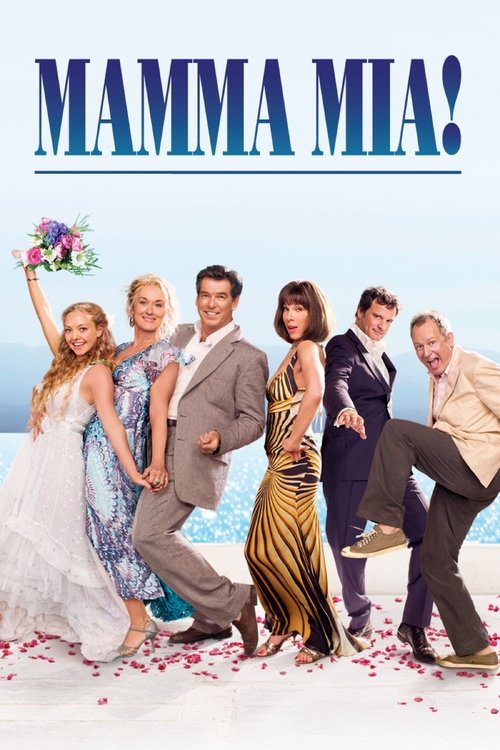
Mamma Mia!
2008 · Phyllida Lloyd
For when you need your spirits hauled up by force — a singalong night with friends, a hangover afternoon, or any moment that calls for zero cynicism and maximum Greek sunshine. Comfort viewing, unashamed.
What it's about
On a small Greek island, a young bride-to-be secretly invites three of her mother's old flames to her wedding, hoping to figure out which one is her father in time to walk her down the aisle. Her fiercely independent single mother, who runs the island hotel, has no idea they're coming — and the whole tangle plays out through the ABBA songbook.
The experience
Sunshine in movie form: giddy, silly, and openly imperfect, with big group numbers that feel less like a performance and more like a party you've been pulled into. Resistance tends to last about one song.
Performances
Meryl Streep flings herself into the role with total, joyful abandon — dancing on rooftops, belting from cliff tops — and her willingness to look ridiculous is exactly what makes it moving.
The craft
Stage director Phyllida Lloyd brought her own record-breaking West End hit to the screen, keeping its rough, communal energy intact: real Greek-island light, ensemble numbers staged like village celebrations, and singing that's charmingly uneven by design. Made by a rare all-female director-producer-writer team, it plays best loud, with company.
Why it matters
A colossal word-of-mouth hit — for a time the highest-grossing film ever in Britain — it proved the jukebox musical could rule the box office and made the singalong screening a cultural fixture.
Phyllida Lloyd, a distinguished British theater and opera director, transferred her own record-breaking West End jukebox musical to the screen and made one of the most purely beloved communal experiences in modern cinema: a bride on a sun-hammered Greek island, three possible fathers summoned in secret, and the entire ABBA songbook deployed as emotional weather. The film was driven by a rare all-female creative trio — Lloyd, producer Judy Craymer, and writer Catherine Johnson — and it runs on Meryl Streep's astonishing willingness to fling herself, mid-career and mid-air, into overalls and 'Dancing Queen.' Critics fixated on the wobblier singing (Pierce Brosnan bore the brunt); audiences understood that the roughness was the point, an invitation rather than a performance to admire from a distance. In Britain it became for a time the highest-grossing film ever released there, and its sing-along screenings helped normalize cinema as participatory ritual. Beneath the camp is something quietly radical: a hit fantasy centered on women in their fifties, desire intact, shot in light the color of retsina and salt.
Reception
Critics sharpened their knives in 2008 — Pierce Brosnan's singing became a running joke in reviews — while audiences made it a global box-office phenomenon; nearly two decades on, the 'so bad' framing has fully melted into 'pure joy,' and it's now defended as deliberate, gloriously sincere camp.
How Mamma Mia! was received, from release to now →
Influences: the films it descends from and the films it influenced
- Muriel's Wedding (1994) — Codified ABBA's catalog as a diegetic vocabulary for female fantasy and escape, staging lip-sync/sing-along numbers as a lonely woman's dreaming — the exact ABBA-as-emotional-lexicon device Mamma Mia inherits.
- Shirley Valentine (1989) — Established the older-woman-rediscovers-desire-on-a-Greek-island template, using sun-bleached Aegean light as the visual site of midlife female liberation that Lloyd's Kalokairi reproduces.
- The Adventures of Priscilla, Queen of the Desert (1994) — Built camp spectacle from an ABBA-and-disco songbook via maximalist costume and lip-sync production numbers, supplying the drag-camp maximalism Mamma Mia softens for the multiplex.
- Grease (1978) — Modeled the blockbuster pop-musical driven by hummable chart hooks and big ensemble numbers, engineered for repeat viewing and audience participation.
- ABBA: The Movie (1977) — Fixed the band's kitsch-glamour visual palette — satin, spangle, Nordic-bright staging — that the film's costume and number design directly quotes.
- Summer Holiday (1963) — Invented the sun-drenched European tourist-musical, welding pop stardom to Mediterranean-holiday travelogue in the way Mamma Mia sells Greece.
- Moulin Rouge! (2001) — A pure jukebox musical built entirely from a pre-existing pop catalog (ABBA), it commercializes the borrowed-songs-as-book-musical model Moulin Rouge! proved viable on screen.
- Mamma Mia! Here We Go Again (2018) — Directly replicates the Kalokairi-island staging and ABBA-catalog architecture, adding a prequel timeline while retaining the unpolished star-vocal aesthetic.
- Rock of Ages (2012) — Extends the stage-to-screen jukebox formula with movie stars (Cruise) belting an 80s hair-metal songbook, foregrounding celebrity casting over trained voices exactly as Mamma Mia did.
- Sunshine on Leith (2013) — A British stage-to-screen jukebox (The Proclaimers) using non-singer ensemble voices and a communal public-square finale explicitly patterned on Mamma Mia's crowd-pleasing close.
- Walking on Sunshine (2014) — A near-clone transplanting the Mediterranean-island wedding plot into an 80s-pop jukebox with the same sun-drenched holiday-musical cinematography.
- Yesterday (2019) — A feel-good jukebox built on one band's catalog (The Beatles), marketed and structured as a communal crowd-pleaser in Mamma Mia's populist mold.
- Jersey Boys (2014) — A Broadway jukebox-musical-to-film adaptation riding the stage-to-screen catalog-show pipeline Mamma Mia's box office reopened for Hollywood.
- The Iron Lady (2011) — The proximate enabling cause — Lloyd's theater-and-opera sensibility for bold emotional staging and her working partnership with Streep, carried directly into this second feature.
- Across the Universe (2007) — Structures its entire narrative around a single band's catalog (The Beatles), sharing the one-artist-jukebox construction where plot is reverse-engineered from song titles and lyrics.
- The Greatest Showman (2017) — Engineers pop-anthem numbers for mass communal sing-along and contemporary belted vocals, chasing the same participatory-blockbuster audience Mamma Mia proved existed.
- Les Misérables (2012) — Prestige stage-to-screen musical that makes raw, live-recorded, deliberately imperfect singing from non-singer stars an expressive virtue — the industrialized version of Mamma Mia's unpolished-vocal ethic.
- Florence Foster Jenkins (2016) — Turns Meryl Streep's deliberately imperfect singing into character and comedy, extending the unpolished-vocal persona she debuted belting ABBA for Lloyd.
Similar films
- Muriel's Wedding (1994) — influence & lineage
- The Sound of Music (1965) — shared sensibility
- Mary Poppins (1964) — shared sensibility
- Anyone but You (2023) — shared sensibility
- La La Land (2016) — shared sensibility
- Premam (2015) — shared sensibility
- Amélie (2001) — shared sensibility
- Nuvvostanante Nenoddantana (2005) — shared sensibility