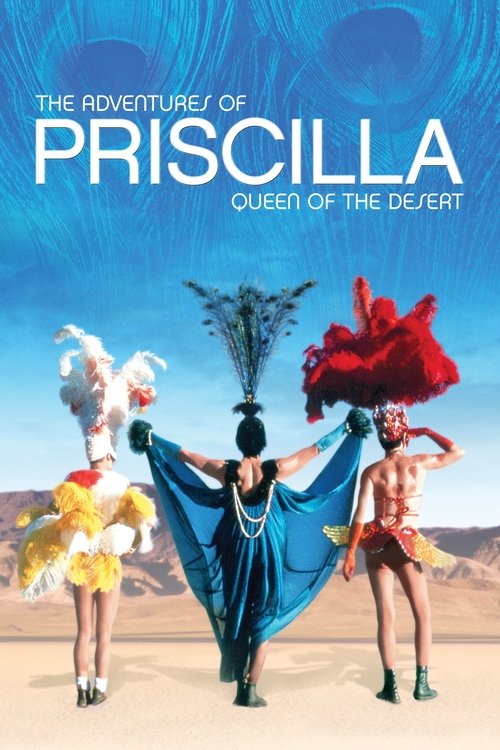
The Adventures of Priscilla, Queen of the Desert
1994 · Stephan Elliott
For a night when you want to laugh, sing along, and feel embraced — comfort viewing with glitter on it, great with friends or when you need your spirits lifted. It has a few sharp edges about prejudice, but it always comes back to joy.
What it's about
Two Sydney drag performers and Bernadette, an older transgender woman recently widowed, board a battered tour bus named Priscilla and drive it across the Australian outback to a casino gig in Alice Springs. Between breakdowns, small-town bars, and lip-synched ABBA numbers performed in full sequins against red desert, the three bicker, clash with locals, and slowly become something like family.
The experience
Big-hearted, campy, and very funny, with a streak of real melancholy running underneath the feathers — it swings from outrageous production numbers to moments of surprising tenderness and sting. The pace is loose and sunny, like the road trip it is.
Performances
Terence Stamp is the revelation — a screen tough guy playing Bernadette with bone-dry wit and wounded dignity — while Hugo Weaving grounds the film and a young Guy Pearce is fearlessly, hilariously reckless.
The craft
The Oscar-winning costumes are a character in themselves — thongs-and-sequins couture staged against the vast emptiness of the outback, including a silver-lamé cape billowing from the roof of a moving bus. The film shoots the desert like a widescreen western and cuts its disco soundtrack with real affection; it's a genuine spectacle that rewards a big screen and loud speakers.
Why it matters
One of the defining Australian films of the 1990s and a landmark that carried drag culture into mainstream cinemas worldwide, later spawning a hit stage musical.
Snapshot
The Adventures of Priscilla, Queen of the Desert is a road movie in sequins: two Sydney drag performers and an older transgender woman board a battered tour bus — christened "Priscilla" — and cross the Australian interior from the coast to a casino gig in Alice Springs. Along the way the film weaves a broad, affectionate comedy of misfits against the vast emptiness of the outback, punctuated by lip-synched cabaret numbers set to ABBA and disco. Written and directed by Stephan Elliott, it starred Terence Stamp as the widowed Bernadette, Hugo Weaving as Tick/Mitzi, and Guy Pearce as the reckless young Adam/Felicia. Modestly budgeted and unmistakably local, it became one of the defining Australian films of the 1990s and an enduring landmark of mainstream queer cinema, remembered as much for its flamboyant costumes — which won the Academy Award — as for its unexpected tenderness. Its central image, a figure in a vast silver train lip-synching opera atop a moving bus in the desert, has become one of the most recognizable in Australian film.
Industry & production
The film emerged from the resurgent, internationally minded Australian industry of the early 1990s, backed by PolyGram Filmed Entertainment through its involvement with local producers; Al Clark and Michael Hamlyn are among its credited producers, working with Elliott's production partners. It was a comparatively low-budget production, and much of its economy is visible on screen: a small principal cast, a single vehicle as its mobile set, and location shooting that turned the outback itself into production value. The exact budget and box-office figures are not something I can state precisely without inviting error, but the film is consistently described as a surprise commercial success that far outperformed expectations for a small Australian comedy, securing wide international distribution — an outcome that owed a great deal to PolyGram's global reach at a moment when the company was aggressively building a film arm.
The casting was itself an industry gamble that paid off. Terence Stamp, a 1960s British screen icon, was cast against type as a trans woman, lending the role gravitas and drawing international press; Hugo Weaving and Guy Pearce were then known primarily from Australian television and film, and Priscilla became a launchpad for both. The production shot on location across New South Wales and South Australia, including Broken Hill, Coober Pedy, and the Kings Canyon area in the Northern Territory, using real remote towns as backdrops. The film premiered internationally in 1994, with a Cannes screening that year helping to establish its festival profile, though I'd flag that the precise sidebar and dates are worth verifying against a primary source rather than taking on my word.
Technology
Priscilla is not a technically innovative film in the sense of camera systems or post-production tools; it was shot photochemically on 35mm and edited conventionally for its era. Its "technology" of interest is instead craft-based and material: the costume and production design that turned limited means into spectacle. The garments — feathered headdresses, a dress fashioned from rubber thongs (flip-flops), the enormous silver train — were engineered as much as designed, built to survive wind, dust, and the physical demands of being worn atop a moving vehicle. The bus itself is a practical, in-camera effect: a real vehicle repainted and dressed, functioning simultaneously as set, prop, and character. Where the film reaches for scale, it does so through composition and costume against real landscape rather than through optical or digital augmentation, which was consistent with the resources and technological norms of a mid-1990s Australian production.
Technique
Cinematography
Brian J. Breheny's photography sets the film's two registers against each other. The cabaret and interior scenes are saturated, artificial, and close — pools of colored light, glitter, mirrored surfaces — while the outback is shot for its scale and emptiness, wide horizontals in which the bus and its occupants are small, incongruous specks of color. The recurring visual joke and pathos of the film both depend on this contrast: extravagant, urban, coded-queer bodies placed against an indifferent, sun-bleached vastness. The most celebrated image — a costumed figure trailing an immense fabric train atop the moving bus — is engineered specifically to exploit this, using the desert's flatness and the sky as a stage backdrop.
Editing
Sue Blainey's editing shapes the film's rhythm around its musical set-pieces. The cabaret numbers are cut to the beat, montage-driven and energetic, functioning as punctuation within an otherwise episodic road narrative. Between them, the pacing is looser and more character-driven, allowing the dramatic scenes — Bernadette's grief, Tick's anxieties about the child waiting in Alice Springs — room to breathe. The structure is that of the road movie: a string of encounters and setbacks strung along a journey, with the editing managing the tonal shifts between broad comedy, musical spectacle, and quieter emotional beats.
Mise-en-scène / staging
The film's staging is dominated by costume, color, and the bus. Interiors and performances are dense with drag iconography; the outback sequences stage the performers as deliberate intrusions of artifice into a naturalistic environment. Key set-pieces are built around this collision — the lavender bus vandalized with a homophobic slur in a country town; an impromptu performance for a remote Aboriginal community; the climactic ascent, in full costume, of a landmark rock formation. Production and costume design (see below) are effectively inseparable from the film's meaning: the spectacle is the argument.
Sound
The soundtrack is central rather than decorative. The film leans heavily on a curated selection of disco and pop — ABBA is its emblematic touchstone — alongside opera excerpts used for the film's grandest visual flourish. These pre-existing tracks anchor the drag numbers and much of the film's emotional shorthand. Guy Gross composed the original score that binds the licensed songs together and underscores the dramatic passages. The interplay between glossy pop artifice and the silence of the desert is part of the film's sound design logic, the music often carrying the characters' interiority where dialogue is sparse.
Performance
The performances balance camp and restraint. Stamp underplays Bernadette, giving the film its emotional ballast through stillness and dry wit rather than flamboyance; his casting against type is essential to how the film asks to be taken seriously. Weaving's Tick is the anxious center, negotiating a hidden family life, while Pearce's Felicia is all provocation and youthful cruelty-as-armor. Bill Hunter, a fixture of Australian cinema, plays Bob, the outback mechanic whose gentle courtship of Bernadette provides the film's most conventional and most disarming romance. The ensemble's willingness to move fluidly between broad comedy and genuine feeling is what keeps the film from collapsing into either pure farce or message-movie earnestness.
Narrative & dramatic mode
The film is structured as a comic road movie with a redemptive arc. Its engine is a journey with a concealed motive — Tick has accepted the Alice Springs booking to reconnect with a wife and a son he has never met — so the physical journey doubles as an emotional one toward acknowledged fatherhood, chosen family, and self-acceptance. Around this spine, the film alternates episodes of comic misadventure (mechanical breakdowns, hostile locals, a memorable and tonally troubling stopover involving Bob's wife Cynthia) with musical interludes. The dramatic mode is fundamentally warm-hearted and reconciliatory: conflict tends to resolve toward tolerance and belonging, and even the film's darker encounters with prejudice are folded into an ultimately affirming shape.
Genre & cycle
Priscilla sits at the intersection of the road movie, the musical, and the ensemble comedy, and it belongs to a specific mid-1990s cycle of queer-themed films reaching mainstream audiences. It is frequently paired with the American To Wong Foo, Thanks for Everything! Julie Newmar (1995), which followed a year later with a comparable drag-road-movie premise and a starrier Hollywood cast; the two are routinely discussed together as bookends of a moment when drag became bankable multiplex material. Within Australian cinema it belongs to a cluster of "quirky" character comedies — alongside Strictly Ballroom (1992) and Muriel's Wedding (1994) — that combined broad humor, outsider protagonists, and pop soundtracks to travel internationally.
Authorship & method
The film is Stephan Elliott's, written and directed by him, and it bears the stamp of a single sensibility that fuses camp spectacle with sentiment. But it is also a triumph of collaboration in a few decisive departments. Costume designers Lizzy Gardiner and Tim Chappel are, arguably, co-authors of the film's identity: their designs won the Academy Award for Best Costume Design, and Gardiner's own Oscar-night dress made of gold American Express cards became a piece of the film's lore. Cinematographer Brian J. Breheny established the visual grammar of artifice-against-emptiness; editor Sue Blainey structured its musical-and-drama rhythm; composer Guy Gross scored the connective tissue around the licensed pop and opera. The choice to build the film around pre-existing ABBA and disco tracks is itself an authorial method — using the shared cultural memory of that music to do emotional and comic work economically.
Movement / national cinema
The film is a product of Australian national cinema in a confident, export-oriented phase. It draws on the country's own iconography — the outback, the country pub, the long empty highway — and inverts the masculine mythology usually attached to those spaces by populating them with drag queens and a trans woman. In doing so it stands slightly apart from the American New Queer Cinema of the same period (which was more often independent, formally aggressive, and confrontational); Priscilla is more populist and reconciliatory in mode, aiming at and reaching a broad general audience. It is best understood within the lineage of post-New Wave Australian filmmaking that repackaged local specificity into internationally legible comedy.
Era / period
Released in 1994, the film is inseparable from its moment. It arrives amid the ongoing AIDS crisis — glancingly but pointedly referenced, including a wall of graffiti in a country town — and amid rising LGBTQ public visibility, of which Sydney's Gay and Lesbian Mardi Gras was a signal Australian expression. The early-to-mid 1990s were a period when mainstream Western audiences were, unevenly, becoming more receptive to queer stories at the multiplex, and Priscilla both benefited from and helped advance that shift. Its politics read as of their time: progressive and humane in intent, while its treatment of the Filipina character Cynthia has since been widely criticized as racist caricature — a reminder that the film's inclusivity was bounded by the blind spots of its era.
Themes
At its core the film is about belonging and chosen family — the way marginalized people build kinship structures in the absence of, or alongside, biological ones. Tick's arc toward fatherhood, Bernadette's late-life romance, and the trio's evolving loyalty to one another all press on this theme. It is also about visibility and defiance: the recurring gesture of performing extravagant queerness in hostile or indifferent spaces, most literally in the image of drag atop the bus in the empty desert. Grief and aging run beneath the comedy, particularly through Bernadette, who has recently lost a partner. And the film is centrally concerned with the tension between performance and authenticity — between the personas of Mitzi, Felicia, and Bernadette and the private selves beneath — resolved not by discarding the performance but by integrating it into a livable life.
Reception, canon & influence
Priscilla was received as a crowd-pleasing critical and commercial success and quickly became one of the most internationally visible Australian films of its decade. Its most concrete honor was the Academy Award for Best Costume Design (Gardiner and Chappel), an unusual win for a small comedy and one that cemented the film's association with its wardrobe. Retrospective assessment has grown more complicated: the film is celebrated as a pioneering, warm-hearted mainstream queer text and simultaneously critiqued for the Cynthia sequence and for questions, raised more sharply in later years, about the casting of cisgender actors in trans and drag roles.
Looking backward, its influences are legible: the road-movie tradition, the Hollywood and Broadway musical's lip-synched showstopper, and the deep well of disco and ABBA-era pop that supplies its emotional vocabulary. Looking forward, its legacy is substantial. It was widely credited with helping to normalize drag and queer stories for general audiences, and it is routinely cited as a companion to To Wong Foo. Its most direct descendant is the stage adaptation, Priscilla Queen of the Desert – The Musical, which premiered in Australia in the 2000s and went on to the West End and Broadway, extending the film's life across a global theatrical circuit. Within Australia it endures as a touchstone of national identity and camp iconography, its bus and its silver-train image absorbed into the broader culture — evidence of a modest desert comedy that traveled far further than its origins would have predicted.
Reception
A word-of-mouth smash out of Cannes in 1994 that turned a tiny Australian road movie into a global crowd-pleaser — and it's since hardened into a queer-cinema classic, even as modern viewers wince at some very 1994 edges.
How The Adventures of Priscilla, Queen of the Desert was received, from release to now →
How to watch The Adventures of Priscilla, Queen of the Desert: what to notice on a first viewing
- Notice the glittery interiors against the sun-bleached outback. Breheny saturates the cabaret scenes with colored light and mirrors, then shoots the desert in wide, bleached horizontals where the bus is a tiny speck of color. The two looks keep the drag performers visibly foreign to the land they are crossing.
- Watch how the costumes are built to fill the widescreen. Gardiner and Chappel design trains, headdresses and silhouettes engineered to hold up against flat desert horizons and just as well in the cramped bus interior. The costume design does double duty: comic exaggeration up close, a scale-defying spectacle from a distance.
- Listen for pop songs carrying scenes where no one talks. The soundtrack leans on ABBA and disco for the numbers, while Guy Gross's original score stitches the licensed tracks to the dramatic scenes between them. Familiar songs do the emotional shorthand that the sparse dialogue leaves out.
- Watch how still Terence Stamp keeps Bernadette against the noise. Stamp underplays every scene, holding dry wit and quiet instead of camp, while Weaving and Pearce work broader and louder around him. His stillness is what lets the film ask to be taken seriously in between the jokes.
- Count how the cabaret numbers cut faster than everything else. Sue Blainey edits the musical set-pieces to the beat, then slows the pace for the road scenes between them where the characters actually talk. The rhythm itself tells you when you're watching a number and when you're watching the story.
Influences: the films it descends from and the films it influenced
- Wizard of Oz (1939) — Supplies the template of a journey across a stylized, empty landscape toward self-acceptance, with sudden bursts of saturated Technicolor spectacle set against drab surroundings — the artifice-against-emptiness palette Breheny pushes to camp extremes.
- Singin' in the Rain (1952) — Codifies the lip-synched showstopper and the diegetic 'performance number' as narrative engine, the Hollywood-musical grammar Priscilla borrows wholesale for its cabaret set-pieces.
- Pink Flamingos (1972) — Establishes drag-as-transgressive-spectacle and the outsized costume as an act of defiant self-assertion, the camp lineage Priscilla sands down into a mainstream register.
- Sunday Bloody Sunday (1971) — An early mainstream film treating gay lives with matter-of-fact tenderness rather than tragedy, prefiguring Priscilla's warm, non-apologetic normalization of queer characters for general audiences.
- Paris Is Burning (1990) — Documents ball-culture drag and the 'chosen family' house structure, whose lip-sync performance and belonging-through-artifice themes Priscilla fictionalizes into narrative form.
- Easy Rider (1969) — Fixes the American road-movie form — vehicle-as-character, episodic hostile encounters, freedom sought across open country — that Priscilla transposes onto the Australian outback and the bus Priscilla.
- Mad Max 2: The Road Warrior (1981) — Establishes the Australian outback-highway iconography and the customized vehicle framed against vast emptiness that Breheny quotes and inverts, replacing dystopian menace with a sequinned bus.
- Cabaret (1972) — Interleaves staged cabaret numbers with dramatic scenes so performance comments on the story, and cuts musical footage to the beat — the editing rhythm Sue Blainey adopts to weave showstoppers into the road narrative.
- To Wong Foo, Thanks for Everything! Julie Newmar (1995) — The near-direct Hollywood answer film — three drag queens cross rural America by car casting glamour-against-emptiness, importing Priscilla's drag-road-movie structure and cast-against-type stunt (Swayze, Snipes) into the studio system.
- The Birdcage (1996) — Extends Priscilla's mainstreaming of drag as warm mass-audience comedy, foregrounding the cabaret stage and performance-versus-authenticity as its central engine.
- Hedwig and the Angry Inch (2001) — Carries forward the lip-synched-cabaret-as-confession and needle-drop scoring, structuring a queer road/tour narrative around performance numbers that reveal a concealed past.
- Kinky Boots (2005) — Reprises the drag-showstopper-plus-sentiment formula and, like Priscilla, was subsequently converted into a globe-touring stage musical, tracing the same film-to-theater afterlife.
- Mamma Mia! (2008) — Institutionalizes Priscilla's authorial method of building an entire film's emotional architecture out of pre-existing ABBA tracks as jukebox showstoppers.
- Priscilla Queen of the Desert – The Musical (2006) — The film's most direct descendant — a stage adaptation that translates its lip-synched disco numbers, Oscar-winning costume iconography and bus imagery into a West End/Broadway jukebox musical.
- Everybody's Talking About Jamie (2021) — Inherits the drag-as-mainstream-coming-of-age template and the pop-number-as-emotional-argument staging, again arriving via the stage-musical pipeline Priscilla helped normalize.
- Tangerine (2015) — Updates the queer road-comedy-across-a-harsh-landscape with needle-drop propulsion and cast-against-type (non-professional trans leads), while implicitly answering Priscilla's later-critiqued casting of cis actors in trans roles.
- Muriel's Wedding (1994) — The other 1994 Australian comedy built on the emotional shorthand of ABBA needle-drops, using shared pop memory to do character and comic work economically.
- Strictly Ballroom (1992) — Part of the same early-'90s Australian wave using heightened costume, spectacle-as-argument and camp maximalism to stage a story of authenticity against conformity.
- Holding the Man (2015) — Australian queer national cinema that fuses camp performance with period needle-drop scoring to fix a specific cultural moment on the soundtrack.
Similar films
- To Wong Foo, Thanks for Everything! Julie Newmar (1995) — influence & lineage
- Muriel's Wedding (1994) — influence & lineage
- Hedwig and the Angry Inch (2001) — influence & lineage
- Easy Rider (1969) — influence & lineage
- Cabaret (1972) — influence & lineage
- Thelma & Louise (1991) — shared sensibility
- Paris, Texas (1984) — shared sensibility
- Desert Hearts (1985) — shared sensibility
All the films related to The Adventures of Priscilla, Queen of the Desert →