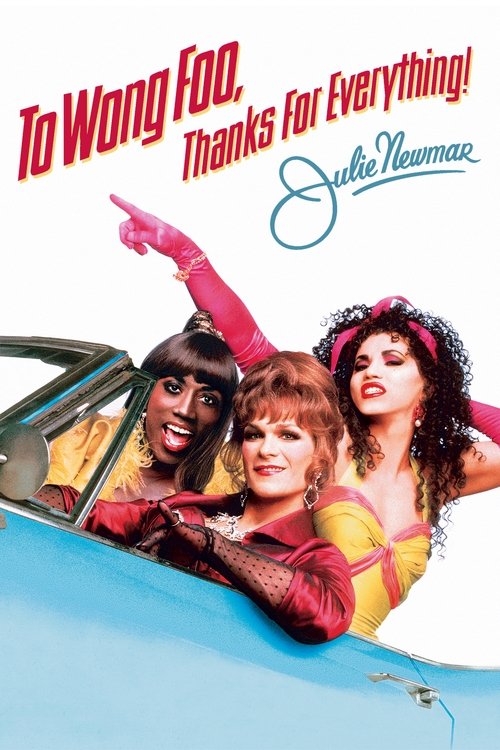
To Wong Foo, Thanks for Everything! Julie Newmar
1995 · Beeban Kidron
For a feel-good night in when you want glitter, one-liners, and a town full of people learning to be better — pure comfort, zero challenge. Reach for it when you need the movie equivalent of a hug in heels.
What it's about
Two polished Manhattan drag queens, Vida Boheme and Noxeema Jackson, win spots in a national pageant in Los Angeles and reluctantly adopt Chi-Chi Rodriguez, a hopeless young novice, for the drive west. When their Cadillac dies in a tiny Midwestern town, the three queens are stranded among locals who have never seen anything like them — and a weekend of makeovers, standoffs, and unlikely friendships begins.
The experience
A big-hearted, broadly funny fairy tale that trades edge for warmth — it's a comedy of kindness, where the laughs come with sequins and the small hurts underneath are allowed to show. Sweet-natured almost to a fault, and disarming because it means every word.
Performances
Patrick Swayze plays Vida not as a stunt but as a full person — grave, maternal, quietly wounded — and earned a Golden Globe nomination for it; Wesley Snipes and John Leguizamo, cast just as boldly against type, commit completely.
The craft
The whole gamble is the casting: three of the era's most conspicuously macho stars playing drag queens with total sincerity, steered by British director Beeban Kidron with more tenderness than satire. The costumes and pageant setpieces are the visual dessert, but the film's real craft is tonal — keeping a potentially mocking premise affectionate from first frame to last.
Why it matters
A landmark of mid-90s Hollywood bringing drag culture to the multiplex, and proof a major studio comedy could treat queens as heroines rather than punchlines — gentle by today's standards, groundbreaking for its moment.
A year after 'Priscilla, Queen of the Desert,' Hollywood produced its own drag road movie, and the gamble was the casting: Patrick Swayze, Wesley Snipes, and John Leguizamo — three of the era's most conspicuously macho stars — as queens stranded in a small Midwestern town when their Cadillac breaks down en route to a national pageant. British director Beeban Kidron, fresh from 'Oranges Are Not the Only Fruit,' steers the material with more warmth than edge; the politics are gentle, the town's conversion to fabulousness a fairy tale, and the queens remain chastely unattached in ways the film's own descendants would refuse. But the sincerity is disarming. Swayze in particular plays Vida Boheme not as stunt but as full characterization — grave, maternal, wounded — and earned a Golden Globe nomination for it. The title comes from a photograph of Julie Newmar, autographed with those words, that the queens carry like a relic. Look for RuPaul, presiding over the opening pageant in the years before drag conquered television.
A Deleuzian reading
A signed photograph of Julie Newmar rides with them the whole way.
The full Deleuzian reading of To Wong Foo, Thanks for Everything! Julie Newmar →
Reception
Critics in 1995 largely shrugged it off as Hollywood's sanitized answer to The Adventures of Priscilla, Queen of the Desert — though audiences disagreed, sending it to #1 at the US box office. Three decades on it's been warmly reclaimed as a queer camp classic, with Patrick Swayze's Vida Boheme now regarded as one of his most beloved performances.
How To Wong Foo, Thanks for Everything! Julie Newmar was received, from release to now →
Influences: the films it descends from and the films it influenced
- The Adventures of Priscilla, Queen of the Desert (1994) — Supplies the entire chassis To Wong Foo copies — three drag queens crossing a continent in a broken-down vehicle, stranded among rural squares, staging lip-synced diva numbers — transplanted from the Australian outback to small-town America.
- Some Like It Hot (1959) — Establishes the comic grammar of hyper-masculine male stars 'passing' in full femme, where both the laughs and the tenderness come from the gap between the actor's body and the gown — the device that makes Swayze and Snipes' casting register.
- Tootsie (1982) — Models the straight leading-man-in-a-dress as an engine for gender empathy and a community's re-education, the template for casting macho stars against type so their femininity teaches the people around them.
- La Cage aux Folles (1978) — Pioneers the mainstream-crossover gentle-queer comedy that plays drag as domestic warmth and maternal devotion rather than transgression, the tonal blueprint for Kidron's non-threatening politics.
- Paris Is Burning (1990) — Codified the drag 'house mother'/maternal-queen archetype and ballroom 'realness' that Vida Boheme's poised, protective authority over her younger charges directly draws on.
- The Rocky Horror Picture Show (1975) — Provides the 'conversion to fabulousness' template — glamorous gender-outlaws descend on repressed middle-American innocents and liberate them from their squareness through sheer theatrical excess.
- The Wizard of Oz (1939) — Lends the fairy-tale sincerity and stranded-travelers-transform-a-drab-town structure, plus the storybook Technicolor tonal register that Kidron adopts over any gritty realism.
- The Birdcage (1996) — The immediate A-list-star mainstream drag comedy whose greenlight To Wong Foo's box office helped enable, extending gentle-queer-politics-wins-over-conservatives to a broad audience.
- Kinky Boots (2005) — Clearest inheritor of 'small-town conversion to fabulousness' — a drag performer literally revitalizes a dying provincial factory town by dazzling its skeptical working-class locals.
- Hairspray (2007) — Anchors a feel-good musical on a beloved male star in matronly drag (Travolta as Edna Turnblad) whose warmth helps win over bigoted squares, extending the man-in-drag-as-maternal-heart device.
- Connie and Carla (2004) — Fugitives hide out performing within a drag community and build a found family, echoing the queens-teach-and-embrace-outsiders warmth and the drag-troupe-as-chosen-family structure.
- Everybody's Talking About Jamie (2021) — Reworks drag-as-small-town-liberation with the same fairy-tale sincerity and a mentoring maternal queen guiding a novice into fabulousness against a provincial backdrop.
- RuPaul's Drag Race (2009) — Fulfills the film's anticipation of drag's mainstreaming — RuPaul, who cameos in To Wong Foo, turned the lip-sync-diva drag aesthetic into mass-audience television.
- Mrs. Doubtfire (1993) — Contemporaneous hit built on the same man-in-matronly-drag-as-nurturing-mother device, where the disguise turns a male performer into the emotional caretaking center of a household/community.
- Stonewall (1995) — Same-year drag-centered queer feature bringing camp performance and gay-liberation narrative into mainstream feature form, sharing the mid-1990s move to humanize drag for general audiences.
- Wigstock: The Movie (1995) — Concurrent documentary capturing the same drag-performance milieu and lip-sync-diva star culture (including RuPaul) that To Wong Foo fictionalizes and glamorizes for Hollywood.
Similar films
- The Rocky Horror Picture Show (1975) — influence & lineage · often watched together
- The Adventures of Priscilla, Queen of the Desert (1994) — influence & lineage
- Some Like It Hot (1959) — influence & lineage
- Tootsie (1982) — influence & lineage
- Hairspray (1988) — shared sensibility
- Pink Flamingos (1972) — shared sensibility
- My Own Private Idaho (1991) — shared sensibility
- Saving Face (2004) — shared sensibility
All the films related to To Wong Foo, Thanks for Everything! Julie Newmar →