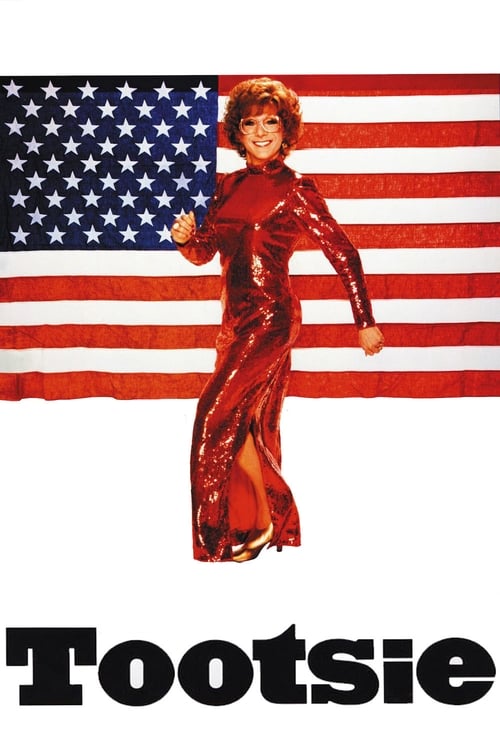
Tootsie
1982 · Sydney Pollack
For a night when you want classic, grown-up comedy — smart, generous, endlessly rewatchable. Pure comfort viewing that happens to have a brain.
What it's about
Michael Dorsey is a brilliant New York actor so difficult nobody will hire him — so he auditions for a daytime soap opera as a woman, Dorothy Michaels, and gets the part. Dorothy becomes a television sensation and an accidental feminist hero, while Michael tangles himself in an impossible knot: he's falling for his co-star, who only knows Dorothy.
The experience
A farce wound tight as a watch, where every lie breeds three complications — but it plays warm rather than frantic, and it keeps landing observations about how men treat women that still sting. You laugh hard and come away oddly moved.
Performances
Dustin Hoffman is astonishing: Dorothy isn't a wig joke but a fully realized person you end up caring about more than Michael. Jessica Lange brings a soft, sad glow that grounds the farce, and Bill Murray drops in deadpan gold as the roommate.
The craft
Sydney Pollack directs farce with a dramatist's discipline — the screenplay is a machine where every setup pays off, taught in writing classes for good reason — and Pollack himself is wonderful onscreen as Michael's exasperated agent. The New York soap-studio world is rendered with affectionate precision.
Why it matters
One of the biggest hits of 1982 and a ten-time Oscar nominee (Lange won), it's regularly ranked among the greatest American comedies ever made, and its gender-swap premise became a template countless films have chased since.
Snapshot
Tootsie is the rarest kind of American studio picture: a broad farce built on a mechanism as old as Plautus that nonetheless arrives with the moral seriousness of a chamber drama. Michael Dorsey (Dustin Hoffman) is a New York actor whose talent is exceeded only by his capacity to make himself unemployable; disguised as Dorothy Michaels, he lands a role on the daytime serial Southwest General and becomes, first, a working actor, then a national phenomenon, then a person trapped by his own success. Released by Columbia in December 1982, it became one of the year's largest hits — second only to E.T. the Extra-Terrestrial at the North American box office — and drew ten Academy Award nominations, including Picture, Director, Actor, Original Screenplay, and, unusually, both Supporting Actress slots (Jessica Lange and Teri Garr). It converted exactly one, Lange's.
What distinguishes Tootsie from the disguise comedies around and behind it is that it refuses to treat the disguise as the joke. The premise is comic; the consequences are not. Michael learns what it costs to be spoken over, patronized, and appraised, and the film's central irony — that he can only become a decent man by ceasing, temporarily, to be a man at all — is delivered without a wink. It was selected for the National Film Registry in 1998 and placed second on AFI's 100 Years…100 Laughs, behind Some Like It Hot, the film it most consciously answers.
Industry & production
Tootsie is an object lesson in how a personal project survives the studio system by accreting collaborators. The property originated well outside Pollack's orbit: an earlier script by Don McGuire (who shares story credit with Larry Gelbart) circulated for years, and the film came together through Hoffman's own advocacy alongside the playwright Murray Schisgal, a longtime friend, with producers Dick Richards and Charles Evans attached. Richards was at one point set to direct; Hal Ashby was also associated with the project before it reached Pollack, who came aboard as director and producer and effectively rebuilt it.
The screenplay's credited authorship — screenplay by Gelbart and Schisgal, story by McGuire and Gelbart — conceals a much larger roster. Uncredited contributions from Elaine May and Barry Levinson are well documented in accounts of the production, with May generally credited by participants for sharpening the Sandy Lester material and the Michael–Jeff roommate dynamic; Robert Garland also worked on drafts. The film's dialogue therefore has a compound texture: Gelbart's epigrammatic snap (he had come from M\A\S\H* and the Broadway tradition), Schisgal's neurotic New York cadences, May's cruel precision about how people wound each other while apologizing.
The shoot, largely on New York locations, was contentious in ways both men later discussed openly. Hoffman and Pollack fought over the film's tone, over how far the character research should extend, and over Hoffman's insistence that Pollack himself play Michael's agent, George Fields — a role Pollack resisted and then made his own. Their antagonism is legible on screen in the best possible way: the Russian Tea Room confrontation between actor and agent has a friction no amount of rehearsal manufactures. Bill Murray, cast as the playwright roommate Jeff, improvised extensively and took no billing in the main titles, a decision consistent with his career-long allergy to conventional star positioning. Geena Davis made her film debut as the soap ingénue April.
Technology
The film's technical program is unglamorous by 1982 standards. There is no optical trickery, no motion control, no lab-intensive effect. It was shot on 35mm in a spherical 1.85:1 format and released, like most major studio pictures of the moment, in Dolby Stereo. The interesting technology is not in the camera department at all — it is cosmetic, and it is the film's actual special effect.
Dorothy Michaels had to withstand what almost no comic drag has ever withstood: the sustained, unforgiving 35mm close-up, lit as a leading actress is lit. The production ran extensive makeup tests before shooting, and the operative decision was against caricature — no exaggerated prosthetics, no burlesque padding, a plausible middle-aged woman rather than a man in a costume. Hoffman has described the test footage as the film's turning point for him personally: seeing a woman he judged unattractive, and realizing he had been trained never to speak to such a woman at a party. That anecdote has been repeated in enough forums, including a widely circulated AFI interview, to count as part of the film's documented history, and it is inseparable from the makeup department's brief.
The second technological subject is diegetic. Southwest General is a videotape product — the multi-camera, flatly lit, fast-turnaround economy of American daytime drama, where a page count is a budget and a blown line is a live disaster. Tootsie dramatizes a specific labor technology, and its climax depends on the viewer understanding that live television cannot be stopped.
Technique
Cinematography
Owen Roizman, who had already given American cinema the abraded New York of The French Connection and Network, and who had shot Three Days of the Condor for Pollack, works here in two registers. The world outside the studio is grainy, ambient, cold-toned — winter Manhattan, restaurant interiors with practical sources, a documentary willingness to let faces fall into shadow. The world inside Southwest General is bright, frontal, shadowless: television light, which flatters nobody and reveals nothing. Cutting between them does most of the film's thematic work without comment.
Roizman also solves the film's hardest photographic problem, which is that Dorothy must be shot sympathetically. The camera does not conspire with the audience against her. It holds her in the same lens language it grants Julie and Sandy, and that neutrality is what allows the character to accrue dignity rather than pity. Roizman's work was nominated for an Academy Award.
Editing
Fredric and William Steinkamp — the father-and-son team who cut repeatedly for Pollack — organize the film around a compression that is easy to miss. The first act moves at farce speed: audition, refusal, transformation, hire, all before the film has settled. The middle expands into something closer to romantic drama, with long two-handers allowed to breathe. The rising-fame montage compresses months into seconds and functions as a trap closing.
The live-broadcast unmasking is the set piece, and it is edited as suspense rather than comedy: the cutting tightens between Dorothy, the control booth, the cast improvising around a monologue nobody scripted, and the monitors carrying it out to millions. The reveal — that Emily Kimberly is in fact Edward Kimberly, her own recluse brother — is played straight into the faces of people whose lives it detonates.
Mise-en-scène / staging
Pollack blocks Tootsie around thresholds and cramped shared spaces: apartment doors that must be reached before someone sees too much, dressing rooms, the studio floor with its cable runs and standing sets. Farce requires architecture, and the film supplies it — but the staging is never presentational. The camera is inside the room, at the height of the people in it, and the near-misses arise from ordinary spatial logic rather than from cartoon coincidence.
The production design (Peter Larkin) and costumes (Ruth Morley, who had dressed Annie Hall) commit to Dorothy's ordinariness. She is not chic. She dresses like a competent professional woman of a certain age in 1982, in blouses and blazers that read as taste rather than as joke, and the film's refusal to make her ridiculous is a design decision before it is a performance decision.
Sound
Dave Grusin's score is of its moment — electric piano, fretless bass, soft-jazz voicings — and it performs a specific function: it keeps insisting the film is a romance while the screenplay behaves like a satire. The recurring theme, "It Might Be You," with lyrics by Alan and Marilyn Bergman and vocal by Stephen Bishop, was nominated for Best Original Song and returns at the emotional junctures with a sincerity the dialogue never permits itself.
The sound design's quieter achievement is Hoffman's vocal work, discussed further below, and the acoustic distinction between the live-television floor — thin, close-miked, room-dead — and the reverberant public spaces of New York.
Performance
Tootsie is a film about acting made by people arguing about acting, and every performance is calibrated to that. Hoffman built Dorothy's voice as a Southern-inflected register pitched slightly above his own — not falsetto, which would have been a joke, but a placement that sounds like a real woman's speaking voice under strain. He plays Michael as a genuine monster of self-regard (the tomato-commercial story, in which he refused to sit because a vegetable cannot sit, is the film's thesis on Method vanity) and Dorothy as a person of stubborn courtesy, and refuses to let either read as the "real" one.
Jessica Lange's Julie is the performance that won the Oscar and deserves it: she plays a woman in a bad relationship with enough intelligence that her passivity registers as exhaustion rather than weakness, and her scenes with Dorothy carry a tenderness the film never cheapens. Teri Garr's Sandy is the film's open wound — an actress whose humiliation is real and whose famous "I never said I love you, I don't care about I love you" outburst is written and played without any comic escape hatch. Dabney Coleman's director Ron is sexism as unreflective habit rather than villainy. Charles Durning's Les proposes to Dorothy with a decency that makes the deception's cost unbearable. George Gaynes plays the soap's aging lech as pure appetite; Bill Murray's Jeff supplies the film's deadpan skepticism, much of it his own invention; and Pollack, as George Fields, gives the movie its comic ballast.
Narrative & dramatic mode
The structure is classical to the point of being pedagogical — Tootsie has become a standard text in screenwriting instruction precisely because its causality is so clean. A protagonist with a fatal flaw (Michael cannot subordinate himself to anyone) adopts a strategy that forces him into the exact behavior his flaw forbids. Every plot complication is a direct product of the deception, and every complication tightens rather than diffuses: Julie's affection, Les's proposal, John Van Horn's advances, Sandy's betrayal, and the contract extension that makes escape contractually impossible.
The dramatic mode, however, is not pure farce. Farce protects its characters; Tootsie does not. Sandy is genuinely damaged, Julie is genuinely deceived, Les is genuinely humiliated. Pollack keeps the register unstable — a scene will begin as a comic bit and end in real injury — and the resolution is deliberately modest. Michael does not get a triumphant reunion; he gets a conversation on a street, a borrowed dress to return, and the film's famous formulation that he was a better man with her as a woman than he ever was with a woman as a man.
Genre & cycle
Tootsie sits inside a lineage that runs from Twelfth Night and Charley's Aunt through Sylvia Scarlett and, most immediately, Some Like It Hot (1959), which supplies the structural template: disguise for economic necessity, romantic entanglement as consequence, and a closing line that declines to resolve. It also belongs to a compact early-1980s cycle of gender-disguise entertainments — Victor/Victoria arrived in March 1982, and the sitcom Bosom Buddies had run from 1980 — which suggests a culture working through something in the idiom it had available.
Simultaneously, the film is a late flowering of screwball: overlapping dialogue, professional adversaries as romantic partners, and the Hawksian conviction that competence is erotic. And it is a backstage picture, part of the industry's long habit of examining its own machinery, with daytime television standing in for the whole apparatus of American entertainment labor.
Authorship & method
Pollack is often filed as a studio craftsman rather than an auteur, which undersells a consistent body of concerns. From They Shoot Horses, Don't They? (1969) through Jeremiah Johnson, The Way We Were, Three Days of the Condor, and Absence of Malice, his subject is the professional who discovers that competence and integrity are not the same thing, and his method is the well-made star vehicle executed with unfashionable rigor. He trained under Sanford Meisner and taught acting before directing, and he came up through the live and episodic television of the late 1950s and early 1960s — a biography that explains both his fluency with actors and his evident ease inside the Southwest General control room.
His key collaborators here are largely his repertory: Roizman behind the camera, the Steinkamps in the cutting room, Grusin scoring, the Bergmans writing lyrics as they had for The Way We Were. The writing, as noted, is genuinely plural, and Pollack's contribution was less authorial voice than adjudication — deciding which of several competing tones the film would ultimately hold. The persistent, well-attested combat with Hoffman was the mechanism of that adjudication rather than an obstacle to it. Gelbart's much-quoted remark about never again working with an Oscar winner shorter than the statuette is usually cited as a joke about Hoffman; it is also an accurate account of the production's temperature.
Movement / national cinema
Tootsie is American commercial cinema at a hinge. It carries the New Hollywood inheritance — location shooting, actor-driven development, morally unresolved endings, an interest in institutional rot — into the emerging blockbuster era without adopting that era's spectacle economics. Roizman's grain, the New York specificity, and the willingness to let the protagonist be unlikeable are all 1970s traits; the high-concept premise, the star-marketed campaign, and the sheer scale of the grosses belong to what came next. It is also, unmistakably, a New York film: theater culture, the actor's economy of auditions and waiting tables, the daytime-serial industry that was then still substantially East Coast.
Era / period
The film arrives at a precise cultural coordinate. The deadline for ratification of the Equal Rights Amendment expired in June 1982, six months before release, and second-wave feminism was passing into a period of consolidation and backlash under a new political order. Dorothy Michaels becomes an accidental feminist icon by doing nothing more radical than declining to be called "honey" — which is both the film's sharpest joke and its most pointed observation about how low the bar sat. The workplace conduct the film depicts, from Ron's condescension to Van Horn's assaults, was then largely without a vocabulary; the legal architecture around workplace sexual harassment was still forming.
There is an inescapable structural irony, noted by critics from the beginning, that a film about women's experience routes it through a man and hands the insight to him. Tootsie is aware of this — Michael's epiphany is presented as belated and slightly absurd — but awareness is not the same as escape.
Themes
The governing theme is that identity is a performance whose costs are unequally distributed. Michael treats acting as a moral vocation and other people as material; becoming Dorothy inverts the arrangement, making him the material. The film's second theme is the ethics of deception in intimacy — every relationship Michael values is founded on a lie he cannot confess without destroying it. A third is professional survival: the film is unsentimental about the fact that Michael's transformation begins as a job hunt, and that art and rent are not separable.
Underneath runs a sustained argument about masculinity as a set of permissions. What Michael gains as Dorothy is not femininity but the experience of its absence — of not being deferred to, not being believed, not being safe. The film's last movement asks whether that knowledge survives the removal of the wig. Its honest answer is: partially, and not yet.
Reception, canon & influence
Contemporary reviews were strong and the commercial response enormous; the film's standing as a comedy of the first rank was established almost immediately and has not seriously eroded. It entered the National Film Registry in 1998, sits high on AFI's comedy list, and is routinely cited among the best American screenplays, including by the Writers Guild. The Criterion Collection's edition, with substantial archival material on the fraught production, consolidated its status as a serious object of study rather than a period hit.
Looking backward, its debts are explicit: Some Like It Hot above all, the Shakespearean disguise comedies behind that, Hawksian screwball for its rhythm, and the American theatrical culture of the Actors Studio — which the film both belongs to and satirizes, using an actor formed by that culture to mock its self-importance.
Looking forward, its influence splits along two lines. The commercial line runs through Mrs. Doubtfire (1993) and a long tail of disguise comedies that borrowed the premise while discarding the ethical seriousness — a lineage in which Tootsie is the ancestor most of them cannot match. The critical line is more complicated. Since the 2010s, and given focused attention in the documentary Disclosure (2020), scholars and trans critics have examined the "man in a dress" comedy as a genre whose pleasures depend on the audience knowing the truth beneath the presentation, with real consequences for how trans people are perceived. Tootsie has no trans character and no such intent, but it is a foundational text in that formal tradition, and the argument that its structure normalizes a suspicious gaze is a serious one that the film's defenders must answer rather than dismiss.
The most recent chapter is theatrical: a stage-musical adaptation, with a score by David Yazbek and a book by Robert Horn, reached Broadway in 2019 and won Tony Awards, relocating the show-within-the-show from daytime television to a Broadway musical and rewriting portions of the material for a changed audience. That a 1982 farce required — and could withstand — that renegotiation is itself the measure of its durability.
A Deleuzian reading
Before the film existed there was a strip of test footage.
The full Deleuzian reading of Tootsie →
Reception
A smash in 1982 — second only to E.T. at the box office and a ten-nomination Oscar heavyweight — and it never really fell out of favour; the shift is that modern viewers now debate its gender politics as much as they quote its jokes.
How Tootsie was received, from release to now →
How to watch Tootsie: what to notice on a first viewing
- Notice the camera photographs Dorothy the way it photographs Julie. Owen Roizman gives her the same lenses, the same light, the same respect in close-up. There is no leering angle and no shot that invites you to laugh at her appearance. Her dignity is a photographic decision before it is a written one. The camera refuses to team up with the audience against her.
- Compare the cold gray New York streets with the television stage. Outside the studio Roizman shoots grainy winter Manhattan and lets faces fall into shadow. Inside Southwest General the light is bright, frontal and shadowless, the kind that flatters nobody. Cutting between those two looks does the film's argument without a line of dialogue. One world hides things and the other cannot.
- Watch how people in the room change when Dorothy declines a nickname. She will not be called honey. Nothing dramatic happens. Dabney Coleman's Ron plays condescension as ordinary habit, and the moment someone stops absorbing it, the whole room's arrangement becomes visible. The small act discloses a situation that was already there. What it exposes is everyone else, not her.
- Listen to Hoffman's voice as Dorothy. It is not a falsetto. He pitches slightly above his own register with a Southern inflection, a placement that sounds like a real speaking voice under strain. Ruth Morley dresses her in blouses and blazers that read as taste, not costume. Once the body and the voice are not funny, everything done to this person becomes legible as what it is.
- Watch the doors, corridors and dressing rooms he has to get through. Pollack blocks the film around thresholds and cramped shared spaces: apartment doors reached just in time, the studio floor with its cable runs. The camera sits inside the room at the height of the people in it. The near-misses come from ordinary spatial logic rather than cartoon coincidence, which keeps the farce inside a real building.
The whole guide to watching Tootsie, with the keys for a rewatch →
Influences: the films it descends from and the films it influenced
- Some Like It Hot (1959) — Wilder and Diamond's structural engine — the disguise must be sustained through a romance it makes impossible, so the third act is built as a countdown of forced proximities rather than a gag chain — is the exact escalation ladder Tootsie rebuilds, with the live-broadcast unmasking standing in for Osgood's curtain line.
- Sylvia Scarlett (1935) — Cukor establishes the sympathetic close-up on the cross-dressed player: the camera holds on Hepburn's face at the moment the disguise costs her something, refusing the leering angle, and Roizman's Dorothy singles adopt that grammar wholesale.
- His Girl Friday (1940) — Hawks's overlapping professional patter — interruption used as rhythm rather than error, scenes cut on the tail of a line instead of its end — is the model for Tootsie's accelerating first act through the agent's office and the audition circuit.
- Charley's Aunt (1941) — The classical farce mechanism of the impostor obliged to be two people in one building — entrances, doorways and near-collisions doing the plotting — is the machinery Tootsie runs in the Southwest General corridors and Michael's apartment.
- Midnight Cowboy (1969) — Hoffman's Ratso is built outside-in from a physical premise (limp, pitched voice, dentition, sweat), and Dorothy is constructed by the identical technique — the film reuses the method and then puts it on trial.
- They Shoot Horses, Don't They? (1969) — Fredric Steinkamp's derby sequences cut on accelerating shot length keyed to the performers' physical deterioration; the same editorial device drives Tootsie's audition-and-rejection montage.
- Three Days of the Condor (1975) — The Pollack–Roizman–Steinkamp–Grusin unit's suspense grammar — cramped interiors, doorways framed as threat thresholds, sparse piano held under dialogue — is transposed intact onto Tootsie's climax, which is cut as a thriller rather than a comedy.
- Network (1976) — Roizman's two-register lighting plan — hard, flat, high-key video inside the studio against soft naturalism in the dramatic scenes — is the precise scheme separating Southwest General from Michael's loft.
- Kramer vs. Kramer (1979) — Hoffman's practice of altering blocking and text inside the take as a provocation to the director (the unscripted glass thrown at the wall) established the working method Pollack had to adjudicate scene by scene on Tootsie.
- Absence of Malice (1981) — Grusin's small-combo scoring — solo piano and electric keys used sparingly under professional-ethics dialogue rather than cueing the emotion — is the scoring discipline carried straight into Tootsie, with the Bergmans supplying the single lyric placement.
- Adam's Rib (1949) — Gender disguise in a professional context systematically demonstrates the double standard Adam's Rib names; Dustin Hoffman's method-actor inhabiting a theatrical role literalizes the naturalist-vs-theatrical performance dialectic at the core of both films.
- Broadcast News (1987) — Extends Tootsie's control-room staging into a full-length professional-ethics comedy: comedy generated by hand-off cutting between booth, floor and on-air feed, with competence and integrity separated exactly as Pollack separates them.
- Soapdish (1991) — Lifts the Southwest General apparatus outright — live-to-tape blocking, actors rewriting each other's scenes on air, the director shouting from the booth — while dropping the ethical stake that motivated it.
- The Crying Game (1992) — Formally inverts the genre's contract by withholding from the audience the knowledge a disguise comedy always grants it, proving by negation that Tootsie's suspense engine runs entirely on who knows what and when.
- Mrs. Doubtfire (1993) — The commercial heir: same second-chance-through-disguise structure and full-prosthetic build, but the flaw-driven causality is replaced by a custody plot that exonerates the deceiver rather than costing him anything.
- The Birdcage (1996) — Treats sustained drag as a character-acting problem rehearsed in-scene — gait, hand behavior, vocal placement worked on in front of us — and keeps the farce's threshold-and-doorway blocking as the engine of the dinner sequence.
- Tropic Thunder (2008) — The purest inheritor of Tootsie's method-satire: an actor's total physical transformation is played simultaneously as genuine craft and as pathology, with the comedy generated by the gap between his self-seriousness and the ordinary people obliged to work with him.
- Sorry to Bother You (2018) — Extends vocal-performance design as the whole mechanism of passing — the dubbed 'white voice' doing structurally what Hoffman's pitched register does, and, like Tootsie, keeping the technique audible rather than hiding it.
- To Wong Foo, Thanks for Everything! Julie Newmar (1995) — Models the straight leading-man-in-a-dress as an engine for gender empathy and a community's re-education, the template for casting macho stars against type so their femininity teaches the people around them.
- My Mom Is a Character 3 (2019) — Model of performance-first female impersonation played straight for character rather than caricature, where the comedy comes from the actor fully inhabiting the woman across long dialogue scenes.
- Victor/Victoria (1982) — Released the same year, it makes the disguise a sustained vocal-design problem — Andrews holding a constructed 'male' register inside musical numbers — the same technical burden Hoffman carries with Dorothy's pitched Southern voice.
- Yentl (1983) — Streisand solves the disguised character's silence with the interior-monologue song, an alternative answer to the dramaturgical problem Tootsie solves by letting Dorothy improvise on air what Michael cannot say as himself.
- Nine to Five (1980) — Turns a mainstream comedy into a delivery system for workplace-sexism critique, using farce and a star turn to make an argument about how women are treated on the job land with a mass audience.
Similar films
- Some Like It Hot (1959) — influence & lineage · same viewing thread
- Midnight Cowboy (1969) — influence & lineage
- Network (1976) — influence & lineage
- Kramer vs. Kramer (1979) — influence & lineage
- What's Up, Doc? (1972) — same viewing thread
- Bringing Up Baby (1938) — same viewing thread
- The Graduate (1967) — shared sensibility
- Charlie Wilson's War (2007) — shared sensibility
All the films related to Tootsie →
Watch it with: curated runs of related films
- Fast Talk & Fur Coats — A run of quick-witted charmers who disguise, con, and sweet-talk their way across class lines — watch them near each other and the century between Lubitsch and Sean Baker collapses into one long, glittering grift.