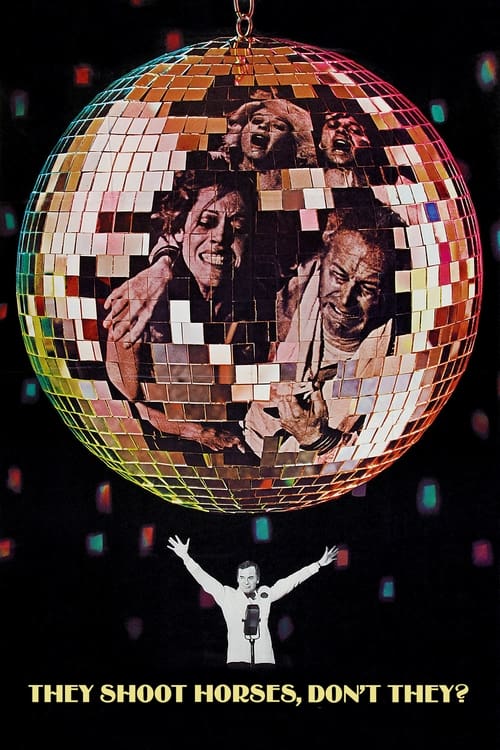
They Shoot Horses, Don't They?
1969 · Sydney Pollack
When you want to be wrecked by a movie and respect it for doing so. This is the opposite of a comfort watch — reach for it when you're ready for one of American cinema's great gut-punches.
What it's about
At the bottom of the Great Depression, desperate strangers sign up for a marathon dance contest in a seaside ballroom: last couple standing wins $1,500. Among them are a bitter failed actress, an aging sailor, and a pregnant young woman, all shuffling for days on end while a silver-tongued emcee turns their exhaustion into a paying show.
The experience
Grueling in the way it intends to be — you feel the hours in your own legs — and steadily devastating as the contest grinds on. It's a film that starts bleak and earns every step darker.
Performances
Jane Fonda is ferocious as the hard-shelled Gloria, a career-redefining turn, and Gig Young won an Academy Award as the emcee whose showbiz patter curdles into something chilling.
The craft
Sydney Pollack confines nearly the whole film to one ballroom and makes the space itself an instrument of pressure — the camera circling the floor, the periodic 'derby' races shot like ordeals. The period detail and dance-hall pageantry make the cruelty underneath land even harder.
Why it matters
One of the defining downbeat American films of 1969, it earned nine Academy Award nominations and stands as a landmark of the New Hollywood era's willingness to indict the American dream.
Snapshot
They Shoot Horses, Don't They? is a Depression-era chamber tragedy disguised as a spectacle film: nearly its entire running time unfolds inside a single seaside ballroom where desperate contestants shuffle through a marathon dance contest for a cash prize most of them will never see. Adapted from Horace McCoy's lean 1935 novel, Sydney Pollack's film turns the marathon into a pitiless emblem of American capitalism and human endurance — bodies pushed past collapse for the entertainment of paying onlookers and the profit of a smiling master of ceremonies. Released in December 1969, at the height of the New Hollywood moment, it stands among that year's defining downbeat, anti-establishment American pictures. It earned nine Academy Award nominations — winning one, Best Supporting Actor for Gig Young — and is frequently cited for the anomaly of a Best Director nomination without a corresponding Best Picture nomination. Anchored by Jane Fonda's hard, despairing performance, it remains Pollack's bleakest film and one of the most uncompromising studio releases of its era.
Industry & production
The film was produced by Robert Chartoff and Irwin Winkler — the partnership that would later shepherd Rocky and Raging Bull — for ABC Pictures, the short-lived theatrical arm of the American Broadcasting Company, in association with Palomar Pictures. It belongs to a transitional industrial moment: the old studio system had collapsed, the Production Code had given way to the new MPAA ratings system (1968), and major companies were gambling on younger directors and darker, more adult material after the unexpected successes of Bonnie and Clyde (1967) and The Graduate (1967).
Horace McCoy's novel had been admired for decades — notably by French critics and existentialist writers, who prized American hardboiled fiction — but was long considered unfilmable owing to its bleakness and its fractured, flash-forward structure. Screenwriter James Poe had reportedly nurtured the adaptation for years and was at one stage attached to direct; the project ultimately passed to Pollack, then in his thirties and several features into a fast-rising career. The screenplay credit went to Poe and Robert E. Thompson. Crucially, the filmmakers preserved and amplified McCoy's device of intercutting the marathon with glimpses of a later reckoning, a structural choice that shaped the entire production.
Pollack confined the shoot largely to a recreated 1930s oceanfront dance hall — the production designed and dressed an enclosed ballroom interior to evoke the piers of Depression-era Southern California — and committed to shooting the marathon more or less in sequence and at punishing length, so that the actors' visible exhaustion would register on camera. This was a relatively expensive, logistically demanding single-location production built around sustained ensemble performance rather than spectacle in the conventional sense.
Technology
Technically the film is a product of late-1960s color filmmaking working in a deliberately unglamorous register. It was shot on 35mm color stock with anamorphic widescreen framing, exploiting the wide frame not for landscape but for the lateral spread of bodies across the dance floor and the social geometry of contestants, band, emcee, and spectators. The period setting required no exotic technology; the achievement lies rather in the controlled, often dim and sweat-toned lighting of a single large interior, and in camera mobility — handheld and moving-camera work threading among the dancers — that anticipates the more kinetic, immersive shooting styles that would spread through 1970s American cinema. Sound is almost entirely diegetic: a live-style marathon band and announcer, with no conventional non-diegetic score layered over the action.
Technique
Cinematography
Philip H. Lathrop's camerawork is central to the film's effect. Rather than observe the marathon from a fixed proscenium distance, the camera enters the floor, circling and weaving among the couples so that the viewer shares their disorientation and fatigue. The widescreen compositions crowd the frame with exhausted, propped-up bodies; the lighting is harsh and enervating, draining glamour from a setting (a dance hall) that conventionally connotes romance and escape. The recurring "derby" sequences — sprint heats in which couples race around the track to eliminate the slowest — are shot with whip-fast, near-frenzied energy, a deliberate contrast to the dead-eyed trudging that fills the rest of the contest. The result is a film that looks physically tiring to watch, by design.
Editing
The editing, by Fredric Steinkamp (Oscar-nominated for the film), is its most distinctive formal feature. The marathon is repeatedly interrupted by brief, fragmentary flash-forwards — disjointed images and sounds of Robert, the young drifter, in legal custody, with snatches of a judge's voice. These shards are withheld of context until the finale, generating a slow accumulation of dread: the audience knows something terrible is coming before it understands what. The cutting also governs rhythm within the marathon itself, accelerating brutally during the derbies and slowing to a numb crawl during the endless hours of shuffling, so that editing rhythm becomes the film's chief means of dramatizing time and endurance.
Mise-en-scène / staging
The single-location confinement is the film's defining staging decision. By refusing to leave the ballroom — the outside world appears only obliquely — Pollack makes the hall a totalizing environment, at once arena, prison, and theater. The space is organized around hierarchies of power and visibility: the contestants on the floor, the band and the emcee on the bandstand commanding attention, the paying spectators in the seats, and the sponsors and managers working the margins. Banners, prize announcements, and the ever-present clock and elimination apparatus turn the décor itself into an instrument of pressure. The staging consistently frames human beings as merchandise on display.
Sound
The soundscape is built from period dance-band standards performed within the fiction, punctuated by the emcee's relentless patter and his signature cries (the "Yowza, yowza, yowza" hype of the floor). The absence of an orchestral score laid over the action keeps the experience grounded and diegetic; the cheerful, brassy music of the 1930s plays in bitter ironic counterpoint to the suffering on the floor. Sound also carries the flash-forward structure — the intrusion of the judicial voice into the marathon's noise.
Performance
The performances are the film's bedrock. Jane Fonda's Gloria Beatty — embittered, fatalistic, contemptuous of false hope — marked a decisive turn in her career away from ingénue roles toward harder, more serious work; her line readings carry a corrosive despair that organizes the whole film. Gig Young, cast against his suave light-comedy image as the emcee Rocky, gives a performance of oily, exhausted showmanship that curdles into something genuinely sinister, and it won him the Academy Award for Best Supporting Actor. Susannah York, as the fragile Hollywood hopeful Alice, charts a harrowing psychological disintegration. The ensemble — including Michael Sarrazin as the passive drifter Robert, Red Buttons as the aging sailor, Bonnie Bedelia and Bruce Dern as a pregnant young wife and her husband — sustains a collective sense of bodies and spirits wearing down in real time.
Narrative & dramatic mode
The dramatic mode is tragedy rendered through endurance and entrapment. The marathon supplies a built-in dramatic engine — a contest with rules, eliminations, and a clock — but the film systematically drains it of the suspense conventional to competition narratives. We do not really watch to see who wins; we watch the slow revelation of what the contest does to people. The flash-forward framing converts the story into a structure of foreboding rather than surprise: the ending is, in a sense, encoded from the start, and the film moves toward it with the inevitability of a mercy killing. The title — drawn from the image of shooting a horse with a broken leg to end its suffering — supplies the governing metaphor and the logic of the devastating conclusion, in which an act of killing is framed as an act of mercy.
Genre & cycle
The film sits at the intersection of several lines. It is a Depression "period" picture, part of a late-1960s and early-1970s American interest in revisiting the 1930s (a cycle that also produced Bonnie and Clyde and, soon after, Paper Moon and The Sting). It is also an inheritor of the literary tradition of American naturalism and the hardboiled, existentially tinged fiction of writers like McCoy, James M. Cain, and their peers. And as a downbeat, institution-as-metaphor ensemble drama, it belongs to the New Hollywood wave of films skeptical of the American Dream. It largely resists the musical's generic promise — it is a dance picture in which dance offers no transcendence — using the iconography of entertainment to indict entertainment itself.
Authorship & method
Sydney Pollack's method here exemplifies his career-long strengths: a director's actor, attentive to performance and to the moral texture of social institutions, working within studio forms while pushing their emotional limits. His decision to shoot at length and in sequence, prioritizing physical authenticity of exhaustion, is the signature directorial gesture. His key collaborators shaped the film decisively: screenwriters James Poe and Robert E. Thompson, who solved the problem of McCoy's elliptical novel; cinematographer Philip H. Lathrop, whose mobile, unglamorous camera defines the look; editor Fredric Steinkamp, whose flash-forward construction defines the dread; and music director Johnny Green, who supervised the period songs that score the marathon from within (Green and Albert Woodbury received an Oscar nomination for the film's scoring). The production design and Donfeld's costumes — both Oscar-nominated — complete the immersive recreation. Pollack would go on to a long, successful career (Jeremiah Johnson, The Way We Were, Tootsie, Out of Africa), but They Shoot Horses remains his darkest and arguably most formally daring work.
Movement / national cinema
The film is an American work of the New Hollywood — the renaissance of director-driven, thematically adventurous studio filmmaking that ran roughly from the late 1960s into the 1970s. Yet its sensibility also reflects a transatlantic literary lineage: McCoy's novel had been embraced in France, where American hardboiled fiction was read as a kind of native existentialism, and the film's fatalism and its focus on the absurd persistence of suffering carry that existential coloring into mainstream American cinema. It is, in that sense, an American film inflected by a European reading of American material.
Era / period
They Shoot Horses, Don't They? is doubly periodized. It depicts the early 1930s Great Depression — its dance marathons were real Depression-era phenomena, endurance contests in which the destitute competed for prize money and, often, simply for food and shelter — and it speaks to its own moment of 1969, a year of profound disillusionment in American life. The marathon's spectacle of human degradation for profit reads as a parable for both eras: the economic desperation of the 1930s and the late-1960s collapse of faith in American institutions and the American Dream. Released the same season as Midnight Cowboy, Easy Rider, and The Wild Bunch, it shares their refusal of consolation.
Themes
The film's central themes are the commodification of human suffering, the cruelty of spectacle, and the exhaustion of hope. The marathon literalizes a capitalist logic in which people are induced to destroy themselves for the entertainment of others and the enrichment of a few — the emcee's relentless cheer masking an economy of exploitation. Bound up with this is a stark existential fatalism: Gloria's conviction that life is a rigged contest with no prize, and that release from suffering may be the only mercy available. The film also probes the corrosion of dreams — the failed actress, the would-be star, the couple banking on a windfall — and the way Hollywood-style fantasies of success function as instruments of control. The closing equation of euthanasia with compassion gives these themes their devastating final form.
Reception, canon & influence
Critically, the film was received as a serious and unusually unsparing work and was a major awards contender, drawing nine Academy Award nominations: Best Director (Pollack), Actress (Fonda), Supporting Actor (Gig Young, the sole winner), Supporting Actress (York), Adapted Screenplay, Art Direction, Costume Design, Film Editing, and Score. The absence of a Best Picture nomination despite the directing nod is a frequently noted oddity of that year's Oscars and is sometimes cited in discussions of Academy anomalies. The film is widely regarded as a turning point for Jane Fonda, repositioning her as a dramatic actress of substance, and as the breakthrough that established Pollack's standing as a major director.
Its influences run backward to Horace McCoy's 1935 novel and the broader currents of American literary naturalism and hardboiled, existentially inflected fiction, as well as to the documented historical reality of Depression-era dance marathons. Looking forward, the film's vision of human endurance contests as profitable spectacle has proven strikingly prescient: it is regularly invoked as an antecedent to later critiques of competitive spectacle and, by extension, to the logic of elimination-based reality television, where ordinary people are placed under sustained strain for an audience's consumption. As a formal model — single-location confinement, sustained ensemble exhaustion, dread built through flash-forward montage — it remains a touchstone for filmmakers seeking to dramatize entrapment. Its reputation as one of the bleakest and most morally serious of New Hollywood's studio productions has held steady; detailed scholarly documentation of certain production specifics is comparatively thin, and where the historical record is uncertain those claims should be treated with appropriate caution, but its standing in the canon of late-1960s American cinema is secure.
A Deleuzian reading
Start with the floor.
The full Deleuzian reading of They Shoot Horses, Don't They? →
Reception
A grueling downer that studios barely knew how to sell in 1969, it earned nine Oscar nominations and has since settled in as one of New Hollywood's defining acts of bleakness — the film that proved Jane Fonda was a serious actress.
How They Shoot Horses, Don't They? was received, from release to now →
Influences: the films it descends from and the films it influenced
- I Am a Fugitive from a Chain Gang (1932) — Establishes the Warner social-problem template of unsparing institutional naturalism ending in unredeemed despair rather than uplift — the studio-realist bleakness Pollack inherits and refuses to soften.
- Sullivan's Travels (1941) — Anatomizes the way Depression-era misery is converted into mass entertainment, the precise commodification-of-suffering logic the dance marathon dramatizes.
- Nightmare Alley (1947) — Carnival geek-show framing of degraded human bodies as paid spectacle, plus a hardboiled descent into existential fatalism with no exit — the naturalist downward arc McCoy and Pollack share.
- The Set-Up (1949) — Near-real-time confinement inside a single arena where a paying crowd consumes one man's escalating physical punishment, scored only by diegetic noise — the staging grammar of bodies-on-display-for-an-audience.
- Ace in the Hole (1951) — The carnival-of-onlookers feeding on a trapped human's suffering, with ironic counterpoint between festive crowd and private agony — direct precedent for spectacle built from another's entrapment.
- 12 Angry Men (1957) — Single-location confinement in which mounting heat, sweat and bodily exhaustion become the real dramatic engine, time and fatigue rather than plot driving the ensemble.
- The Pawnbroker (1965) — Pioneers the subliminal flash-cut intrusion — momentary images puncturing the present — the editing grammar Fredric Steinkamp redeploys as the film's flash-forward dread.
- Cabaret (1972) — Weaponizes diegetic musical numbers as ironic counterpoint to encroaching catastrophe — the anti-musical strategy of using performed entertainment to comment on social rot from within.
- The Day of the Locust (1975) — Depression-era period spectacle that climaxes in a crowd transformed into a consuming mob, extending the commodification of suffering into apocalyptic mass-audience frenzy.
- Rollerball (1975) — Stages an endurance blood-sport as profitable mass spectacle that systematically grinds bodies for a watching public — the marathon's logic projected onto institutionalized entertainment.
- All That Jazz (1979) — Builds dread of death through flash-forward/fantasy intercutting around a performer's physical collapse, the same montage-of-foreboding structure applied to exhaustion-unto-death.
- The Running Man (1987) — Literalizes the film's prophecy: an elimination contest staged as televised entertainment where ordinary contestants are placed under lethal strain for an audience's consumption.
- Dancer in the Dark (2000) — An anti-musical built on diegetic numbers and handheld camera around a doomed female lead, repositioning a non-actor (Björk) as tragic protagonist — the structural and performative echo of Fonda's against-type turn.
- Series 7: The Contenders (2001) — The explicit reality-TV realization of the seed's vision — an elimination spectacle of ordinary people under sustained duress, presented as a competition broadcast for ratings.
- The Hunger Games (2012) — Reanimates the core conceit — ordinary people placed in a televised endurance contest, their suffering packaged as profitable spectacle for a mass audience — the dance marathon scaled to a national broadcast.
- Tootsie (1982) — Fredric Steinkamp's derby sequences cut on accelerating shot length keyed to the performers' physical deterioration; the same editorial device drives Tootsie's audition-and-rejection montage.
- Petulia (1968) — Fractured flash-forward/flash-back temporal montage in a New Hollywood register (shot by Nicolas Roeg), the same nonlinear scrambling of chronology used to foreshadow catastrophe.
- Midnight Cowboy (1969) — Contemporaneous New Hollywood naturalism of the dispossessed, marrying mobile handheld grit to subjective flash-inserts and an uncompromisingly downbeat fatalism.
- Absence of Malice (1981) — Pollack's early demonstration of Actors Studio direction in which physical behavior carries interior states rather than dialogue, the performance method he applies to Newman's contained fury.
- The Lusty Men (1952) — Adapted from Horace McCoy, it shares the writer's Depression hard-luck sensibility, staging an endurance spectacle (the dance marathon) as a commercialized arena that grinds down its desperate contestants.
- The Swimmer (1968) — Pollack, who shot the uncredited Shirley Abbott sequence here, builds his next film on the same device: a durational physical ritual performed before spectators, with zooms tightening on a body being destroyed as public entertainment.
Similar films
- All That Jazz (1979) — influence & lineage
- Midnight Cowboy (1969) — influence & lineage
- 12 Angry Men (1957) — influence & lineage
- The Hustler (1961) — shared sensibility
- The Grapes of Wrath (1940) — shared sensibility
- Faces (1968) — shared sensibility
- The Deer Hunter (1978) — shared sensibility
- The Panic in Needle Park (1971) — shared sensibility