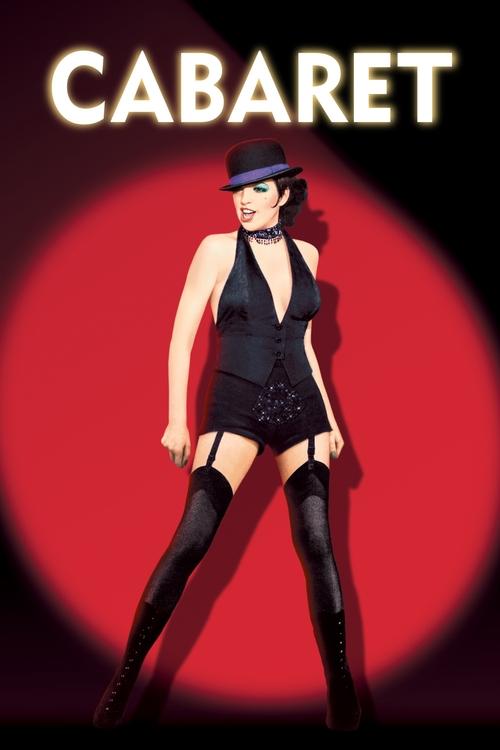
Cabaret
1972 · Bob Fosse
When you want dazzle with teeth — a film that entertains you thrillingly and then makes you think hard about what entertainment can be complicit in. Rewatchable, but it lands like a warning.
What it's about
Berlin, 1931. Inside the seedy Kit Kat Klub, American singer Sally Bowles chases stardom and pleasure under the painted gaze of a leering Master of Ceremonies, while a reserved British academic gets pulled into her orbit. Outside the club doors, the Weimar Republic is dying and the Nazis are gathering strength — and the party inside plays on, louder and more desperate.
The experience
Intoxicating and chilling at once: the musical numbers are electric, but the film keeps cutting from the stage's decadent fun to what's happening in the streets, so the glitter grows steadily more sinister. It's a musical that leaves you uneasy rather than uplifted — deliberately.
Performances
Liza Minnelli's Sally Bowles is one of the defining musical performances on film — needy, radiant, and heartbreaking — and Joel Grey's rouged, ageless Emcee is pure unsettling genius; both won Oscars.
The craft
Bob Fosse confines nearly every song to the cabaret stage, so the numbers comment on the story instead of interrupting it — a structural idea that remade the movie musical. His angular choreography, the smoky amber-and-neon cinematography, and razor-sharp editing between stage and world give the film a cold modern gleam; the Kander and Ebb songs are all killers.
Why it matters
It won eight Academy Awards and effectively ended the innocent Hollywood musical, proving the form could carry political darkness; nearly every serious screen musical since works in its shadow.
Snapshot
Cabaret is the film that severed the American movie musical from its own conventions and reassembled it as something colder, sharper, and more modern. Adapted from the 1966 Broadway musical by Kander and Ebb — itself descended from John Van Druten's play I Am a Camera and, at root, Christopher Isherwood's Berlin Stories — Bob Fosse's second feature confines nearly all of its singing and dancing to the stage of a single seedy nightclub, the Kit Kat Klub, in Berlin as the Weimar Republic curdles into Nazism. Sally Bowles (Liza Minnelli), an American cabaret performer of large appetite and small talent, and the Master of Ceremonies (Joel Grey), a rouged, ageless imp, preside over a decadence that the film treats as both intoxicating and doomed. The picture won eight Academy Awards — a total famously exceeded, at that year's ceremony, by The Godfather's Best Picture even as Fosse took Best Director — and it remains a rare case of a stage-to-screen musical that the cinema improved by fundamentally rethinking. Its reputation rests on a single formal decision: the numbers are diegetic, performed for an audience within the story, so that spectacle and reality are held apart and then made to comment on one another.
Industry & production
Cabaret was produced by Cy Feuer for Allied Artists and ABC Pictures, distributed by Allied Artists in the United States, and shot largely in and around Munich, at the Bavaria Film studios and on West German locations standing in for 1931 Berlin. The early 1970s were a precarious moment for the Hollywood musical: expensive roadshow productions such as Star! and Doctor Dolittle had failed badly in the preceding years, and the genre's inflated production model looked moribund. Fosse came to the film under a cloud — his 1969 debut Sweet Charity, also adapted from his own stage work, had been a commercial disappointment — and by several accounts he was not the studio's first choice and worked under close scrutiny. The relatively contained budget, the European shoot, and the decision to strip the show down all reflect an industry hedging its bets on a genre it no longer trusted. That the film became both a critical triumph and a substantial commercial success helped demonstrate that the musical could survive by becoming leaner and more adult rather than grander.
Crucially, the production discarded much of the stage score. The Broadway show had used the conventional book-musical device of characters bursting into song; Fosse and screenwriter Jay Presson Allen cut the "integrated" numbers sung by the romantic leads and kept, with few exceptions, only songs that could plausibly be staged inside the Kit Kat Klub. New songs, including "Mein Herr" and "Money," were written by Kander and Ebb for the film to replace excised material. This was as much a dramaturgical decision as an industrial one, but it also let the production concentrate its resources on a single, richly detailed performance space.
Technology
Cabaret was shot in 35mm and released in a standard 1.85:1 ratio rather than the wide roadshow formats associated with the genre's prestige productions — itself a signal of its intimate, anti-spectacular ambitions. The film relies on no novel photographic technology; its innovations are in method rather than apparatus. Its most consequential technical dimension is the marriage of location and studio shooting with an editing scheme conceived at the script and shooting stage, cutting on musical accents and using the multiple takes and coverage that film — unlike the stage — permits. The film's period surfaces were built through production design and costume rather than optical effects. In short, Cabaret is a reminder that a landmark can be made almost entirely from long-available tools used with unusual rigor.
Technique
Cinematography
Geoffrey Unsworth, the British cinematographer who would shortly shoot Murder on the Orient Express and Superman and had already lit 2001: A Space Odyssey, photographed Cabaret, and his work is central to its meaning. The club interiors are smoky, amber, underlit — faces catching hard key light against pooling shadow, a look drawn from the visual memory of Weimar-era imagery and the grain of period photography. Unsworth's diffusion and his handling of practical light sources (footlights, table lamps, the stage's own glare) give the Kit Kat Klub a tactile, sweat-and-greasepaint physicality. The daylight exteriors are cooler and flatter, deliberately drained of the club's glamour, so that the cut from stage to street registers as a drop in temperature. The camera inside the club is mobile and often low or oblique, framing the performers through the audience, the orchestra, the haze — always insisting that we watch the show as spectators seated among Berliners.
Editing
The editing, by David Bretherton, won the Academy Award and is arguably the film's signature achievement. Cabaret is built on the principle of intercutting: a cabaret number is crosscut with the "real" action outside the club, so that the Emcee's leering song and the world's brutality rhyme, mock, and foreshadow one another. The most cited instance is the sequence in which the beating of a man is intercut with the stage, and the Emcee's grotesque comedy of a "gorilla" in a tutu resolves, in "If You Could See Her," into a line equating the gorilla with a Jew — the cut binding the cabaret's transgression to the pogrom forming outside. Elsewhere the slap of a Nazi and the crash of a cymbal fall together. Bretherton and Fosse cut within numbers on the beat, fragmenting the choreography into flashes of gesture — a stockinged leg, a tilted bowler, a grin — a strategy that would become a Fosse signature and, decades later, the lingua franca of music video and the modern musical.
Mise-en-scène / staging
Fosse, a choreographer before he was a director, staged the Kit Kat numbers with a deliberately grotesque, angular vocabulary: hunched shoulders, splayed knees, jutting hips, the isolated hand — bodies made ugly-beautiful, erotic and repellent at once. The club is a bounded world of tilted chairs, a proscenium, a spectral house band, and the ever-present, sardonic audience. The décor is decayed grandeur; the costumes (garters, bowlers, the Emcee's white face and painted lips) fuse Weimar demimonde with something clownish and rotten. Against this, the exterior world of Sally's boardinghouse, Brian's rooms, and the wealthy von Heune estate is staged with a naturalism that makes the club's stylization feel like a fever.
Sound
The score is Kander and Ebb's, arranged and conducted by Ralph Burns, whose adaptation won the Academy Award for Best Scoring. Because the music is diegetic, the film almost entirely refuses non-diegetic underscoring — there is little or no orchestral scoring "over" the drama in the classical Hollywood manner. Songs are sourced to the stage or to a radio; the terrifying exception is "Tomorrow Belongs to Me," which begins as an angelic solo by a fresh-faced youth at a beer garden and swells into a Nazi anthem taken up by the crowd, the film's most chilling demonstration that its music can migrate from the club into the world. This discipline about where music is allowed to come from is the film's structural spine.
Performance
Liza Minnelli's Sally Bowles is a performance of calculated dissonance — vocally and physically electric on stage, needy and self-deluding off it. The film pointedly makes Sally a genuinely magnetic performer while suggesting her life is a fiction she cannot sustain, and Minnelli's stardom (and her inheritance, as Judy Garland's daughter, of the musical's own history) charges the role. Joel Grey's Emcee, carried over from the Broadway original, is one of cinema's great sustained grotesques: a figure of no fixed age, gender, or morality who functions as the film's chorus and its conscience-in-negative. Both won Academy Awards (Minnelli for Best Actress, Gray for Best Supporting Actor). Michael York's Brian, the reserved English writer through whom we enter Berlin, anchors the naturalistic register against which the cabaret detonates.
Narrative & dramatic mode
Cabaret runs two narratives in counterpoint. The first is a chamber drama of desire: Sally, Brian, and the wealthy playboy Maximilian form a triangle whose bisexual candor was startling for a mainstream 1972 release, alongside a secondary romance between the Jewish suitor Fritz and the heiress Natalia. The second is the historical narrative of Nazism's rise, present almost entirely at the edges of the frame — a body in the street, a swastika armband, a rising song — until it saturates everything. The cabaret numbers form a third, commentative layer, a Brechtian device (descended from the show's own debts to Weimar political theater) in which the Emcee editorializes on the action through song. The film's mode is therefore ironic and non-integrated: it refuses the musical's usual promise that song expresses inner truth, and instead makes song a performance that lies, seduces, and warns.
Genre & cycle
The film sits at the hinge of the "adult" or revisionist Hollywood musical. Where the classical integrated musical (the Freed Unit at MGM, into which Minnelli was quite literally born) dissolved the boundary between story and song, Cabaret rebuilds that wall and turns it into subject matter. It belongs to a small cycle of early-1970s musicals reckoning with the genre's exhaustion, and it stands as the most successful demonstration that the form could be reinvented for a New Hollywood sensibility — sexually frank, politically serious, formally self-aware. Its lineage runs back through the Weimar Kabarett tradition and the "backstage musical," but it treats those inheritances critically rather than nostalgically.
Authorship & method
Cabaret is a Fosse film in the fullest sense — the moment his choreographic authorship became cinematic authorship. His method fused staging and cutting into a single gesture: he choreographed for the camera and the edit, not for the proscenium, fragmenting dance into filmed shards. His key collaborators were essential to the result. Geoffrey Unsworth's photography supplied the film's smoke-and-amber sensuality. David Bretherton's editing realized the intercutting structure that is the film's central idea. Composer John Kander and lyricist Fred Ebb, with arranger-conductor Ralph Burns, provided a score written to be performed within the fiction, and wrote new numbers to suit the film's stricter logic. Screenwriter Jay Presson Allen (with earlier contributions in the film's development) reshaped the stage book toward the Isherwood material and the intercut structure. The following year, the same Fosse-driven synthesis of choreography and editing would define Lenny and the television special Liza with a Z, and later All That Jazz — but Cabaret is where the method arrives whole.
Movement / national cinema
Cabaret is an American film, but a deracinated one: shot in West Germany, steeped in Weimar iconography, and formally indebted to European traditions — the epic theater of Brecht and Weill, the political cabaret of 1920s Berlin, the visual memory of German art and photography of the period. It is contemporaneous with the New Hollywood, sharing that movement's appetite for moral ambiguity, sexual frankness, and formal risk, and it can be read as New Hollywood's incursion into the one genre most resistant to it. The film's Germanness is a construction — a reconstruction of a lost Berlin — rather than a documentary claim, and part of its power is the tension between American showbiz vitality and a distinctly European sense of impending catastrophe.
Era / period
The film depicts Berlin around 1931, in the last convulsions of the Weimar Republic, roughly two years before Hitler's chancellorship. It was made in 1971 and released in 1972, at a moment when the Vietnam War, the collapse of the studio system, and a loosening of censorship (the MPAA rating system had replaced the Production Code only a few years earlier) had made a frank, politically dark musical commercially thinkable. The period distance is doubled: a 1972 audience watching 1931 knew exactly what was coming, and the film exploits that dramatic irony relentlessly — every gaiety is shadowed by the viewer's knowledge of the Holocaust that the characters cannot yet see.
Themes
The film's governing theme is the seduction of looking away — the fantasy that the cabaret's "divine decadence" can wall out politics, and the discovery that it cannot. Decadence and denial are twinned: Sally's willed frivolity is the individual version of a society's refusal to see fascism assembling in plain sight. Sexuality is treated as liberation and as evasion at once. Performance and authenticity are held in permanent tension, since the film's most honest statements are made in the most artificial venue. And money — the Emcee's cynical anthem, Max's careless wealth — links private appetite to the corruptions that let the Nazi movement grow. Above all, Cabaret is about spectatorship itself: the club audience that watches and does nothing is a mirror held up to us.
Reception, canon & influence
Cabaret was received on release as a major critical event and became a commercial success, culminating in eight Academy Awards including Best Director for Fosse, Best Actress for Minnelli, and Best Supporting Actor for Gray — the celebrated instance of a film sweeping the ceremony while losing Best Picture to The Godfather. It has since entered the canon as one of the defining American films of the 1970s and, alongside All That Jazz, as the cornerstone of Fosse's reputation as a screen author; it was selected for preservation in the U.S. National Film Registry as a work of cultural and historical significance.
Its influences run backward to Isherwood's Berlin Stories, Van Druten's I Am a Camera, the Weimar political-cabaret tradition, and the Brecht–Weill theater whose alienation devices the film adapts. Looking forward, its imprint is enormous. Fosse's fragmented, beat-cut choreography became a template that music video and later screen musicals absorbed almost unconsciously; Chicago (2002), adapting another Kander-and-Ebb-associated property, explicitly revived the Cabaret strategy of confining musical fantasy to a stylized performance space to win the genre a new Oscar-era legitimacy. More broadly, Cabaret legitimized the idea that a musical could be adult, ironic, and politically grave, and its central formal insight — that keeping the songs on a stage lets the film think about spectacle rather than simply deliver it — remains one of the most influential solutions to the perennial problem of putting music on screen. The stage show, meanwhile, has been repeatedly revived in productions that themselves absorb the film's darker, more diegetic sensibility, so that Fosse's movie has to a striking degree rewritten the theatrical work from which it came.
A Deleuzian reading
A man is beaten in the street outside the Kit Kat Klub.
The full Deleuzian reading of Cabaret →
Reception
A hit and Oscar juggernaut in '72, it's since climbed even higher — now routinely called the greatest movie musical, and the film that proved the genre could be adult, sour, and political after decades of candy-coloured escapism.
How Cabaret was received, from release to now →
How to watch Cabaret: what to notice on a first viewing
- Notice every song performed on the Kit Kat Klub stage. Nearly all the singing and dancing is confined to the club, never breaking into the kind of spontaneous number where a character just bursts into song in the street. Keeping music inside the club lets the film use songs as commentary rather than as an expression of anyone's true feelings.
- Watch what the film cuts to right after a number on stage. Cabaret numbers are repeatedly crosscut with events happening outside the club, so a song and a piece of real violence land close together. The editing lets the stage act and the street rhyme with each other without a word of dialogue connecting them.
- Notice the angular, almost ugly shapes the dancers make. Hunched shoulders, splayed knees, jutting hips, and isolated hand gestures define the Kit Kat choreography throughout. The deliberately unglamorous movement makes the numbers erotic and repellent at the same time.
- Compare the smoky amber glow of the club to the flat daylight outside it. Geoffrey Unsworth lights the club's interior warm and underlit, then shoots the exteriors cooler and flatter, drained of that glamour. The temperature drop from stage to street is built directly into the lighting, before the story confirms what's changed.
- Watch how Joel Grey's Emcee reacts to everything with the same knowing grin. He comments on the action through song and expression without ever appearing to have a fixed age, gender, or moral position. His fixed grin becomes the film's chorus, always watching, never quite taking a side.
The whole guide to watching Cabaret, with the keys for a rewatch →
Influences: the films it descends from and the films it influenced
- The Blue Angel (1930) — Establishes the diegetic cabaret stage as a moral and spectatorial lens — Dietrich's Lola-Lola sings only within the fiction, the blueprint for confining song to the nightclub floor that Fosse makes doctrine.
- Applause (1929) — Pioneers the seedy backstage-burlesque milieu shot with a roving, grimy realism, treating vaudeville numbers as squalid labor rather than uplift — the anti-glamour register Cabaret inherits.
- The Threepenny Opera (1931) — Transposes the Brecht–Weill alienation device to film, where songs interrupt and comment on the action instead of expressing interior feeling — the direct source of the Emcee's ironic numbers.
- West Side Story (1961) — Choreography conceived and cut FOR the camera rather than the proscenium, and proof that a screen musical could carry tragic, socially serious weight — both premises Fosse builds on.
- Sweet Charity (1969) — Fosse's own 'Big Spender' rehearses the method whole: dance fragmented into isolated body-part shots, held angular poses, and beat-synced cuts confined to a single stage.
- A Hard Day's Night (1964) — Proto-music-video kinetic cutting of live performance — jagged, rhythm-driven montage — that Fosse's cut-on-the-beat editing absorbs and disciplines.
- Meet Me in St. Louis (1944) — The integrated MGM book-musical (by Liza's own father) where characters burst spontaneously into song — the exact convention Cabaret pointedly revises by banishing music from lived reality to the stage.
- The Great Dictator (1940) — Fosse extends Chaplin's dual-register structure by making the performance space itself the ironic frame: Kit Kat Klub numbers slide from comic entertainment to political allegory as the SA grows stronger outside, the same tonal grammar by which Chaplin's ghetto comedy and Hynkel's pomposity coexist in morally charged counterpoint without ever directly colliding.
- Oliver! (1968) — Fosse extended Oliver!'s tonal-dissonance device—violence and threat held within entertainment spectacle through spatial simultaneity—by architecturalizing it: his threshold framing between the Kit Kat Klub stage and the Nazi street is the same formal technique Reed used to keep Sikes's brutality and Fagin's comedy in one suspended frame, pushed from productive ambiguity to ironic critique.
- Becket (1964) — Unsworth's expressive widescreen color and source-light work, descending directly from the cinematographer's prestige craft on Becket.
- They Shoot Horses, Don't They? (1969) — Weaponizes diegetic musical numbers as ironic counterpoint to encroaching catastrophe — the anti-musical strategy of using performed entertainment to comment on social rot from within.
- Pandora's Box (1929) — Revives the Weimar demimonde of destructive desire and dresses Sally Bowles in the Louise-Brooks silhouette, treating amoral sexuality with the same observational, non-condemning frankness Pandora's Box pioneered.
- All That Jazz (1979) — Extends the fusion of choreography and cutting into a single gesture and the intercut structure — filmed dance shards edited on the beat — now turned autobiographical.
- Pennies from Heaven (1981) — Weaponizes the Brechtian gap between number and reality, staging lavish lip-synced fantasies against Depression squalor so the songs ironize rather than console.
- Chicago (2002) — Explicitly revives Cabaret's central strategy — confining all musical fantasy to a stylized vaudeville stage intercut with grim reality — using a Fosse-derived choreographic vocabulary to reclaim Oscar legitimacy for the genre.
- Moulin Rouge! (2001) — Pushes Fosse's cut-on-the-beat fragmentation to a hyper-kinetic extreme and anchors its numbers in a diegetic cabaret performance space presided over by an emcee figure.
- Dancer in the Dark (2000) — Restricts its musical numbers to the heroine's diegetic interior escape, jump-cut and multi-camera against a social-realist frame — song as a coping fiction, never a spontaneous overflow.
- Hedwig and the Angry Inch (2001) — Frames its songs as an actual cabaret set delivered to camera by a Brechtian emcee-narrator, using the stage-bound number as direct address and political-emotional commentary.
- A Bridge Too Far (1977) — Geoffrey Unsworth developed the diffusion-filtered, deliberately desaturated palette — draining primary color toward elegiac amber and pewter gray — that he transplants directly into A Bridge Too Far's autumnal Dutch cinematography, giving both films their quality of beauty already in the process of dying.
- The Night Porter (1974) — Demonstrated diegetic Weimar cabaret as the stage where eroticism and rising fascism fuse into spectacle, the sound-world Cavani echoes in her camp 'performances.'
- Murder on the Orient Express (1974) — Unsworth's fog-filtered inter-war glamour lighting and Weimar-era period sheen, the immediate stylistic rehearsal for the carriage's nostalgic luxe.
- Richard III (1995) — Model for 1930s decadence and creeping fascism rendered through Art Deco design and glossy surface, where production design carries the political menace.
- Velvet Goldmine (1998) — Backstage-musical architecture in which decadent, sexually ambiguous stage numbers are intercut as ironic commentary on the offstage narrative rather than as integrated spectacle.
- The Mysterious Gaze of the Flamingo (2025) — Models the diegetic cabaret stage as ironic commentary on encroaching authoritarian terror, the tonal-modulation device that lets the drag numbers carry the political register of 1982.
- New York, New York (1977) — Shares Cabaret's star Minnelli and its Kander–Ebb songwriting team, and keeps its numbers on the bandstand — a revisionist musical that treats performance as diegetic labor inside an unhappy story.
- Nashville (1975) — Every song is performed diegetically on an actual stage and intercut with a political panorama, with no non-diegetic scoring — the same wager that keeping music inside the fiction lets the film think about spectacle.
- Liza with a Z (1972) — The same-year Fosse–Minnelli TV special deploys the identical synthesis of choreographed staging and beat-cut multi-camera editing, made concurrently as a pure concert distillation of the method.
- Mephisto (1981) — Uses Weimar-to-Nazi stage performance as the lens on political seduction, the theatrical number commenting on the regime's rise — the same staging-the-politics-through-the-stage device that drives Höfgen's career.
- O Lucky Man! (1973) — A contemporaneous film-musical hybrid that uses self-contained diegetic numbers as detached, ironic commentary on political rot, paralleling Price's song cycle as structural chorus rather than book-musical integration.
- Phantom of the Paradise (1974) — The decadent stage number intercut with the narrative as social/industry satire — the diegetic-performance-as-commentary structure Phantom uses for its Paradise concerts.
- The Rocky Horror Picture Show (1975) — Shares the decadent-emcee-as-sexual-ringmaster device — a corseted, sexually ambiguous host performing directly at the camera under hot front-light while offstage repression curdles into menace.
- The Hunger Games: The Ballad of Songbirds & Snakes (2023) — Pioneered diegetic musical performance as political commentary inside an authoritarian order, the technique Songbirds & Snakes adopts by using Lucy Gray's staged songs as coded resistance and characterization.
- Black Book (2006) — Model for using diegetic cabaret performance as ironic counterpoint to fascist menace, the singing-body-on-stage as both seduction and camouflage that Rachel's nightclub numbers echo.
- Funny Girl (1968) — The post-roadshow backstage musical built around a driven female performer whose numbers are anchored to the diegetic stage rather than spilling into open song.
- Seven Beauties (1975) — The bitter cabaret number used as ironic counterpoint to rising fascism — the same sound strategy as Jannacci's acidic, mocking score.
Similar films
- The Blue Angel (1930) — influence & lineage
- All That Jazz (1979) — influence & lineage
- Moulin Rouge! (2001) — influence & lineage
- West Side Story (1961) — influence & lineage
- Chicago (2002) — influence & lineage
- The Great Dictator (1940) — same viewing thread
- To Be or Not to Be (1942) — same viewing thread
- The Producers (1968) — same viewing thread
All the films related to Cabaret →
Watch it with: curated runs of related films
- Comedy Declares War on Fascism — A run of satires and cabaret turns that meet tyranny with ridicule — watch these together to see performers puncture dictators and expose the void behind the uniform.