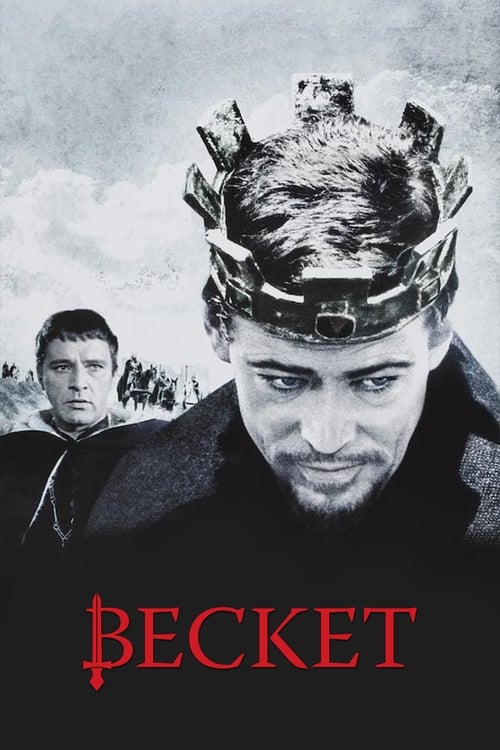
Becket
1964 · Peter Glenville
For a night when you want grown-up drama with real weight — great actors circling each other over honor, power, and a broken friendship. More absorbing than comforting; it asks your full attention and repays it.
What it's about
Henry II of England and Thomas Becket are drinking companions, co-conspirators, the closest of friends — until the king, hoping to bring the Church to heel, installs Becket as Archbishop of Canterbury. The appointment backfires: Becket takes the office seriously, discovers a loyalty higher than the crown, and the two men who loved each other become immovable adversaries. It's a battle of church against state fought as something far more painful — a friendship curdling into betrayal.
The experience
Talky in the best sense: long, charged confrontations where every line is a blade, building a slow ache as two proud men refuse to blink. It plays like a tragedy you can see coming and can't look away from — stately on the surface, wounded underneath.
Performances
Richard Burton and Peter O'Toole, face to face at the height of their powers — Burton all contained conviction as Becket, O'Toole volcanic and needy as Henry, a king who can command everything except the one man's love he actually wants. Watching them share a frame is the whole show.
The craft
Adapted from Jean Anouilh's stage play by Edward Anhalt, whose screenplay won the Oscar, and directed by Peter Glenville, who had staged the play himself and knows exactly where the drama lives — in faces, not spectacle. The period production is lavish, but the film's real luxury is language: it's built to let two magnificent voices collide.
Why it matters
One of the crowning achievements of 1960s prestige historical cinema, it earned twelve Academy Award nominations and fixed Burton and O'Toole's duel in film memory as a benchmark for actor-versus-actor drama.
Snapshot
Becket is a prestige historical drama adapted from Jean Anouilh's 1959 play Becket, ou l'honneur de Dieu, dramatizing the friendship and rupture between Henry II of England (Peter O'Toole) and Thomas Becket (Richard Burton), the boon companion whom the king elevates to Archbishop of Canterbury only to find him transformed into an immovable defender of the Church. Produced by Hal B. Wallis for Paramount and directed by Peter Glenville — who had staged the play on Broadway — it is a film built squarely on the strengths of mid-century Anglo-American "quality" cinema: a literate screenplay, lavish period craft, and two of the era's most charismatic theatrical actors playing in close, combustible proximity. It was a critical and awards success, earning twelve Academy Award nominations and winning one, for Edward Anhalt's adapted screenplay. Today it is remembered less as a formal landmark than as a superbly acted chamber piece in epic costume, and as the first of Peter O'Toole's two screen portrayals of Henry II.
Industry & production
The film belongs to the cycle of roadshow-scaled literary adaptations that flourished in Hollywood and Britain in the late 1950s and 1960s, when studios courted prestige and event status to compete with television. Hal B. Wallis, a producer with a long history of awards-oriented pictures, secured the rights to Anouilh's play after its considerable stage success in Paris, London, and on Broadway. The Broadway production — directed by Glenville and famously featuring Laurence Olivier and Anthony Quinn, who at one point exchanged the two leading roles — established Glenville as the obvious choice to translate the material to the screen, an instance of the period's frequent transfer of theatrical talent and properties intact into film.
Casting paired Burton and O'Toole, both at high points of their fame: Burton a Shakespearean star and tabloid figure, O'Toole fresh from his breakout in Lawrence of Arabia (1962). The supporting cast drew on the British stage establishment, most notably John Gielgud as the wily Louis VII of France. Production was based in England, with interiors built at studio facilities (Shepperton is the commonly cited base) and the film mounted in widescreen Panavision and Technicolor for roadshow presentation. The exact technical pedigree of the large-format presentation is one point where popular accounts vary, and the safest claim is that it was conceived as a color, anamorphic-widescreen prestige release rather than a true large-negative epic on the scale of contemporaneous 70mm productions.
The picture performed respectably and was a major awards contender, its twelve nominations spanning picture, both lead actors (Burton and O'Toole competed against each other in Best Actor), direction, screenplay, score, art direction, cinematography, costume, sound, and editing. Its single win, for the screenplay, is consistent with the way the industry valued the film: as a triumph of adaptation and performance more than of spectacle.
Technology
Becket was made with the standard prestige toolkit of early-1960s color filmmaking: anamorphic widescreen lenses and the rich, saturated Technicolor palette associated with high-end period production. There is no claim to technological innovation here; the film's interest lies in the deployment of mature tools rather than the introduction of new ones. The relevant technological context is the wide-gauge, color, roadshow format itself, which imposed both opportunities (sweeping compositions, deep tonal range for stone, candlelight, and ecclesiastical color) and constraints (the anamorphic frame's resistance to tight close-ups, which the filmmakers had to negotiate in a story driven by two faces in conflict). Where the record on the precise lab and exhibition specifications is thin, it is better to describe the film as a handsomely mounted color widescreen production than to assert details that are not securely established.
Technique
Cinematography
The photography is credited to Geoffrey Unsworth, one of the foremost British cinematographers of the period and later the lensman of 2001: A Space Odyssey, Cabaret, and Murder on the Orient Express. His work on Becket is controlled and pictorial rather than flamboyant: cool stone interiors, the gold and crimson of vestments, the gray Channel light of Normandy and the road. Unsworth's instinct for soft, enveloping light and for the dramatic value of architectural space serves a film that spends much of its time in throne rooms, cathedrals, and the king's chambers. The widescreen frame is used to set figures against the weight of institutions — Becket dwarfed by the nave, Henry isolated on his throne — so that the political stakes are legible in the staging as well as the dialogue.
Editing
The film was cut by Anne V. Coates, who had recently won acclaim (and an Academy Award) for Lawrence of Arabia. Her work here is in a different register: where Lawrence demanded epic temporal compression and celebrated transitions, Becket is a dialogue picture, and the editing is largely in service of performance and rhythm — holding on the actors, shaping the long verbal duels between Burket and Henry, and managing the play's episodic structure across years and locations. The cutting earned an Oscar nomination, recognition that the film's sense of pace and clarity, despite its theatrical origins, was an achievement of construction.
Mise-en-scène / staging
The production design (by John Bryan, with costumes by Margaret Furse, both Oscar-nominated) gives the film its tactile authority: heavy stone, fur, leather, and metal, the textures of a cold and physical medieval world. The staging retains a strong theatrical spine — much of the drama is conversation between two men in a room — but Glenville and his designers open the play outward into hunting fields, the Channel crossing, the French court, and finally Canterbury Cathedral, so that the private quarrel acquires geographic and institutional scale. The mise-en-scène consistently frames the church-versus-crown conflict materially, in the contrast between the king's warm, disorderly chambers and the austere verticality of ecclesiastical space.
Sound
Laurence Rosenthal's score (Oscar-nominated) leans on liturgical and quasi-medieval color — choral and ceremonial textures appropriate to a story about the sacred and the secular — while reserving its weight for the tragic arc of Becket's transformation and martyrdom. The film's sound work was also nominated. As with the rest of the craft, the aim is supportive and atmospheric rather than experimental; the music underlines the movement from intimate friendship to ritual confrontation.
Performance
Performance is the film's true subject and its greatest strength. Burton plays Becket as a man of cool intelligence and buried feeling who discovers, almost to his own surprise, a vocation he is willing to die for — the famous arc toward "the honor of God." O'Toole's Henry is the showier role: mercurial, sensual, petulant, capable of real tenderness and real cruelty, a king whose love for Becket curdles into the rage that produces the murder. The two actors, both trained on the stage and both gifted with extraordinary verbal facility, generate a charged intimacy that carries the picture; their scenes together — by turns affectionate, bantering, and lacerating — are the reason the film endures. Gielgud's brief turn as Louis VII is a model of sly comic statecraft. The concentration of acting honors among the film's nominations reflects this correctly.
Narrative & dramatic mode
The film's dramatic mode is the historical tragedy of friendship and conscience, structured around a single relationship rather than a panorama. Anouilh's play, and Anhalt's faithful adaptation, frame the events partly in flashback from Henry's penance at Becket's tomb, lending the whole a retrospective, elegiac cast: we know from the outset that this love ends in murder and remorse. The narrative proceeds episodically through the stages of the men's bond — companions in dissipation and statecraft, then king and chancellor, then king and archbishop, then antagonists — and locates its tragedy in the irony that Henry creates his own nemesis by giving Becket a cause worthy of him. The mode is literate and dialogue-driven, closer to the tradition of the well-made historical play than to action cinema.
Genre & cycle
Becket sits at the intersection of the costume historical drama and the "church versus state" martyr narrative. It belongs to a recognizable mid-1960s cluster of British and Anglo-American films dramatizing crises of conscience in English history, most obviously alongside A Man for All Seasons (1966), Fred Zinnemann's film of Robert Bolt's play about Thomas More — another principled cleric-statesman destroyed by a willful English king, and another stage-derived prestige adaptation. It is also, with The Lion in Winter (1968), part of an informal Plantagenet diptych unified by O'Toole's Henry II. More broadly it exemplifies the prestige literary adaptation as a genre of production — the kind of film made to be performed, awarded, and admired for craft and language.
Authorship & method
Peter Glenville was primarily a man of the theater, and Becket is in many ways an auteurless film in the strict sense — its authorship is distributed across a strong producer, a celebrated playwright, an Oscar-winning adapter, and two star actors. Glenville's contribution is best understood as that of a sensitive theatrical director translating a property he knew intimately from the stage, prioritizing text and performance and trusting his designers and cinematographer for the visual scale. Edward Anhalt's screenplay is the film's signal creative achievement, faithfully rendering Anouilh's structure and epigrammatic dialogue while adjusting it to cinematic scene-work; it won the film's only Oscar. The key collaborators — Unsworth (camera), Coates (editing), Rosenthal (score), Bryan and Furse (design and costume) — were each top-rank craftspeople, and the film is in large part a showcase of their professionalism in concert. The "method," such as it is, was the standard prestige model: secure a proven property, cast it brilliantly, and mount it with the best available technicians.
Movement / national cinema
The film is a hybrid of national cinemas: a Hollywood-financed Paramount production made in England with a substantially British cast and crew, derived from a French play about English and French medieval history. It does not belong to any aesthetic movement; it predates and stands apart from the British New Wave's contemporaneous social realism, representing instead the older, internationalist prestige tradition of English-language cinema. Its lineage is theatrical and literary rather than cinematic-modernist.
Era / period
Produced in 1964, Becket is a characteristic artifact of the roadshow-prestige moment in Anglo-American film, when the industry pursued long, handsome, literate event pictures aimed at adult audiences and awards. Its diegetic period is the twelfth century — the reign of Henry II (reigned 1154–1189) and the conflict that culminated in Becket's murder in Canterbury Cathedral in 1170. It is worth noting a well-documented historical liberty inherited from Anouilh's source: the play casts Becket as a conquered Saxon resentful of his Norman masters, dramatizing a racial-national tension that gives the friendship a charged subtext. The historical Becket was of Norman descent, not Saxon; Anouilh worked from an outdated nineteenth-century historiography and later acknowledged the error. The film preserves this dramatically potent but historically inaccurate framing, and any account of the picture should flag it rather than treat the film as reliable history.
Themes
The central themes are friendship and betrayal; the conflict between sacred and secular authority; and the discovery of a vocation worth dying for. Becket's arc turns on the idea of honor — the chancellor who served the king's honor with cool competence finds, in the archbishopric Henry forces on him, a higher honor, "the honor of God," to which he transfers an absolute loyalty. The film is also about love and its perversion into destruction: Henry's possessive devotion to Becket, frustrated by Becket's new allegiance, becomes the engine of the tragedy, encapsulated in the king's anguished outburst against the "turbulent priest" that his knights take as license to murder. Beneath these runs the inherited theme of the conquered and the conqueror, the Saxon and the Norman, which colors the men's intimacy with the politics of subjugation.
Reception, canon & influence
Critically, Becket was received as a distinguished, intelligent, and superbly acted film, its twelve Academy Award nominations testifying to its standing with the industry; its single win, for the screenplay, fairly identifies where its excellence was felt to lie. The principal reservation in its reception, then and since, has been that it is fundamentally a filmed play — magnificently performed and appointed, but more theatrical than cinematic, its power residing in language and acting rather than in distinctively filmic invention.
Looking backward, the film's influences are literary and dramatic: Anouilh's play above all, and behind it the long tradition of treating the Becket–Henry conflict on stage, including T. S. Eliot's verse drama Murder in the Cathedral (1935), which approaches the same martyrdom from a very different, more liturgical and interiorized angle. The film's flawed Saxon-Becket conceit descends, as noted, from nineteenth-century historiography by way of Anouilh.
Looking forward, Becket's most direct legacy is its partnership with The Lion in Winter (1968), in which O'Toole reprised Henry II opposite Katharine Hepburn's Eleanor of Aquitaine — a rare instance of an actor carrying a historical monarch across two separate prestige films, and one that has linked the two pictures permanently in critical memory. More broadly, Becket helped consolidate the 1960s vogue for the stage-derived English historical conscience drama that A Man for All Seasons would crown two years later. Its enduring reputation rests above all on the Burton–O'Toole duet, frequently cited as one of the great paired performances of the decade, and it remains a touchstone for the proposition that, in the right hands, two actors in a room can sustain an epic.
A Deleuzian reading
Henry kneels.
The full Deleuzian reading of Becket →
Reception
A prestige heavyweight in 1964 — 12 Oscar nominations, though only the screenplay won — it then drifted out of circulation for decades until a 2007 restoration and re-release reminded everyone it existed; today it's mostly remembered as the Burton–O'Toole title bout it always was.
How Becket was received, from release to now →
Influences: the films it descends from and the films it influenced
- Henry V (1944) — Establishes the Technicolor stage-to-screen English-history prestige template Becket inherits — a theatrically framed text opening out into cinematic scale while keeping language and performance as the load-bearing element.
- Hamlet (1948) — The prototype 'filmed play' whose authority rests on a single star actor's command of verse rather than distinctly filmic invention — exactly the basis on which Becket was both praised and faulted.
- Richard III (1955) — Anamorphic-widescreen Technicolor staging of English court intrigue, modeling the proscenium-derived blocking and direct-address rhetoric Glenville reuses for crown-and-court scenes.
- Murder in the Cathedral (1951) — Dramatizes the identical Becket martyrdom from T.S. Eliot's verse drama, supplying the liturgical, interiorized church-versus-crown treatment that Anouilh's secular, ironic version answers and inverts.
- Lawrence of Arabia (1962) — Shares Anne Coates' editing hand and Peter O'Toole's star ascendancy, and sets the anamorphic roadshow-prestige scale plus the death-and-flashback framing device Becket's structure echoes.
- A Man for All Seasons (1966) — Crowns the same stage-derived English conscience drama Becket helped consolidate: a man of conscience set against his king in a church-versus-state martyrdom built on verbal duels, not spectacle.
- The Lion in Winter (1968) — O'Toole literally reprises Henry II, extending Becket's chamber-epic of two actors trading Anouilh-flavored barbed dialogue across a single household-scaled power struggle.
- Anne of the Thousand Days (1969) — Reproduces the Becket mold — a stage-rooted Tudor royal tragedy mounted as episodic prestige, its drama driven by king-versus-conscience confrontation scenes and lavish period appointments.
- Mary, Queen of Scots (1971) — Applies the same crown-tragedy prestige formula, structuring the whole picture around a central royal duel of wills photographed as a sequence of charged two-person encounters.
- Cromwell (1970) — Extends the English-history prestige drama built on sustained crown-versus-conscience antagonism, privileging declamatory acting set-pieces over action.
- 2001: A Space Odyssey (1968) — Carries forward Geoffrey Unsworth's large-format, light-sculpting cinematography — the same painterly control of color and scale he brought to Becket's cathedral interiors.
- Cabaret (1972) — Unsworth's expressive widescreen color and source-light work, descending directly from the cinematographer's prestige craft on Becket.
- Murder on the Orient Express (1974) — Reunites both Geoffrey Unsworth (camera) and Anne Coates (editing) on another all-star, lushly appointed literary adaptation — a near-complete transplant of Becket's technical team into the prestige whodunit.
- The Dresser (1983) — Vindicates Becket's core proposition that two actors in a room can sustain an epic — a theatrically rooted two-hander whose entire dramatic engine is the duet between its leads.
- The Madness of King George (1994) — Anouilh stage adaptation that splits the English king between public office and private agony — the two-bodies tension Bennett sharpens via porphyria.
- The Miracle Worker (1962) — Carries Laurence Rosenthal's score and the same stage-to-screen two-hander craft — a feature sustained almost entirely on the charged confrontation of two performers in confined rooms.
- The Young Lions (1958) — Showcases Edward Anhalt's adaptation method — compressing a sprawling literary source into taut, epigrammatic character confrontations — the screencraft that won Becket its only Oscar.
- The Comedians (1967) — Glenville and composer Laurence Rosenthal reunite with Richard Burton on another literary-prestige adaptation, repeating the director's text-and-star-forward method.
Similar films
- The Lion in Winter (1968) — influence & lineage · same viewing thread
- Hamlet (1948) — influence & lineage · same viewing thread
- Lawrence of Arabia (1962) — influence & lineage
- Henry V (1989) — same viewing thread
- Chimes at Midnight (1965) — same viewing thread
- Hamlet (1996) — same viewing thread
- Macbeth (1971) — same viewing thread
- Conclave (2024) — shared sensibility
All the films related to Becket →
Watch it with: curated runs of related films
- Shakespeare's Kings and Killers — Watch these near each other and the same machinery keeps turning in new tongues — the murdered king, the usurped crown, the prophecy and the ambition that curdles into slaughter — as Olivier, Welles, Kurosawa, Polanski and Branagh each bend Shakespeare to the screen.