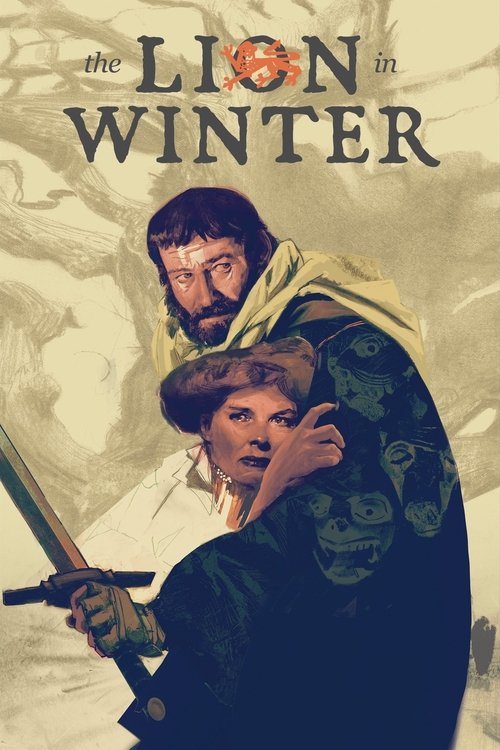
The Lion in Winter
1968 · Anthony Harvey
When you're in the mood to watch brilliant people tear each other apart and love every second — great for anyone who savors dialogue over action. A challenge in intensity, pure pleasure in execution.
What it's about
Christmas, 1183. The aging Henry II of England summons his family to court: the queen he keeps imprisoned, Eleanor of Aquitaine, their three scheming sons, his young mistress, and the boy-king of France. Over one holiday, husband and wife wage total war — with words — over which son will inherit the crown. Every embrace hides a knife; every negotiation is also a marriage fight decades in the making.
The experience
Verbally electric — two hours of the most vicious, quotable, blackly funny dialogue in any historical drama, delivered at fencing speed. It plays like a battle film where every weapon is a sentence, and it leaves you exhilarated and a little bruised.
Performances
Peter O'Toole's roaring, wounded Henry and Katharine Hepburn's Oscar-winning Eleanor are one of cinema's great duels — regal, cruel, and heartbreakingly married. A very young Anthony Hopkins (Richard) and Timothy Dalton (Philip) hold their own in early screen roles.
The craft
James Goldman adapted his own play, giving medieval monarchs mordant, modern-sounding wit without breaking the period spell; the cold stone castle setting keeps the epic scaled to faces and voices. John Barry's choral score adds grandeur the sets deliberately withhold. It rewards attention the way great theater does — lean in and don't miss a line.
Why it matters
An awards-laden classic that set the standard for the talk-driven historical drama, and the template for treating dynastic politics as savage family melodrama.
Snapshot
The Lion in Winter is a chamber war film disguised as a costume epic. Adapted by James Goldman from his own 1966 Broadway play, it stages a single fictional Christmas court — Chinon, 1183 — at which the aging Henry II of England, his imprisoned queen Eleanor of Aquitaine, their three surviving sons, the king's young mistress, and the boy-king of France maneuver over the English succession. Nothing in the plot is historically attested as having happened in that room on that day; what is real are the people, the dynastic stakes, and the documented hatreds. Goldman uses that license to write a film in which medieval monarchs trade modern, mordant, almost contemporary insults, and the result is one of the most verbally electric of all historical dramas. The film is remembered above all for two towering performances — Peter O'Toole's Henry and Katharine Hepburn's Eleanor — and for John Barry's choral score, but it is also a precise piece of construction: a movie about a family that fights the way families fight, scaled up to the level of kingdoms. It won three Academy Awards and remains a touchstone for the "dynastic family at war" mode that later television would inherit.
Industry & production
The film belongs to the late-1960s prestige cycle, the moment when literary stage properties were still being mounted as serious, star-driven roadshow attractions even as that whole model was beginning to collapse. It was produced by Martin Poll with Joseph E. Levine's Embassy Pictures involved on the financing and distribution side, and it carried the markings of an Anglo-American prestige co-production: British and American talent, European locations, a Broadway source. Goldman's play had run on Broadway in 1966 (where it was, by most accounts, only a modest commercial success), and the screen rights moved quickly into a project that would prove far more durable than the stage original.
The casting strategy was central to the film's identity and to its marketing. Peter O'Toole had already played Henry II four years earlier in Becket (1964), and producing a film in which he returns to the same king at a later, more ruined stage of life was a deliberate piece of casting continuity that the production leaned on. Katharine Hepburn, then in her late fifties and recently widowed by the death of Spencer Tracy (who had died in 1967, shortly after they finished Guess Who's Coming to Dinner), came to Eleanor as a comeback of sorts and as a role explicitly built around a formidable older woman. The supporting bench was, in retrospect, extraordinary: it gave Anthony Hopkins one of his first significant screen roles as Richard the Lionheart and marked the film debut of Timothy Dalton as Philip II of France, alongside Nigel Terry as John and John Castle as Geoffrey.
Anthony Harvey, directing only his second feature, was a relatively unproven choice to hold so much marquee talent, and the production's gamble on him paid off critically. The film opened to strong reviews and to awards momentum that carried it through the 1968 season.
Technology
The picture was shot on 35mm color stock using conventional spherical lenses rather than the anamorphic widescreen processes that had defined the big historical epics earlier in the decade; the cumulative impression is of a relatively intimate frame rather than the vast horizontal canvas of a Lawrence of Arabia or El Cid. (The precise lab and lens specifications are not something I can confirm in detail without risk of error, so I note the general technological posture rather than asserting exact figures.) The relevant technological point is aesthetic restraint: this is an epic subject deliberately shot at the scale of a play, lit and exposed for stone, candle, firelight, and weather rather than for spectacle. The production used real medieval and quasi-medieval locations — exteriors associated with Ireland and the south of France, including ancient abbey and castle architecture — to supply texture that a soundstage could not, then kept the camera close to faces inside.
Technique
Cinematography
The cinematography is credited to Douglas Slocombe, a major British cameraman whose later fame would include the Indiana Jones films. Here his work is notable for its commitment to cold, naturalistic, low-key interiors: the conceit of "winter" is carried visually as much as verbally, with the castle rendered as a drafty, under-lit, genuinely uncomfortable place where breath might fog and where warmth is rationed. The palette runs to stone grays, browns, the orange of fire, and the pallor of winter daylight. Faces are frequently the brightest objects in the frame, which suits a film that is fundamentally about reading and misreading human expression. The camera tends to observe the verbal duels rather than editorialize them, holding actors in two-shots and group compositions so that the audience can watch alliances shift in real time across a single take.
Editing
Editing duties were handled by John Bloom. The film's cutting is built to serve performance and language: the rhythm is governed by the dialogue's thrust-and-parry, so the editing must know when to stay on a speaker, when to cut to the listener for the reaction that reframes a line, and when to release a scene. Harvey himself had begun his career as a film editor — including work in the Kubrick orbit — and that background shows in the picture's confidence about where the cut belongs. The film resists montage and pace-for-its-own-sake; its tension is conversational, and the edit honors that.
Mise-en-scène / staging
Because the source is a play and the action is confined largely to one castle over a few days, staging is the film's central craft problem, and its central achievement. The production design (by Peter Murton) and the costumes (by Margaret Furse, who earned an Academy Award nomination for the film) build a world that is tactile and worn rather than gilded — armor, furs, heavy fabrics, cold stone. The blocking continually rearranges the family into temporary configurations: pairs conspiring in corners, the king presiding, the queen entering to break a tableau. Doorways, thresholds, and the act of who is allowed into which room carry dramatic weight. The film opens out the play just enough — into courtyards, a barge, a wine cellar — to relieve the staginess without ever forgetting that the real arena is the space between two faces.
Sound
The sound design is dominated by John Barry's score (discussed below), but the film also uses the ambient cold of its spaces — wind, fire, the clatter of a hard winter court — as connective tissue. Crucially, the film trusts silence and the unaccompanied human voice. Goldman's dialogue is the primary instrument, and long stretches play without music so that the verbal architecture is fully audible. When Barry's choir returns, it functions almost liturgically, a reminder of the religious-historical frame around the secular cruelty.
Performance
Performance is the film's reason for being. O'Toole's Henry is a study in vital, theatrical decay — a man who still has the king's roar but knows the count of his remaining years, lurching between manipulative charm, genuine grief, and explosive rage. Hepburn's Eleanor is the film's gravitational center: regal, self-mocking, wounded, and lethal, delivering Goldman's most barbed lines with a control that lets vulnerability bleed through the wit. Their scenes together are the spine of the picture. Around them, Hopkins gives Richard a banked, dangerous intensity; Castle's Geoffrey is the coldly intelligent middle son who knows no one will ever choose him; Terry's John is a study in pampered uselessness; and Dalton's Philip brings a younger, sharper menace. The ensemble functions as a true company — each performance calibrated to the shifting alliances of the script.
Narrative & dramatic mode
The film's dramatic mode is essentially theatrical: it is a unity-of-place chamber drama of intrigue, closer to a Restoration comedy of cruelty or a Shavian debate play than to the action-historical epic its setting might suggest. The plot is a series of negotiations, betrayals, and reversals over a single question — who inherits — but the engine is not suspense about the outcome (history has already answered) so much as the spectacle of intelligent, damaged people wielding language as a weapon. Goldman writes in a deliberately anachronistic register: the characters are medieval, but their irony, their psychological self-awareness, and their wisecracks are modern. This is a chosen convention, not a lapse, and it gives the film its peculiar doubleness — period in its trappings, contemporary in its emotional and verbal texture. The mode is tragic-comic: very funny line by line, devastating in cumulative effect, ending not in resolution but in the exhausted recognition that these people will keep doing this to one another.
Genre & cycle
The Lion in Winter sits at the intersection of the historical/costume drama and the prestige literary adaptation, and within the specific 1960s cycle of serious films about English kings and the men around them — most directly Becket (1964) and A Man for All Seasons (1966), with which it is almost always grouped. All three are stage-derived, dialogue-driven, star-vehicle treatments of the English medieval and Tudor past, and all three were awards-season prestige releases. The Lion in Winter distinguishes itself within that cycle by its domesticity: where Becket is about church and crown and A Man for All Seasons about conscience and state, Lion is about a marriage and a family. It is the costume drama turned inward, the epic reduced to the dining table — which is precisely why it has aged into a model for a different medium.
Authorship & method
Authorship here is genuinely shared. James Goldman, as both playwright and screenwriter, is in many respects the film's primary author: the structure, the voice, and the central conceit are his, and he won the Academy Award for the adaptation. Anthony Harvey, the director, came up as an editor and approached the material as a problem of performance and rhythm rather than spectacle; his method was to clear space for actors and to keep the cutting in service of language, and he received a Best Director nomination for it. Douglas Slocombe supplied the cold naturalist photography that gave the film its physical world. John Barry, the composer, contributed what may be the film's single most recognizable element — a powerful, semi-liturgical orchestral-and-choral score that won the Academy Award for Best Original Score and that lends the family squabbles a tragic, ceremonial grandeur they would otherwise lack. Margaret Furse's costumes and Peter Murton's production design complete the authorship of the film's look. The film is thus a rare case where writer, director, composer, and cast all visibly contribute identifiable layers.
Movement / national cinema
The film is best understood as British prestige cinema operating within an Anglo-American financing and distribution system — a characteristic late-1960s arrangement in which American money and a Broadway property were realized by largely British talent on European locations. It is not part of any avant-garde or new-wave movement; if anything it belongs to the conservative, craft-centered, literary wing of British filmmaking that ran parallel to the rougher energies of the British New Wave earlier in the decade. Its lineage is the tradition of the well-made British historical and literary adaptation, and its international reach reflects the era's transatlantic production economy more than any national-cinema program.
Era / period
Released in 1968, the film arrives at a hinge moment in film history — the year of the European political ruptures, of 2001: A Space Odyssey and the loosening of Hollywood's old order, the dawn of the New Hollywood. The Lion in Winter faces backward in form and forward in sensibility. In form it is a roadshow-adjacent prestige picture of a kind that was about to become unfashionable; in sensibility its corrosive irony, its frank treatment of a loveless dynastic marriage, and its willingness to make its heroes contemptible are very much of the late sixties. Within its own diegesis the "era" is the high medieval Angevin moment of 1183, but the film treats that period as a costume for thoroughly modern anxieties about aging, marriage, parenthood, and power.
Themes
The dominant theme is family as a theater of war: love and hatred are not opposites here but the same energy, and the cruelest blows are landed by the people who know one another best. Closely linked is aging and legacy — Henry's terror of mortality and his obsession with what he will leave behind drives the whole succession plot, while Eleanor's awareness of lost beauty and lost power shadows her every line. The film is centrally about marriage as a lifelong, unkillable entanglement: Henry and Eleanor cannot live together and cannot be free of each other, and the film refuses the consolation of either reconciliation or clean rupture. Power and its corruptions run throughout — every affection is also a maneuver, every alliance provisional. And beneath the wit lies a bleak meditation on failure: these are brilliant people who have made wreckage of their lives and their children, and who go on anyway. The famous note the film ends on — endurance without resolution, the capacity to keep going precisely because there is nothing else to do — is its deepest statement.
Reception, canon & influence
Critically the film was very well received on release and translated that reception into major awards recognition: it earned seven Academy Award nominations and won three — Best Actress for Katharine Hepburn, Best Adapted Screenplay for James Goldman, and Best Original Score for John Barry — while losing Best Picture to Oliver!. Hepburn's win is itself a piece of Oscar history: it came in a rare tie with Barbra Streisand (Funny Girl), and it followed immediately on her win the previous year, an unusual back-to-back recognition for one of the medium's defining stars. O'Toole was nominated for Best Actor (his second nomination for playing Henry II, after Becket) and Harvey for Best Director.
The influences on the film are primarily theatrical and literary: Goldman's anachronistic, wit-driven dialogue descends from the tradition of the historical debate-play (the Shavian model of using the past to argue the present), and the film's immediate cinematic context is the prestige English-history cycle of Becket and A Man for All Seasons, with O'Toole's prior Henry serving as an explicit bridge. The contrast it draws — stage-derived language against real medieval stone — is its method for transmuting that inheritance.
The influence forward runs in two directions. As a film, it cemented the viability of the talky, performance-driven historical chamber drama and helped launch the screen careers of Anthony Hopkins and Timothy Dalton; it was later remade as a 2003 television film with Patrick Stewart and Glenn Close, a sign of the property's continuing prestige appeal. More significantly, its central template — the brilliant, vicious dynastic family destroying itself over succession, rendered in sharp contemporary dialogue — anticipates a whole strain of later prestige television and film about ruling families at war with themselves. Modern viewers and critics routinely reach for it as a forebear when describing dynastic-intrigue dramas, and the lineage from The Lion in Winter to later "family empire" storytelling is one of the clearest cases of a 1960s film whose deepest influence was eventually felt on the small screen rather than the large. Its enduring canonical status rests less on visual innovation than on the proof it offered: that an epic could be built entirely out of a family arguing in cold rooms, and that this could be both ferociously entertaining and genuinely tragic.
A Deleuzian reading
A castle at Christmas, 1183, and the coldest thing on screen is the architecture.
The full Deleuzian reading of The Lion in Winter →
Reception
A prestige hit in 1968 — Oscars, a Golden Globe for Best Picture (Drama) — though some critics sniffed at it as filmed theater; today it's beloved precisely for that theatricality, rediscovered as the ultimate acid-tongued chamber piece and an unofficial Christmas movie.
How The Lion in Winter was received, from release to now →
Influences: the films it descends from and the films it influenced
- Becket (1964) — O'Toole plays the very same Henry II two films earlier, and both are stage-to-screen prestige English-history pictures built on long, literate two-hander confrontations rather than battle spectacle — the explicit bridge Goldman and Harvey work from.
- A Man for All Seasons (1966) — Robert Bolt's model of dramatizing Tudor power as articulate moral argument staged in cold stone rooms, privileging performance-and-text over pageantry, is the immediate prestige-adaptation template Lion follows.
- Who's Afraid of Virginia Woolf? (1966) — Nichols stages a marriage as sustained verbal blood-sport in lacerating close two-shots; Lion transposes that domestic combat into a royal household, keeping the camera on faces trading wounds.
- Long Day's Journey Into Night (1962) — Lumet's faithful single-location filming of a family flaying itself across one long day and night — ensemble actors held to unity of place — is the family-as-war chamber model Lion adopts wholesale.
- Saint Joan (1957) — Shaw's historical debate-play, where medieval figures argue with deliberately modern wit to interrogate the present, is the Shavian anachronistic-dialogue tradition Goldman directly inherits.
- Dr. Strangelove (1964) — Harvey cut his teeth as Kubrick's editor on this film, and the dialogue-driven, performance-serving cutting rhythm he brings to Lion — cutting to language, not action — is learned from that editing-room apprenticeship.
- Henry V (1944) — Olivier renders Shakespearean dynastic history as throne-room rhetoric and verbal kingship; it founds the lineage of English monarchs warring in words that Goldman's anachronistic script knowingly plays against real stone.
- The Lion in Winter (2003) — A direct remake with Patrick Stewart and Glenn Close reprising the O'Toole/Hepburn roles, preserving Goldman's text and the cold-room chamber staging intact.
- The Madness of King George (1994) — Alan Bennett's stage-to-screen British royal drama mixes sharp anachronistic wit with the private dysfunction of a dynasty, sustaining Lion's prestige-chamber method of treating monarchy as family pathology.
- The Favourite (2018) — Lanthimos weaponizes deliberately anachronistic, profane dialogue inside a period court, turning royal intimacy into vicious three-way power combat — Goldman's anachronism-against-period-stone pushed to its extreme.
- The Crown (2016) — Morgan builds an epic out of a ruling family arguing in cold rooms in contemporary cadence — Lion's proof that an epic can be made entirely of dynastic quarrel, serialized for television.
- Succession (2018) — A brilliant, vicious dynasty destroying itself over succession rendered in razor contemporary dialogue is the most direct heir to Lion's central conceit, scene-by-scene maneuvering replacing battlefield.
- Game of Thrones (2011) — Extends the brilliant-and-vicious-family-warring-over-succession template into epic fantasy, its dialogue-driven scheming and throne-room maneuvering descending from Lion's verbal power-combat.
- The Death of Stalin (2017) — Iannucci films a succession struggle as anachronistic-voiced, vicious comedy among rivals jockeying in rooms — Lion's mordant treatment of power as family bloodsport transposed into a Soviet key.
- The Gathering Storm (2002) — Two titanic actors sparring as a long-married historical couple in firelit interiors (O'Toole/Hepburn) is the precise two-hander dynamic Finney and Redgrave reproduce as Winston and Clementine.
- Anne of the Thousand Days (1969) — Part of the same British prestige English-history cycle, it dramatizes a royal marriage as political war through chamber confrontations, Burton echoing O'Toole's kingly verbal duels.
- Mary, Queen of Scots (1971) — Jarrott again stages dynastic succession as personal combat between two formidable equals (Redgrave and Jackson), extending Lion's structure of the two-hander between matched antagonists.
Similar films
- Becket (1964) — influence & lineage · same viewing thread
- Long Day's Journey Into Night (1962) — influence & lineage
- The Favourite (2018) — influence & lineage
- Who's Afraid of Virginia Woolf? (1966) — influence & lineage
- Henry V (1989) — same viewing thread
- Hamlet (1948) — same viewing thread
- Ran (1985) — same viewing thread
- Chimes at Midnight (1965) — same viewing thread
All the films related to The Lion in Winter →
Watch it with: curated runs of related films
- Shakespeare's Kings and Killers — Watch these near each other and the same machinery keeps turning in new tongues — the murdered king, the usurped crown, the prophecy and the ambition that curdles into slaughter — as Olivier, Welles, Kurosawa, Polanski and Branagh each bend Shakespeare to the screen.