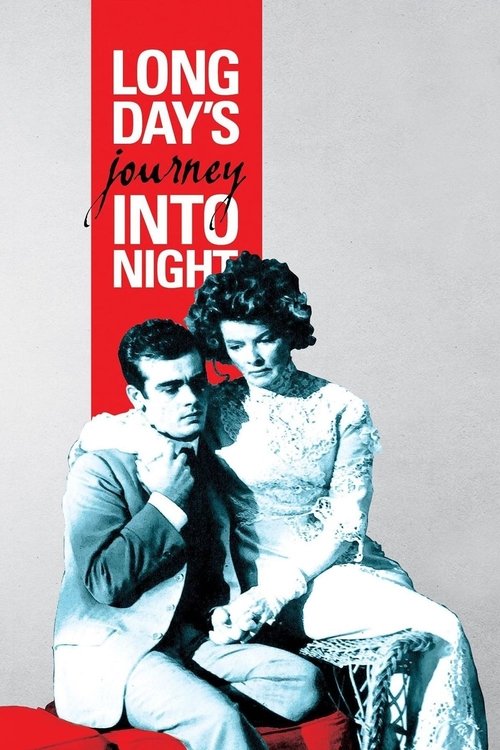
Long Day's Journey Into Night
1962 · Sidney Lumet
For when you want to go all the way down — a long, serious evening with a great American tragedy, not comfort viewing. Reach for it when you're ready to sit with a family at its worst and feel wrung out afterward.
What it's about
One foggy August day in 1912, in a summer house on the Connecticut shore, a family of four slowly comes apart: a penny-pinching father who was once a famous actor, a mother sliding back into morphine addiction, a hard-drinking older son, and a younger son whose cough may be something much worse. It follows the Tyrones from breakfast to midnight as old wounds, old debts, and old accusations surface one conversation at a time. Nothing arrives from outside — the whole drama is the family talking to, at, and past each other.
The experience
Slow-burning and airless in the best way — you feel the fog closing in as the day darkens and the talk gets more honest and more cruel. It's emotionally punishing but hypnotic; the three hours earn themselves, and by the end you feel like you've lived a whole night in that house.
Performances
Katharine Hepburn's Mary is one of her greatest performances — fluttering, evasive, heartbreaking as the morphine pulls her out of reach. Ralph Richardson makes the miserly father pitiable rather than villainous, and Jason Robards is devastating as the wrecked older son.
The craft
Sidney Lumet refuses to 'open up' the play and instead tightens it — the camera prowls the house like a fifth family member, and Boris Kaufman's black-and-white photography lets the light die in real time from morning brightness to lamplit gloom. It's a masterclass in filming actors: long takes, patient framing, faces doing the work.
Why it matters
It set the standard for how to put a major American play on screen without embalming it, and it remains a touchstone for Eugene O'Neill on film and for Lumet's reputation as the great director of actors.
Snapshot
Sidney Lumet's Long Day's Journey Into Night is a near-complete filming of Eugene O'Neill's autobiographical tragedy, the most exacting screen translation of a major American play attempted to that point. Across roughly three hours it confines four members of the Tyrone family — and the camera — to a fog-wrapped Connecticut summer house on a single day in August 1912, watching a household corrode through recrimination, addiction, and buried grief from breakfast brightness to a midnight stupor. The film is less an "opening up" of theater than a deliberate intensification of it: Lumet and cinematographer Boris Kaufman treat the proscenium as a pressure vessel. With Katharine Hepburn as the morphine-haunted Mary, Ralph Richardson as the miserly former matinee idol James, Jason Robards as the dissolute elder son Jamie, and Dean Stockwell as the consumptive younger son Edmund (O'Neill's surrogate), the picture is built around four sustained, unsparing performances. It stands as a landmark of the prestige literary-adaptation cycle of the late 1950s and early 1960s and as one of the defining works of Lumet's early career as an "actor's director."
Industry & production
The film emerged from independent producer Ely Landau's conviction that serious theatrical and literary work could be filmed faithfully and economically outside the major-studio system — an impulse he would later formalize in the American Film Theatre series of the 1970s. Long Day's Journey Into Night was produced on a modest budget, well below contemporary studio norms, and the project depended on the participation of stars willing to work for minimal or deferred compensation out of commitment to the material. Contemporary accounts consistently describe the principals as accepting scale or near-scale wages; the precise financial terms are not something I can document with certainty, and I will not invent figures.
The production strategy was essentially theatrical. Lumet, trained in live television (Studio One, Playhouse 90) and the New York stage, rehearsed his cast intensively before shooting, as one would mount a play, so that the long emotional arcs could be performed in extended takes rather than assembled from fragments. The film was shot largely on a confined set standing in for the Monte Cristo–style New London cottage, with exteriors and fog used sparingly as punctuation. The result was a picture made quickly and cheaply by the standards of its running time and ambition — a model of how a small independent could capture a canonical text.
O'Neill's own history shadows the production. The playwright wrote Long Day's Journey Into Night in 1941–42 and stipulated it not be performed or published until long after his death; his widow, Carlotta Monterey O'Neill, released it earlier, and it reached the stage in Stockholm and then Broadway in 1956, where José Quintero's production won the Pulitzer Prize and established Jason Robards as the preeminent interpreter of Jamie. The film thus arrived only a few years after the play's revelation as a posthumous masterwork, and it carried the aura of an instant classic to the screen.
Technology
The film was shot on 35mm black-and-white stock with monaural sound — both conservative choices for 1962, when color and widescreen were the commercial default, and both expressive ones. Monochrome suited a memory-play set in 1912 and allowed Kaufman to model faces and fog in gradations of gray rather than spectacle. The most consequential technological instrument is the lens kit: the early 1960s saw the zoom and a wide range of focal lengths become flexible storytelling tools, and Lumet built his entire visual scheme around varying focal length to manipulate the apparent space between characters. Sound is naturalistic and theater-derived, privileging the spoken text; there is no technological showmanship. The picture's modernity lies not in apparatus but in the rigor with which standard tools are bent toward a single dramatic idea.
Technique
Cinematography
Boris Kaufman — the brother of Dziga Vertov and Mikhail Kaufman, and the photographer of On the Waterfront and Lumet's 12 Angry Men — shoots in a restrained, sculptural black and white. The interiors are lit to feel both lived-in and entrapping; the fog that rolls in off the Sound becomes a visual correlative for Mary's withdrawal into the morphine past. Kaufman and Lumet use deep staging and careful focus to keep the family physically proximate yet emotionally severed. The collaboration is notable for its discipline: the camera rarely calls attention to itself, and the photographic "effects" are reserved for moments — the deepening dark of the fourth act, the single hanging lamp — where the text demands them.
Editing
Editor Ralph Rosenblum, later Lumet's and Woody Allen's frequent collaborator, cuts against the grain of conventional coverage. Because the performances were rehearsed and shot in long takes, editing here is less about pace than about preserving the integrity of sustained acting while shaping the four-act architecture. The cutting yields to the actors, holding on faces through monologues that a more nervous film would have fragmented. The rhythm slows as the day descends, mirroring the family's exhaustion; the film's length is itself an editorial position — a refusal to abridge O'Neill.
Mise-en-scène / staging
The single-set confinement is the film's central formal fact, and Lumet's signature technique is the systematic use of focal length to externalize psychological isolation. As he later described in his memoir Making Movies, he planned a progressive lens strategy so that, as the day wears on and the characters retreat into themselves, the camera moves to longer lenses that compress and isolate each figure within the frame, flattening the space between them and the world. The blocking keeps the family circling the same parlor furniture — table, chairs, the bottle, the stairs to Mary's room — so that the house becomes a closed circuit of approach and retreat. The staircase functions as a vertical axis of dread, the route by which Mary ascends into her addiction.
Sound
The soundscape is dominated by O'Neill's language, delivered with stage clarity. Ambient sound — foghorns, the sea — is used selectively as an emotional register rather than realist texture; the foghorn in particular becomes an aural emblem of Mary's lostness and James's fear. The sparing score (see below) leaves long stretches to the unaccompanied human voice, which is the film's true instrument.
Performance
Performance is the film's reason for being. Hepburn's Mary Tyrone traces a devastating arc from brittle, defensive lucidity through evasion to the spectral, girlish dissociation of the final descent, when the morphine returns her to a convent-school past; it is widely regarded as among her finest screen performances and earned her an Academy Award nomination for Best Actress. Ralph Richardson plays James as a penny-pinching, self-justifying former actor whose miserliness — the cheap doctor, the dimmed lights — is inseparable from his love and his guilt. Jason Robards brings to Jamie the authority of his Broadway interpretation: the drunken elder brother whose cruelty and tenderness collapse into one in the climactic confession. Dean Stockwell, a former child star, gives Edmund the watchful fragility of the consumptive observer who is also O'Neill's younger self. At the 1962 Cannes Film Festival the ensemble was honored with acting prizes, the male leads sharing recognition and Hepburn cited for Best Actress — an institutional acknowledgment that the film's achievement is fundamentally collective and performed.
Narrative & dramatic mode
The film preserves O'Neill's classical structure: four acts compressed into roughly one day, observing the Aristotelian unities of time, place, and action. There is almost no external event; the "plot" is the gradual disclosure of what the family already knows — Mary's relapse, Edmund's tuberculosis, James's stinginess, Jamie's self-destruction — circling the same wounds until each is exposed to the bone. This is naturalist tragedy in the late-O'Neill mode: confessional, repetitive, and incantatory, building through accusation and retraction toward a few great arias of self-revelation. The dramatic engine is recurrence rather than progression; characters relitigate the past until the past consumes the present. The film's fidelity to this anti-dramatic shape — its willingness to be long, static, and verbal — is precisely what makes it formally radical as cinema.
Genre & cycle
The picture belongs to several overlapping categories: the family melodrama or chamber drama; the "filmed theater" tradition; and, most specifically, the prestige literary-adaptation cycle that ran through American and Anglo-American cinema in the late 1950s and early 1960s, when filmmakers brought O'Neill, Tennessee Williams, Arthur Miller, and William Inge to the screen with new frankness about addiction, sexuality, and family pathology. Lumet himself was a central figure in this cycle, having filmed Williams (The Fugitive Kind, 1960) and Miller (A View from the Bridge, 1962) in the same period. Within that cycle, Long Day's Journey sits at the austere, uncompromising end — closer to documentary preservation of a text than to the more cinematically "opened" Williams adaptations of the era.
Authorship & method
The film is doubly authored — by O'Neill, whose autobiographical text is treated as near-sacrosanct, and by Lumet, whose method is to subordinate cinematic flourish to performance and structure while shaping both through a hidden, rigorous visual design. Lumet's authorship here is that of the great theatrical metteur en scène of American film: he conceives a controlling visual idea (the lens-driven progression into isolation), rehearses exhaustively, and then makes himself the servant of his actors. His key collaborators are essential to the result: Boris Kaufman's photography supplies the gray, fog-bound atmosphere; Ralph Rosenblum's editing protects the performances; and composer André Previn provides a spare, restrained score that underscores the family's melancholy without sentimentalizing it. The screenwriting "method," such as it is, consists largely of judicious trimming of O'Neill's text rather than reinvention — a deliberately self-effacing adaptation philosophy.
Movement / national cinema
The film is a product of American cinema's New York–centered, theater-and-television–trained wing — the milieu of live-TV directors and Actors Studio–adjacent performers who brought stage seriousness to film in the late 1950s and 1960s. It is not part of a formal movement, but it participates in a transatlantic art-cinema sensibility: independently financed, festival-oriented (its Cannes recognition is telling), and addressed to a cultured audience rather than a mass one. In this sense it anticipates the American independent and "quality" cinema that would coexist with Hollywood through the decade.
Era / period
Long Day's Journey Into Night arrives at a hinge moment, as the studio system weakened and independent production, foreign art film, and franker adult subject matter reshaped American screens. Its black-and-white austerity and three-hour length run counter to the era's commercial trends toward color and spectacle, marking it as a self-conscious prestige object. The film's subject — addiction, illness, family dysfunction rendered without moralizing uplift — reflects the loosening of censorship and the rising appetite for psychological realism that characterized the early 1960s. It is very much a film of the moment when American cinema was learning to take its own playwrights at full, unflinching strength.
Themes
The film's governing themes are O'Neill's: addiction as both literal affliction and metaphor for the family's mutual dependency and denial; the inescapability of the past, which returns through Mary's morphine reveries and the men's drink; guilt and blame circulating without resolution among four people who love and wound one another in the same breath. Fog and night operate as sustained symbols — the retreat from clarity into oblivion, the day's literal journey from light toward darkness. Money and miserliness, embodied in James, connect material thrift to spiritual and emotional withholding. Beneath all of it runs the theme of artistic and personal failure — the actor who sold his talent for a sure-thing role, the sons who cannot become themselves — and the possibility, faint and unredemptive, of understanding without absolution.
Reception, canon & influence
The film was received as a serious, demanding achievement and as a showcase for extraordinary acting, crowned by the collective honors at Cannes and Hepburn's Oscar nomination. Critically it has been esteemed less for cinematic innovation than for the rare integrity of its translation: it is repeatedly cited as one of the most faithful and most fully realized filmings of a great play, and Hepburn's Mary is regularly ranked among her major performances. Its canonical standing rests on this reputation as a definitive screen record of O'Neill.
The influences on the film are clear and acknowledged: O'Neill's autobiographical text above all, drawing on his own family — the actor-father famous for a single lucrative role, the mother's morphine addiction, the alcoholic brother, the consumptive playwright-son — and behind O'Neill the traditions of naturalist and classical tragedy. Formally, Lumet drew on his live-television and theatrical training, importing the rehearsal discipline and intimacy of those forms into film.
Its influence forward is felt chiefly as a model. The picture helped validate the faithful, performance-centered filming of canonical plays and prefigured Ely Landau's American Film Theatre project of the 1970s, which industrialized the same idea. For Lumet it consolidated a reputation as the American cinema's foremost director of actors and adaptor of theatrical material, a strain he would carry through a long career. And it set a benchmark against which later screen O'Neill — and filmed theater generally — would be measured. The honest scholarly note is that its legacy is one of exemplary preservation rather than stylistic progeny: it shaped expectations for what a play-into-film could be more than it founded a school of imitators.
A Deleuzian reading
Watch how the room shrinks.
The full Deleuzian reading of Long Day's Journey Into Night →
Reception
Praised at Cannes in 1962 but a commercial non-event — three hours of Eugene O'Neill was a hard sell — it's since climbed into the conversation as perhaps the greatest American play adaptation ever filmed, and a key exhibit in the case for Lumet as an actor's director without equal.
How Long Day's Journey Into Night was received, from release to now →
Influences: the films it descends from and the films it influenced
- 12 Angry Men (1957) — Lumet and Kaufman's prototype for the lens-lengthening strategy reused here — progressively longer focal lengths through the runtime to flatten and compress a single room into claustrophobia.
- On the Waterfront (1954) — Boris Kaufman's Oscar-winning location-grained naturalist B&W established the gray, unglamorous documentary texture he brings to the Tyrone house.
- L'Atalante (1934) — Kaufman's apprenticeship under Vigo — the fog-and-water poetic-realist haze that becomes the film's foghorn-shrouded coastal gloom.
- A Streetcar Named Desire (1951) — Model for prestige stage-to-screen fidelity carried by a near-intact Method ensemble confined to a single deteriorating domestic set.
- The Long Voyage Home (1940) — Earlier reverent O'Neill filming whose Gregg Toland fog-bound deep-focus chiaroscuro prefigures the maritime melancholy and atmospheric confinement.
- Marty (1955) — Product of the same live-television teleplay school whose rehearsal-intensive, intimate small-cast realism Lumet imported wholesale into film.
- Cat on a Hot Tin Roof (1958) — Lumet confines O'Neill's family demolition to a single domestic interior with black-and-white sustained close framings and editing that preserves the durational integrity of extended confrontational speeches without cutting to coverage—directly extending the performance-duration preservation strategy Webster used on the Newman-Ives sequences.
- The Little Foxes (1941) — Inherits the filmed-stage-play tradition, using staging-in-depth and long takes to keep a fixed family group dramatically alive within confined rooms.
- Who's Afraid of Virginia Woolf? (1966) — Extends the confined-house family-cannibalism chamber piece, with Haskell Wexler's stark B&W and a four-hander built on long, performance-protecting takes.
- The Iceman Cometh (1973) — Ely Landau's American Film Theatre directly industrialized this faithful-filming model, applied to another O'Neill text of addiction and denial.
- A Delicate Balance (1973) — American Film Theatre entry applying the same self-effacing, text-primary camera to a single-set theatrical ensemble.
- A Woman Under the Influence (1974) — Addiction-and-denial inside the family home carried almost entirely by sustained ensemble performance, structured by recurrence rather than plot progression.
- Equus (1977) — Lumet's own continuation of the prestige-play strain — again subordinating image to a canonical text and to actors through exhaustive pre-rehearsal.
- The Boys in the Band (1970) — Single-apartment, near-real-time theatrical ensemble transposed with the original stage cast and minimal 'opening up' of the play.
- Glengarry Glen Ross (1992) — Ensemble-acting showcase from a revered play that values spoken-text delivery and actor confrontation over cinematic flourish.
- 'night, Mother (1986) — Two-hander, single-house, real-time adaptation about despair and the inescapable past, camera held entirely in service of performance.
- August: Osage County (2013) — Late inheritor — the addicted-matriarch family drama from a Pulitzer play, ensemble-driven and confined to the family home.
- Blue Moon (2025) — A theatrical adaptation that preserves the classical unities and subordinates the camera to long, unbroken actor takes of confessional speech.
- The Lion in Winter (1968) — Lumet's faithful single-location filming of a family flaying itself across one long day and night — ensemble actors held to unity of place — is the family-as-war chamber model Lion adopts wholesale.
- Ordinary People (1980) — A living-room chamber drama carried entirely by performance and the gradual unsealing of a death the family will not name, modeling the rationed-revelation withholding strategy.
- Autumn Sonata (1978) — Chamber confrontation of mother and child over buried damage, staged in tight focal isolation with spoken text given total primacy over incident.
- The Night of the Iguana (1964) — The era's model of filming a major stage play via unity of time, sustained long takes, and trusting formidable actors to carry uninterrupted scenes—the same anti-embalming approach Huston applies to Williams.
Similar films
- Equus (1977) — influence & lineage
- 12 Angry Men (1957) — influence & lineage
- On the Waterfront (1954) — influence & lineage
- Who's Afraid of Virginia Woolf? (1966) — influence & lineage
- A Woman Under the Influence (1974) — influence & lineage
- The Long Voyage Home (1940) — influence & lineage
- A Streetcar Named Desire (1951) — influence & lineage
- Hamlet (1948) — shared sensibility