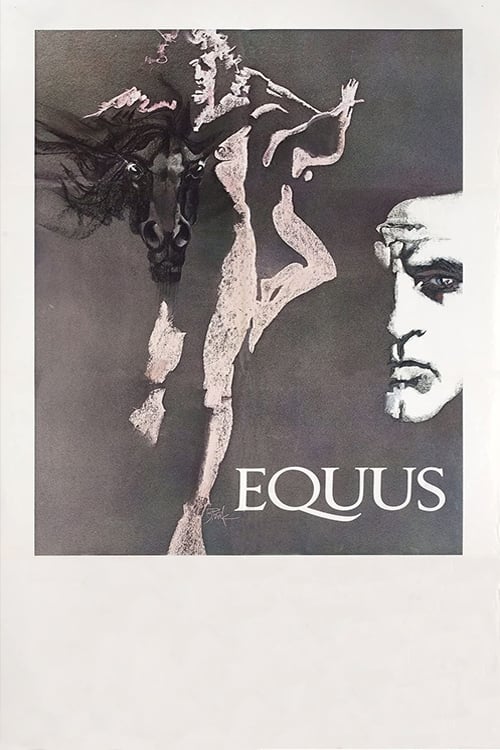
Equus
1977 · Sidney Lumet
For a night when you want a serious, grown-up film to chew on for days — something closer to a great play than a popcorn movie. This is challenge, not comfort: unsettling, adult, and worth it.
What it's about
A psychiatrist is handed the case nobody can explain: a quiet seventeen-year-old stable boy who blinded six horses in a single night. As Martin Dysart digs into the boy's home life — a domineering father, a devout mother, and a private obsession with horses that runs far deeper than a job — the investigation turns back on the doctor himself, forcing him to weigh what 'curing' this boy would actually cost. It's a detective story where the mystery isn't who, but why.
The experience
Slow-burning, talky, and quietly devastating — it works like a therapy session that keeps peeling back one more layer than you're ready for. The mood is clinical on the surface and feverish underneath, and it builds to scenes of startling rawness. You come out arguing with it.
Performances
Richard Burton, in one of his last great roles, delivers the psychiatrist's monologues with a weary, self-lacerating grandeur — you can hear a whole disappointed life in his voice. Peter Firth is fearless as the boy, veering between blankness and ecstatic intensity.
The craft
Sidney Lumet takes a celebrated stage play and films it straight, trusting the language and the faces to carry it — long takes, close-ups, and confessional monologues delivered almost to camera. The result is intimate and intense rather than showy: a film that rewards your full attention more than a big screen, built on writing and acting rather than spectacle.
Why it matters
A famous test case of bringing theater to the screen, it earned Oscar nominations for both leads and stands as one of the boldest of Lumet's actor-driven dramas of the 1970s.
Snapshot
Equus is Sidney Lumet's screen adaptation of Peter Shaffer's 1973 stage play, a psychological mystery that uses the framework of a clinical investigation to stage a metaphysical argument about worship, sexuality, and the price of normality. A psychiatrist, Martin Dysart (Richard Burton), is handed the case of Alan Strang (Peter Firth), a seventeen-year-old stable boy who has gouged out the eyes of six horses with a hoof pick. As Dysart unwinds the boy's pathology — a private religion fusing Christian iconography, horse-flesh, and erotic awe — he is forced to confront the aridity of his own life and the troubling vocation of a healer whose "cure" will extinguish the very capacity for passion that he himself lacks. The film is significant less as cinema than as a test case in the problem of adaptation: Shaffer's play was a triumph of theatrical abstraction, and Lumet's decision to render its world in literal, naturalistic terms became the central critical controversy of the production. It remains best known for Burton's late-career Oscar-nominated performance, Firth's harrowing reprise of the role he created on stage, and the enduring debate over whether the play's power could survive being filmed at all.
Industry & production
Equus arrived as a prestige literary adaptation at a moment when Shaffer's play was an international sensation. Premiered by the National Theatre at the Old Vic in 1973 under John Dexter's direction, Equus had become a long-running success in London and a Tony Award–winning hit on Broadway, lending the film property considerable cultural prestige. The screen rights were taken up by producers Elliott Kastner and Lester Persky, with distribution through United Artists. The budget was modest by the standards of the era's spectacle films; this was a talk-driven chamber piece sold on the strength of its source and its star.
Casting linked the film directly to the stage production. Peter Firth, who had originated Alan Strang in London, was brought to the screen, anchoring the film in the role's theatrical lineage. For Dysart, the production secured Richard Burton, who had himself played the psychiatrist on Broadway, taking over a part associated on stage with Anthony Hopkins. Burton's involvement was both a commercial draw and a redemptive narrative for an actor whose film career had grown erratic in the 1970s. The supporting cast was drawn substantially from the British theatrical establishment — Colin Blakely and Joan Plowright as Alan's parents, Harry Andrews as the stable owner, Eileen Atkins as the magistrate Hesther Salomon who brings Dysart the case, and Jenny Agutter as Jill Mason, the girl whose advances precipitate the catastrophe. The production is generally documented as having been shot in Canada (Ontario), standing in for the play's Hampshire setting, though the granular production record is comparatively thin.
The film's principal industry friction was creative rather than financial: the question, contested from the outset, of how a piece built on non-realistic staging should be filmed. Shaffer wrote the screenplay himself, which gave the adaptation authorial legitimacy but did not resolve the deeper formal problem the medium imposed.
Technology
Equus is technologically conservative, as befits a dialogue-driven adaptation of the late 1970s. It was shot on 35mm in color using conventional production equipment, with no notable optical or special-effects innovation. The one domain where technology bears directly on the film's meaning is the depiction of the horses and the climactic blinding. On stage, the horses were embodied by actors in skeletal metal masks and platform hooves, and the blinding was conveyed entirely through stylization and lighting. Film offered Lumet the option of real animals and physical staging, and the production's choice to use actual horses shifted the burden of the climax onto practical effects and editing rather than theatrical convention. The decision is less a technical achievement than a technical premise with profound aesthetic consequences, discussed below.
Technique
Cinematography
The cinematography is by Oswald Morris, one of the most distinguished British directors of photography of his generation, an Oscar winner whose long association with John Huston and credits such as Fiddler on the Roof and The Man Who Would Be King made him a master of expressive color and texture. In Equus, Morris works in a restrained, naturalistic register for the framing investigation scenes — the consulting room, the Strang household, the courtroom of memory — reserving heightened effects for Alan's nocturnal communions with the horses. The recurring critical observation is that Morris's gift for atmosphere is somewhat at odds with the play's anti-illusionist design: the more beautifully and concretely the stable nights are rendered, the more the material's deliberate abstraction is flattened into the literal. The blinding sequence is the film's most aggressively cinematic passage, where lighting, lens, and cutting are mobilized to convey horror that the stage had rendered through suggestion.
Editing
Edited by John Victor-Smith, the film's cutting follows the play's structure of nested recollection: the present-tense analytic sessions repeatedly dissolve into dramatized flashbacks as Dysart reconstructs Alan's history. The editing carries the burden of translating the play's fluid, presentational time — on stage, past and present coexist on a single bare platform — into film's more literal grammar of scene and flashback. For most of the running time the rhythm is measured and theatrical, governed by the cadence of Burton's monologues. The exception is the final atrocity, where the editing accelerates into rapid, fractured cutting to stage the violence, the film's sharpest departure from its otherwise deliberate pace.
Mise-en-scène / staging
Mise-en-scène is where the adaptation's central wager is most visible. Shaffer and Dexter's stage Equus was an explicitly anti-naturalistic construction — a bare circular platform, benches, actors-as-horses, the audience partly seated on stage — designed so that the spectator's imagination supplied the world. Lumet's film replaces this with rooms, fields, a real stable, and real animals. The result splits critics: the framing device — Dysart's institutional world of offices and corridors — is staged with Lumet's characteristic plain competence, while Alan's mythic interior is asked to do, through literal locations, what the theater achieved through emptiness. The recurring charge is that naturalism domesticates the material, turning ritual into incident. Lumet retains one theatrical residue: long, frontal, monologue-driven scenes in which Burton addresses the camera or an unseen interlocutor, preserving the play's confessional architecture even as the surrounding world is made concrete.
Sound
The score is by Richard Rodney Bennett, a prolific British composer of concert and film music whose credits include Murder on the Orient Express for Lumet. The detailed record of the film's sound design is thin, but in keeping with the production's overall approach the music supports rather than abstracts, underscoring the psychological tension of the sessions and the eerie exaltation of the stable scenes. Sound in Equus is most charged in Alan's invented liturgy — the chant of equine names and the private god-language ("Equus") he intones — where the human voice carries the film's ritual dimension.
Performance
Performance is the film's principal achievement and its most durable claim on attention. Burton's Dysart is a study in eloquent exhaustion: the role is built from long arias of self-interrogation, and Burton's instrument — the burnished, fatigued voice, the watchful stillness — gives the psychiatrist's spiritual envy a genuine gravity. It earned him an Academy Award nomination for Best Actor, one of the last and most respected of his career. Firth, reprising Alan from the stage, delivers a performance of raw exposure — physical, frightened, and erotically charged — that culminates in the demanding nude scene with Agutter and the blinding; he, too, received an Oscar nomination, for Best Supporting Actor. The supporting playing, drawn from the British stage, is uniformly precise, with Plowright and Blakely sketching the religious mother and resentful father whose collision Dysart identifies as the soil of Alan's pathology.
Narrative & dramatic mode
The narrative operates as a detective story turned inside out. The "crime" — the blinding of the horses — is known from the start; the mystery is its motive, and the investigation is psychiatric rather than forensic. The dramatic engine is Dysart's reconstruction of Alan's history through analytic sessions, abreaction, and re-enactment, so that the film advances by excavation, each session peeling back another layer toward the originating trauma. Crucially, Shaffer doubles the inquiry: as Dysart solves Alan, he is unsolved by him, the case becoming a mirror in which the psychiatrist sees his own passionless marriage, his sterile worship of a dead Greek antiquity, and his complicity in a normalizing profession. The mode is confessional and rhetorical — closer to dramatized argument than to conventional plot — and its climax is intellectual as much as visceral: Dysart's recognition that to cure Alan is to "take away his worship," to trade ecstasy for adjustment.
Genre & cycle
Nominally a drama-mystery-thriller, Equus belongs less to a film cycle than to a theatrical and literary one. It is a specimen of the 1970s prestige stage-to-screen adaptation, the period in which acclaimed plays were transferred to film as vehicles for major performances. It also sits within the era's broader cultural fascination with psychiatry and the anti-psychiatry critique — the suspicion, shared with figures like R.D. Laing, that "madness" might house a truth that normality has lost, and that psychiatric cure is a form of social policing. Within Shaffer's own career it forms a pair with Amadeus, his other great drama of an ordinary man's anguished envy of a divine, disruptive passion he cannot possess — Dysart to Alan as Salieri to Mozart.
Authorship & method
The film is a meeting of two strong authorships in some tension. Sidney Lumet was by 1977 a master of the actor-driven, location-grounded American film, fresh from Network (1976) and with Dog Day Afternoon, Serpico, and 12 Angry Men behind him; his method privileged rigorous rehearsal, respect for the written word, and unobtrusive technique in service of performance. That craftsmanship made him a logical choice to protect a great play and its actors — but his fundamental naturalism was arguably the wrong instrument for material whose theatrical power was anti-naturalistic. Peter Shaffer, adapting his own play, retained its language and structure largely intact while opening it out into real spaces, a fidelity to text that paradoxically betrayed the staging. The key collaborators reinforce the prestige-craft profile: Oswald Morris's cinematography, Richard Rodney Bennett's score, and John Victor-Smith's editing all serve the performances with skill, but none works against the grain of literalism that the source perhaps required. The authorship question that hangs over Equus is therefore not who controlled it but whether anyone's method could reconcile a profoundly theatrical conception with the camera's literalizing eye.
Movement / national cinema
Equus resists neat national placement. Directed by an American, adapting a British play, shot in Canada with a largely British cast and financed for an American studio, it is a transatlantic prestige co-production rather than a product of any single national movement. Its deepest affiliations are with the British theater — the National Theatre, Dexter's direction, the Royal-Shakespeare-and-West-End tradition that supplied its players — and with the American tradition of literate, performance-centered filmmaking that Lumet exemplified. It belongs, in short, to the international art-prestige market of the 1970s more than to any indigenous school.
Era / period
The film is firmly of its moment, the late-1970s aftermath of the cultural upheavals of the previous decade. Its frank treatment of adolescent sexuality and nudity, its sympathy for transgressive passion against bourgeois respectability, and above all its anti-psychiatric suspicion of "normalization" are all legible as products of a period that had absorbed the sexual revolution and the counterculture's distrust of institutions. The Vietnam-era erosion of faith in authority finds a quiet echo in Dysart's loss of faith in his own healing function. At the same time the film's literary seriousness and its confidence that a stage play could command a wide film audience mark it as a late instance of a prestige model that the blockbuster era was already beginning to displace.
Themes
The governing theme is the conflict between worship and normality — the idea that passionate, even pathological, devotion may be a higher human state than the well-adjusted blankness that psychiatry produces. Alan's homemade religion, in which the horse is god, slave, and lover, is monstrous in its consequences yet possessed of an intensity Dysart can only envy. From this flow the film's other concerns: the entanglement of the sacred and the sexual, dramatized in Alan's fusion of Christian imagery, equine worship, and erotic ecstasy; the formation of pathology in the home, in the collision between a repressively religious mother and a puritanical, hypocritical father; and the moral ambiguity of the cure, Dysart's agonized recognition that to make Alan "normal" is to perform a kind of spiritual castration. Underlying all of these is the question of the psychiatrist's own life — the sterile marriage, the secondhand worship of antiquity, the suspicion that the doctor is more profoundly sick than the patient.
Reception, canon & influence
Critical reception was sharply divided, and the division fell almost entirely along the fault line of adaptation. Many reviewers admired the performances — Burton's return to form and Firth's ferocity were widely praised — while judging the film a fundamental misconception, arguing that Lumet's literal horses and real locations destroyed the imaginative abstraction that had made the play overwhelming in the theater; the blinding, suggested and unbearable on stage, became merely graphic on film. Others defended the seriousness of the enterprise and the power of the acting. The industry verdict registered in the performances: Burton received a Best Actor nomination, Firth a Best Supporting Actor nomination, and Shaffer a nomination for his adapted screenplay, though the film did not convert these into wins. (Beyond the broad fact of these nominations and the mixed-to-respectful critical consensus, the detailed box-office and awards record is best treated with caution here.)
The influences on the film run backward to its source and its stage realization: Peter Shaffer's 1973 play, John Dexter's anti-naturalistic National Theatre production, and behind them the era's anti-psychiatric thought and the long literary lineage of pagan ecstasy set against Christian and bourgeois repression. The film's forward legacy is paradoxical. As cinema, its influence is slight; it founded no cycle and is rarely cited as a stylistic model. Its lasting cultural function has instead been as a perennial example in the critical literature on adaptation — the standard case study of a great play diminished by literal filming, invoked whenever the limits of transferring theatrical abstraction to the screen are discussed. It also preserves, however imperfectly, a record of Burton's late artistry and of Firth's stage-created Alan, and it secured Equus a permanent, if contested, place in the canon of difficult adaptations. Shaffer's own later triumph with Amadeus (1984), where a more imaginative director found cinematic equivalents for his theatrical conceits, is frequently read against Equus as the counter-example that clarifies what Lumet's film could not solve.
A Deleuzian reading
A man sits up in the dark and talks about a god he has never been able to worship.
The full Deleuzian reading of Equus →
Reception
Divisive on release — critics argued Lumet's realism (real horses, real stables) flattened the stylized theatricality that made Peter Shaffer's play a sensation — and it's still mostly discussed as a fascinating misfire redeemed by its acting.
How Equus was received, from release to now →
Influences: the films it descends from and the films it influenced
- Suddenly, Last Summer (1959) — Establishes the template Equus reworks: a psychiatrist extracts a withheld, sacred-sexual horror from a damaged patient, the truth delivered as a single climactic flashback the whole film has been structured to defer.
- Long Day's Journey into Night (1962) — Lumet's own prior model for transferring a canonical play to film by textual fidelity and near-static, actor-trusting staging rather than 'opening out' — the same instinct he brings (and the same risk he runs) on Equus.
- The Pawnbroker (1964) — Source of Lumet's subliminal flash-cut flashback grammar — traumatic memory intruding in accelerating bursts — which returns as the editing strategy of Equus's blinding climax.
- 12 Angry Men (1957) — Lumet's chamber-theatrical method: confine the drama, subordinate camera to performance, and build to a verbal climax — the unobtrusive prestige-craft profile he carries into Equus.
- Who's Afraid of Virginia Woolf? (1966) — Demonstrates filming a verbally dense stage text while preserving its language and stage-scaled acting — and gives Burton the precedent for delivering theatrical declamation to a camera.
- Marat/Sade (1967) — The model for committing a deliberately anti-naturalist, ritualized stage production to film, with an asylum frame fusing madness, performance, and Theater-of-Cruelty spectacle — the abstraction Lumet's literalism abandons.
- Reflections in a Golden Eye (1967) — Oswald Morris's stylized, desaturated color scheme yoked to a story of a repressed man's erotic fixation on a horse — the same cinematographer's vocabulary of equine-sexual imagery feeding Equus.
- Spellbound (1945) — Originates the psychoanalytic inverted-detective structure Equus inherits: the symptom is the clue, the cure is the investigation, and a repressed image is withheld until its decoding resolves the case.
- The Royal Hunt of the Sun (1969) — Shaffer's earlier stage conceit on film — a rational, disenchanted European destroyed by his encounter with ecstatic pagan worship — the worship-versus-normality engine Equus restates through Dysart.
- Ordinary People (1980) — Builds its entire dramaturgy on Equus's therapeutic engine — escalating analyst-patient sessions that excavate a guarded trauma — treating the confessional breakthrough itself as the film's climax.
- Amadeus (1984) — Shaffer adapting his own anti-naturalist play again, but with a director who invents cinematic equivalents for theatrical conceits — the deliberate counter-solution to Equus, retaining the confessional frame and worship-versus-mediocrity theme.
- Agnes of God (1985) — Directly reprises Equus's setup: a skeptical clinician investigating an inexplicable act of religious ecstasy, a stage play opened into real spaces, the sacred-and-sexual held in unresolved tension with rational diagnosis.
- The Prince of Tides (1991) — Extends the analyst-as-excavator structure, using confessional flashback within the therapy relationship to stage the slow recovery of a buried, shame-laden traumatic memory.
- A Dangerous Method (2011) — Dramatizes the talking cure itself as its subject — psychiatric authority entangled with the patient's sexual pathology — extending Equus's distrust of the analyst who normalizes what he cannot feel.
- Sleuth (1972) — Anthony Shaffer (Peter's twin) adapting his own theatrical two-hander to film, sharing the Shaffer signature of an intellectual gamesman whose elaborate rationality is the play's real subject.
- One Flew Over the Cuckoo's Nest (1975) — Same post-counterculture anti-psychiatry argument dramatized: institutional 'normality' as the disease and madness as suppressed vitality, the very inversion Dysart confesses to envying.
- Doubt (2008) — A playwright filming his own tightly argued chamber play about faith versus certainty, sharing Equus's interrogation structure where the investigator's own conviction, not the 'crime,' is what's truly on trial.
Similar films
- Long Day's Journey Into Night (1962) — influence & lineage
- 12 Angry Men (1957) — influence & lineage
- Doubt (2008) — influence & lineage
- Sleuth (1972) — influence & lineage
- The Elephant Man (1980) — shared sensibility
- The Power of the Dog (2021) — shared sensibility
- The Spy Who Came In from the Cold (1965) — shared sensibility
- Hamlet (1996) — shared sensibility