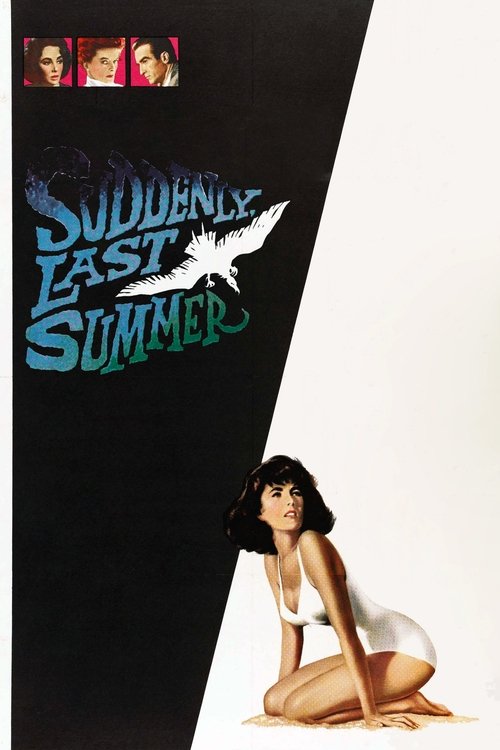
Suddenly, Last Summer
1959 · Joseph L. Mankiewicz
When you want high drama with teeth — a film to chew on, argue about, and marvel at for its sheer nerve. This is a challenge watch, best when you're in the mood for something intense and strange rather than soothing.
What it's about
A wealthy New Orleans widow's beloved son has died abroad, and the young cousin who was with him came home raving — so the widow wants her lobotomized, and is prepared to fund a hospital to make it happen. A neurosurgeon is brought in to operate but insists on first finding out what the young woman actually saw. The film becomes a duel over one buried memory: money and reputation on one side, an unbearable truth on the other.
The experience
Talky, feverish, and deliberately overheated — a hothouse of monologues that keeps ratcheting toward a single devastating act of remembering. It's lurid in the grand Tennessee Williams manner: you watch it half-hypnotized, waiting for the storm to break.
Performances
Katharine Hepburn is chilling as the widow, delivering venom as gracious Southern hospitality, and Elizabeth Taylor is ferocious as the young woman fighting for her own mind — their scenes are heavyweight bouts. Montgomery Clift brings a wounded stillness between them.
The craft
Adapted from Tennessee Williams's play by Williams and Gore Vidal, it's a masterwork of saying the unsayable — smuggling shocking material past 1950s censorship through pure insinuation and poetic dialogue. Mankiewicz stages it like a pressure cooker, all garden-conservatory opulence closing in around the characters.
Why it matters
One of the boldest studio films of its era, famous for what it dared to imply at the tail end of the Production Code, and a peak of the Williams-adaptation wave that dominated late-1950s Hollywood. The Hepburn–Taylor showdown remains legendary.
Snapshot
Suddenly, Last Summer is a hothouse gothic of repression, a chamber drama in which a single buried memory becomes a battlefield over money, sanity, and an unspeakable truth. Adapted from Tennessee Williams's one-act play by Williams and Gore Vidal, produced by Sam Spiegel, and directed by Joseph L. Mankiewicz, it stages a contest between a wealthy New Orleans widow, Violet Venable (Katharine Hepburn), who would have her niece lobotomized to silence her, and a young neurosurgeon (Montgomery Clift) who insists on excavating what the niece, Catherine (Elizabeth Taylor), actually witnessed when her cousin Sebastian died abroad. The film is talky, theatrical, and lurid by turns, and it remains notable for the way it smuggled cannibalism and coded homosexuality past the Production Code at the very end of the Code's effective dominion. It is also a showcase for three of the era's most charismatic performers operating at high intensity, and a film whose subject — predatory consumption, literal and figurative — is unusually consonant with its own overheated style.
Industry & production
The film was a transatlantic prestige production assembled by Sam Spiegel's Horizon Pictures and released through Columbia Pictures, made in the wake of Spiegel and Columbia's enormous success with The Bridge on the River Kwai (1957). Spiegel acquired Williams's brief, scandalous one-act — first staged in 1958 off-Broadway on a double bill with Something Unspoken under the umbrella title Garden District — and commissioned Gore Vidal to expand roughly an hour of stage material into a feature. Williams shares screen credit, though by most accounts the structural opening-out of the play was Vidal's work, and Williams reportedly grew unhappy with aspects of the adaptation.
Principal photography took place in England, primarily at Shepperton Studios, a choice that reflects both Spiegel's London base and the economics of the period. The casting brought together Hepburn, Taylor, and Clift — three major stars whose combined wattage was the film's chief commercial asset. The production is now nearly as famous for its off-screen tensions as for the finished work: the long-circulated account holds that Hepburn, appalled by Mankiewicz's and Spiegel's treatment of the fragile, post-accident Montgomery Clift, expressed her contempt on the final day of shooting. The episode is widely reported in biographies of all involved, though it survives as anecdote rather than documented fact and should be read with that caution. What is not in dispute is that Clift, in declining health following his 1956 car accident, struggled through the shoot, and that Taylor — who had a deep personal loyalty to Clift — reportedly worked to protect him. The film was a commercial success on release; precise grosses are not something I can responsibly quote here.
Technology
This is a black-and-white, monaural, standard-process production of the late studio era, and its technological interest lies less in novelty than in deliberate restraint. At a moment when Hollywood was answering television with color and widescreen spectacle, Suddenly, Last Summer was shot in black and white and in an essentially academic-to-modest aspect ratio, the better to serve a film built almost entirely from faces, rooms, and talk. The one place the production reaches for technological spectacle is the climactic flashback, where the recovered memory is rendered through superimposition, harsh overexposure, and optical effects rather than conventional dramatization — a choice that keeps the unspeakable partly abstract and dependent on Catherine's narrating voice. Otherwise the film's tools are the classical ones: studio sets, controlled lighting, and the dolly.
Technique
Cinematography
The cinematography is by Jack Hildyard, fresh from his Academy Award–winning work on The Bridge on the River Kwai. Here he trades that film's tropical scale for a claustrophobic, high-contrast monochrome keyed to interiors: the shadowed Venable mansion, the cavernous institutional spaces of the asylum, and above all Sebastian's jungle garden, a primordial conservatory of carnivorous plants that functions as the film's central visual metaphor. Hildyard's lighting tends toward the sculptural, isolating faces against darkness in the long interrogation passages and lending Hepburn's Violet a brittle, monumental glamour. The climactic flashback departs sharply from this controlled idiom into bleached, hallucinatory imagery — a stylistic rupture meant to register the eruption of buried trauma into consciousness.
Editing
The editing — credited to William Hornbeck, a veteran of long standing, with Thomas Stanford — serves a structure that is essentially a withheld revelation. For most of its length the film is paced as theater, holding on extended monologues and two-handers and trusting performance and language to carry duration. The cutting becomes assertive only at the climax, where fragmented, repetitive flash-images are intercut with Catherine's narration to assemble the truth in pieces. The contrast between the film's patient first movement and its convulsive final one is its principal editorial gesture.
Mise-en-scène / staging
Mise-en-scène is where the film most clearly betrays its theatrical origins and turns that origin into an asset. The art direction and design — associated with the British designer Oliver Messel — give the production its two defining environments: the decaying opulence of the Venable house with its Venus flytrap garden, and the bleak modern asylum to which Catherine is confined. The carnivorous garden is the film's governing image, a literalization of Sebastian's, and his mother's, predation. Mankiewicz stages much of the drama in long, mobile takes that let the camera prowl among speakers, preserving the architecture of Williams's dialogue while opening the single set of the play into a layered world. Violet's celebrated entrance via a small private elevator, descending into the garden like a goddess into her grove, is a piece of pure staged spectacle.
Sound
The sound design centers on the spoken word — this is a film of arias, confessions, and interrogations — and on Williams's heightened, incantatory language. The musical score is generally credited to Buxton Orr, with the British composer Malcolm Arnold associated with the music as well; the precise division of labor is something I would not want to state with false confidence. The scoring works in a lush, ominous register, swelling beneath the monologues and rising to near-hysteria in the flashback, where music, screaming, and voiceover combine to evoke the horror that the image only fragmentarily shows.
Performance
Performance is the film's true medium. Hepburn plays Violet Venable as a magnificent monster — controlled, imperious, and finally mad — sustaining enormous monologues, including the famous account of the Encantadas and the baby sea turtles devoured by birds, with a terrifying serenity. Taylor's Catherine moves from sedated fragility to the full, harrowing reenactment of the truth, and her climactic narration is among the most physically committed work of her career. Clift, frailer and more interior than his co-stars, plays the surgeon as a quiet moral center, his very stillness a counterweight to the women's grand rhetoric — a quality that reads, in light of his condition during filming, as both performance and circumstance. Mercedes McCambridge, as Catherine's grasping mother, sharpens the film's portrait of a family willing to trade a daughter's mind for an inheritance. Hepburn and Taylor were both recognized with Academy Award nominations for Best Actress.
Narrative & dramatic mode
The film's dramatic mode is the gradual forced confession — a structure closer to detective fiction and to psychoanalysis than to conventional melodrama. The dead Sebastian Venable never appears (his face is withheld throughout), existing only as an absence around which the living circle and contend. The narrative engine is a question — what happened "suddenly, last summer" — and the plot is the slow, coerced extraction of an answer that two parties have powerful reasons to suppress: Violet, to protect the myth of her son, and Catherine's own family, to secure the Venable money. The neurosurgeon's investigation, culminating in a truth serum, makes the recovery of repressed memory the literal mechanism of the climax. This is a recognizably Mankiewiczian design — a film organized around testimony, retrospection, and the unreliability of what people say about themselves and their dead — though here pushed to gothic extremity.
Genre & cycle
Suddenly, Last Summer sits at the intersection of several cycles. It belongs to the late-1950s wave of prestige Tennessee Williams adaptations — A Streetcar Named Desire (1951), The Rose Tattoo (1955), Baby Doll (1956), Cat on a Hot Tin Roof (1958) — that brought Williams's sexually charged Southern dramas to the screen in increasingly explicit form. It is also a key text of Southern Gothic on film, trading in decay, repression, family rot, and the grotesque. And in its asylum setting, its threat of lobotomy, and its theme of a woman declared insane to keep her quiet, it touches the period's cycle of psychiatric melodrama. The cannibalistic revelation pushes it toward horror, making it a peculiar hybrid: a literary prestige picture with the secret architecture of a monster movie.
Authorship & method
The film is a genuine collision of strong authors. Tennessee Williams supplies the source material, the symbolic vocabulary (the carnivorous garden, the devouring birds, the using of human beings), and the language. Gore Vidal performs the structural adaptation, expanding and rationalizing the one-act into feature form. Joseph L. Mankiewicz directs in the mode that defined his best work — A Letter to Three Wives (1949) and All About Eve (1950) — privileging dialogue, retrospective narration, and the verbal duel, and trusting actors to hold long, articulate scenes. The match between Mankiewicz's literary, talk-driven sensibility and Williams's monologue-heavy material is close, even as the gothic excess of the subject sits somewhat outside Mankiewicz's usual urbanity. Among collaborators, Sam Spiegel's role as producer was decisive in marshaling the resources and the cast; Jack Hildyard supplied the monochrome look; and the British craft base at Shepperton, including Messel's design, shaped the film's physical world. The result is authored at several levels at once, which is part of why critics have long debated how much of it is Williams and how much Mankiewicz.
Movement / national cinema
The film is a product of Hollywood's late classical studio system, made by an American director and American stars but physically produced in Britain under a producer who worked transatlantically — a configuration increasingly common as American production decentralized in the late 1950s. It is not part of any film movement in the avant-garde sense; its lineage is theatrical and literary rather than cinematic-modernist. Where it gains a broader significance is as one of the films through which American cinema, under commercial and legal pressure, began to enlarge the range of adult subject matter it could address.
Era / period
1959 places the film at the threshold of the Production Code's collapse. The Code still governed Hollywood, and its prohibition on depicting homosexuality remained formally in force, yet Suddenly, Last Summer dealt centrally — if through indirection — with a homosexual man's predatory use of others, and with cannibalism, themes that only a few years earlier would have been unthinkable. The film handled this by keeping Sebastian's homosexuality coded and his face unseen, and by framing the material within a structure of condemnation rather than endorsement; it reportedly drew careful handling from the Code administrators and the Legion of Decency. It belongs, in other words, to the brief transitional moment — alongside other late-1950s "adult" pictures — when the old machinery of censorship was bending under the weight of material it could no longer entirely suppress, anticipating the Code's replacement by the ratings system the following decade.
Themes
The film's master theme is consumption — the using of people, treated both as metaphor and, finally, as literal horror. Sebastian "used" his mother and then his cousin as bait to procure young men; the boys he exploited consume him in turn; Violet would consume Catherine's mind to preserve a fiction; Catherine's family would trade her sanity for money. Around this run Williams's characteristic concerns: sexual repression and the violence of the closet, the predatory dynamics of family and class, and a bleak theology in which God is glimpsed in the spectacle of the strong devouring the weak — the sermon Violet draws from the sea turtles and the birds. The lobotomy that threatens Catherine literalizes the theme of enforced silence: the film is, at bottom, about who is permitted to speak the truth and who will be cut, sedated, or institutionalized to prevent it. Madness, sanity, and money are inseparable in its moral economy.
Reception, canon & influence
Backward — influences on the film. The film draws on Tennessee Williams's distinctive fusion of Southern Gothic, classical myth (the imagery of sacrifice and dismemberment carries echoes of Greek tragedy and the Orphic), and Freudian psychology, all filtered through the symbolist density of his late-1950s writing. It inherits the structural devices of the well-made mystery and of psychoanalytic narrative — the buried memory recovered under pressure — and it stands on the shoulders of the earlier successful Williams screen adaptations, which had established both a market and a method for translating his work.
Reception. Contemporary criticism was divided in a way that has persisted: admirers praised the performances — particularly Hepburn's and Taylor's — and the audacity of the material, while detractors found the film overwrought, static, or distastefully lurid, and questioned how much sense its symbolic apparatus finally made. The two Best Actress nominations confirmed its standing as a serious awards-season picture, and it was recognized as well for its art direction. Over time the film has been read increasingly through the lens of its coded queerness, becoming a recurring case study in scholarship on the representation — and suppression — of homosexuality under the Production Code, where Vito Russo's foundational work on gay images in film helped fix its reputation as a key text of the "monstrous" closet.
Forward — legacy. The film's influence is felt less in direct imitation than in its status as a touchstone. It is a fixture in accounts of how late-1950s cinema pried open the Code, and in the canon of Williams adaptations against which later ones are measured. Its central conceit — the unseen, devouring absent figure and the witness whose truth must be forced out against powerful suppression — anticipates a durable mode of psychological gothic. And its frank yoking of repression, predation, and horror has made it a perennial reference point for critics and filmmakers interested in the gothic underside of mid-century respectability. Where the historical record on its production and reception is thin or anecdotal — particularly regarding the on-set conflicts — it is best treated as well-attested legend rather than documented fact, and I have flagged it as such above.
A Deleuzian reading
Start with the turtles.
The full Deleuzian reading of Suddenly, Last Summer →
Reception
A lurid box-office hit in 1959 that critics treated as overheated Tennessee Williams excess; today it's reclaimed as a fascinating artifact of coded queer cinema and high Gothic camp, endlessly picked over in queer film studies.
How Suddenly, Last Summer was received, from release to now →
Influences: the films it descends from and the films it influenced
- A Streetcar Named Desire (1951) — Establishes the template this film inherits — translating a Williams play to screen by retaining its monologue arias and hothouse single-set claustrophobia while negotiating the Code's censorship of its sexual core through coded ellipsis.
- Cat on a Hot Tin Roof (1958) — Immediate predecessor in the Williams-adaptation cycle whose method it extends: a family interrogation that drives toward forced confession of a suppressed (homosexual) truth, with the dead/absent man whose nature must be spoken aloud.
- The Glass Menagerie (1950) — The first Williams screen adaptation, which built the market and the retrospective-narration method — a remembered past framed by a narrator's voice — that this film weaponizes into withheld testimony.
- All About Eve (1950) — Mankiewicz's own template of the verbal duel and nested retrospective narration, where character is built through long articulate speeches and overlapping flashback testimony rather than action.
- A Letter to Three Wives (1949) — Mankiewicz's structural device of an absent woman whose voiceover frames flashbacks — the talk-driven, narration-bracketed architecture he reuses for Catherine's forced recollection.
- Citizen Kane (1941) — The investigation-by-testimony structure built around a never-fully-seen central figure reconstructed only through others' accounts, plus the deep-focus high-contrast monochrome that the gothic compositions echo.
- Rebecca (1940) — The prototype of the devouring absent character — a dead figure who never appears yet dominates every scene — whose true predatory nature is the withheld revelation finally forced into the open.
- Spellbound (1945) — The psychoanalytic-melodrama engine of a traumatic repressed memory recovered under clinical pressure, visualized through dreamlike superimposition — the exact narrative machinery of Catherine's breakdown.
- Gaslight (1944) — The threat-of-committal melodrama in which a woman's sanity is weaponized against her by a powerful relative, the suppression-of-the-witness dynamic Mrs. Venable mounts against Catherine.
- Sweet Bird of Youth (1962) — Extends the Williams-adaptation craft directly — monologue-driven confession of a corrupt past, predation and consumption of the young, staged as theatrical long takes.
- The Night of the Iguana (1964) — Later Williams adaptation measured against this one, sustaining the hothouse single-location pressure-cooker and the long articulate breakdown monologue as its dramatic climax.
- Reflections in a Golden Eye (1967) — Carries forward the coded-queerness-as-monstrosity mode with Taylor again at the center, dramatizing repressed desire and predation under a veneer of Southern military respectability.
- Hush...Hush, Sweet Charlotte (1964) — Descends in the Grand Guignol Southern gothic line — a withheld memory of a dismemberment/killing, a wealthy matriarch's household, and a sane woman menaced toward madness.
- The Beguiled (1971) — Extends the carnivorous-garden conceit — a hothouse of repressed Southern women who literally consume/dismember the predatory man — making explicit the devouring-as-revenge metaphor this film encoded.
- Marnie (1964) — Descendant in the psychiatric melodrama of a buried childhood trauma forced into consciousness through superimposed flashback and incantatory interrogation as the curative climax.
- Equus (1977) — Establishes the template Equus reworks: a psychiatrist extracts a withheld, sacred-sexual horror from a damaged patient, the truth delivered as a single climactic flashback the whole film has been structured to defer.
- Rashomon (1950) — Sibling in the contested-testimony mode — a death reconstructed through irreconcilable subjective accounts where the truth is the thing the structure withholds until the final telling.
- The Night of the Hunter (1955) — Sibling in expressionist Southern gothic, using high-contrast monochrome and a predator stalking the innocent to expose the horror beneath mid-century respectability.
- From Here to Eternity (1953) — Mankiewicz cast Clift in a role where his Method deterioration vocabulary — moral refusal at physical cost, conflict expressed through bodily erosion — could be pushed to its terminus, while the film navigated the Production Code's prohibition on homosexual content using the same symbolic displacement strategy Zinnemann had employed from Jones's novel.
- The Children's Hour (1961) — A Williams theatrical adaptation that structures its drama around an unnameable homosexuality kept offscreen and reached only by verbal insinuation — the same Code-era rhetoric of the unspoken.
Similar films
- Cat on a Hot Tin Roof (1958) — influence & lineage · same viewing thread
- A Streetcar Named Desire (1951) — influence & lineage · same viewing thread
- Eve's Bayou (1997) — same viewing thread
- Who's Afraid of Virginia Woolf? (1966) — shared sensibility
- Long Day's Journey Into Night (1962) — shared sensibility
- Lolita (1962) — shared sensibility
- Carnal Knowledge (1971) — shared sensibility
- Teenage Sex and Death at Camp Miasma (2026) — shared sensibility
All the films related to Suddenly, Last Summer →
Watch it with: curated runs of related films
- Heat and Reckoning in the American South — A run of Southern dramas where family, race, and old money simmer under the same unbearable heat — watch them together to trace the region from the plantation myth through the civil-rights march.