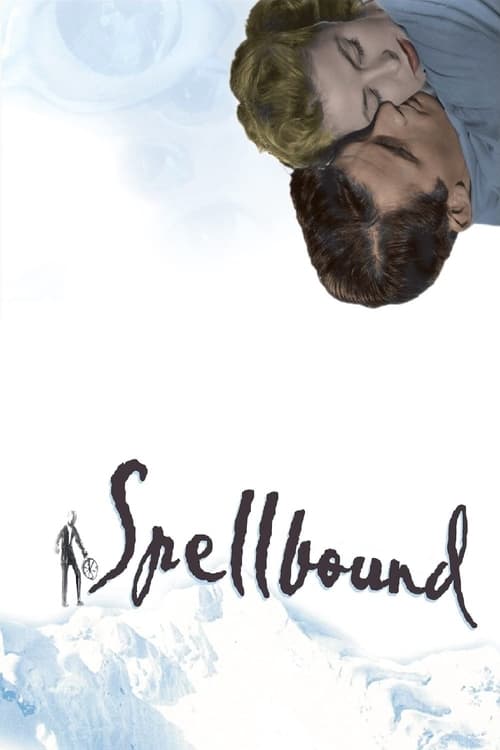
Spellbound
1945 · Alfred Hitchcock
For a classic-movie night when you want old-Hollywood glamour with an undertow of unease — a couch, a drink, and a black-and-white thriller that's more seductive than scary.
What it's about
At a Vermont psychiatric hospital, the brilliant and coolly rational Dr. Constance Peterson falls for the institution's charming new director — then discovers he's an impostor with no memory of who he is, terrified he may have murdered the real doctor. Convinced of his innocence, she goes on the run with him, using psychoanalysis itself as her detective's toolkit to dig the truth out of his buried past.
The experience
A heady blend of romance and mystery that plays like a fever dream — swooning one minute, quietly menacing the next. The pleasure is watching love and suspicion wrestle in every scene, with the answer locked inside a mind that can't be trusted.
Performances
Ingrid Bergman is luminous as the analyst thawing from clinical detachment into reckless devotion — she makes falling in love look like a professional crisis — and Gregory Peck brings a haunted, wounded uncertainty to the man who doesn't know his own name.
The craft
Its showpiece is a dream sequence designed by Salvador Dalí — eyes, scissors, and impossible landscapes rendered with genuine surrealist strangeness — and Miklós Rózsa's score, with its eerie electronic wail, practically invented the sound of screen psychology. Hitchcock wraps it all in silvery, romantic black-and-white.
Why it matters
It caught Hollywood's postwar fascination with psychoanalysis at full flood and set the template for the psychological thriller in which the mystery is inside someone's head.
Snapshot
Spellbound is Alfred Hitchcock's lush, knowingly Freudian romantic thriller, the second of his collaborations under producer David O. Selznick and the most explicit screen statement of mid-1940s Hollywood's fascination with psychoanalysis. Ingrid Bergman plays Dr. Constance Petersen, a coolly rational analyst at a Vermont sanitarium who falls in love with the institution's incoming director (Gregory Peck), only to discover he is an amnesiac impostor convinced he has committed murder. The film yokes a detective plot — find the buried memory, exonerate the man — to a love story, and stages the investigation as a literal excavation of the unconscious. It is remembered today less for its mystery mechanics, which Hitchcock himself dismissed, than for two production set pieces: Salvador Dalí's dream sequence and Miklós Rózsa's Oscar-winning, theremin-laced score. As a cultural document it captures the moment American popular cinema absorbed Freud into its dramatic vocabulary; as a Hitchcock film it is a transitional, producer-shaped work that nonetheless rehearses obsessions — guilt transference, the innocent accused, the curative power of confession — he would carry into Notorious, Vertigo, and Marnie.
Industry & production
Spellbound was a David O. Selznick production released through United Artists in 1945, made while Hitchcock was bound by his multi-year contract to Selznick International Pictures — the arrangement that had brought him to Hollywood for Rebecca (1940). The project bears Selznick's fingerprints as heavily as Hitchcock's. The producer was himself then undergoing psychoanalysis, and the subject's commercial and personal appeal to him is well documented; he engaged his own analyst, Dr. May Romm, who receives an on-screen credit as psychiatric advisor. The source was the 1927 novel The House of Dr. Edwardes by "Francis Beeding" (a joint pseudonym of Hilary St. George Saunders and John Palmer), a gothic tale of a madman running an asylum that the adaptation largely discarded in favor of the amnesia-and-analysis structure.
The casting paired Selznick's prestige contract star Ingrid Bergman, then at the height of her popularity after Casablanca and Gaslight, with Gregory Peck, a rising actor whom Selznick was grooming. The production was characteristically subject to Selznick's voluminous memoranda and his insistence on emotional accessibility, which at times pulled against Hitchcock's preferences; the friction between the two men over this period is part of the documented record of their partnership, though specific creative attributions should be treated with the caution the secondhand accounts deserve. The film was a substantial commercial success and a multiple Academy Award nominee — Best Picture, Director, Supporting Actor, Cinematography, Special Effects, and Score — winning for Rózsa's music.
Technology
The most-discussed technical element is Rózsa's use of the theremin, an early electronic instrument whose eerie, wavering vocal-like tone is sounded whenever Peck's character is gripped by his phobia. Spellbound was among the films (alongside Billy Wilder's The Lost Weekend, scored by Rózsa the same year) that introduced the instrument to mainstream Hollywood as a signifier of psychological abnormality, establishing a convention that would echo through later science-fiction and suspense scoring. The film also deploys period optical and in-camera effects: rear projection for the skiing climax, and a celebrated subjective effect in which a hand holding a revolver tracks across the frame and fires directly at the camera. In the original Technicolor release prints, the gunshot was accompanied by two frames hand-tinted red — a startling splash of color in an otherwise black-and-white film, surviving in some prints and restorations and lost from others. The dream sequence required specialized set construction and large-scale painted elements to realize Dalí's imagery in three dimensions rather than as simple matte work.
Technique
Cinematography
George Barnes, an Academy Award winner for Rebecca, shot Spellbound in glossy black and white, lighting Bergman in the soft, luminous high-key manner of Selznick's star photography while reserving harder contrasts and disorienting angles for the thriller passages. The film's signature visual idea is the recurring motif of parallel lines on white — ski tracks in snow, fork-marks scored across a white tablecloth, the striped pattern of a bedspread — which trigger the protagonist's panic and are photographed to lurch into the foreground. Barnes and Hitchcock use subjective camera throughout: the dissolve into white that floods the frame, the looming first-person POV, and the famous oversized prop work. A frequently cited example is the kiss accompanied by a montage of opening doors, an externalization of emotional release rendered through editing and optical superimposition rather than performance alone.
Editing
Cut by Hal C. Kern (a longtime Selznick collaborator and Gone with the Wind editor) with William Ziegler, the film alternates between the measured rhythm of dialogue-driven analysis scenes and sharp, associative montage at moments of psychic crisis. The editing carries the picture's central conceit: memory is recovered in fragments, and the cutting literalizes the analytic process of assembling clues into a coherent narrative. The door-montage and the climactic gunshot depend entirely on editorial timing for their impact.
Mise-en-scène / staging
The production design contrasts the orderly, wood-paneled sanitarium and the domestic warmth of Dr. Brulov's home against the vertiginous dreamscape and the white voids of the phobia sequences. The Dalí dream — with its painted eyes on draped curtains, the giant scissors, the faceless proprietor, the sloping rooftop and the wheel — is the film's mise-en-scène centerpiece, conceived to look unlike conventional soft-focus movie dreams. It was reportedly designed and shot at far greater length than what survives in the release cut, with much of Dalí's material excised; the precise extent of what was filmed versus merely planned is debated, and the fuller version is generally considered lost. William Cameron Menzies, the production designer associated with the film's special sequences, is part of this history, though credit lines for the dream's execution are tangled.
Sound
Beyond the theremin, the sound design supports the subjective program: the score swells and recedes with the protagonist's mental state, and silence is used to isolate the triggering images. Rózsa's main theme functions as both love motif and anxiety motif, its two faces tracking the film's fusion of romance and dread.
Performance
Bergman anchors the film with a performance that must hold intellectual authority and romantic vulnerability simultaneously — the analyst whose reason is overwhelmed by feeling. Peck plays passivity and dread, a hero who is largely acted upon, his blankness suiting a man emptied of memory. The standout supporting turn is Michael Chekhov (nephew of the playwright Anton Chekhov and an influential acting teacher) as Constance's warm, shrewd mentor Dr. Alexander Brulov, a performance nominated for Best Supporting Actor. Leo G. Carroll, a recurring Hitchcock player, provides the institutional menace.
Narrative & dramatic mode
The screenplay marries two of Hitchcock's favorite structures: the wrong-man thriller and the romantic quest. The dramatic engine is a double mystery — what happened to the real Dr. Edwardes, and what is buried in the impostor's mind — solved not by detection in the streets but by analysis on the couch. This makes psychoanalysis the literal plot mechanism: the "talking cure" and dream interpretation are the means by which the crime is reconstructed and the hero cleared. The narration is largely aligned with Constance, positioning the audience as fellow investigator and lover, and the climax delivers the genre's required reversal by relocating guilt onto an unexpected figure. Critics have long noted that the psychology is dramatized in simplified, almost diagrammatic form; the film treats repression and recovered memory as a lock that the right key will open in a single cathartic stroke.
Genre & cycle
Spellbound sits at the intersection of the romantic melodrama and the emerging psychological thriller, and it belongs to a distinct 1940s Hollywood cycle of psychoanalytic films — pictures in which Freudian concepts, asylums, amnesia, and analysts drove the drama. The vogue, fed by the wartime and postwar prestige of psychiatry, produced a run of related titles across the decade. Within Hitchcock's own work it is the most overtly Freudian entry, though guilt, projection, and the return of the repressed run through his filmography. It also participates, through its visual style and its preoccupation with a tormented psyche, in the broader monochrome shadow-world that overlaps with film noir, even as its Selznick gloss and romantic resolution distinguish it from noir's fatalism.
Authorship & method
The film is a genuine collaboration — and contest — of strong authors. Hitchcock directs, bringing his interest in subjective vision, transferred guilt, and suspense built on audience knowledge, but working within constraints set by Selznick, whose taste for emotional clarity and star luminosity shapes the final form. The screenplay is credited to Ben Hecht, one of Hollywood's most prolific and respected writers, who shared Selznick's interest in psychoanalysis and would reteam with Hitchcock on Notorious; Angus MacPhail is credited with the adaptation. George Barnes photographs, Miklós Rózsa scores, and Hal C. Kern edits, all bringing Selznick-house craft pedigree. The participation of Salvador Dalí — recruited for the surrealist credentials his name conferred as much as for the imagery — was a publicity coup as well as an aesthetic choice. Hitchcock's own later assessment, delivered in his interviews with François Truffaut, was notably cool: he framed the film as a manhunt dressed in pseudo-psychoanalysis and expressed dissatisfaction that the Dalí material was compromised in execution.
Movement / national cinema
This is studio-era American filmmaking, produced inside the independent-prestige model that Selznick pioneered. Yet Spellbound is shot through with European influence: Hitchcock's British and German-inflected suspense craft, Rózsa's Central European musical training, Chekhov's Russian and émigré theatrical lineage, and Dalí's Spanish surrealism. The dream sequence in particular imports the imagery of European Surrealism — the movement of Dalí and Luis Buñuel — into a mainstream Hollywood frame, one of the more direct transfusions of avant-garde art into commercial American cinema in the period.
Era / period
Released in 1945, Spellbound arrives at the close of the Second World War, when psychiatry had gained public visibility through its role in treating combat trauma and "shell shock," and when Freudian ideas were diffusing into middlebrow American culture. The film both reflects and helped popularize that interest, presenting the analyst as a glamorous, authoritative figure and the cure as dramatic and attainable. Its confident, optimistic faith in reason and confession — that buried truth, once spoken, heals — is very much of its postwar moment.
Themes
The governing theme is guilt and its transference: a man convinced he is a murderer who is in fact innocent, carrying since childhood the "guilt complex" of an accidental death he believes he caused. Around this cluster Hitchcock's recurring preoccupations: the innocent accused, the unreliability of appearances, and confession as redemption. Psychoanalysis supplies the thematic frame — repression, the return of the repressed, dream as coded message, the symbolic trigger (white surfaces and parallel lines) standing in for unspeakable trauma. The romance carries its own theme: the conflict between reason and desire, dramatized in an analyst who must abandon clinical detachment to save the man she loves. Knowledge — who knows what, and when — structures both the suspense and the love story.
Reception, canon & influence
Spellbound was a popular success on release and was nominated for six Academy Awards, winning Best Original Score for Rózsa; critical reception then and since has been admiring of its craft and stars while skeptical of its tidy, schematic psychology. Its standing in the Hitchcock canon is secure but secondary — it is rarely ranked with his greatest works, and Hitchcock's own dismissals have colored its reputation, yet it is indispensable to understanding his development and the 1940s psychoanalytic cycle.
Looking backward, the film draws on the Freudian psychoanalytic literature mediated through figures like May Romm and the cultural moment; on European Surrealism via Dalí for its dream imagery; on the Selznick prestige-production template established by Rebecca; and on Hitchcock's own British wrong-man thrillers. Looking forward, its influence runs along several lines: Rózsa's theremin scoring helped codify the instrument as the sound of psychological derangement and, later, the uncanny in science fiction; the film cemented the screen archetype of the analyst-detective and the cinematic dream-as-clue, a device endlessly reworked in later psychological thrillers; and it stands as a touchstone whenever Hollywood's mid-century romance with Freud is discussed. Within Hitchcock's own art, Spellbound is a rehearsal for the deeper, darker treatments of obsession, trauma, and the curative or destructive recovery of the past that culminate in Vertigo and Marnie. Its most famous individual artifact — the Dalí dream sequence — has had an afterlife independent of the film, repeatedly cited, parodied, and studied as a rare meeting of high surrealism and the studio system.
A Deleuzian reading
Watch the fork.
The full Deleuzian reading of Spellbound →
Reception
A big hit in 1945 — six Oscar nominations including Best Picture — but its stock has slipped: today it's filed as mid-tier Hitchcock, its pop-Freudianism looking quaint next to the mature obsessions of Vertigo. Even Hitchcock shrugged it off to Truffaut as 'just another manhunt story wrapped up in pseudo-psychoanalysis.'
How Spellbound was received, from release to now →
Influences: the films it descends from and the films it influenced
- Rebecca (1940) — Established the Selznick prestige-production template Spellbound runs on — gloss, high-key star lighting, and a psychologically haunted heroine investigating a man's buried past under Selznick's demand for emotional clarity.
- The 39 Steps (1935) — Hitchcock's foundational 'wrong man' structure — an innocent fugitive paired with a skeptical woman who becomes his protector — which Spellbound transplants into a psychiatric register.
- Un Chien Andalou (1929) — Dalí's Surrealist vocabulary of cut eyes, melting perspective and dream-logic juxtaposition is directly imported into Spellbound's painted dream sequence by the same artist.
- The Cabinet of Dr. Caligari (1920) — German Expressionist precedent for distorted painted sets externalizing a deranged mind, and the framing twist of psychiatric institution and unreliable disturbed protagonist.
- Secrets of a Soul (1926) — The original cinematic dream-as-clinical-clue — a Freudian case film where decoding a stylized dream cures the patient's phobia, the exact narrative engine of Spellbound's analysis.
- Blind Alley (1939) — Earlier Hollywood use of psychoanalysis-as-plot with a literal dream-flashback decoded onscreen to unlock repressed guilt, prefiguring Spellbound's analyst-detective method.
- The Snake Pit (1948) — Carries forward the analyst-as-detective archetype and the dramatization of psychiatric treatment, with subjective devices visualizing the patient's fractured perception.
- The Day the Earth Stood Still (1951) — Inherits Rózsa's theremin coding directly — Bernard Herrmann redeploys the instrument Spellbound cemented as the sound of psychological unease into the voice of the uncanny and the science-fictional.
- Vertigo (1958) — The mature fulfillment of Spellbound's themes and techniques — subjective camera, the curative/destructive recovery of a repressed past, and obsessive trauma — treated with the depth the earlier film only rehearsed.
- Marnie (1964) — Direct extension of Spellbound's psychoanalysis-as-plot: a phobia triggered by a color/visual cue (red, white) traced to a buried childhood trauma whose recovery is the film's climax.
- Psycho (1960) — Caps the analyst-detective device Spellbound popularized — ending with a literal psychiatrist's expository diagnosis of the disturbed mind, the schematic Freudian explanation taken to its limit.
- Marathon Man (1976) — Later Hecht-lineage paranoid thriller of an innocent pursued through a world he can't decode, extending the wrong-man structure with the recurring threat-as-trauma motif Spellbound staged through guilt.
- Shutter Island (2010) — Modern apotheosis of the cinematic-dream-as-clue and analyst-detective archetype — stylized hallucination sequences must be decoded to recover a repressed traumatic memory, explicitly indebted to Spellbound's psychoanalytic thriller template.
- A Beautiful Mind (2001) — Pioneers staging a disturbed mind's inner states as designed, photographed sequences (the Dalí dream) rather than clinical description — the foundational move of dramatizing delusion as scene.
- Equus (1977) — Originates the psychoanalytic inverted-detective structure Equus inherits: the symptom is the clue, the cure is the investigation, and a repressed image is withheld until its decoding resolves the case.
- Suddenly, Last Summer (1959) — The psychoanalytic-melodrama engine of a traumatic repressed memory recovered under clinical pressure, visualized through dreamlike superimposition — the exact narrative machinery of Catherine's breakdown.
- The 4th Man (1983) — Treats the psychoanalytic dream as a set of decodable symbols that unlock a hidden crime, the template for the film's prophetic visions rendered as readable Catholic/Delilah iconography.
- Pursued (1947) — It codifies the cinematic psychoanalysis Busch adopts — a buried traumatic memory as the mystery's literal solution, recovered through a talking-cure structure.
- Lady in the Dark (1944) — Contemporary entry in the 1940s Freudian cycle built around elaborate stylized dream sequences whose symbolism the analyst interprets to resolve neurosis.
- Notorious (1946) — Immediate Hecht–Hitchcock reunion extending the same craft — subjective camera, guilt and trust between a damaged woman and a withholding man — into a tauter, less schematic form.
- The Seventh Veil (1945) — Same-year British Freudian melodrama using hypnosis and recovered-trauma analysis as the climactic curative device, paralleling Spellbound's 'recover the repressed memory to free the patient' structure.
- The Lost Weekend (1945) — Shares Miklós Rózsa's theremin as the sonic signature of a disintegrating mind, the scoring innovation Spellbound pioneered the same year to render psychological derangement audible.
- The Spiral Staircase (1946) — Psychological thriller built on subjective-camera POV and trauma-induced affliction, extending Spellbound's technique of putting the audience inside a damaged psyche.
- Now, Voyager (1942) — Names the talking cure explicitly: like Charlotte's reconstruction under Dr. Jaquith, it makes psychoanalysis the narrative engine that excavates a repression and rebuilds the protagonist — the 1940s psychoanalytic-melodrama vogue Now, Voyager helped open.
- High Anxiety (1977) — Direct ancestor of the psychiatric-power plot and the asylum-intrigue framing, supplying the conceit of a doctor-protagonist navigating institutional psychoanalysis that Brooks builds the whole Psycho-Neurotic Institute around.
- Murder, My Sweet (1944) — Deploys the era's subjective-hallucination device — a stylized dream/psychosis montage rendering a character's impaired, distorted vision on screen, kin to the film's expressionist drugged interlude.
Similar films
- Marnie (1964) — influence & lineage
- Psycho (1960) — influence & lineage
- Vertigo (1958) — influence & lineage
- Notorious (1946) — influence & lineage
- Rebecca (1940) — influence & lineage
- The 39 Steps (1935) — influence & lineage
- Persona (1966) — shared sensibility
- Hour of the Wolf (1968) — shared sensibility
All the films related to Spellbound →