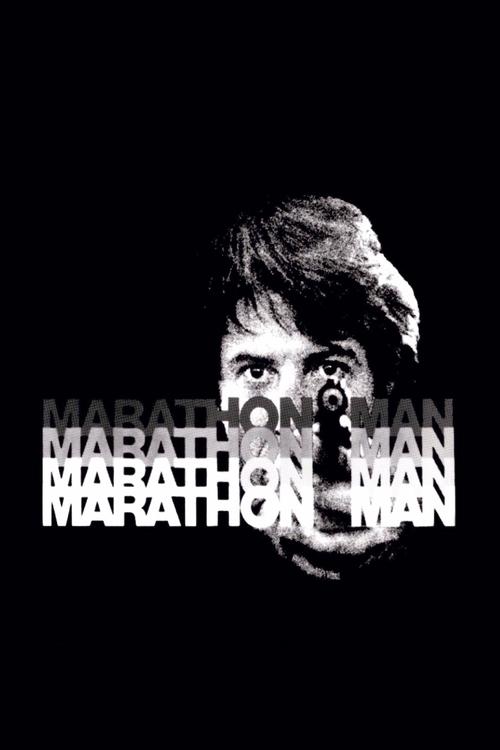
Marathon Man
1976 · John Schlesinger
When you're craving a real thriller — the sweaty, grown-up 1970s kind where nobody can be trusted and the tension is earned scene by scene. Brace yourself for the famous sequence; it's earned its reputation.
What it's about
A bookish Columbia graduate student who runs marathons to burn off his obsessions is yanked, with no warning and no training, into a lethal international intrigue involving his mysterious brother, a fugitive Nazi war criminal, and a fortune in looted diamonds. He knows nothing, trusts the wrong people, and has only his stamina and his wits to survive a conspiracy that considers him disposable.
The experience
A slow coil of dread that snaps into some of the most nerve-shredding suspense of its era — including a scene involving a dentist's chair that has made generations of viewers squirm. Paranoid, grubby, and relentless once it grips; you'll feel the exhaustion of a man running for his life in every sense.
Performances
Dustin Hoffman makes the student's terror and improvisation completely believable — an ordinary man, not an action hero. Laurence Olivier is chilling as the fugitive war criminal, playing evil as something soft-spoken, meticulous, and utterly patient.
The craft
William Goldman adapted his own novel into a lean machine of a screenplay, and Schlesinger directs with an art-film eye for texture and unease — New York feels hostile down to the pavement. The suspense set pieces are masterclasses in withholding, built more from silence and implication than spectacle.
Why it matters
A cornerstone of the paranoid thrillers of 1970s America, it lodged one three-word question — asked in a dental chair — permanently in popular culture and remains the reason many people fear dentists.
Snapshot
Marathon Man is a paranoid thriller built on a collision of generations and continents: a bookish Columbia graduate student and amateur distance runner is pulled, without warning or preparation, into a lethal intrigue involving his secret-agent brother, a fugitive Nazi war criminal, and a cache of looted diamonds. Adapted by William Goldman from his own 1974 novel and directed by the British émigré John Schlesinger, the film fuses two distinct sensibilities — the European art-cinema gravity Schlesinger brought from Darling and Sunday Bloody Sunday, and the conspiratorial, institutionally distrustful mood of mid-1970s American cinema. It is remembered above all for a single scene of dental torture and the line associated with it ("Is it safe?"), which lodged the picture permanently in popular memory, and for the much-retold encounter between its two stars: the deeply prepared Method actor Dustin Hoffman and the classically trained Laurence Olivier. Beneath the suspense machinery, the film is a meditation on the long reach of historical atrocity — the Holocaust and, glancingly, McCarthyism — into the supposedly safe present of a young American who would rather be reading and running.
Industry & production
The film was a Paramount production mounted at the height of the studio's 1970s run, produced by Robert Evans (then closely identified with Paramount's prestige output) and Sidney Beckerman. Its commercial logic was unambiguous: a best-selling thriller by a writer who was, at that moment, among the most bankable screenwriters in Hollywood. Goldman had won an Academy Award for Butch Cassidy and the Sundance Kid (1969) and would win again for All the President's Men, released the same year as Marathon Man; adapting his own novel gave the project a marquee literary pedigree and tight authorial control over the source.
The casting strategy paired a contemporary American star at the peak of his reputation, Dustin Hoffman, with a theatrical eminence, Laurence Olivier, whose participation carried both prestige and risk. Olivier was gravely ill during the period — widely reported to have been seriously sick with cancer and other ailments — and questions about insurability around his casting are part of the film's lore; the precise contractual details are not something I can verify with confidence, so I'll flag that as an area where accounts vary. Roy Scheider, fresh from Jaws (1975), took the pivotal role of the brother, with William Devane and the Swiss actress Marthe Keller filling out the conspiracy.
Production drew on substantial New York location work — Columbia, Central Park, the reservoir, the diamond district — anchoring the abstraction of the spy plot in a tactile, recognizable city. The film's ending is frequently cited as having been altered from earlier conceptions during post-production; reshooting and recutting of a thriller's climax was not unusual in this era, and Goldman himself later wrote about the gap between script and finished film in his industry memoir Adventures in the Screen Trade, which remains a primary source for behind-the-scenes accounts.
Technology
Marathon Man was made with the standard professional toolkit of mid-1970s Hollywood: 35mm color photography, anamorphic or spherical lensing finished for theatrical projection, optical and mechanical effects rather than any electronic image manipulation. Its technological interest lies less in apparatus than in the era's prevailing aesthetic of available-light naturalism and long-lens urban shooting, which cinematographer Conrad Hall and his peers had helped normalize across the decade. The torture sequence — a dentist's drill on a living nerve — depends on practical sound design and editing rather than any visual effect, a reminder that the period's most visceral cinema often achieved its impact through suggestion and rhythm rather than spectacle. There are no notable innovations in process or format associated with the film; its sophistication is one of craft applied to conventional means.
Technique
Cinematography
Conrad Hall, one of the most honored American cinematographers of the period (Cool Hand Luke, Butch Cassidy and the Sundance Kid), shoots New York with a textured realism that resists glamour. The visual program contrasts the open, exposed spaces of Babe's running life — the park, the reservoir at dawn — with cramped, threatening interiors: the brownstone apartment, the chair in the torture room, the diamond merchants' offices. Hall's handling of the running sequences gives the film its title image a recurring lyricism, while his interiors tighten claustrophobically as the plot closes in. The photography is integral to the film's argument that the protagonist's world of light and air is being invaded by something dark and enclosed.
Editing
The film's suspense rests heavily on its cutting. Editor Jim Clark — a distinguished British editor who would later win an Oscar for The Killing Fields — structures the first act as a set of seemingly unrelated strands (the runner, the brother, the old man in the diamond district, a fatal road-rage collision between two elderly drivers) that the audience must hold in suspension until they converge. This deliberate withholding, characteristic of the conspiracy thriller, makes comprehension itself a source of tension. In the torture scene, the editing's restraint — cutting around the act, letting sound and reaction carry it — is what makes the sequence unbearable, and is a textbook example of suggestion outperforming explicit depiction.
Mise-en-scène / staging
Schlesinger stages the film around oppositions of safety and exposure. The recurring motif of the question "Is it safe?" — posed by the torturer who cannot understand why his victim does not know what he is being asked — externalizes the film's central anxiety. The diamond district sequence, in which the fugitive is recognized by Holocaust survivors on the street, is staged as a slow eruption of buried history into a banal commercial setting. Domestic and institutional spaces are rendered uncanny: the safe-deposit vault, the antiseptic torture room, the apartment that should be a refuge.
Sound
Sound is the engine of the film's most famous scene; the whine of the dental drill is among the most cited uses of diegetic sound in 1970s cinema for its power to induce physical discomfort. Michael Small's score, discussed below, contributes a restrained, anxious texture rather than conventional thriller bombast.
Performance
The film is, in performance terms, a study in contrasts and is inseparable from the legend of its two leads. Hoffman's Babe is interiorized, physically committed (the running, the exhaustion), and reactive — a civilian overwhelmed. Olivier's Dr. Christian Szell, the so-called "White Angel" modeled in the popular imagination on Nazi camp doctors, is a study in clipped, courtly menace. The widely repeated anecdote — that Hoffman exhausted himself to play exhaustion and Olivier responded, "Why don't you try acting, dear boy?" — has been told and retold so often that it should be treated as part of the film's mythology rather than as firmly documented fact; Goldman and others have given accounts, but the exact wording and circumstances are not reliably fixed. What is verifiable is that Olivier's performance earned an Academy Award nomination for Best Supporting Actor.
Narrative & dramatic mode
The film operates in the mode of the "innocent drawn into the labyrinth" — a Hitchcockian structure (the ordinary man who knows nothing but is presumed to know everything) reworked for the disillusioned 1970s. Its dramatic engine is dramatic irony at the level of information: for much of the film the protagonist, and often the audience, lack the knowledge that the institutional players possess. The screenplay deliberately fragments exposition, opening with apparently disconnected vignettes whose relevance is withheld. The central reversal — that the brother's world of covert operations has reached into Babe's protected life — converts a coming-of-age portrait of a grieving young scholar into a survival narrative. The "marathon" of the title is both literal (Babe's running, his idolization of distance runners) and figurative (the protracted ordeal of endurance the plot becomes), and the film's climax is structured as a test of whether the runner can outlast his pursuer.
Genre & cycle
Marathon Man sits squarely within the 1970s American paranoia / conspiracy thriller cycle — the run of films, many of them suspicious of government and hidden institutions, that includes Klute (1971), The Parallax View (1974), The Conversation (1974), Three Days of the Condor (1975), and All the President's Men (1976). The fictional "Division," an opaque clandestine agency that protects the war criminal for its own ends, is the genre's signature device: power that is unaccountable, unseen, and morally compromised. The film also draws on the older tradition of the Nazi-fugitive thriller, in which the unfinished business of the Second World War surfaces decades later — a lineage that runs alongside Ira Levin's The Boys from Brazil (filmed in 1978, also with Olivier in a Nazi-doctor role). Within this matrix, Marathon Man is distinguished by its grafting of intimate, almost art-house character study onto pulp thriller machinery.
Authorship & method
The film is a meeting of strong authorial hands. John Schlesinger, a central figure of the British New Wave (A Kind of Loving, Billy Liar, Darling) who had crossed to America to make the Oscar-winning Midnight Cowboy (1969), brought a European seriousness about character, milieu, and moral ambiguity to genre material; his outsider's eye for New York recalls Midnight Cowboy's. William Goldman, adapting his own novel, supplied the architecture of withheld information and the terse, ironic dialogue that are hallmarks of his screenwriting; his later writings made the production one of the better-documented case studies of the gap between script and screen. Conrad Hall (cinematography) and Jim Clark (editing) were craftsmen of the first rank whose contributions shaped the film's realism and suspense. Michael Small, the composer, had become something of a house musician for the paranoia cycle, having scored Klute and The Parallax View; his work here extends that sensibility of cool, modernist unease rather than reaching for romantic or heroic register. The production design by Richard MacDonald, a frequent Schlesinger collaborator, organized the film's spatial oppositions.
Movement / national cinema
The film is a hybrid artifact of transatlantic filmmaking: an American studio property, set in and shot in New York, directed by an Englishman and edited by another, photographed by an American master, and anchored by the most celebrated of British stage actors opposite an American Method star. It belongs to the broader phenomenon of "New Hollywood," but Schlesinger's involvement situates it also within the migration of British New Wave directors into American cinema in the late 1960s and 1970s. This dual parentage gives the film its characteristic tone — more sober and morally weighted than a purely genre-driven thriller, more visceral and commercial than a European art film.
Era / period
Released in 1976, the film is steeped in the disillusionment of its moment: post-Watergate distrust of government, the lingering cultural processing of the Vietnam era, and a national mood receptive to stories of hidden institutional corruption. Its preoccupation with a Nazi war criminal living undetected reflects the period's continuing reckoning with the Holocaust and with the question of how such men escaped justice — concerns sharpened in the public imagination by the long, unresolved hunt for figures like Josef Mengele. The film also carries a specifically American historical wound: Babe's scholarly obsession is bound up with the memory of his father, a victim of the McCarthy-era persecutions, linking the European catastrophe to a homegrown one and making the film a study of inherited political trauma across two continents.
Themes
At its core the film concerns the persistence of the past — the refusal of historical atrocity to stay buried, and its irruption into ostensibly safe lives. The looted diamonds are a literal embodiment of this: wealth extracted from murdered people, still circulating, still able to kill. The recurring question "Is it safe?" crystallizes the film's deepest anxiety, the impossibility of security in a world where institutions (the Division) collude with monsters for expedience. Secondary themes include the relationship between knowledge and survival, the contrast between the life of the mind (Babe the historian, the runner) and the life of violence into which he is conscripted, and the betrayal of the protected by those meant to protect them — familial, romantic, and governmental. Running itself functions as the film's master metaphor: endurance as the only available virtue in a contest one did not choose to enter.
Reception, canon & influence
Marathon Man was a prominent release of its year and has endured as a touchstone of the 1970s thriller, though contemporary criticism was not uniformly admiring; the film drew both praise for its tension and craftsmanship and reservations about the plausibility and brutality of its plot. Olivier's performance was singled out and earned an Academy Award nomination for Best Supporting Actor. Over time the dental-torture sequence has become one of the most referenced scenes in American cinema, and the phrase "Is it safe?" has passed into wider cultural shorthand.
Influences on the film (backward): It draws on the Hitchcockian innocent-in-peril template; on the contemporaneous paranoia-thriller cycle (Klute, The Parallax View, Three Days of the Condor), a connection literalized by Michael Small's shared authorship of several of those scores; and on the postwar tradition of Nazi-fugitive fiction.
Legacy (forward): The film helped consolidate the image of the hidden Nazi war criminal as a thriller antagonist, a figure that recurs in works such as The Boys from Brazil (1978). Its torture scene became a durable reference point and an object of parody and homage across later film and television. It is frequently cited in discussions of acting method as the emblematic case of Method-versus-classical technique, and in screenwriting pedagogy — partly through Goldman's own influential memoir — as a study in adaptation and the reshaping of a thriller in post-production. Within Schlesinger's and Goldman's filmographies it stands as a key 1970s work, and within the broader canon it remains a defining example of how the decade's commercial cinema could carry serious historical and political weight.
A Deleuzian reading
The reservoir at dawn, and a young man running its loop.
The full Deleuzian reading of Marathon Man →
Reception
A prestige hit on release — it earned Laurence Olivier an Oscar nomination and cemented Dustin Hoffman's method-actor legend — and it's since settled in as a cornerstone of the 1970s paranoid-thriller cycle, though these days it's remembered less as a whole film than for two or three indelible moments.
How Marathon Man was received, from release to now →
Influences: the films it descends from and the films it influenced
- The 39 Steps (1935) — Establishes the innocent-man-on-the-run template Goldman and Schlesinger inherit — an uncomprehending civilian flung into a conspiracy he must decode while fleeing, structuring suspense around withheld information rather than the hero's competence.
- North by Northwest (1959) — The 'innocent in the labyrinth' pursued by an unseen organization, plus the principle that exposed daylight space (the crop-duster field) can be more menacing than shadow — directly feeding Schlesinger's safety-vs-exposure staging oppositions.
- The Manchurian Candidate (1962) — Pioneers the postwar paranoid-conspiracy architecture of hidden controllers manipulating an unknowing protagonist, the fragmented-exposition mode Marathon Man extends in its post-Watergate register.
- In Cold Blood (1967) — Conrad Hall's breakthrough in available-light naturalism — documentary-grade location lighting and high-contrast realism — is the exact cinematographic method he carries into Marathon Man's grit ed New York.
- Butch Cassidy and the Sundance Kid (1969) — William Goldman's screenwriting signature — terse ironic dialogue and architecture of withheld information — plus a Conrad Hall collaboration, making it the joint Goldman/Hall template Marathon Man refines for a thriller.
- Midnight Cowboy (1969) — Schlesinger's own outsider's eye for New York milieu and his European seriousness about character within genre material — the location-grounded realism he reapplies to the conspiracy thriller.
- Klute (1971) — Michael Small's cool, modernist score of dissonant unease — rather than romantic or heroic scoring — which he carries directly into Marathon Man, making him the paranoia cycle's house composer.
- Spellbound (1945) — Later Hecht-lineage paranoid thriller of an innocent pursued through a world he can't decode, extending the wrong-man structure with the recurring threat-as-trauma motif Spellbound staged through guilt.
- The Stranger (1946) — Reworks the hidden-Nazi-unmasked thriller, the fugitive war criminal surfacing in everyday America and exposed through one investigator's dogged pursuit.
- Black Sunday (1977) — Extends the 70s procedural-paranoia thriller's cross-cutting toward a withheld convergence — pursuer and threat tracked separately until they meet — with documentary-textured suspense staging.
- The Boys from Brazil (1978) — Consolidates the hidden-Nazi-war-criminal-as-antagonist figure Marathon Man popularized, even mirroring its Olivier casting (here as the hunter) to anchor the historical-reckoning thriller.
- Misery (1990) — William Goldman adaptation that distills the Marathon Man torture dynamic into sustained intimate captivity — suspense wrung from a helpless protagonist at a sadist's mercy in close quarters.
- Apt Pupil (1998) — Directly extends the persistence-of-the-past motif — a concealed Nazi war criminal living quietly until the past erupts — inheriting Marathon Man's framing of buried history as present-tense menace.
- Road to Perdition (2002) — Conrad Hall's final film, carrying forward his available-light naturalism and sculpted-shadow realism — the cinematographic lineage Marathon Man helped establish as American thriller grammar.
- Munich (2005) — Methodical hunter-and-hunted structure built on withheld convergence and moral ambiguity in the pursuit of Nazi-era reckoning, extending the cycle's suggestion-over-depiction approach to violence.
- Hostel (2005) — Inherits Marathon Man's dental/bodily-torture set piece as a reference point — the scene's 'suggestion over depiction' dread is the explicit ancestor the later torture-suspense cycle both homages and inverts.
- Absolute Power (1997) — Goldman's script architecture—a lone figure trapped between institutional power and personal survival, procedural betrayal revealed through competent professionals navigating systems that have turned against them—is the thriller template he carries wholesale into the Baldacci adaptation.
- Captain America: The Winter Soldier (2014) — Named touchstone for the ordinary-body-in-extremis chase grammar — visceral, ground-level pursuit where an unprepared protagonist is run down through public urban space, model for the freeway ambush.
- The Parallax View (1974) — Shares Michael Small's authorship and the cycle's lone-figure-versus-faceless-organization paranoia, with suspense built on the dread of convergence withheld until too late.
- The Odessa File (1974) — Contemporaneous Nazi-fugitive thriller working the same postwar 'hidden war criminal surfaces in the present' material, the persistence-of-the-past device Marathon Man centers on Szell.
- Three Days of the Condor (1975) — The innocent insider hunted by his own apparatus, sharing the cycle's distrust of intelligence agencies and the protagonist who must improvise survival without grasping the full design.
- All the President's Men (1976) — William Goldman screenplay built on the same fragmented, drip-fed exposition and post-Watergate institutional distrust, dramatizing the assembly of buried truth from scattered fragments.
- Rocky (1976) — A contemporaneous showcase for Garrett Brown's then-new Steadicam in chase/run sequences — sibling proof of the 1976 technological moment whose fluid pursuit shots Rocky shares.
Similar films
- The Manchurian Candidate (1962) — influence & lineage
- Munich (2005) — influence & lineage
- Road to Perdition (2002) — influence & lineage · often watched together
- Notorious (1946) — often watched together
- The Asphalt Jungle (1950) — shared sensibility
- Sleuth (1972) — shared sensibility
- The Sting (1973) — shared sensibility
- Oppenheimer (2023) — shared sensibility
All the films related to Marathon Man →