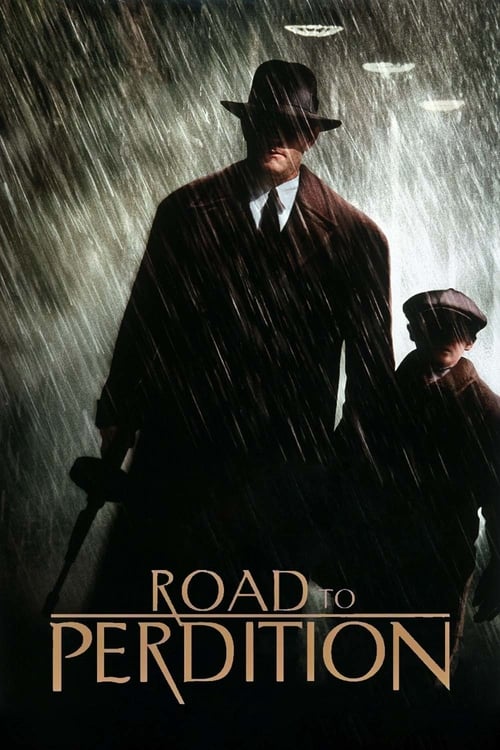
Road to Perdition
2002 · Sam Mendes
For when you want a serious, beautiful crime drama on a rainy night — something with weight and consequence rather than thrills for their own sake. It asks a little patience and pays it back in feeling.
What it's about
Depression-era Illinois: Mike Sullivan is a feared enforcer for an Irish crime boss who raised him like a son. When Sullivan's twelve-year-old boy secretly witnesses a killing, the family becomes a problem the organization can't leave alone, and father and son end up on the road together — running for their lives, pulling bank jobs to hit back, and getting to know each other for the first time. It's a gangster story, but the heart of it is a father trying to keep his son from becoming what he is.
The experience
Somber, stately, and quietly gripping — more mournful than pulpy, with bursts of violence that land harder for how composed everything around them is. It builds a slow, heavy sadness and earns it.
Performances
Tom Hanks works powerfully against type as a killer who keeps his warmth locked away, and Paul Newman, in one of his final screen roles, brings a wounded gravity to the crime patriarch — their scenes together are the film's soul.
The craft
This was the last film shot by the great cinematographer Conrad L. Hall, and it looks it: rain, lamplight, and shadow composed like paintings, with several sequences staged almost wordlessly. Sam Mendes directs with deliberate calm, letting images and Thomas Newman's plaintive score carry emotion the characters won't voice. It's one of the most beautiful gangster films ever made and deserves the biggest, darkest screen you have.
Why it matters
It helped prove that a graphic novel could be the source of prestige, grown-up drama, and it stands as a career landmark for its cinematographer — a farewell masterclass in light.
Snapshot
Road to Perdition is a Depression-era gangster tragedy organized around a single, ancient story shape: a father and son on the road, fleeing the consequences of the father's profession. Michael Sullivan is an enforcer for an Irish crime patriarch in the Illinois quad-cities; when Sullivan's elder son secretly witnesses a killing, the boy becomes a liability the organization cannot tolerate, and the ensuing reprisals send father and son into flight and counter-attack. The film is Sam Mendes's second feature, made directly after American Beauty (1999) had won him the Academy Award for Best Director, and it announced that his interest lay less in genre mechanics than in composed images, withheld emotion, and the moral weather of American life. It is most often remembered as the final film photographed by Conrad L. Hall, who died shortly after its release and received a posthumous Academy Award for it, and as one of the last major screen roles for Paul Newman. Its reputation is that of a handsome, melancholy, deliberately restrained crime picture — admired for craft, occasionally faulted for coldness.
Industry & production
The film originated not in screenwriting but in comics: Max Allan Collins's 1998 graphic novel Road to Perdition, illustrated by Richard Piers Rayner and published through DC's Paradox Press imprint. Collins drew openly on the historical Tri-Cities underworld — the crime boss "John Rooney" is rooted in the real Rock Island racketeer John Looney — and on the Japanese manga Lone Wolf and Cub, whose wandering-assassin-and-child premise supplies the book's spine. David Self adapted the screenplay.
The project was produced by DreamWorks Pictures, the studio with which Mendes had made American Beauty, with Twentieth Century Fox involved on the distribution side internationally; Mendes's producing partner Walter F. Parkes and Dean Zanuck were among the producers, and Richard D. Zanuck — a Hollywood lineage figure — was also attached. The casting was a deliberate gambit: Tom Hanks, the era's most trusted everyman star, was placed against type as a contract killer, and Paul Newman was cast as the surrogate father whose affection and treachery drive the plot. The supporting ensemble included Jude Law as a freelance assassin-photographer, a pre-Bond Daniel Craig as the boss's resentful biological son, Stanley Tucci as the Capone lieutenant Frank Nitti, Jennifer Jason Leigh as Sullivan's wife, Ciarán Hinds, and Tyler Hoechlin as the surviving son. Shooting took place largely in and around Illinois and on studio stages, with period reconstruction handled by production designer Dennis Gassner. Reliable production-cost figures should be treated cautiously here; the picture was a mid-budget studio prestige release rather than a tentpole, and it performed respectably without becoming a blockbuster. I will avoid citing a specific gross, as I cannot verify an exact figure.
Technology
Road to Perdition was made on 35mm photochemical film, and its technical identity is inseparable from that choice. Conrad Hall exploited the medium's tonal range to build images of deep shadow and isolated, sourced light — pools of practical illumination in dark interiors, rain-silvered streets, snow and overcast exteriors drained of warmth. The film predates the wholesale industry shift to digital capture, and it stands as a late, virtuoso demonstration of what a master cinematographer could do with celluloid, controlled lighting, and restraint rather than spectacle. There is comparatively little reliance on visual effects; the film's "technology" is fundamentally that of classical photographic craft — lenses, lamps, filtration, and the laboratory — deployed by an artist at the end of a long career. Thomas Newman's score and the sound mix were realized to studio standards of the era, with the sound design used pointedly (see Sound, below) rather than maximally.
Technique
Cinematography
Hall's photography is the film's signature achievement, and the case for it is concrete rather than impressionistic. He works in a muted, near-monochrome palette — slates, browns, blacks, the cold blue-gray of winter light — that visually equates the Depression landscape with moral exhaustion. Compositions are frequently frontal and architectural, with figures dwarfed by doorways, windows, and the horizontal sprawl of farmland and city street, an approach widely and reasonably compared to the paintings of Edward Hopper and the regionalist American canvases of the period. Hall favored a soft, diffused key and let large areas of the frame fall to shadow, so that faces are often half-lit or backlit, withholding the very emotion the actors are suppressing. He had already won Academy Awards for Butch Cassidy and the Sundance Kid (1969) and American Beauty (1999); this was his third and final Oscar, awarded posthumously. The work reads as a summation of his style: light as moral commentary, beauty held in tension with violence.
Editing
Jill Bilcock, an Australian editor known for the kinetic montage of Baz Luhrmann's films, here works in a far more measured register, matching Mendes's preference for sustained, composed shots over fragmentation. The cutting lets scenes breathe — holding on faces, allowing silence — and reserves rhythmic acceleration for the few outbreaks of violence. The contrast with Bilcock's flashier credits underscores that the film's deliberate tempo was a chosen aesthetic, not a default.
Mise-en-scène / staging
Gassner's production design reconstructs 1931 with an emphasis on emptiness and order: spare interiors, gleaming sedans, period storefronts, and the recurring iconography of roads, rail, and threshold. Mendes stages many key exchanges with theatrical formality — characters arranged across a frame, distances held, gestures minimized — a sensibility traceable to his background in stage direction. Weather and landscape do dramatic work throughout: rain and snow externalize grief and dread, and the open American road literalizes the title's double meaning, "Perdition" being both a destination town and a word for damnation.
Sound
The film's most discussed technical decision is an act of subtraction. In the sequence in which Sullivan executes a rival faction in the rain, the diegetic gunfire is suppressed and the moment is carried almost entirely by Thomas Newman's music, the violence rendered as a near-silent, balletic tableau. The choice abstracts the killing into something mournful and ritualized rather than visceral, and it is the clearest instance of the film using sound design as authorial statement — confirming that Road to Perdition treats violence as tragedy to be witnessed, not action to be enjoyed.
Performance
The performances are built on suppression. Hanks plays Sullivan with a closed, watchful stillness, refusing the warmth audiences expected of him; the role's power comes from what is withheld. Newman gives Rooney a weathered tenderness shadowed by ruthlessness, making the betrayal at the story's center genuinely tragic rather than merely plotted — the performance earned him an Academy Award nomination for Best Supporting Actor. Jude Law, cast against his usual handsomeness, plays the assassin Maguire as a sallow, ghoulish opportunist. Daniel Craig's portrait of the favored-but-unworthy son and Tyler Hoechlin's grounded turn as the surviving boy complete an ensemble keyed to restraint over display.
Narrative & dramatic mode
The film's mode is classical tragedy in gangster dress. Its engine is a chain of fathers and sons: Rooney and his biological son Connor; Rooney and Sullivan, his "adopted" son in violence; Sullivan and his own two boys. The narration is retrospective and elegiac, framed by the surviving son's adult voice, which lends the events the quality of memory and lament rather than suspense. Structurally it is a road picture grafted onto a revenge plot, but the genre beats are consistently muted — the film is more interested in the inheritance of sin and the question of what a father passes to a son than in the kinetics of pursuit. The central irony is moral: a killer's deepest wish is that his son not become him, and the entire journey is an attempt to redeem a single life from a corrupt lineage.
Genre & cycle
Road to Perdition belongs to the gangster film, and specifically to the Prohibition/Depression-era strain populated by figures like Capone and Nitti. But it sits at a deliberate remove from the maximalist American gangster tradition of Coppola's The Godfather films and Scorsese's GoodFellas — it borrows the milieu and the father-son inheritance theme of the former while rejecting operatic scale and energetic excess. Its closer kin are the more austere, painterly crime pictures and revisionist Westerns-in-disguise, and, crucially, the comic-book and manga lineage from which it springs. Within the early-2000s wave of graphic-novel adaptations it is an outlier: a prestige literary treatment rather than a genre spectacle.
Authorship & method
The film is best understood as a meeting of distinct authorial sensibilities. Sam Mendes brought a theater director's formalism and a fresh-from-American Beauty preoccupation with the rot beneath American respectability, favoring composition, stillness, and thematic clarity over genre kinetics. Conrad L. Hall, at the end of a five-decade career, supplied the visual philosophy — light and shadow as moral language — that arguably defines the film more than its script does; the collaboration was a continuation of their American Beauty partnership. Thomas Newman, also returning from American Beauty, contributed a restrained, melancholic, often Irish-inflected score that underwrites the elegiac tone and carries the film's most radical sound choices. Jill Bilcock edited against her own flamboyant reputation toward patience and weight. David Self adapted Collins's graphic novel, compressing and reshaping it for the screen. The method throughout is one of refinement and reduction — taking pulpy source material and a violent premise and rendering them with the gravity of tragedy.
Movement / national cinema
This is a Hollywood studio production, made within the American prestige-picture system, and it does not belong to a formal film movement. Its most interesting affiliations are cross-cultural and cross-medium. Through Collins's graphic novel it descends from the Japanese manga Lone Wolf and Cub (Kazuo Koike and Goseki Kojima), transplanting that work's wandering-assassin-and-child figure into Irish-American Illinois. Through Hall's photography it draws on a distinctly American visual tradition — Hopper, regionalist painting, the iconography of Depression-era documentary. It is thus an American film with a Japanese narrative ancestor and a painterly national-art inheritance, rather than a product of any national cinema "school."
Era / period
The film is set in 1931, at the depth of the Great Depression and near the end of Prohibition, and it is steeped in that moment's textures: empty highways, breadline-gray towns, the Capone-Nitti Chicago underworld, and the historical Tri-Cities racketeering Collins drew upon. As a production it belongs to the early-2000s post-American Beauty moment of DreamWorks prestige filmmaking and to the last years before digital capture displaced photochemical cinematography in mainstream American film. It therefore carries a double period identity — a meticulous reconstruction of 1931 and a late artifact of an analog craft tradition.
Themes
The dominant theme is paternal inheritance — what fathers transmit to sons, and whether that transmission can be refused. Sullivan, who has inherited a vocation of violence from his surrogate father Rooney, is driven by the desperate hope that his own son will inherit something else. Bound up with this are guilt and damnation (the title's "Perdition" naming both a place and a spiritual state), loyalty and betrayal within a quasi-familial criminal order, and the impossibility of a clean separation between love and complicity — Rooney loves Sullivan and dooms him; Sullivan loves his son and endangers him by his very nature. Beneath the crime plot runs a steady meditation on whether a man defined by killing can purchase, through one final act of protection, the redemption of the next generation.
Reception, canon & influence
Critically, the film was received as a work of exceptional craft and considerable emotional reticence. Reviewers widely praised Hall's cinematography, Newman's gravity, and Mendes's compositional control, while a recurring strain of criticism found the film cold or overly tasteful — admiring its surfaces while questioning whether its restraint kept the audience at arm's length. Its awards profile centered on the technical and supporting categories: Conrad Hall's posthumous Academy Award for Best Cinematography became the film's defining honor and a poignant capstone to his career, and Paul Newman's Best Supporting Actor nomination marked one of the final major recognitions of his acting life.
The lines of influence run clearly backward. Road to Perdition descends, by way of Collins and Rayner's graphic novel, from Lone Wolf and Cub; it absorbs the father-son inheritance preoccupations of the Godfather tradition while consciously rejecting its scale; and Hall's images draw on Edward Hopper and American regionalist painting. Looking forward, its legacy is more about sensibility than direct imitation. It stands as a high-water mark for the painterly, elegiac, restrained crime film and as evidence that a graphic novel could yield somber prestige drama rather than genre spectacle — a counter-model to the comic-book adaptations that dominated the following decade. For Daniel Craig it was an early step toward stardom, and within film history it is durably fixed as Conrad Hall's valediction: the last work of a great cinematographer, and an argument for light and shadow as the true language of a film. Beyond these threads, claims of specific, traceable influence on later filmmakers are thin, and it would be inventing a record to assert more.
A Deleuzian reading
A man stands in the rain firing a Thompson submachine gun, and the gun makes no sound.
The full Deleuzian reading of Road to Perdition →
Reception
In 2002 it was received as handsome but chilly — respectful reviews, solid box office, and a nagging 'style over substance' complaint trailing Mendes's American Beauty follow-up. Two decades on it's been warmly reappraised, now routinely called one of the most beautiful American films of its era and underrated Mendes.
How Road to Perdition was received, from release to now →
Influences: the films it descends from and the films it influenced
- Lone Wolf and Cub: Sword of Vengeance (1972) — Supplies the narrative armature Collins's graphic novel adapts: a stoic assassin and his child traveling a road of vengeance, with violence framed as a ritual of paternal duty rather than spectacle.
- The Godfather (1972) — Gordon Willis's underexposed amber top-light and the gangster-as-paternal-inheritance tragedy that Perdition inherits wholesale while deliberately shrinking the operatic scale to a two-hander.
- In Cold Blood (1967) — Conrad Hall's own monochrome chiaroscuro and his signature rain-on-glass-as-tears device — shadows of running water crossing a face — which he consciously reprises decades later for Perdition.
- The Conformist (1970) — Storaro's frontal, architectural compositions that deploy hard light and engulfing shadow as moral verdict, the same light-as-conscience grammar Hall builds the film around.
- American Beauty (1999) — The immediate Mendes/Hall/Newman partnership that codified the symmetrical frontal framing, theatrical stillness, and 'rot beneath American respectability' Perdition transplants into period crime.
- The Night of the Hunter (1955) — Expressionist storybook chiaroscuro and theatrically formal staging of menace stalking children, a painterly fable-of-evil mode Hall's silhouettes and tableaux echo.
- Once Upon a Time in America (1984) — Establishes the elegiac, measured-tempo gangster memory-tragedy — friendship, betrayal, and loss scored with melancholy — that sets Perdition's mournful register.
- Days of Heaven (1978) — Almendros's magic-hour, American-regionalist landscape painting and a child's elegiac voiceover, the Hopper/Wyeth pictorialism Hall translates to Depression backroads.
- Butch Cassidy and the Sundance Kid (1969) — Hall's earlier sepia-washed, painterly period photography and his romance of doomed male partnership establish the elegiac-Americana palette he refines into Perdition's muted tones.
- The Untouchables (1987) — Conrad Hall's anamorphic deep-focus compositions and near-monochrome chiaroscuro period lighting extend the Burum approach: the gangster-era frame as pictorial architecture, with overhead shots and low angles inflating moral geometry into physical space in a direct lineage from The Untouchables' visual method.
- The Godfather Part II (1974) — Conrad Hall's cinematography is the most direct visual homage to Willis's Godfather work in American studio filmmaking: rain-lit, deeply low-key, every source motivated by practicals, shadow used as moral weight around a patriarch whose violence destroys the family it was meant to protect.
- The Wild Bunch (1969) — Mendes builds a men-on-a-doomed-mission elegy around loyalty, betrayal and obsolescence, scoring death as mournful ritual in the Peckinpah tradition.
- The Assassination of Jesse James by the Coward Robert Ford (2007) — Extends the painterly, voiceover-driven, restrained period crime-as-tragedy mode — Deakins's diffused Hopperesque light and patient tempo are a direct heir to Hall's valediction.
- A History of Violence (2005) — Proves the same counter-model: a graphic novel rendered as somber, restrained adult drama about a father's hidden damnation rather than comic-book spectacle.
- Skyfall (2012) — Mendes and Deakins extend the architectural frontal composition and light-as-language chiaroscuro — silhouetted figures against luminous fields — into the franchise thriller.
- The Outfit (2022) — Conrad Hall photographed this period organized-crime film explicitly modeling Edward Hopper's paintings — empty rooms, single-source amber light, figures isolated in geometric interior space — a documented artistic decision that Moore and Dick Pope directly echo in The Outfit's visual register.
- Spectre (2015) — Mendes's prestige-drama gift for painterly, classically composed widescreen tableaux (with Conrad Hall) is the authorial template he imports into the Bond series' visual weight.
- Miller's Crossing (1990) — Renders pulpy Prohibition-gangster material with formal, ritualized gravity and a fixation on coats, hats, and codes of fathers and surrogate sons rather than kinetic action.
- There Will Be Blood (2007) — Shares the Depression-era American tableau, glacial measured tempo, and a tragedy of paternal inheritance and damnation built from regionalist painting and suppressed performance.
- No Country for Old Men (2007) — Carries forward the diegetic-suppression sound design — near-scoreless, letting wind, footsteps, and gunfire dominate — and the measured, elegiac fatalism of restrained crime.
- Public Enemies (2009) — Another Depression/Prohibition gangster elegy treating the outlaw's doom with cold tonal control and suppressed emotion, foregrounding texture and period architecture over genre kineticism.
- Nightmare Alley (2021) — Conrad Hall's cinematography deploys American Depression-era chiaroscuro with Hopper-influenced spatial desolation in exterior sequences — rain-slicked Midwestern streets, figures dwarfed by flat empty space rendered in backlit shadow — anticipating Laustsen's strategy for del Toro's daylit-despair passages, where the period American landscape is Hopper made cinematographic.
- The Funeral (1996) — Carries forward the Depression-era gangster as painterly low-key Catholic tragedy of fathers, sons and inevitable retribution, again organized around death-rites and mourning.
- A Man Called Otto (2022) — Pairs Thomas Newman's elegiac scoring with Hanks cast against his likability into a grief-stricken, closed-off man — the same Newman-texture-plus-Hanks-against-warmth calibration Otto performs.
- Cinderella Man (2005) — Depression-era prestige drama scored by Thomas Newman with a desaturated two-register palette, the same warm-interior/cold-exterior scheme Totino uses.
Similar films
- The Godfather (1972) — influence & lineage
- There Will Be Blood (2007) — influence & lineage
- No Country for Old Men (2007) — influence & lineage
- Miller's Crossing (1990) — influence & lineage
- A History of Violence (2005) — influence & lineage
- Days of Heaven (1978) — influence & lineage
- The Assassination of Jesse James by the Coward Robert Ford (2007) — influence & lineage
- American Beauty (1999) — influence & lineage
All the films related to Road to Perdition →