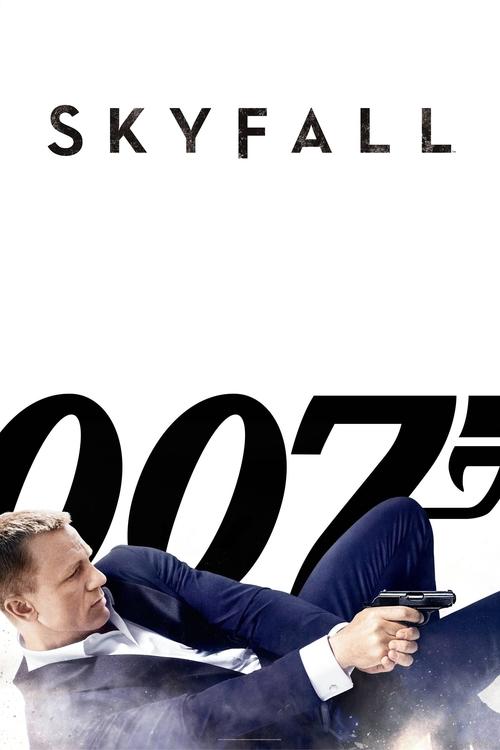
Skyfall
2012 · Sam Mendes
For when you want a big, gorgeous crowd-pleaser that's smarter than it needs to be — event-movie spectacle for a night in that still gives you something to feel. Pure comfort, elevated.
What it's about
After a mission goes wrong and a stolen hard drive exposes undercover agents worldwide, MI6 itself comes under attack — and a battered, written-off James Bond returns from presumed death to hunt the man responsible. It's a spy thriller that doubles as a reckoning: with Bond's age, M's leadership, and whether the whole institution still has a place in the modern world.
The experience
Sleek, confident blockbuster filmmaking with unexpected emotional weight — thrilling set pieces threaded through a story about aging, loyalty, and loss. It moves like a Bond film but lingers like a drama.
Performances
Javier Bardem's Silva is one of the great modern movie villains — flamboyant, wounded, genuinely unpredictable — and Judi Dench finally gets M a full role to play rather than a desk to sit behind.
The craft
Roger Deakins shoots what may be the most beautiful Bond film ever made — a silhouetted fight against Shanghai neon, misty Scottish moors, a casino floating in lantern light — with Sam Mendes giving every set piece dramatic stakes. Made for the biggest screen available, with a theme song that became an instant standard.
Why it matters
Released for the franchise's fiftieth anniversary, it became the first Bond film to cross a billion dollars and reset expectations for how prestigious a blockbuster spy movie could be.
Snapshot
Skyfall is the twenty-third official James Bond film and the third to star Daniel Craig, arriving in 2012 to coincide with the fiftieth anniversary of the franchise launched by Dr. No (1962). Directed by Sam Mendes and photographed by Roger Deakins, it is the most self-consciously "authored" entry in the series — a prestige film made inside a blockbuster machine — and the one that most directly turns the apparatus of Bond toward questions of age, obsolescence, and institutional survival. Its narrative strips Bond down (a botched mission, a presumed death, a return as a diminished man) and rebuilds him, while its antagonist, Silva, functions as a dark mirror of the secret-agent ideal. Commercially it was a watershed: the first Bond film to gross over a billion dollars worldwide and, at the time, the highest-grossing film in the series. Critically it was embraced as one of the strongest Bonds ever made, and it remains a touchstone for how a long-running franchise can metabolize its own history.
Industry & production
Skyfall emerged from a fraught production limbo. After Quantum of Solace (2008), the financial collapse and bankruptcy reorganization of Metro-Goldwyn-Mayer, the franchise's co-owner, suspended development for an extended period — the longest gap between Craig-era films. Once MGM's situation stabilized, Eon Productions (Michael G. Wilson and Barbara Broccoli) moved forward with Sony Pictures handling distribution. The hiring of Sam Mendes — an Academy Award winner for American Beauty (1999) and a celebrated theater director — signaled the producers' intent to court prestige, recruiting a filmmaker associated with actors and dramatic interiority rather than action spectacle.
The screenplay was developed by series regulars Neal Purvis and Robert Wade together with playwright and screenwriter John Logan, whose involvement deepened the film's literary and thematic ambitions. Production was anchored at Pinewood Studios, with location work in Istanbul (standing in for the pre-credits chase and the Turkish sequences), London, and the Scottish Highlands around Glen Coe for the climactic estate; the Shanghai and Macau material combined location and constructed sets. The film's release was deliberately timed to the franchise's golden jubilee, and its marketing leaned into both nostalgia and renewal.
Technology
Skyfall is a landmark in the adoption of digital cinematography by a major, traditionally celluloid-bound production. Roger Deakins, long associated with film, shot the picture digitally on the Arri Alexa — a decision he has discussed as a turning point in his own embrace of digital capture, citing the camera's latitude in low light and its responsiveness to the heavily controlled, color-saturated lighting schemes he designed. The film became a frequently cited proof case that digital acquisition could deliver the painterly, high-contrast image quality associated with the best photochemical work. The production paired this with extensive practical effects and stunt work in the Bond tradition, reserving digital effects largely for extension and enhancement rather than spectacle for its own sake, so that the film's most striking images read as photographed rather than rendered.
Technique
Cinematography
Deakins's photography is the film's most lauded craft achievement and earned him an Academy Award nomination (he did not win that year). His approach is built on bold, almost graphic uses of color and silhouette. The Shanghai high-rise sequence — Bond stalking an assassin against a wall of shifting neon and the reflective glass of the tower — reduces the figures to backlit shapes, a near-abstract composition that became the film's signature image. Elsewhere Deakins works in deep shadow and pools of motivated light: the amber warmth of the Macau casino, the cold institutional palettes of MI6, and finally the desaturated, fog-bound Scottish moor and the firelit destruction of the Skyfall estate. Throughout, the framing favors clarity and stillness over the kinetic shaky-cam aesthetic that had dominated much 2000s action, lending the film a composed, classical bearing.
Editing
The film was cut by Stuart Baird, who had previously edited Casino Royale (2006). The editing balances the series' obligatory propulsion — the Istanbul pre-credits chase across rooftops and atop a train — with a markedly patient rhythm in the dramatic scenes, allowing performances and reaction shots to breathe. The action is constructed to remain spatially legible, a deliberate corrective to the rapid, fragmentary cutting of Quantum of Solace; geography and cause-and-effect are preserved so that set pieces read as readable physical events rather than impressionistic blurs.
Mise-en-scène / staging
Production designer Dennis Gassner's environments externalize the film's thematic concerns. The recurring motif is decay and exposure: a half-flooded, derelict island lair for Silva; an MI6 forced underground into Churchill-era tunnels after its headquarters is attacked; and, finally, the Skyfall lodge itself — Bond's ancestral home, a cold stone house on a barren moor that the protagonist deliberately turns into a trap and watches burn. The climactic staging inverts the franchise's globe-trotting glamour, retreating to an almost gothic, elemental landscape. The much-noted return of the silver Aston Martin DB5 stages nostalgia as physical object, a relic wheeled out and ultimately sacrificed.
Sound
Skyfall won the Academy Award for Best Sound Editing (Per Hallberg and Karen Baker Landers) and was nominated for Sound Mixing, recognition of a soundscape that ranges from the percussive clarity of its action to the eerie quiet of the Highland finale. Thomas Newman's score — his first for the franchise — departs from the brass-forward idiom of predecessor David Arnold, favoring textured, rhythmic, often electronic-inflected cues while still deploying the Monty Norman "James Bond Theme" at calculated moments of triumph. Adele's title song "Skyfall," co-written with Paul Epworth, won the Academy Award for Best Original Song, the first Bond theme to do so, and its melodic material is woven into Newman's score.
Performance
Daniel Craig plays Bond as a wounded, aging professional, physically depleted after his presumed death and psychologically frayed — a performance built on fatigue and reluctant duty rather than suave invulnerability. Judi Dench, in her final and most substantial appearance as M, is effectively the film's co-lead, her authority and mortality central to the plot. Javier Bardem's Silva is a flamboyant, theatrical villain — peroxide-blond, insinuating, wounded — whose extended introductory monologue and unsettling intimacy with Bond mark one of the series' most discussed antagonist performances. Ralph Fiennes (Gareth Mallory), Naomie Harris (Eve, revealed as Moneypenny), Ben Whishaw (a youthful, digital-native Q), and Albert Finney as the estate's gamekeeper Kincade round out an unusually deep dramatic ensemble.
Narrative & dramatic mode
Structurally, Skyfall is a resurrection-and-homecoming story grafted onto the spy thriller. It opens with failure and apparent death, moves through Bond's reluctant return and physical reconstitution, and ends not with the protection of a global asset but with the defense of a person — M — at Bond's childhood home. The dramatic mode is closer to psychological tragedy than to the procedural caper: the film foregrounds interiority, backstory (Bond's orphaning, his origins as Scottish gentry), and the surrogate mother-son bond between M and her agent. The plot machinery — a stolen list of undercover operatives — is largely a pretext; the true engine is the relationship triangle of M, Bond, and Silva, all former or current instruments of the same institution. The villain's scheme, in which capture is part of the plan, organizes the middle act around inevitability rather than pursuit.
Genre & cycle
The film sits within the Craig-era reinvention of Bond that began with Casino Royale — grittier, more emotionally exposed, more concerned with consequence — but where the first two Craig films chased a Bourne-influenced realism, Skyfall reconciles that modern sensibility with the franchise's classical iconography. It re-admits elements the reboot had withheld: Q, Moneypenny, the gadget-laden DB5, a flamboyant supervillain with a secret island lair, and a male M handing over the office. In genre terms it is simultaneously a contemporary techno-thriller (cyber-terrorism, leaked identities, an enemy who attacks through networks) and a nostalgic restoration of mid-century Bond, consciously bridging the cycle's reboot with its heritage to prepare the ground for Spectre (2015).
Authorship & method
Skyfall is unusually legible as the product of a specific creative partnership. Sam Mendes brought a theater director's emphasis on performance, motivation, and thematic coherence, treating Bond as a character study; he would return for Spectre. His collaboration with Roger Deakins — the most decorated cinematographer of his generation — produced the film's defining visual identity and pushed the franchise toward a more authored image. John Logan's contribution to the script (alongside Purvis and Wade) sharpened its literary and psychological register, including its Oedipal and elegiac dimensions. Thomas Newman's score and Stuart Baird's editing complete a craft team assembled less in the action-blockbuster mold than in the prestige-drama one. The film's method is to apply the resources and seriousness of awards-season filmmaking to a property usually exempt from such treatment — and to make that elevation the point.
Movement / national cinema
Skyfall is a quintessential product of the British studio system as it operates within global Hollywood financing: an Eon/Pinewood production, steeped in British institutions (MI6, the Intelligence and Security Committee, the imagery of London and the Scottish Highlands), yet financed and distributed through American majors and made for a worldwide audience. It belongs to no avant-garde movement; rather it exemplifies the transnational "British blockbuster," drawing on the country's deep pools of acting, craft, and studio infrastructure. Its preoccupation with the relevance of an old intelligence service in a networked age can be read as a distinctly British meditation on declining imperial power and the persistence of tradition.
Era / period
The film is firmly of the early 2010s: its anxieties are post–financial-crisis and post-WikiLeaks, fixated on cyber-warfare, leaked identities, and the question of whether human agents and analog institutions retain any purpose in a digital, asymmetric world. Mallory's parliamentary inquiry into MI6's relevance, and M's defense of "the shadows," stage a contemporary debate about surveillance, accountability, and the visibility of secret work. At the same time, the film is steeped in retrospection — the franchise jubilee, the resurrected DB5, the explicit invocation of "old-fashioned" methods — making its period identity a deliberate dialectic between 2012's networked present and the analog past it mourns.
Themes
The film's governing themes are mortality, obsolescence, and resurrection. Bond's near-death and tarnished return interrogate whether the agent — and the apparatus he serves — has outlived its usefulness; the repeated motif of "old dog, new tricks" runs through the plot. M's maternal authority anchors a strand of family and orphanhood: Bond, Silva, and M form a fraught surrogate family in which the villain is the wronged child seeking to destroy the mother who abandoned him, and Bond the loyal son who dies a little to save her. Silva functions as Bond's shadow — what loyalty becomes when betrayed — making the film a meditation on the cost of service. The Scottish finale, returning Bond to a childhood home he then destroys, literalizes the theme of burning away the past to be reborn. Beneath it all runs an elegiac concern with tradition versus modernity: the human versus the digital, the personal versus the institutional, memory versus the network.
Reception, canon & influence
Skyfall was met with broad critical acclaim and exceptional commercial success, becoming the first Bond film to surpass a billion dollars at the worldwide box office and, at its release, the series' highest grosser. It won two Academy Awards — Best Original Song and Best Sound Editing — and earned further nominations including Cinematography, Original Score, and Sound Mixing, an unusual level of awards recognition for an action franchise entry. Critics singled out Deakins's photography, Bardem's villain, and Dench's expanded role, and many ranked it among the finest Bonds ever made.
Looking backward, the film's influences are several and widely noted by critics. Silva's scheme — in which his capture and incarceration are themselves part of the plan — drew frequent comparison to the Joker's engineered captivity in Christopher Nolan's The Dark Knight (2008), part of a broader debt to that film's reconception of the blockbuster villain. The climactic siege of an isolated house, with the hero improvising traps against an overwhelming force, evokes both the home-invasion thriller (critics reached for Straw Dogs) and, more wryly, the booby-trap comedy of a homestead defense; the elegiac return to Bond's origins recalls the domestic, mortal turn of On Her Majesty's Secret Service. The film also pays explicit homage to Goldfinger through the resurrected DB5. More broadly, Deakins has cited a painterly, high-contrast visual sensibility that aligns the film with classical studio craft rather than contemporary action montage.
Looking forward, Skyfall reset the franchise's trajectory: it restored the classic supporting architecture (Q, Moneypenny, a male M in Fiennes's Mallory) that carried directly into Spectre and No Time to Die, and it reframed the Craig era as an emotional throughline culminating in Bond's mortality. Its visual language — the neon-silhouette Shanghai duel above all — became a widely imitated reference point in cinematography and commercial imagery, and the film is routinely credited with demonstrating that high-end digital capture could match the prestige of celluloid. Adele's Oscar-winning theme reinvigorated the cultural prominence of the Bond title song, shaping the marquee-artist approach to subsequent entries. Within the canon, Skyfall stands as the Craig era's critical and commercial high-water mark and as a model for how a legacy franchise can turn its own age and history into subject matter.
A Deleuzian reading
Bond rides the elevator to an empty floor of a Shanghai tower, all glass and dark.
The full Deleuzian reading of Skyfall →
Reception
Hailed on release as the best Bond in decades — a $1.1 billion, Oscar-winning victory lap for the franchise's 50th anniversary — and it's largely held that status, though a revisionist strain now picks at its villain's suspiciously convenient master plan.
How Skyfall was received, from release to now →
Influences: the films it descends from and the films it influenced
- Goldfinger (1964) — Skyfall directly resurrects the silver DB5 with its ejector seat and revives the gadget-and-grandeur production-design template Hamilton codified, quoting it as franchise self-mythology.
- On Her Majesty's Secret Service (1969) — Establishes the elegiac, domestic-and-mortal register — Bond as a vulnerable man facing loss — that Skyfall revives by returning the agent to his childhood home to grieve a surrogate mother.
- Casino Royale (2006) — Reboots Bond as a psychologically wounded character study with a continuous emotional arc, the prestige-drama approach to the franchise that Skyfall inherits and deepens.
- The Dark Knight (2008) — Supplies the blueprint for Silva — a theatrical villain whose capture and incarceration are themselves the plan — reconceiving the blockbuster antagonist as architect of his own captivity.
- Straw Dogs (1971) — Provides the siege-of-the-isolated-house climax in which a man improvises lethal traps against an overwhelming assaulting force, the structural model for the Skyfall lodge finale.
- No Country for Old Men (2007) — Deakins's motivated, naturalistic low-key lighting and patient spatial editing — legible geography over montage — feed directly into Skyfall's classical action staging.
- The Assassination of Jesse James by the Coward Robert Ford (2007) — Deakins's painterly, high-contrast silhouette photography and backlit figures against luminous backgrounds prefigure the neon Shanghai duel's compositional language.
- American Beauty (1999) — Mendes's theater-trained method — performance, motivation, and thematic coherence foregrounded, scored by Thomas Newman — is the authorial sensibility he transplants onto Bond.
- Road to Perdition (2002) — Mendes applies prestige-drama craft and an Oedipal father-son elegy to a genre property, with painterly cinematography and a Newman score — the exact elevation strategy of Skyfall.
- Batman Begins (2005) — Extends the proven model of handing a franchise tentpole to a distinctive auteur (with Deakins' prestige cinematography), validated commercially by Begins.
- Quantum of Solace (2008) — Realizes the franchise's courtship of prestige intimate-drama directors that QoS's Forster experiment opened, with even fuller psychological interiority.
- Harry Potter and the Prisoner of Azkaban (2004) — Mendes and Roger Deakins continue the auteur-elevates-blockbuster lineage Cuarón opened, lending a mainstream franchise painterly natural light and considered, authored compositions.
- Spectre (2015) — Carries forward Skyfall's restored supporting architecture (Q, Moneypenny, Fiennes's male M) and the Mendes–Newman authored-image partnership into the next entry.
- No Time to Die (2021) — Completes the Craig-era mortality throughline Skyfall reframed, paying off Bond's age-and-obsolescence theme by literalizing his death and homecoming.
- Blade Runner 2049 (2017) — Deakins extends Skyfall's neon-silhouette, single-source-color compositions into a full visual system, proving high-end digital capture can carry prestige imagery.
- 1917 (2019) — The Mendes–Deakins collaboration matures into an even more authored image-system, with elemental, light-driven staging and decay-and-exposure environments extended from Skyfall.
- How to Train Your Dragon: The Hidden World (2019) — Deakins' Shanghai high-rise fight is the scope-silhouette shot the film repeatedly quotes: figures reduced to black shapes against a single saturated luminous plane, with all information carried by contour and negative space in the widescreen frame.
- Sicario (2015) — Deakins reuses motivated low-key lighting, silhouetted figures against sky, and patient spatial legibility in action — the same craft grammar he forged on Skyfall.
- Skyfall's Shanghai jellyfish duel lineage — Drive (2011) — Shares the contemporaneous neon-noir vocabulary of backlit silhouettes and saturated single-color light sources that defined Skyfall's most-imitated set piece.
- Jarhead (2005) — Extends the Mendes–Deakins look directly — rigorously symmetrical framing and silhouetted figures staged against fire and backlight, the charged-tableau aesthetic developed on Jarhead.
- Mission: Impossible - Ghost Protocol (2011) — The contemporaneous Bond reset toward legibly-staged practical set-pieces (via Roger Deakins) in the same early-2010s large-format event-film mode GP helped define.
- Operation Mincemeat (2022) — Thomas Newman's Bond scoring pedigree directly links the two — Mincemeat explicitly invokes Fleming and the Bond mythology that wartime deception helped seed.
- Captain America: The Winter Soldier (2014) — Adjacent reinvention of a franchise tentpole through surveillance-era anxiety and a betraying insider, pairing institutional-grounding mise-en-scène with an aging-hero meditation.
- Iron Man 3 (2013) — A franchise entry that imports prestige cinematography and a damaged-hero interiority alongside a villain whose 'capture' is a staged act of manufactured terror, mirroring IM3's Toll-lensed classicism and Killian's engineered spectacle.
Similar films
- Spectre (2015) — influence & lineage
- No Time to Die (2021) — influence & lineage
- Casino Royale (2006) — influence & lineage
- Goldfinger (1964) — influence & lineage
- Mission: Impossible - Dead Reckoning Part One (2023) — same viewing thread
- Mission: Impossible - The Final Reckoning (2025) — same viewing thread
- Quantum of Solace (2008) — shared sensibility
- Tinker Tailor Soldier Spy (2011) — shared sensibility
All the films related to Skyfall →
Watch it with: curated runs of related films
- Rogue Heroes, Rigged Systems — A run of slick, propulsive 21st-century spectacle — spies, super-soldiers, sci-fi survivors, and dystopian rebels all squaring off against some vast machine or shadowy apparatus — best watched back-to-back when you want momentum, style, and a lone figure taking on the whole board.