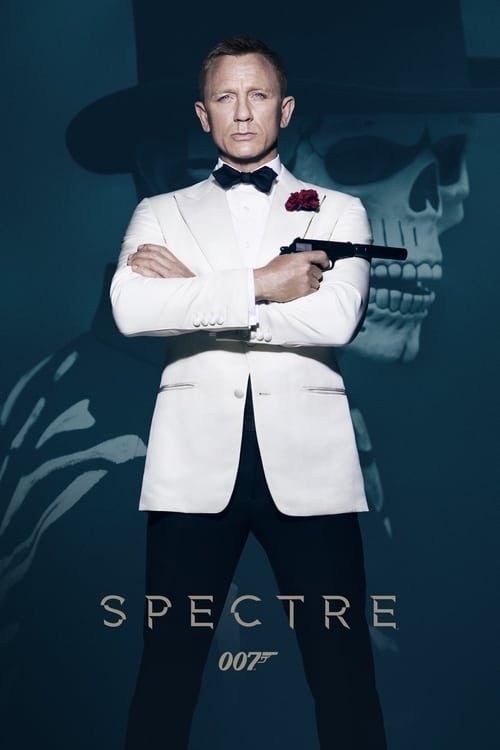
Spectre
2015 · Sam Mendes
For when you want polished, big-budget escapism — exotic locations, tailored suits, and destruction on an operatic scale. A comfortable Saturday-night blockbuster, best with the sound up.
What it's about
A cryptic message from his past sends James Bond off-book, following a trail from Mexico City to Rome to the Austrian Alps toward a shadowy criminal organization whose reach seems to touch everything he's lost. Back in London, M fights a political battle to keep the double-0 program alive against a surveillance-obsessed rival — two fronts of the same war over whether a man with a license to kill still has a place in the modern world.
The experience
Sleek, enormous, and unhurried in the way of late-era Bond — long stretches of brooding elegance punctuated by huge set pieces. It's a moodier, more mythology-heavy ride than a standard spy romp, glamorous even when it's grim.
The craft
The opening sequence — a seemingly unbroken tracking shot gliding through Mexico City's Day of the Dead festival — is one of the great cold opens in the franchise, and the whole film is photographed with a burnished, shadowy beauty. Sam Mendes stages action with real geographic clarity, and it absolutely rewards the biggest screen and best speakers you can find.
Why it matters
As the film that tried to bind the entire Daniel Craig era into one hidden design and revive the series' classic arch-villain iconography, it became a flashpoint in the debate over franchise universe-building — and set the stage for Craig's farewell.
Snapshot
Spectre is the twenty-fourth official James Bond film from Eon Productions and the fourth to star Daniel Craig, reuniting the principal creative team of Skyfall (2012): director Sam Mendes, composer Thomas Newman, and editor Lee Smith. Its narrative ambition is unusual for the series — it attempts to retroactively braid the three preceding Craig films (Casino Royale, Quantum of Solace, Skyfall) into a single concealed design, revealing the criminal syndicate SPECTRE and its head, Ernst Stavro Blofeld (Christoph Waltz), as the hidden author of Bond's accumulated losses. The film is at once a lavish, globe-spanning action picture and a self-conscious act of franchise consolidation, returning to the iconography of the 1960s Sean Connery era — the cat-stroking arch-villain, the volcano-lair scale of the antagonist's operation, the organization with the octopus ring — that Eon had been legally barred from using for decades. The result is a film of striking individual sequences and a somewhat strained connective tissue, widely received as accomplished but a step down from the critical peak of Skyfall.
Industry & production
The defining industrial fact of Spectre is the recovery of the rights to SPECTRE and Blofeld themselves. Those elements had been entangled since the 1960s in the litigation surrounding Thunderball and the contributions of Kevin McClory, which is why the Bond films of the 1980s onward had to invent surrogate organizations and unnamed villains. A settlement reached between Eon/MGM and the McClory estate around 2013 cleared the way, and Spectre is the franchise's first chance in roughly half a century to deploy the syndicate and its leader by name. The title and central conceit are therefore not merely story choices but the spending of a hard-won legal asset.
The picture was produced by Michael G. Wilson and Barbara Broccoli for Eon, with MGM and Columbia Pictures; it was among the last Bond films distributed by Sony before the distribution arrangement passed to Universal/MGM for the subsequent entry. Spectre is routinely cited as one of the most expensive films ever made, with budget figures commonly reported in the region of a quarter of a billion dollars and above; precise accounting for studio tentpoles of this kind is never fully transparent, and reported numbers should be treated as approximate. Some sense of the scale entered public record through the 2014 Sony Pictures hack, which exposed internal correspondence about the production's costs and script anxieties — an unusual case of a blockbuster's development friction becoming visible in real time.
Principal photography ranged across Mexico City, Rome, Austria (the Sölden and Obertilliach areas of the Alps), Morocco (Tangier and the desert near Erfoud), and London, with interiors at Pinewood Studios. The production commissioned a bespoke vehicle, the Aston Martin DB10, built in a small run specifically for the film and not sold to the public — a continuation of the series' long symbiosis with Aston Martin as both prop and marketing engine. At a reported runtime of roughly 148 minutes, Spectre was at the time the longest Bond film.
Technology
The most consequential technical decision was photochemical. Roger Deakins had shot Skyfall digitally on the Arri Alexa, and that film became a landmark argument for digital cinematography. For Spectre, the incoming cinematographer Hoyte van Hoytema reversed course and shot on film stock, working anamorphically. The choice is legible on screen in the grain structure and the rendering of highlights, and it marks a deliberate texture shift within the Craig run rather than a continuation of Deakins's digital look. The pre-title Mexico City sequence is built around an extended, apparently unbroken take that moves through a Day of the Dead crowd, across rooftops, and into a hotel, demanding elaborate Steadicam and aerial coverage and digital stitching to sustain the illusion of continuity. The film also stages a large-scale practical explosion in the Moroccan desert sequence; reports at the time described it as among the largest practical detonations filmed for a feature, though such superlatives are marketing claims and the exact ranking is not independently verifiable. As with all modern Bond entries, practical stunt work — the Rome car chase, the alpine plane-versus-vehicles pursuit — was integrated with digital cleanup and extension.
Technique
Cinematography
Van Hoytema's photography is the film's clearest authorial signature after Mendes himself. The Mexico City opener is the showpiece: a swooping, choreographed long take that establishes scale, geography, and Bond's predatory calm in one gesture, a sequence whose ambition recalls the opening of Welles's Touch of Evil as a benchmark for the form. Elsewhere the palette is muted and wintry — the Austrian snow, the bleached Moroccan desert, the cold blues of London — punctuated by the warm decay of the Rome night scenes and the orange dust of the desert explosion. The framing tends toward the classical and symmetrical, in keeping with the film's restorationist impulse; this is less the chiaroscuro expressionism Deakins brought to Skyfall's Shanghai and Scotland and more an even, monumental compositional mode.
Editing
Lee Smith, returning from Skyfall and a frequent Christopher Nolan collaborator, cuts the action for legibility rather than fragmentation — the Rome car chase and the train fight with the henchman Mr. Hinx (Dave Bautista) are built to be spatially readable, in conscious contrast to the rapid-cut idiom of the Bourne films that had pressured the franchise a decade earlier. The film's editorial challenge is structural rather than kinetic: it must service a great deal of expository connective material linking the previous three films, and the most common critical complaint about Spectre's shape is that the back half slows as it discharges this plot machinery.
Mise-en-scène / staging
The production design (Dennis Gassner) leans into iconography: a vast SPECTRE meeting hall, a desert crater complex that functions as a modern descent of the Ken Adam villain-lair tradition, and a recurring octopus motif tied to the syndicate's ring. The staging consciously revives 1960s Bond grammar — the secret board meeting, the villain's monologued reveal, the gadget-laden Aston Martin — and asks the audience to recognize these as homage. Costuming places Craig's Bond in the tailored, sharply silhouetted mode the Craig era had cultivated, with Tom Ford tailoring continuing the series' luxury-brand integration.
Sound
Thomas Newman's score returns the lush, percussive orchestral idiom he established on Skyfall, including motivic callbacks. The title song, Sam Smith's "Writing's on the Wall," won the Academy Award for Best Original Song and became, by report, the first Bond theme to reach number one on the UK singles chart — a notable commercial fact even as the song divided opinion against the high bar of Adele's "Skyfall." The sound design foregrounds the heavy mechanical presence of the action set-pieces — aircraft, collapsing buildings, the desert blast — against quieter, more intimate registers in the Madeleine Swann scenes.
Performance
Craig plays Bond with the weary, bruised interiority that had become his signature, here inflected toward a man being told that his life has been secretly authored by another. Christoph Waltz brings his characteristic insinuating menace to Blofeld, though the film's structure withholds him for long stretches and many critics felt his gifts were underused. Léa Seydoux's Madeleine Swann is positioned as more than a conventional Bond love interest — a psychologically wary figure who would return in the subsequent film — but the romance's accelerated arc drew skepticism. Monica Bellucci, cast as the widow Lucia Sciarra, was widely noted as the oldest actress to play a Bond love interest, though her role is brief. Ralph Fiennes (M), Ben Whishaw (Q), and Naomie Harris (Moneypenny) deepen the rebuilt "Whitehall" ensemble, with Andrew Scott as the bureaucratic antagonist C.
Narrative & dramatic mode
Spectre operates in two simultaneous dramatic modes. The first is the classical Bond quest: a cryptic message from the dead M (Judi Dench, glimpsed posthumously) sends Bond off-book to Mexico, Rome, Austria, and Morocco, peeling back layers toward the syndicate. The second is a metafictional retrospective: the film reframes the entire Craig cycle as Blofeld's long campaign of personal vengeance, with the revelation that Blofeld (born Franz Oberhauser) is Bond's foster-brother and the self-described "author of all your pain." This is the film's boldest and most contested move — an attempt to impose unity and psychological motive on a trilogy that had not been conceived as a single arc. The parallel A-plot, in which the bureaucrat C engineers a global surveillance network ("Nine Eyes") to render the Double-O program obsolete, grafts a post-Snowden anxiety about mass data collection onto the spy-versus-machine theme, pitting Bond's analog humanism against an automated security state.
Genre & cycle
The film sits at the late-classical phase of the Craig reboot cycle that began with Casino Royale (2006). Where that cycle's early entries stripped Bond down to a grittier, Bourne-adjacent realism, Spectre swings back toward the baroque maximalism of the Connery and Moore eras — the syndicate, the lair, the henchman with a physical gimmick, the gadget car. It is thus a hinge film: a reboot reabsorbing the very tropes the reboot had discarded, now framed nostalgically. Within the broader action-thriller genre of the mid-2010s, it represents the legacy-franchise mode of consolidation, comparable to how other long-running series of the period reached back to their origin mythologies.
Authorship & method
Sam Mendes, a theater and prestige-drama director (American Beauty, Road to Perdition), brought to the Bond series an emphasis on character interiority, classical composition, and thematic weight, and Spectre extends the authorial project of Skyfall: Bond as an aging, mortal figure interrogating his own institutional and personal past. Mendes confirmed Spectre would be his last Bond film. The key collaborators define the film's craft: Hoyte van Hoytema (cinematography), whose return to film stock is the production's signal aesthetic decision; Thomas Newman (score); Lee Smith (editing); and a writing team of John Logan, Neal Purvis and Robert Wade, with Jez Butterworth. The screenwriting record here is genuinely contentious — the Sony hack exposed internal worry over the script, and the burden of retrofitting four films into one continuity is widely seen as the source of the film's structural strain. Production designer Dennis Gassner and the Eon producers Wilson and Broccoli round out the authorial constellation that gives the series its remarkable institutional continuity.
Movement / national cinema
Spectre belongs to the British studio-blockbuster tradition centered on Pinewood and Eon, an institution that has functioned for over six decades as a distinct strand of British commercial cinema with global reach. It is not part of any art-cinema movement, but its director, composer, and crew draw on the prestige end of British and international filmmaking, and the film's self-mythologizing engages directly with the national-cultural meaning of Bond as a British export and a recurring negotiation of post-imperial British identity on the world stage.
Era / period
Produced and set in the mid-2010s, the film is steeped in that moment's preoccupations: state surveillance and the merging of intelligence agencies, the contested value of human agents in an age of drones and data, and institutional accountability. The "Nine Eyes" plot is a direct fictionalization of post-Snowden debate. At the same time the film is pointedly retrospective, mining the 1960s for its villain iconography — a doubled temporality in which a contemporary surveillance thriller wears the costume of vintage Bond.
Themes
The governing themes are authorship and the past: the idea that Bond's life has been secretly designed by an antagonist who claims paternity over his suffering, literalized through the foster-brother backstory. Adjacent to this runs the surveillance theme — the human spy versus the panopticon, intimacy and judgment versus automated mass data. The film also continues the Craig era's meditation on obsolescence and mortality: the Double-O program threatened with shutdown, Bond contemplating a life beyond the service, and the recurrent motif of the dead returning to govern the living (the posthumous message from the previous M). Finally there is the theme of legacy and lineage itself, both within the story and at the level of the franchise reckoning with its own history.
Reception, canon & influence
Critical reception was broadly positive but markedly cooler than the acclaim for Skyfall, which had been a critical and commercial high-water mark for the series. Praise concentrated on the Mexico City opening, van Hoytema's photography, the Rome and train sequences, and the production's sheer craft; reservations centered on a convoluted and overlong second half, the underuse of Waltz, the strained plausibility of the Blofeld-as-foster-brother revelation, and an underdeveloped central romance. The film was a major commercial success worldwide, and "Writing's on the Wall" won the Academy Award for Best Original Song.
The influences ON the film run backward into the franchise's own canon — the Connery-era SPECTRE pictures (Dr. No, From Russia with Love, Thunderball, You Only Live Twice) and the Ken Adam lair aesthetic — and outward to the long-take tradition (Welles, and a lineage of bravura opening shots) that the Mexico sequence joins. The post-Snowden surveillance discourse supplies its topical backbone.
Its forward legacy is twofold. Within the franchise, Spectre set the terms for No Time to Die (2021), which carried forward Madeleine Swann, Blofeld, and the Craig-era continuity to its conclusion; Spectre's consolidation made that finale possible. Beyond the screen, the film's Day of the Dead opening had a documented real-world effect: Mexico City did not hold a Day of the Dead parade before the film, and the spectacle the production staged for the sequence is credited with inspiring the city to inaugurate an actual annual parade afterward — a rare instance of a Bond film materially reshaping the very tradition it depicted. As a piece of the Craig hexalogy, Spectre is now generally read as the transitional, slightly overreaching penultimate movement: the film that gathered the threads, with mixed grace, so that the series could end them.
A Deleuzian reading
There is a ring.
The full Deleuzian reading of Spectre →
Reception
Landed in 2015 as the deflating follow-up to Skyfall — solid box office, shrugging reviews — and a decade on it's still fighting that 'the disappointing one' tag, though defenders have warmed to it as the most classically Bond of the Craig era.
How Spectre was received, from release to now →
Influences: the films it descends from and the films it influenced
- Touch of Evil (1958) — The Mexico City pre-credits sequence is a direct homage to Welles's celebrated unbroken crane-and-tracking opening shot, sustaining an extended single take across a teeming border-town crowd before erupting into violence.
- Dr. No (1962) — Establishes the SPECTRE organization and the gun-barrel/visual-grammar Eon house style that Spectre retroactively reclaims and reconsolidates as franchise canon.
- From Russia with Love (1963) — Supplies the train-compartment fight as a set-piece template — the Spectre brawl with Hinx (Dave Bautista) restages the Connery–Red Grant carriage duel almost beat for beat.
- Thunderball (1965) — Codifies the faceless cat-stroking Blofeld and the SPECTRE boardroom of conspirators that Spectre's Rome meeting scene deliberately resurrects.
- You Only Live Twice (1967) — Ken Adam's volcano-lair production design is the lineage source for Spectre's vast desert crater complex, the franchise's signature 'baroque villain headquarters' staging.
- On Her Majesty's Secret Service (1969) — Provides the Blofeld-clinic/snowbound-romance and the mortal-Bond-love-story DNA that Spectre echoes through Madeleine Swann and the Hoffler Klinik alpine sequence.
- Skyfall (2012) — Mendes and his crew carry forward the same authorial project — aging, mortal Bond interrogating his institutional past — and Spectre directly continues its plot threads while extending its classical compositional approach.
- Road to Perdition (2002) — Mendes's prestige-drama gift for painterly, classically composed widescreen tableaux (with Conrad Hall) is the authorial template he imports into the Bond series' visual weight.
- The Conformist (1970) — Vittorio Storaro's architectural symmetry and chiaroscuro fascist-Rome interiors prefigure Spectre's symmetrical-composition aesthetic and its nocturnal Roman set-pieces.
- The Spy Who Loved Me (1977) — Reprises the Ken Adam mega-lair and the silent, towering henchman (Jaws) whose physical menace is the prototype for Spectre's Mr. Hinx.
- Quantum of Solace (2008) — Pays off the slowly assembled overarching syndicate QoS began seeding — Quantum is retconned as a tendril of Spectre — completing the serialized-continuity bet.
- No Time to Die (2021) — Inherits Spectre's retrofitted continuity wholesale — Madeleine Swann, Blofeld, the foster-brother backstory — building its entire finale on the threads Spectre gathered.
- Let the Right One In (2008) — Hoyte van Hoytema's earlier breakthrough establishes the cold, precise, negative-space photographic sensibility he brings to Spectre's symmetrical framing.
- Her (2013) — Van Hoytema's warm anamorphic film-stock palette and lens-flare-tolerant naturalism here directly informs his decision to shoot Spectre on celluloid rather than digital.
- Mission: Impossible – Rogue Nation (2015) — Shares the contemporaneous spy-genre turn to large-scale practical stunts and a shadow-syndicate conspiracy, staging analog set-pieces (opera, motorcycle chases) against the same surveillance-era anxieties.
- Inception (2010) — Models the modern blockbuster commitment to practical in-camera spectacle — real explosions and physical sets over CGI — that Spectre's record-setting Morocco detonation continues.
- Tinker Tailor Soldier Spy (2011) — Re-establishes the period-textured British espionage mood of institutional decay and surveillance bureaucracy that underwrites Spectre's post-Snowden 'Nine Eyes' subplot.
Similar films
- Skyfall (2012) — influence & lineage
- No Time to Die (2021) — influence & lineage
- Tinker Tailor Soldier Spy (2011) — influence & lineage
- Quantum of Solace (2008) — shared sensibility
- Tenet (2020) — shared sensibility
- Spider-Man: Brand New Day (2026) — shared sensibility
- Casino Royale (2006) — shared sensibility
- Mission: Impossible - The Final Reckoning (2025) — shared sensibility