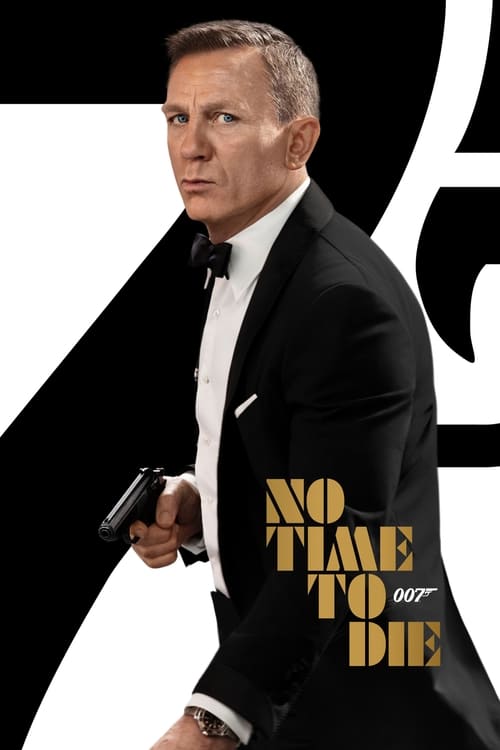
No Time to Die
2021 · Cary Joji Fukunaga
For a full-evening event movie when you want spectacle with real feeling underneath — especially if you've followed Craig's Bond from the start and want the arc to land. Comfort viewing with a lump in the throat.
What it's about
James Bond has left active service for a quiet life in Jamaica when an old CIA friend arrives asking for one favor: help rescue a kidnapped scientist. The mission pulls him back into MI6's orbit and onto the trail of a villain wielding a frightening new bioweapon — and forces him to confront unfinished business from the one romance he never got over. It's a globe-trotting spy adventure with unusually personal stakes, and the farewell chapter of Daniel Craig's Bond.
The experience
Big, sweeping, and surprisingly emotional — the set pieces thunder, but the film keeps returning to questions of love, family, and what a spy's life costs. At nearly three hours it plays as both a thrill ride and a long goodbye.
Performances
Daniel Craig gives his most openly emotional turn in the role, letting weariness and tenderness show through the armor, with Léa Seydoux grounding the film's romantic core and Ana de Armas stealing her brief stretch of it outright.
The craft
Fukunaga stages the action with sweep and clarity — a stunning cold open and a bravura extended sequence built around long, flowing takes — while Hans Zimmer's score weaves in themes from across the Craig era. Made for the biggest, loudest screen available.
Why it matters
The first Bond film to give its hero a true ending, it closed the series' fifteen-year experiment in serialized storytelling and redefined how much emotional consequence a blockbuster franchise could carry.
Snapshot
No Time to Die is the twenty-fifth film in the EON Productions James Bond series and the fifth and final entry to star Daniel Craig, closing the continuous character arc that began with Casino Royale (2006). Directed by Cary Joji Fukunaga — the first American to direct an official Bond film — it is at once a conventional globe-trotting action thriller and a deliberate act of narrative finality: the picture ends with the death of its protagonist, a structural decision without precedent in the series' six decades. Running roughly two hours and forty-three minutes, it is the longest Bond film, and it bears the weight of that length as both summation and elegy. Conceived as the capstone to the Craig era's experiment in serialized continuity and emotional consequence, it folds together the romance of Casino Royale, the trauma of Skyfall, and the conspiracy mythology of Spectre into a single valedictory statement. It is also a film shadowed by its own production history — most visibly the COVID-19 pandemic, which delayed its release by roughly eighteen months and turned it into one of the most prominent test cases for the survival of theatrical cinema after 2020.
Industry & production
The production was famously turbulent even before the pandemic. Danny Boyle was attached to direct and developed the project with his frequent collaborator John Hodge, but departed in August 2018 over what was publicly characterized as creative differences. Fukunaga was hired in September 2018, making him a relatively late arrival to a film already pointed toward production. The screenplay passed through multiple hands — Neal Purvis and Robert Wade, the series' long-standing writing team, with Fukunaga himself credited and additional dialogue credited to Phoebe Waller-Bridge, whose involvement drew considerable press attention as a gesture toward sharpening the film's wit and its handling of female characters.
The film is the product of EON Productions (Michael G. Wilson and Barbara Broccoli) in association with Metro-Goldwyn-Mayer and Universal Pictures for international distribution. Its release schedule became one of the defining industry stories of the pandemic: originally slated for spring 2020, it was repeatedly postponed as theatrical markets collapsed, finally opening in late September 2020 in the UK and early October 2021 worldwide. The decision by EON and MGM to hold the film for theatrical release rather than sell it to a streaming service — reportedly the subject of substantial bids — became emblematic of the industry's wager on the durability of the cinema. Production itself was marked by an on-set injury to Craig requiring ankle surgery and by an explosion that damaged a set at Pinewood, the series' home studio. The picture was the last to be released by the pre-Amazon MGM regime; Amazon's acquisition of MGM, completed afterward, reframed the entire franchise's future.
Technology
Within the fiction, the central technological device is "Heracles," a programmable nanobot bioweapon coded to individual DNA — a plot engine that updates the Bond series' recurring fascination with weapons of mass, and here selective, destruction. The premise reflects a post-genomic, post-pandemic anxiety about targeted biological harm, though the screenplay was written before COVID-19; the resonance is coincidental but unmistakable in the released film. As a production, the film is notable for its commitment to large-format and practical methods over digital spectacle. It was photographed substantially on IMAX-certified film cameras, with key sequences captured in 65mm, positioning it within a contemporary movement (alongside Christopher Nolan's work) reasserting photochemical capture at the high end. The pre-titles Matera sequence and the climactic island assault deploy practical stunts, real vehicles, and full-scale destruction, with the production's emphasis on in-camera effects forming part of its marketing and its craft identity.
Technique
Cinematography
The film was shot by Linus Sandgren, the Swedish cinematographer who won an Academy Award for La La Land. Sandgren brought a heightened, saturated palette and a taste for anamorphic widescreen and large-format texture. The Matera prologue is staged in golden Italian light with sweeping vehicular choreography; the Norwegian forest sequence trades in cold, misty greens; the villain's island lair is rendered in stark, brutalist geometry. Sandgren's work favors strong, sometimes expressionistic color motifs over the cooler naturalism Roger Deakins brought to Skyfall, giving the film a more romantic, storybook surface appropriate to its elegiac purpose. The use of film stock and IMAX framing lends the action a tactile grandeur, and several set pieces — notably a long, apparently continuous stairwell descent during the final act — foreground the camera's mobility as a dramatic instrument.
Editing
Editing was handled by Tom Cross (Oscar winner for Whiplash) and Elliot Graham. The film's considerable length is its defining structural challenge: it must function as a discrete thriller while also paying off five films of accumulated story. The editors manage a rhythm that alternates between propulsive, kinetic action cutting and unusually patient dramatic passages — long-held two-shots in the Bond–Madeleine scenes, extended quiet in the film's final movement. The climax's stairwell sequence is constructed to read as a sustained, escalating single push, a showcase of action geography assembled for legibility rather than fragmentation.
Mise-en-scène / staging
Fukunaga and his designers stage the film as a tour of contrasting environments, each with its own visual logic: the warm decay of Matera, the autumnal melancholy of Norway, the Caribbean ease of Bond's Jamaican retirement, and the cold, ruined-industrial monumentality of Safin's island poison garden and missile base. Production design (by Mark Tildesley) leans on the series' tradition of the architecturally expressive villain's lair while inflecting it with a sense of dereliction and dread. The poison garden in particular evokes a long lineage of Bond's hothouse spaces of menace, restaged as a place of cultivated death.
Sound
Hans Zimmer composed the score, taking over from previous-era composers and integrating both the classic Monty Norman "James Bond Theme" and motifs from Louis Armstrong's "We Have All the Time in the World," the love theme from On Her Majesty's Secret Service (1969) — a pointed citation that aligns this film's tragic romance with the only prior Bond film to end in death (of Bond's wife). Billie Eilish and Finneas O'Connell wrote and performed the title song, "No Time to Die," which won the Academy Award for Best Original Song; its hushed, minor-key restraint signals the film's mournful register from the outset. The sound design throughout balances the franchise's signature percussive action with notably spare, near-silent passages in the finale.
Performance
Craig's final performance is the film's center of gravity: a Bond permitted weariness, tenderness, and ultimately grief, extending the more vulnerable, psychologically wounded characterization he had cultivated across the era. Léa Seydoux returns as Madeleine Swann, given far more interiority and agency than the conventional "Bond girl," her relationship with Bond carrying the dramatic stakes. Rami Malek plays the villain Lyutsifer Safin in a quiet, scarred, soft-spoken register. Lashana Lynch debuts as Nomi, a new "007" agent — a notable franchise gesture. Ana de Armas, in a brief but widely praised single sequence as the CIA agent Paloma, supplies the film's most exuberant comic-action interlude. Ralph Fiennes (M), Naomie Harris (Moneypenny), Ben Whishaw (Q), Jeffrey Wright (Felix Leiter), and Christoph Waltz (Blofeld) reprise their roles, closing out the ensemble built across the era.
Narrative & dramatic mode
Structurally, the film operates as serialized melodrama grafted onto the spy-thriller template. Where most Bond films are episodic and self-contained, No Time to Die is consequential and terminal: it assumes knowledge of Spectre and Casino Royale, opens with a prologue establishing Madeleine's childhood trauma, and builds toward an ending in which Bond, infected with the DNA-targeted nanoweapon and unable to touch his lover and child without killing them, chooses to die in a missile strike. The introduction of a daughter, Mathilde, is the decisive break: it gives Bond, for the first time, a future to lose, and converts the climax from a survival narrative into a sacrifice. The dramatic mode is closer to tragedy than to the franchise's usual ironic adventure — the film knowingly courts sentiment and finality that the series had always structurally refused.
Genre & cycle
The film belongs to the long-running spy-action cycle that Bond effectively founded in 1962 and to the specific "rebooted, serialized, emotionally weighted" sub-cycle the Craig films established in response to both the Jason Bourne pictures and the broader turn toward continuity-driven blockbuster storytelling. It is a late entry in a cycle increasingly conscious of its own conventions, alternately honoring and interrogating Bond's archetypes — the disposable woman, the disfigured villain, the gadget, the lair. Its willingness to kill its hero marks a generic departure that reflects the influence of contemporary serialized franchise cinema, where character death and continuity have become legible to mass audiences.
Authorship & method
Fukunaga arrived from prestige television and independent film — Sin Nombre, Jane Eyre, the celebrated first season of True Detective (which he directed in its entirety), and the Netflix war film Beasts of No Nation. His authorial signature lies in atmospheric, character-driven realism and in a facility with long-take action, and the Bond assignment represented a marked scaling-up. The degree of his authorship is necessarily constrained by the franchise's strong producer-driven house style under Barbara Broccoli and Michael G. Wilson, who function as the series' true continuity authors. Key collaborators define the film's texture as much as the director: Sandgren's saturated large-format photography, Zimmer's citation-laden score, Cross and Graham's editorial architecture, and the Purvis-and-Wade screenplay (with Waller-Bridge and Fukunage) carrying the burden of resolving the era's accumulated threads. The film is best understood as a collaborative, producer-supervised summation rather than a singular directorial statement.
Movement / national cinema
No Time to Die is a quintessential product of the British blockbuster apparatus, made at Pinewood Studios with a largely British crew and the cultural iconography of Bond as a British institution, financed and distributed through American studios (MGM/Universal). It sits within the transnational, English-language tentpole tradition rather than any art-cinema movement, though its hiring of auteur-adjacent directors (Sam Mendes before Fukunaga) reflects a strategy of importing prestige sensibilities into franchise filmmaking. Its crew is internationally sourced — a Swedish cinematographer, a German composer, an American director — embodying the globalized production model of the contemporary blockbuster.
Era / period
The film is inseparable from its moment. Produced in the late 2010s and released in 2021 after pandemic-driven delay, it captures a cultural juncture in which the franchise was reckoning with shifting expectations around gender (the introduction of a female 007, the reframing of the "Bond girl"), with the genre's debt to more grounded modern action cinema, and with the economics of theatrical exhibition under existential threat. Its release became a symbolic event: a major studio's bet that audiences would return to cinemas for a star-driven spectacle, and a marker of the end of one franchise epoch (the Craig era, the pre-Amazon MGM) on the cusp of another.
Themes
The dominant theme is mortality and the cost of love. The Craig films had progressively stripped Bond of invulnerability; this film completes the project by making him a man with something to lose and then taking it from him. Related motifs include legacy and inheritance (the daughter, the passing of the 007 designation, the literal poison of the past), trust and betrayal (Madeleine's secrets, the recurring Spectre conspiracy), and time itself — foregrounded in the title, in the recurring "We Have All the Time in the World," and in the film's elegiac sense of an era running out. The DNA-targeted weapon allegorizes a contemporary fear of intimacy turned lethal: Bond cannot touch those he loves without destroying them, literalizing the franchise's long association of Bond with the death of those around him.
Reception, canon & influence
Critical reception was broadly positive, with particular praise for Craig's performance, the action set pieces, and the audacity of the ending, alongside recurring criticism of the film's length and the underdevelopment of Malek's villain. Among the Craig films it is generally ranked below Casino Royale and Skyfall but is widely regarded as an emotionally satisfying and unusually consequential conclusion. The film was a substantial commercial success given the constrained pandemic exhibition environment, though precise comparative figures should be read in light of those abnormal conditions. It won the Academy Award for Best Original Song and received craft nominations; the exact slate is a matter of record I will not reconstruct from memory here.
Backward, the film draws most pointedly on On Her Majesty's Secret Service (1969), borrowing its love theme and its singular precedent of Bond's marriage ending in death, and on the entire continuity of the Craig era. Its psychological seriousness reflects the influence of the Bourne films and of the contemporary turn toward serialized, consequence-driven blockbusters. Forward, its legacy is double: as the definitive end of the Craig characterization, it reset the franchise to a point of total reinvention, leaving the next casting and conception — under the Amazon-MGM regime — an open question at the time of writing. More broadly, by killing its protagonist it demonstrated that even the most conservative of legacy franchises could embrace narrative finality, contributing to a wider blockbuster culture increasingly willing to let long-running characters reach genuine endings.
A Deleuzian reading
Hold one image: Bond standing on the open deck of Safin's island, the missiles already in the air, not running.
The full Deleuzian reading of No Time to Die →
Reception
Landed in late 2021 as the pandemic-battered 'cinema is back' event, greeted warmly as an emotional send-off; a few years on it's settled into being the Craig era's most argued-about entry, with the bold swings either aging well or grating harder depending on who you ask.
How No Time to Die was received, from release to now →
Influences: the films it descends from and the films it influenced
- On Her Majesty's Secret Service (1969) — Supplies the direct template of Bond's doomed marriage and a recurring love-theme woven into the score as emotional leitmotif, which No Time to Die cites melodically and structurally to earn its tragic ending.
- Casino Royale (2006) — Establishes the Craig-era serialized continuity and the vulnerable, wounded-Bond performance register — emotional stakes carried through a love story — that No Time to Die treats as accumulated debt to be resolved.
- Skyfall (2012) — Roger Deakins' saturated, expressionistic lighting and the prestige-auteur-on-Bond model (an arthouse director scaling up) is the precedent Sandgren and Fukunaga extend with large-format color and an isolated villain's lair.
- The Bourne Ultimatum (2007) — Pioneers the consequence-driven, serialized spy-action mode whose psychological seriousness the dossier names as a direct influence, forcing legacy franchises toward continuity and moral weight.
- True Detective S1 (2014) — Fukunaga's own long-take, character-driven realism — most famously the unbroken tracking action sequence — is the authorial signature he imports into Bond's legible, mobile action geography.
- Beasts of No Nation (2015) — Fukunaga's handheld, atmospheric war photography and patient dramatic rhythm around a damaged protagonist preview the contrasting-environments staging and emotional gravity he brings to the franchise.
- Children of Men (2006) — Its sustained long-take action choreography with legible spatial geography is the modern grammar Fukunaga adopts for the film's set pieces, prioritizing continuous space over fragmented cutting.
- Goldfinger (1964) — Codifies the producer-driven Eon house style — the expressive villain lair, gadget-and-spectacle architecture, and citational musical motifs — that Broccoli and Wilson preserve as the series' true continuity authorship.
- Skyfall (2012) — Shares the Craig-era 'home and origin' melodrama and the isolated, theatrical villain lair, both films staging the franchise's mythology against stark contrasting landscapes.
- Spectre (2015) — The immediate serialized predecessor whose accumulated plot threads (Madeleine, Blofeld) No Time to Die inherits and resolves, sharing Hoyte van Hoytema's large-format, expressionistic color palette.
- Quantum of Solace (2008) — Culminates the carried-over grief-and-revenge arc and serialized continuity QoS extended directly out of Casino Royale.
- Dune (2021) — Greig Fraser's large-format photography with spare near-silence and patient dramatic rhythm extends the same prestige big-format aesthetic, a pandemic-era theatrical bellwether sharing the moment.
- Top Gun: Maverick (2022) — A post-pandemic legacy-sequel built on emotional finality and the cost of a protagonist's past, deploying large-format photography and citational scoring of an earlier film's themes.
- No Way Up / Indiana Jones and the Dial of Destiny (2023) — Continues the legacy-franchise reckoning with mortality and aging heroes, using citational scores and serialized melodrama to grant a long-running character a consequence-laden send-off.
- Bond 26 (forthcoming) (2025) — The total reinvention No Time to Die's protagonist death made possible — resetting the franchise under the Amazon-MGM regime to a clean slate of casting and conception.
- Logan (2017) — A legacy-franchise installment that kills its long-running protagonist to achieve genuine narrative finality, sharing the mortality-cost-of-love and tragic-death conclusion as a deliberate franchise terminus.
- Avengers: Endgame (2019) — Part of the same blockbuster turn toward consequence and finality, letting central characters die to close serialized arcs — the wider culture the dossier credits Bond with joining.
- Mission: Impossible – Fallout (2018) — Extends the legible, geographically coherent spy-action set piece against contrasting global environments, sharing the patient build-to-spectacle rhythm and serialized-spy melodrama.
Similar films
- Skyfall (2012) — influence & lineage
- Spectre (2015) — influence & lineage
- Avengers: Endgame (2019) — influence & lineage
- Casino Royale (2006) — influence & lineage
- Goldfinger (1964) — influence & lineage
- Quantum of Solace (2008) — shared sensibility
- Tenet (2020) — shared sensibility
- Mission: Impossible - The Final Reckoning (2025) — shared sensibility