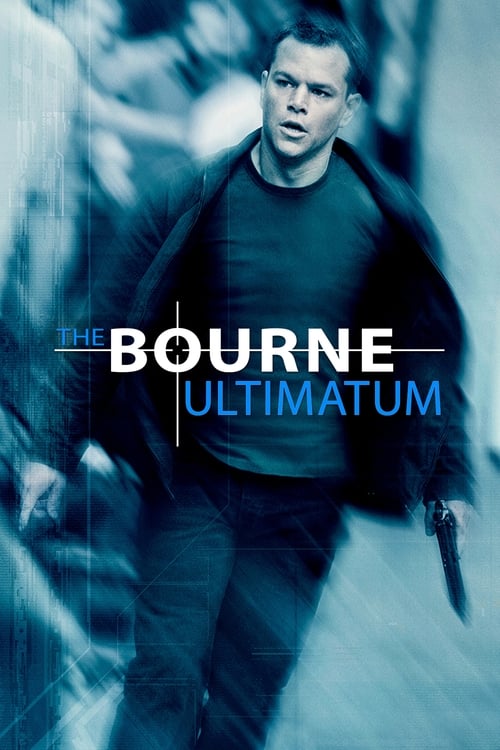
The Bourne Ultimatum
2007 · Paul Greengrass
When you want to be pinned to the couch — maximum momentum, real craft, and a payoff that closes a story rather than just topping the last set piece.
What it's about
A London journalist starts publishing exposés about a classified upgrade to the program that made Jason Bourne, and the story flushes Bourne out of hiding one last time. Chasing fragments of his own recovered memory across Europe, North Africa, and finally New York, he closes in on the place where he was unmade — while the agency deploys everything it has to erase him first.
The experience
Relentless — a two-hour sprint of surveillance, pursuit, and hand-to-hand desperation that barely lets you exhale, yet builds to something genuinely mournful about what was done to its hero. It makes being watched feel physical.
Performances
Matt Damon completes the role with almost no wasted words — a performance carried in the body — while Joan Allen and David Strathairn play the war inside the agency with quiet, escalating menace.
The craft
Greengrass's kinetic style reaches its peak here: the Waterloo Station surveillance sequence and the Tangier rooftop chase are masterclasses in sustained tension, and the film's editing and sound work won three Academy Awards. Loud speakers and a big screen pay off enormously.
Why it matters
Arriving amid daily headlines about secret prisons and warrantless surveillance, it caught its cultural moment exactly — a blockbuster that made state overreach feel visceral — and it stands as the rare trilogy-closer widely considered the series' best.
Snapshot
The third entry in Universal's Bourne franchise closes the loop on Jason Bourne's amnesiac odyssey by returning him to his point of origin: the classified program that unmade him. Where The Bourne Identity (Doug Liman, 2002) posed the question of who Bourne was, and The Bourne Supremacy (Greengrass, 2004) made him a fugitive from his own crimes, Ultimatum converts the quest for selfhood into a procedural reckoning with institutional violence. The film is simultaneously a culmination and a symptom: it arrived at the precise moment when American audiences were absorbing daily disclosures about extraordinary rendition, CIA black sites, and warrantless surveillance, and it channeled those anxieties through a relentlessly kinetic form that made complicity feel visceral rather than abstract. Its three Academy Awards — Film Editing, Sound Editing, Sound Mixing — were unusual distinctions for an action picture, marking the film as something the industry recognized as technically distinctive even when critical opinion on its methods remained divided.
Industry & production
Universal Pictures and The Kennedy/Marshall Company produced the film on a reported budget in the range of $110 million, a significant expansion over the earlier installments. Principal photography ranged across four continents: London and Waterloo Station; Tangier and the labyrinthine medina of Morocco; Madrid; Turin; and New York City, where the final act's rooftop chase and underwater climax were staged. The ambitious multi-location shoot was logistically demanding in ways that bear on the film's texture — the Waterloo sequence alone required the temporary cooperation of Network Rail and the use of hundreds of extras funneled through one of Europe's busiest transit hubs.
Paul Greengrass returned from The Bourne Supremacy, having transformed the franchise's register from the relatively classical grammar of Liman's first film into something rawer and more pressurized. The production inherited the core creative team: Matt Damon, whose investment in the character had deepened across two films; screenwriter Tony Gilroy, who had shaped all three scripts (alongside co-writers Scott Z. Burns and George Nolfi on this entry); and cinematographer Oliver Wood. Gilroy subsequently made comments in interviews suggesting a difficult creative process on the project, though the exact character of those tensions remains a matter of industry lore rather than documented record. What is clear is that the collaborative structure was under strain by the third film, and Gilroy pivoted almost immediately to direct his own feature, Michael Clayton, released the same year.
Robert Ludlum, whose 1990 novel supplied the title and franchise premise, had died in 2001 before any of the films were released. The screenplays depart substantially from the novels' plots, retaining the character and the mythological architecture — Treadstone, the amnesiac assassin, the institutional betrayal — while constructing largely original narratives. This is a franchise where the literary source functions as a brand license rather than a story engine.
Technology
The film was shot on a mixture of 16mm and 35mm film stocks, with Super 16 used extensively for handheld sequences. The 16mm grain, amplified and visible particularly in low-light environments, serves an ideological as much as an aesthetic function: it connotes surveillance footage, news reportage, the amateur documentary — registers that claim access to the real. The digital intermediate process allowed the color grade to be pushed toward the desaturated, high-contrast palette that became the franchise's visual signature, and that would propagate widely through action cinema in the subsequent decade.
The Waterloo sequence exploited London's genuine CCTV infrastructure conceptually if not literally; the tension of being watched through multiple screens simultaneously was achieved through conventional production means, but the sequence's emotional architecture depends on the audience's familiarity with actual surveillance aesthetics. This represents an early example of fiction cinema borrowing the grammar of real surveillance systems to generate dread.
Technique
Cinematography
Oliver Wood's work across the Bourne films established a form that critics and theorists have variously called "chaos cinema," "shaky cam," or, more rigorously, an intensification of the handheld vérité tradition. In Ultimatum, the approach reaches its most developed expression. The camera is almost never still; even in dialogue scenes, it drifts and reframes, as though always seeking a new angle of attack. Focal lengths tend toward the longer end in crowded environments, compressing space and amplifying the sensation of figures moving through dense urban geography. The Tangier chase sequence — Bourne pursuing the asset Desh through the rooftops and stairwells of the medina — is shot with a frantic energy that makes spatial orientation deliberately difficult, placing the viewer inside the panic rather than above it.
This is a significant departure from classical Hollywood action grammar, which privileges legibility: audiences should always know where bodies are in space. Greengrass and Wood are less interested in legibility than in sensation. The question is not "where is Bourne?" but "what does it feel like to be hunted?" The camera's instability becomes an argument about the character's psychological state.
Editing
Christopher Rouse, who won the Academy Award for Film Editing for this film, works in sequences of remarkable compression. The average shot length in action passages approaches two to three seconds, with individual cuts often far shorter. This rhythm is calibrated not for confusion but for impact: Rouse's cuts tend to land on moments of physical consequence — a body hitting a surface, a hand grasping a weapon, a face registering pain — so that even at high velocity the editing has a percussive logic. The Waterloo sequence, often cited as the film's set-piece masterwork, intercutting Bourne's real-time radio guidance of the reporter Ross with the surveillance operatives' attempts to isolate him, demonstrates a more classical crosscutting intelligence beneath the surface frenzy. Rouse is managing multiple spatial arcs and an asymmetrical information flow — the audience knows more than Ross, less than Vosen's team, and exactly as much as Bourne — and the editing choreographs these differentials with precision.
Mise-en-scène / staging
Greengrass's staging reflects his documentary background: he tends to avoid preplanned blocking in favor of improvised movement, instructing actors to find their own paths through space while multiple cameras capture the results. This produces performances with a spontaneous physical quality — Matt Damon's Bourne does not move like a staged action hero but like someone genuinely thinking through spatial problems in real time. The Tangier fight sequence, confined to the narrow hallway and bathroom of a safe house, is deliberately the opposite of the wide-open spectacle that action cinema conventionally offers. Greengrass uses constraint — low ceilings, cluttered surfaces, inadequate light — to generate claustrophobic intensity, and the staging within that constraint feels improvised and therefore contingent in a way that planned stunt choreography often does not.
The film's final revelation scene, in which Bourne confronts Dr. Hirsch (Albert Finney), is staged with comparative stillness. Two men in a room; the camera handheld but slower; the physical action replaced by dialogue and memory. The contrast with everything preceding it is formally strategic — the film has been teaching us that motion means danger, so the stillness of the confrontation registers as a different kind of violence.
Sound
The sound design, which earned two of the film's three Oscars, operates in tight integration with the editing. Rather than the conventionally "clean" mix of Hollywood action — where score, effects, and dialogue occupy distinct perceptual bands — the Bourne sound world is layered and often deliberately murky. Footsteps, urban ambience, the creak of infrastructure, and the blunt impact of bodies against surfaces are given unusual prominence; music is frequently absent from sequences where a conventional film would deploy it. The score, when present, functions as an intensifier rather than a narrator. John Powell's work across all three Bourne films established a recognizable sonic identity — rhythmically propulsive, often built from ostinato patterns and percussive strings — but the sound designers' choice to foreground environmental texture gives the film a rawness that distinguishes it from more musically saturated action pictures.
Performance
Matt Damon's performance in the trilogy's conclusion is distinguished by its economy. Bourne is a character with severely limited interiority — he cannot access his own history — and Damon renders this not as blankness but as extreme vigilance. The eyes are always scanning; the body is always coiled; speech is reduced to the operationally necessary. The emotional register that this economy finally permits, in the confrontation with Hirsch and in the film's closing sequence, carries weight precisely because it has been withheld so long. The supporting cast — David Strathairn as the bureaucratically ruthless Vosen, Julia Stiles as the morally compromised Nicky Parsons — are deployed with similar discipline, their characters' interiority often communicated through what they are prevented from saying rather than what they say.
Narrative & dramatic mode
The film's dramatic structure is a closing spiral: Bourne moves from the periphery toward the center, from effect toward cause, from fugitive toward instigator. The narrative engine is the newspaper reporter Ross, whose articles have surfaced the name "Blackbriar" — the successor program to Treadstone — and who functions less as a character than as a catalyst for Bourne's final acceleration. His death early in the film, a consequence of Bourne's attempt to protect him, establishes the film's moral stakes: institutional power kills people even in the act of being exposed, and Bourne's attempt at protection accelerates the very danger it means to prevent.
The dramatic mode is paranoid procedural — a genre that reached its Hollywood peak in the 1970s with films like The Parallax View, Three Days of the Condor, and All the President's Men. Like those films, Ultimatum is structured around the accumulation of institutional knowledge against the resistance of institutional secrecy, with the lone investigator (here, the investigator is himself the secret) moving through layers of cover toward a revelation that indicts the system rather than an individual villain. The film is careful to distribute moral responsibility across a bureaucratic structure rather than locating it in a single antagonist: Vosen is a functionary, not a mastermind; Hirsch is an enabler, not an architect; the architect is the program itself.
Genre & cycle
Ultimatum is the pivotal entry in what became recognizable as the post-Bourne spy film cycle of the 2000s and 2010s. The franchise had already contributed significantly to the franchise-wide reconception of James Bond: Casino Royale (Martin Campbell, 2006) explicitly repositioned Bond in response to the Bourne series' success, replacing ironic invulnerability with physical vulnerability and emotional consequence. Ultimatum confirmed that the transformation was not a temporary adjustment but a redefinition of what the spy film could do.
The cycle the Bourne series helped generate is characterized by several features that depart from classic Bond conventions: protagonists with moral injuries rather than moral certainty; institutional antagonists rather than supervillains; realist location shooting in place of exotic sets; and action choreography that emphasizes the costs of violence rather than its pleasures. This cycle extends through the Daniel Craig Bond films, through the revived Mission: Impossible series under Christopher McQuarrie, and into the superhero genre, where Captain America: The Winter Soldier (the Russo brothers, 2014) drew explicitly on the paranoid conspiracy template.
Authorship & method
Paul Greengrass came to feature filmmaking from British current-affairs television, having worked extensively in documentary journalism. His breakthrough feature, Bloody Sunday (2002), reconstructed the 1972 massacre in Northern Ireland using a sustained handheld vérité style that made no concession to dramatic comfort. United 93 (2006), made between the Bourne films, applied the same approach to the September 11 hijacking with a real-time procedural structure. These films establish that Greengrass's method is not a stylistic affectation but an ethical position: the handheld camera refuses the composed distance of classical filmmaking because distance implies a safety that the subject does not permit.
Oliver Wood's cinematography across the trilogy provided the visual framework within which this position was executed at franchise scale. John Powell's scores — propulsive, rhythmically insistent, built more on momentum than on melodic statement — are integral collaborators in the overall affect. Christopher Rouse emerged from this collaboration as one of the defining action film editors of his generation.
Tony Gilroy's screenwriting across the trilogy is underappreciated in discussions that focus on Greengrass's stylistic dominance. Gilroy's structural instincts — the asymmetric information distribution, the bureaucratic antagonists, the interlocking procedural arcs — provide the architecture within which Greengrass's sensory approach operates. The combination is unusual: a director whose method is fundamentally anti-schematic paired with a writer whose structures are meticulously designed.
Movement / national cinema
Ultimatum occupies an interesting national-cinematic position. It is an American studio franchise film, produced by Universal, starring an American actor, and rooted in American anxieties about state power. Yet it is directed by a British filmmaker whose sensibility is shaped by British documentary television and European political cinema; shot by an American cinematographer using a style more associated with European vérité traditions; and set largely outside the United States, treating America as a target to be reached rather than a home to be protected. The film's relationship to American cinema is therefore slightly alien — it views American institutional power from outside, which is part of what gives its critique its particular sharpness.
This is not "national cinema" in any strict sense, but it reflects the globalization of Hollywood production, in which a British director's political sensibility can be delivered through an American franchise to an international audience.
Era / period
The film was released in August 2007, at a moment when American public discourse about intelligence programs, extraordinary rendition, and the legal frameworks of the War on Terror was at an unusual pitch of intensity. Congressional hearings on CIA interrogation practices, media coverage of secret detention programs, and the Abu Ghraib photographs were all recent or ongoing contexts. The film neither names these realities nor avoids them; Operation Blackbriar's logic — that the government may create, use, and destroy human beings under a national security rationale — is a fairly direct fictional analog to documented programs, and the film treats it with a degree of moral clarity that the official discourse of the period often lacked.
This contemporaneity is worth noting because it gives the film a political charge that was not simply inherited from the Ludlum novels, which were written in a Cold War framework. The screenplay relocates the franchise's paranoid logic into a specifically post-9/11 institutional landscape.
Themes
The film's central thematic concern is the relationship between institutional violence and individual identity. Bourne cannot know who he is because who he is was constructed by a covert program, and the program's purpose was to strip its subjects of the selfhood that would allow them to refuse orders. The revelation that he volunteered — that there is a version of David Webb who chose to become Jason Bourne — complicates any simple reading of him as a victim, and the film is honest about this complication. He is complicit in his own unmanning; the question is whether complicity forecloses redemption.
Surveillance and its discontents constitute a second thematic layer. The film is unusual in depicting surveillance as both terrifying and penetrable — Bourne repeatedly uses the system's own infrastructure against it, turning CCTV feeds, communication intercepts, and institutional information flows into tools of evasion and exposure. This reflects a particular moment's understanding of intelligence systems: powerful but not omniscient, networked but therefore vulnerable to anyone who understands the network.
The film also meditates, somewhat quietly, on journalism as a form of institutional courage — Ross's columns are what catalyze the entire plot, and his death frames the institutional cost of speaking.
Reception, canon & influence
Critical reception was strongly positive, with particular praise for Greengrass's direction and the Waterloo sequence. A.O. Scott's review in The New York Times captured the dominant response: admiration for the film's formal intensity alongside some ambivalence about whether that intensity served coherent dramatic ends or constituted an end in itself. The dissenting critical position — articulated most systematically by scholars and critics attentive to action cinema's formal conventions — argued that Greengrass's technique, whatever its documentary pedigree, was finally a form of audience manipulation rather than realism, generating sensation by withholding the spatial orientation that allows viewers to fully process action.
This debate, crystallized in later years by the video essay "Chaos Cinema" by Matthias Stork (2011), which used the Bourne films as central examples, continues to organize academic discussion of post-2000 Hollywood action cinema. Greengrass's position in that debate is that his formal choices are ethically motivated — that the destabilized camera produces an empathic identification that classical Hollywood grammar forecloses. The debate is genuinely unresolved.
Backward, the film draws on a long tradition of paranoid political thrillers, most explicitly the American films of the 1970s, and on the British vérité tradition running from the Free Cinema movement through Alan Clarke's television work. Greengrass's approach to institutional violence has clear debts to Costa-Gavras's political cinema of the late 1960s and 1970s.
Forward, the film's influence is extensive. Within the spy cycle it helped create, it remains the reference point for action-oriented engagement with questions of state violence and covert operations. The Russo brothers' work on the Marvel Cinematic Universe — particularly The Winter Soldier — represents the most explicit mainstream acknowledgment of the Bourne template, importing both the paranoid conspiracy structure and elements of the handheld kinetic grammar into a superhero context. The Daniel Craig Bond films, initiated with Casino Royale in the same year as Supremacy, continued to develop in dialogue with the Bourne cycle throughout Craig's tenure. More diffusely, the desaturated visual palette and handheld action grammar of Ultimatum became so widely imitated across action cinema that they eventually read as genre convention rather than distinctive style — a fate that attends films whose innovations are too successful to remain innovations.
A Deleuzian reading
A man stands in Waterloo Station with a phone pressed to his ear.
The full Deleuzian reading of The Bourne Ultimatum →
Reception
Rapturously received in 2007 — a rare threequel hailed as the best of its trilogy — and it's only grown in stature since, now routinely cited as the peak of 2000s action filmmaking whose style the rest of Hollywood spent a decade imitating.
How The Bourne Ultimatum was received, from release to now →
Influences: the films it descends from and the films it influenced
- The Battle of Algiers (1966) — Marcello Gatti's Super 16 pseudo-documentary grain — staging fiction to simulate newsreel footage — is the formal prototype for Oliver Wood's Bourne texture and the ideological strategy of borrowing surveillance aesthetics to implicate the viewer in institutional violence.
- Z (1969) — Raoul Coutard's handheld tracking of figures through dense crowds while withholding spatial overview established the kinetic grammar for the paranoid-institutional thriller — the camera as witness inside rather than observer above — that Greengrass inherits wholesale.
- The French Connection (1971) — Owen Roizman's pursuit photography deliberately sacrificed shot legibility for the sensation of being inside a chase, setting the precedent for the Tangier sequence's disorienting rooftop geography where spatial orientation is subordinated to panic.
- The Manchurian Candidate (1962) — Lionel Lindon's flash-cut editing between hypnotic implantation sessions and fragmented memory established identity-amnesia as an editing problem — a rhythm of intrusion and suppression — that Christopher Rouse literalizes as Bourne's recurring trauma structure.
- Three Days of the Condor (1975) — The procedural architecture of a CIA analyst hunted by his own agency's enforcement apparatus, using tradecraft details — dead drops, cover identities, protocol violations — as the primary suspense machinery, is the direct narrative template for Bourne's institutional-antagonist plot.
- The Conversation (1974) — Walter Murch's sound design foregrounding degraded surveillance audio as the primary carrier of paranoid meaning is the formal antecedent for Bourne's ambient-texture-foregrounded approach, where earpiece chatter, crowd noise, and room tone carry ideological weight rather than merely atmospheric filler.
- Ronin (1998) — Robert Fraisse's location-based car chase photography through actual European city streets — no process shots, no CGI inserts, spatial geography preserved — established the grounded-in-place kinetic action standard that the Bourne franchise institutionalized and exported globally.
- Bloody Sunday (2002) — Ivan Strasburg's Super 16 handheld work on Greengrass's own Derry documentary drama is the direct laboratory for the improvised-blocking and ambient-sound-foregrounded technique — actors moving through unrehearsed crowd geometry — that Greengrass imported into the franchise two years later.
- The Bourne Supremacy (2004) — The fullest expression of the Greengrass–Christopher Rouse cutting style begun here; its Oscar-winning editing effectively canonized Bourne's fragmentary action grammar.
- Quantum of Solace (2008) — Editors Matt Chesse and Richard Pearson attempted to replicate Christopher Rouse's metric-montage cutting rhythm so directly that the result was widely criticized as incoherent — demonstrating by negative example that Rouse's technique depended on precise spatial anchoring between cuts that the imitators omitted.
- Taken (2008) — Morel's European-location action, structured entirely around a protagonist's systematic procedural recovery operation using tradecraft discipline as dramatic motor, transplants Bourne's economy-of-means performance register and stripped-down institutional competence into a more classical revenge frame.
- Haywire (2011) — Soderbergh cast MMA fighter Gina Carano and refused to use editing to manufacture impact that the performer's body couldn't generate — an explicit formal inversion of Rouse's editing-as-choreography, testing whether Bourne's kinetic effect lived in the cut or the body.
- Zero Dark Thirty (2012) — Bigelow and Greig Fraser adopt Bourne's procedural-institutional narrative architecture — bureaucratic chains of command as dramatic structure, intelligence tradecraft as scene grammar — and its desaturated surveillance-inflected visual register to authenticate CIA operational space as morally contaminated rather than heroic.
- Captain America: The Winter Soldier (2014) — The Russos imported Bourne's institutional-betrayal narrative architecture — operative discovering his own agency is the antagonist — into superhero cinema, and hired cinematographer Trent Opaloch to approximate handheld-vérité texture specifically for the elevator ambush and highway combat sequences.
- Safe House (2012) — Codified parallel cross-cutting between surveillance command-rooms and ground-level pursuit — the institutional-corruption-watching-its-own-agent structure Safe House restages in its CIA op-center scenes.
- The Hunger Games (2012) — Defines the handheld, accelerated-cutting action grammar — disorienting proximity and rapid fragmentation — that Ross adopts for the bloodbath sequences (the film's most-debated technique).
- Jason Bourne (2016) — The direct progenitor: Christopher Rouse's Eddie-cut action style, the Waterloo Station surveillance ballet, and the near-silent competent protagonist that the 2016 film reassembles from the same parts.
- No Time to Die (2021) — Pioneers the consequence-driven, serialized spy-action mode whose psychological seriousness the dossier names as a direct influence, forcing legacy franchises toward continuity and moral weight.
- The Berlin File (2013) — Modeled the surveillance aesthetic of CCTV feeds, comms intercepts and overhead tracking woven into the action geography, so pursuit is staged through the apparatus of watching.
- World War Z (2013) — Codifies the shaky-cam, impact-cut editing grammar of post-2002 action that WWZ's close-quarters combat scenes directly inherit.
- Black Widow (2021) — Its handheld, fragmented hand-to-hand combat cut on impact rather than on clean masters supplies the Greengrass/Christopher Rouse verité-action grammar that Beristain's camera and the film's close-quarters fights directly inherit.
- United 93 (2006) — Barry Ackroyd's simultaneous multi-camera documentary-style shooting of ensemble procedural sequences, developed with Greengrass the year immediately preceding Ultimatum, directly informs the spatial grammar of the Waterloo command-center intercutting where no camera holds a privileged overview position.
- Casino Royale (2006) — The franchise recalibration — eliminating gadgetry, foregrounding physical performance economy, casting Craig for his capacity to suppress affect rather than charm — was an explicit institutional response to Bourne's commercial and critical reframing of what a spy thriller's acting register should be.
- Mission: Impossible III (2006) — Extends the same kinetic handheld surveillance-and-pursuit craft in parallel, sharing III's grounded mid-2000s espionage idiom and parallel cross-cutting of converging agents.
- Green Zone (2010) — The fullest expression of the Greengrass-Rouse-Powell action style — handheld geography of pursuit through real cities — that Green Zone redeploys onto occupied Baghdad.
- The Bourne Legacy (2012) — Gilroy scripted its concurrent-timeline overlaps (events glimpsed in Ultimatum recur in Legacy from another angle), making Legacy a literal formal continuation of the chase-wrapped-around-an-expose architecture he helped build.
- Mission: Impossible - Ghost Protocol (2011) — The fragmented handheld shaky-cam action grammar GP deliberately repudiates, choosing spatial-continuity legibility precisely as the counter-statement to Bourne's chaos cinema.
Similar films
- Ronin (1998) — influence & lineage · same viewing thread
- United 93 (2006) — influence & lineage
- Quantum of Solace (2008) — influence & lineage
- Zero Dark Thirty (2012) — influence & lineage
- Bloody Sunday (2002) — influence & lineage
- The Bourne Supremacy (2004) — same viewing thread
- The Bourne Identity (2002) — same viewing thread
- Jason Bourne (2016) — shared sensibility
All the films related to The Bourne Ultimatum →
Watch it with: curated runs of related films
- The Silent Professional — A run of lethal loners who move through the world with monkish economy — watch them back to back for pure, terse competence under pressure and men who just want to disappear.