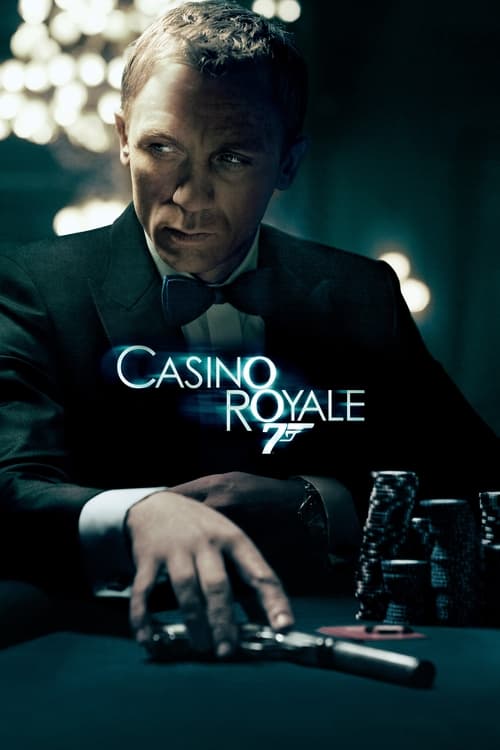
Casino Royale
2006 · Martin Campbell
For when you want a big, confident action night that also has a brain and a pulse — thrilling without being disposable. A perfect gateway if you think you don't like Bond movies.
What it's about
James Bond, newly promoted to 00 status and still rough around the edges, is sent to a high-stakes poker game in Montenegro to bankrupt Le Chiffre, a private banker to the world's terrorists. With treasury accountant Vesper Lynd watching the money and watching him, the mission becomes a test of whether Bond can survive becoming the weapon his job requires.
The experience
Lean, brutal, and surprisingly emotional — the action hits hard and practical, the poker scenes are genuinely tense, and the romance gives the whole thing a bruised heart you don't expect from the franchise. It earns its swagger.
Performances
Daniel Craig redefined the role — flinty, physical, and wounded — and Eva Green's Vesper Lynd matches him beat for beat, making their sparring the best thing in the film.
The craft
Martin Campbell strips the series back to muscle and nerve: the opening parkour chase is a modern action landmark, the stunts are punishingly physical, and the film withholds the series' iconic flourishes until it has earned them. Big screen and loud speakers strongly recommended.
Why it matters
It resurrected a franchise widely considered exhausted and reset the tone of blockbuster action toward grounded, character-driven grit — its influence is visible across a decade of thrillers that followed.
Snapshot
Martin Campbell's Casino Royale is the twenty-first entry in Eon Productions' James Bond franchise and the first genuine origin story the series ever attempted. Casting Daniel Craig as a newly minted 00 Agent, the film abandons the gadget-laden baroque of the Brosnan years in favour of a stripped-back psychological thriller rooted in Ian Fleming's 1953 debut novel. Its central conceit — withholding the iconic gun barrel sequence and the traditional "Bond... James Bond" declaration until the final frames — structures the entire film as a bildungsroman in which the audience watches a dangerous man harden into a legend. The result revitalized a franchise that many industry observers had declared moribund and reset the aesthetic terms for the blockbuster action film at large.
Industry & production
The rights to Fleming's first novel had a tortured commercial history that for decades prevented Eon from adapting it. Because the Casino Royale property was sold separately in the early 1950s — leading to a live CBS television production in 1954 and the 1967 Columbia spoof starring David Niven — it sat outside the canonical Eon series until Sony's acquisition of MGM in 2005 resolved the outstanding rights entanglements and brought the property fully under the franchise's control. The timing proved decisive: Sony's distribution arm became the film's primary releasing partner, injecting both resources and corporate urgency to make the relaunch count.
Producers Barbara Broccoli and Michael G. Wilson had been developing the reboot concept through the early 2000s, watching the James Bond template — then lampooned as exhausted self-parody — lose market share to the grittier action cinema emerging elsewhere. The decision to return to Fleming's source text was partly remedial and partly opportunistic: Casino Royale offered a clean slate, a story untouched by the Eon canon, and a narrative pretext for introducing a Bond who is still learning the trade.
Principal photography spread across multiple countries — the Bahamas, the Czech Republic (serving as several continental European locations including Montenegro), Italy, and the United Kingdom — with the construction-site parkour sequence in the opening act staged at an enormous real-world building site. Locations chosen for Venice's Grand Canal hotel climax were actual Venetian settings, lending the collapsing-building finale a physical authenticity that CGI alone could not have provided.
The casting of Daniel Craig generated unusual public controversy. An online campaign, centered on the website DanielCraigIsNotBond.com, argued that Craig — blond, physically stocky, not conventionally suave — was wrong for the role. Broccoli and Wilson held firm, and the film's reception converted most critics within days of its release.
Technology
Casino Royale does not foreground technology as spectacle in the manner of its immediate predecessors. It uses digital intermediate grading to precise but restrained effect, pushing contrast and desaturating selectively to signal mood shifts rather than to impose a uniform palette. The film's celebrated pre-title sequence, shot in high-contrast black and white, was achieved through both in-camera choice and DI processing, drawing on a visual grammar associated with noir and with the classic Bond titles that opened Dr. No.
The production employed prevision and stunt planning of considerable sophistication for the Madagascar free-running sequence. Sébastien Foucan, co-founder of the freerunning discipline, performed his own movement in a sequence that required camera rigs mounted on cranes and remote heads to track fast vertical movement across scaffolding. Unlike the computer-generated action of many contemporaries, this sequence was shot as practically as the logistics allowed, with visual effects compositing kept to a minimum.
Technique
Cinematography
Cinematographer Phil Méheux, reuniting with Campbell after their collaboration on GoldenEye (1995), maintained a more restrained visual register than the series had recently favoured. Widescreen framing tends toward close observation of faces — Craig's Bond is read through expression and physical tension as much as through dialogue — and the camera rarely indulges in the virtuosic crane moves that had become a franchise signature. The Bahamas sequences use open, high-key natural light; the interior casino and interrogation scenes tighten the palette toward amber and shadow. The black-and-white prologue owes something to both the noir tradition and to the memory of the earliest Bond films, establishing a visual lineage while signaling rupture.
Editing
The film's pacing is more deliberate than franchise precedent. The lengthy poker sequences at the Casino Royale itself — sequences that in other action films would be compressed into montage shorthand — are allowed to run at near-dramatic tempo, building tension through close-ups of hands and eyes rather than through kinetic cutting. The editing discipline reflects confidence that the film's real dramatic engine is psychological rather than kinetic. The stairwell fight scene, by contrast, is cut tightly and without elegance: the violence is abrupt, ugly, and fatigue-inducing, its rhythm designed to strip glamour rather than to generate excitement in the conventional sense.
Mise-en-scène / staging
Campbell stages action with a clarity unusual in 2000s blockbuster cinema, which had absorbed the post-Saving Private Ryan doctrine that disorientation equals intensity. The Madagascar chase is choreographed so that spatial relationships remain legible even at high speed. The torture scene — Le Chiffre restraining Bond on a bottomless chair and attacking him with a knotted rope — is staged with a clinical simplicity that makes it more disturbing than most franchise violence: no cutaways, no comedy, no rescue until Bond is already broken and deliberately choosing to mock his torturer. The Venice sinking sequence, operatic in scale, is blocked as physical problem-solving with a tragic outcome, foregrounding physical consequence over spectacle.
Sound
David Arnold's score — his fourth for the Bond franchise — departs from the orchestral bombast of his earlier entries to accommodate a more psychological register. The film's theme song, "You Know My Name," performed by Chris Cornell, is itself a structural choice: a hard rock track rather than the traditional crooned ballad signals that the film is playing a different emotional game. More significant is Arnold's management of the iconic Monty Norman/John Barry Bond theme: it is withheld almost entirely through the film's two-and-a-half-hour running time, surfacing only at the very end when Bond first identifies himself in full. The anticipation created by this deferral is itself a formal argument about identity — Bond is not yet Bond until the film decides he is.
Performance
Daniel Craig's performance is the film's most consequential element. Where Brosnan played Bond as a surface of ironic charm, Craig's approach works inward: his Bond is physically indelicate, emotionally raw, and inclined to catastrophic misjudgement. The performance draws on a tradition of stoic British masculinity under pressure — the Fleming novels' Bond was never as unflappable as the Connery films suggested — and finds genuine feeling in the Vesper Lynd scenes that the franchise had not typically asked of its leads. Eva Green's Vesper is written and played as Craig's intellectual equal, and the chemistry between them carries the film's emotional structure. Mads Mikkelsen's Le Chiffre is notably understated, the film's refusal of theatrical villainy being of a piece with its broader rejection of franchise convention.
Narrative & dramatic mode
Casino Royale structures itself as both a spy thriller and a tragedy of education. The poker game is the narrative engine, but the film's actual subject is the formation of a professional identity through loss. Bond enters the film still capable of sentiment — his feeling for Vesper is presented as genuine, not performed — and exits it having deliberately armored that capacity away. This arc, compressed into a single film, gives the story a novelistic weight unusual in franchise cinema: the hero is diminished by his victory.
The film draws on classical dramatic irony throughout. The audience knows Bond survives; Fleming's novel was the first in a series; the franchise is unkillable. What suspense exists is therefore not about outcome but about cost — what survives the ordeal, what is lost. Vesper's betrayal and death is the pivot on which this irony turns, converting a love story into origin myth.
Genre & cycle
Casino Royale belongs to the mid-2000s cycle of franchise reboots committed to what the period's discourse called "grounding" — the excision of the fantastic or stylized in favour of physical plausibility and psychological realism. Christopher Nolan's Batman Begins (2005) is the most direct formal precursor, both films returning a franchise to its source text and insisting on origin as the site of character truth. The Bond series had itself influenced Batman's visual grammar for four decades; in 2006 the debt ran the other way.
The film also responds explicitly to Doug Liman and Paul Greengrass's Bourne films (2002–2004), which had demonstrated that the spy thriller could sustain serious ambition and had drawn audiences away from the Bond franchise in doing so. Casino Royale's adoption of hand-held urgency, its preference for location physicality over studio construction, and its moral ambiguity around intelligence tradecraft all engage the Bourne template. Where the Bourne films proposed a Bond-style hero stripped of institutional sanction, Casino Royale proposes the institutional hero stripped of institutional comfort.
Authorship & method
Martin Campbell is a technically accomplished journeyman director with a particular gift for franchise reinvention: GoldenEye (1995) had similarly rescued Bond from post-Cold War irrelevance by introducing Brosnan. His direction here is disciplined rather than auteurist — the film bears his competence without bearing his signature in any immediately identifiable way, which may be the appropriate approach for a franchise asset of this scale.
The screenplay credit goes to Neal Purvis and Robert Wade, the franchise's regular writing team through this period, with substantial revisions by Paul Haggis, who had recently received wide attention for Crash (2005). Haggis's contribution to the Vesper arc and to the film's emotional legibility is credited in production accounts, though the precise attribution of specific scenes is not clearly established in the public record.
Phil Méheux's cinematography and David Arnold's score are collaborative partnerships with the director of long standing. The film's overall aesthetic is perhaps most properly attributed to the producing framework — Broccoli and Wilson's strategic decision about the kind of Bond they wanted — rather than to directorial vision per se.
Movement / national cinema
Casino Royale is British production in its infrastructure, cultural reference, and institutional identity: Pinewood Studios, British crew, a British lead, and a narrative about the British intelligence apparatus. It belongs to the long lineage of the British spy film, a genre that from the Hitchcock of The 39 Steps (1935) through the le Carré adaptations of the 1960s and 1970s has used espionage as a vehicle for interrogating national character and institutional loyalty.
Yet it is also a globalized entertainment product — financed, distributed, and marketed internationally, shot across multiple national territories, and designed for a worldwide audience that has no specific relationship to Britishness. The tension between these two modes — between the particular character of the Fleming world and the universalism of the blockbuster — runs through the film and through the Craig-era franchise generally.
Era / period
The film arrives at a specific historical moment: the mid-2000s, when the post-September 11 reconfiguration of Western intelligence culture had entered popular discourse but had not yet produced settled narrative frameworks for processing it. Le Chiffre's position as banker to non-state terrorist actors, M's awareness that Bond's operation may generate more problems than it solves, and the film's refusal to deliver a clean ideological payoff all reflect this uncertainty. Bond's torture — and the film's unsentimental treatment of it — lands differently in a decade when the meaning and legality of torture by state actors was a live public argument.
The era is also the era of franchise consolidation in Hollywood — the decade in which intellectual property management became the dominant studio logic and in which reboots, remakes, and origin stories emerged as the preferred form for maintaining franchise value. Casino Royale is both a product of this logic and, in its ambition, a partial critique of it.
Themes
The film's central preoccupations are trust, professional identity, and the cost of institutional belonging. Bond's investment in Vesper is figured as a wager — the same metaphor as the casino game — and his loss is the price of admission to the franchise world. The film suggests that the series hero's famous emotional detachment is not innate but acquired, not a character trait but a scar.
Questions of institutional loyalty and cynicism run beneath the surface. M is presented not as a benevolent superior but as a calculating strategist who uses Bond instrumentally and knows it. Mathis, the figure Bond trusts, is suspected of betrayal. The very poker game around which the plot turns is a contest of bluffing and concealment. The film's world rewards duplicity and punishes sincerity — Vesper's genuine conflict about her situation is what destroys her.
Masculinity under pressure is a consistent concern. The torture scene literalises the threat to Bond's bodily integrity in terms that are explicitly sexual; the film is unusually frank about what violence does to the body rather than merely to the narrative. Craig's Bond is allowed to be frightened, humiliated, and emotionally destabilised in ways that complicate rather than reinforce the franchise's traditional gender dynamics.
Reception, canon & influence
Critical reception was strongly positive and commercially the film performed well beyond expectations, becoming among the highest-grossing entries in the franchise to that point and reclaiming Bond's position as a prestige entertainment event. The controversy around Craig's casting collapsed within the film's opening weeks as reviewers and audiences recognized the performance's quality.
The film's backward influences are traceable to Fleming's novel most directly, but also to the psychological seriousness of John le Carré's spy fiction (which had always operated as an implicit critique of the Bond world's values), to the post-Saving Private Ryan insistence on physical realism in action sequences, and most immediately to the Bourne films and Batman Begins.
Its forward influence operates on multiple registers. Within the franchise, it established the psychological template for the subsequent Craig films — Quantum of Solace (2008), Skyfall (2012), Spectre (2015), and No Time to Die (2021) — all of which extend Casino Royale's emotional architecture with varying degrees of success. Skyfall in particular builds directly on the wound Casino Royale opens, exploring M's culpability and Bond's institutional disillusionment.
Beyond the franchise, Casino Royale contributed to the normalization of what might be called the reboot-as-origin-story as Hollywood's preferred mode of franchise maintenance. Its demonstration that a longstanding series could be reimagined without destruction — could strip itself to first principles and find renewed vitality there — was absorbed as industry lesson across the subsequent decade. Whether this constitutes a benign influence on popular cinema is a question the field has not yet settled.
A Deleuzian reading
Le Chiffre weeps blood.
The full Deleuzian reading of Casino Royale →
Reception
Announced with Daniel Craig as a 'blond Bond', it drew a genuine pre-release fan revolt — complete with boycott websites — then landed as the best-reviewed Bond in decades and instantly silenced the backlash. Twenty years on it's routinely ranked the best (or top-two) Bond film ever made.
How Casino Royale was received, from release to now →
Influences: the films it descends from and the films it influenced
- GoldenEye (1995) — Campbell applied the identical franchise-reboot strategy here: strip Bond to psychological first principles after dormancy, establishing competence over camp — the structural template he repeated with greater severity in 2006.
- From Russia with Love (1963) — Casino Royale consciously echoes FRWL's pacing architecture: no gadget gimmicks, one high-stakes physical confrontation as narrative engine, and a torture sequence that tests the protagonist's composure before the climax — the Bond template stripped to essentials.
- The Spy Who Came in from the Cold (1965) — Phil Méheux's black-and-white prologue directly inherits Ritt's visual grammar: grainy, unglamorous, the spy's moral compromise rendered in monochrome because ethical clarity is being withheld from the audience and the character alike.
- Le Samouraï (1967) — Daniel Craig's inward masculinity — interior read through ritual and action rather than dialogue — descends from Delon's Costello: the taciturn professional whose self-containment the camera observes patiently rather than explains.
- License to Kill (1989) — The first sustained attempt to shoot a Bond film as unglamorous revenge thriller; Dalton's cold-eyed performance and the franchise's willingness to depict physical consequence without euphemism anticipates Craig's approach by seventeen years, before audiences were ready for it.
- The Bourne Identity (2002) — The close-quarters, unglamorous fight choreography Casino Royale directly adopted as counterpoint to Brosnan-era stylization; both films also hinge on the spy-as-identity-crisis-protagonist, making amnesia and self-dissolution the narrative engine rather than mission competence.
- Batman Begins (2005) — The one-year-earlier template for franchise-reboot-as-psychological-origin: strip a legacy character to his traumatic first principles, earn the icon through bildungsroman rather than assuming it. Casino Royale follows this structural logic exactly, substituting Fleming's novel for Year One.
- Munich (2005) — The post-9/11 intelligence operation rendered as moral reckoning; violence that accrues psychological cost rather than offering catharsis establishes the emotional register Casino Royale imports into the Bond franchise — killing as wound rather than resolution.
- The Bourne Supremacy (2004) — Directly pressured by Bourne into a grittier, deglamorized reinvention of Bond — bruising practical stunts, an emotionally scarred agent, and handheld realism replacing gadgetry.
- Layer Cake (2004) — Directly reaps Layer Cake's chief legacy — Daniel Craig's leading-man menace and cool interiority, the very qualities the film showcased, repurposed to reinvent Bond as a hard professional.
- Jason Bourne (2016) — The Bourne template's clearest catalysis: it strips Bond of glamour and gadgets for a damaged, physically grounded, competent operative and bone-real violence — the reinvention explicitly chasing Bourne's realism.
- Harry Potter and the Prisoner of Azkaban (2004) — Following Azkaban's example of an installment that darkens and grounds a long-running series, it reinvented the franchise's visual grammar toward grittier, more realist texture.
- Quantum of Solace (2008) — Extends Casino Royale's tragic irony as its direct structural premise: Bond's suppressed mourning for Vesper is the engine, and unglamorous violence escalates as psychological symptom rather than spectacle, following the emotional architecture the predecessor opened.
- Skyfall (2012) — Roger Deakins extends Casino Royale's close-observation-of-faces cinematography into sustained portraiture; the narrative completes the wound Casino Royale opens — Bond's institutional disillusionment translated into M's culpability and eventual death as the cost of that first betrayal.
- No Time to Die (2021) — The tragic irony structure Casino Royale initiates reaches its logical endpoint: the bildungsroman that made Bond a lover and a self with history completes when that self is destroyed, extending the withheld leitmotif's emotional discipline into Bond's death as the only honest conclusion.
- John Wick (2014) — The spatial clarity in action staging — camera held wide, cuts to geography rather than confusion — that Casino Royale's parkour chase established as the post-Bourne alternative becomes John Wick's signature grammar; the grief-driven, inward protagonist also inherits the Craig emotional template.
- Star Trek (2009) — Demonstrated that recasting a culturally iconic role via a stripped-back origin — performed as fresh embodiment rather than imitation of predecessors — is commercially viable; Pine and Quinto's impressionist homages to Shatner and Nimoy apply exactly this Daniel Craig template.
- The Amazing Spider-Man (2012) — Established the reboot-as-emotional-realism playbook — strip an over-familiar franchise back to a vulnerable, unfinished protagonist — the same 'justify the do-over by getting closer to the person' bet Sony placed on Webb.
- Black Widow (2021) — Its post-Bourne reboot of Bond into a grittier, physically grounded, emotionally wounded espionage register is the genre reorientation the film's spy-thriller texture inherits.
- The Girl with the Dragon Tattoo (2011) — Kleinman's fully CG main title, working the Binder tradition of abstract bodies in liquid motion, is the acknowledged model for Blur Studio's black-oil overture as a self-contained graphic short film.
- Tinker, Tailor, Soldier, Spy (2011) — Alfredson crystallizes the le Carré inflection Casino Royale imported into Bond: Oldman's inward performance mode, deliberate procedural pacing that reads as authenticity, and the revelation that the institution itself is the wound — the establishment as source of espionage's tragedy.
- Atomic Blonde (2017) — The Berlin spy aesthetic and unglamorous violence with accumulating physical cost across the film; the stairwell fight's spatial clarity and single-shot grammar directly extends the staging logic Casino Royale established for credible spy action — geography held wide so consequences register.
- Mission: Impossible – Fallout (2018) — The HALO jump and Paris motorcycle pursuit consolidate the practical-stunt-as-franchise-prestige-marker that Casino Royale legitimized; both films treat physical consequence — Cruise's ankle break, Craig's torture — as authentication of spectacle rather than interruption of it.
- The Bourne Ultimatum (2007) — The franchise recalibration — eliminating gadgetry, foregrounding physical performance economy, casting Craig for his capacity to suppress affect rather than charm — was an explicit institutional response to Bourne's commercial and critical reframing of what a spy thriller's acting register should be.
- Mission: Impossible III (2006) — Contemporaneous reinvention of a legacy spy brand toward grit and the body-as-vulnerability — its torture sequence and bruised hero share III's stripped-down, physically-imperiled register.
- Mission: Impossible - Dead Reckoning Part One (2023) — Shares the grounded, parkour-and-practical-stunt rebuild of the spy thriller against CG-heavy convention, prizing physical chase over gadgetry.
Similar films
- Quantum of Solace (2008) — influence & lineage
- Skyfall (2012) — influence & lineage
- The Bourne Identity (2002) — influence & lineage
- No Time to Die (2021) — influence & lineage
- The Spy Who Came In from the Cold (1965) — influence & lineage
- Atomic Blonde (2017) — influence & lineage
- John Wick (2014) — influence & lineage
- Goldfinger (1964) — shared sensibility
All the films related to Casino Royale →