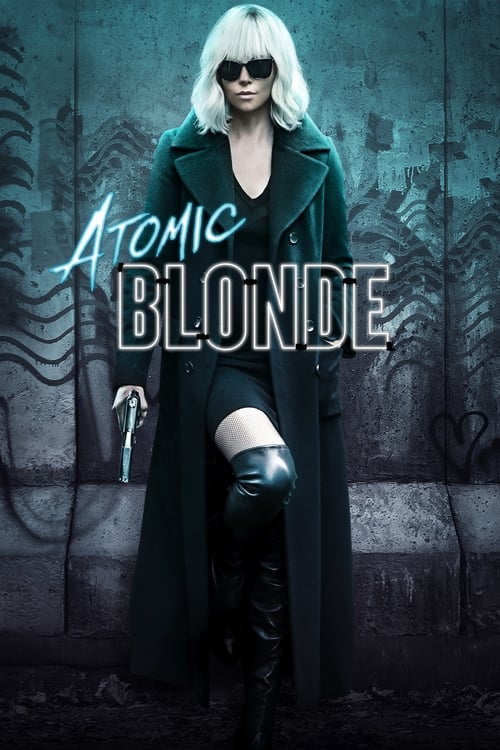
Atomic Blonde
2017 · David Leitch
For when you want pure style and impact — a Saturday-night action fix with great music, not homework. Comfort viewing for anyone whose comfort is watching a spy take and throw punches.
What it's about
Berlin, the last days before the Wall comes down. An MI6 agent is sent into the divided city to investigate the murder of a fellow operative and recover a stolen list that names every double agent in play — while trying to figure out which of her supposed allies is the traitor. It's a Cold War spy plot delivered as a series of brutal, bruising fights.
The experience
Sleek, loud, and physically punishing — the neon and needle-drops keep it cool while the fights make you wince. The plot's double-crosses are knotty, but the film runs on adrenaline and style more than suspense.
Performances
Charlize Theron does visibly demanding physical work, taking hits and showing the damage — her spy gets tired, bloodied, and keeps going, which is rarer than it sounds. James McAvoy is a live wire as her feral Berlin contact.
The craft
Directed by stunt veteran David Leitch, it treats fight choreography as the main event: long, sustained brawls staged so you can see every exchange, including a stairwell sequence built to play as one continuous take. The ice-blue and neon look and the wall-to-wall 1980s soundtrack make it a film for good speakers.
Why it matters
A signature of the late-2010s wave of stunt-team-driven action filmmaking and a proof of concept for female-led action built on visible, practical fight work rather than editing tricks.
Snapshot
Atomic Blonde is a Cold War espionage thriller built as a vehicle for sustained, bruising physical action and an aggressively curated 1980s pop aesthetic. Adapted from Antony Johnston and Sam Hart's 2012 graphic novel The Coldest City, it sends MI6 operative Lorraine Broughton (Charlize Theron) into Berlin in the final days before the Wall falls, tasked with recovering a stolen list of compromised agents and uncovering the identity of a double agent code-named "Satchel." The film matters less for its convoluted plot than for what it represents at the intersection of two trends: the rise of the stunt-professional-turned-director (here David Leitch in his first solo feature credit) and a late-2010s appetite for female-led action built around a star doing visibly demanding physical work. It is best understood as a stylistic statement — a film that foregrounds craft, choreography, and surface — wrapped around a familiar genre skeleton.
Industry & production
The project originated as a literary property: Johnston and Hart's monochrome graphic novel, optioned and developed under the working title The Coldest City before the splashier Atomic Blonde was adopted. Kurt Johnstad, screenwriter of Zack Snyder's 300, wrote the adaptation, loosening the source material's austere tone in favor of a more flamboyant, music-driven register.
Charlize Theron was the engine of the production. She was attached as both star and producer (through her Denver and Delilah Productions banner), and her involvement shaped the film's identity around a performer willing to commit to extended hand-to-hand combat. Theron reportedly trained for months — the publicity record emphasizes her physical preparation, including injuries sustained during training — and her producorial stake meant the action design served her capabilities rather than concealing them through doubling. The film was released by Focus Features, positioning it as a mid-budget genre title rather than a tentpole; precise budget and box-office figures vary across sources, so I won't assign hard numbers, but it is generally characterized as a modest commercial performer that nonetheless built a durable reputation.
The most consequential production fact is Leitch himself. A former stuntman and stunt coordinator — long associated with the company 87Eleven, which he co-founded with Chad Stahelski — Leitch had served as uncredited co-director on John Wick (2014). Atomic Blonde was his first credited solo directorial effort, and the production was effectively a proof of concept that the John Wick school of legible, performer-forward action could anchor a film outside that franchise. The supporting cast — James McAvoy, John Goodman, Toby Jones, Eddie Marsan, and Sofia Boutella — was assembled to surround Theron with character texture without challenging her centrality.
Technology
Atomic Blonde is a product of mature digital production. Shot digitally, it relies on a contemporary post-production pipeline for its heavily stylized color work — the icy blues, sodium-vapor oranges, and neon magentas that define its Berlin are achieved through aggressive digital grading rather than in-camera stock characteristics. The period setting (1989) is conjured largely through production design, costume, and the soundtrack rather than format mimicry; this is not a film attempting to look like it was shot in 1989, but one applying a hyper-saturated, music-video-derived contemporary gloss to a period world.
The film's most discussed technological feat is the so-called "single-take" stairwell battle, which I'll address under Technique. Its achievement depends on digital tools — hidden cuts, stitching, and invisible transitions that conceal the seams between separately captured pieces of choreography. The illusion of an unbroken long take is a post-production and planning accomplishment as much as a shooting one, and it belongs squarely to the digital era's capacity to fuse discrete fragments into a seemingly continuous whole.
Technique
Cinematography
Jonathan Sela, who had shot John Wick and would become a frequent Leitch collaborator, photographs Atomic Blonde in a high-contrast, color-blocked idiom. The palette is the film's signature: cold blues and teals for surveillance and dread, hot pinks and reds for sex and violence, the sickly amber of East Berlin interiors. Neon and practical light sources are exploited heavily — the camera lingers on reflective surfaces, rain-slicked streets, and lit signage so that the city reads as a graphic environment, closer to the source comic's panels than to documentary realism. Compositions favor strong silhouettes and saturated washes; the look is unapologetically designed, prioritizing iconographic clarity over naturalism.
Editing
Elísabet Ronaldsdóttir, another John Wick veteran, cut the film, and the editing operates in two distinct modes. In its action set pieces — above all the celebrated stairwell-and-apartment sequence — the cutting works to hide itself, sustaining the impression of continuous, real-time combat. This is the film's editorial thesis: that withholding the cut, or disguising it, makes violence land with more weight and credibility than the fragmented quick-cutting that dominated mid-2000s action. Elsewhere, the film cuts rhythmically to its soundtrack, using needle-drops as structural punctuation, and it deploys a framing device — Lorraine's post-mission debrief — that lets the narrative move between past action and present interrogation, with editing carrying the irony between what she did and what she reports.
Mise-en-scène / staging
Staging is where the film's stunt-world DNA is most visible. Fights are choreographed and blocked for legibility and duration: combatants occupy clearly readable space, exchanges escalate through exhaustion, and the camera is positioned to register full-body movement rather than impressionistic fragments. The much-noted attention to physical cost — characters tire, stumble, improvise with environmental objects — is a staging philosophy, not merely a stunt one. The period mise-en-scène (graffitied Wall, smoke-filled clubs, brutalist East Berlin apartments) is rendered as stylized spectacle, and Leitch repeatedly stages action against backdrops of historical rupture, so that personal violence plays out before the larger collapse of the Cold War order.
Sound
The soundtrack is arguably the film's most defining single element. Atomic Blonde is wall-to-wall with 1980s pop and new wave — period-appropriate and period-evoking selections drawn from the era's German and Anglo-American charts (the record reliably includes Nena's "99 Luftballons," David Bowie, New Order, Depeche Mode, and similar staples). Music is not background but foreground: tracks are chosen as ironic or atmospheric commentary, frequently diegetically anchored in clubs and radios, and cut directly into the action's rhythm. The needle-drop strategy aligns the film with a lineage of pop-scored crime and action cinema, and it does much of the work of establishing both time and attitude. Tyler Bates contributed score work that sits beneath and between the licensed songs.
Performance
Theron's performance is the film's center of gravity, and it is primarily a physical one. Lorraine is written and played as opaque, controlled, and withholding; emotion is rationed, and much of the characterization is carried through movement, endurance, and the visible toll of combat. The role is built to showcase an actor doing credible, sustained fighting, and its impact rests on the audience's belief that the star is genuinely absorbing punishment. James McAvoy, as the volatile Berlin station chief David Percival, provides the film's most animated performance — erratic, theatrical, morally slippery — functioning as a chaotic counterweight to Theron's cool. Sofia Boutella plays the French operative Delphine in a relationship that gives Lorraine her rare moments of vulnerability, while Goodman, Jones, and Marsan supply seasoned supporting texture within the interrogation and field-handler frames.
Narrative & dramatic mode
The film operates in the espionage-thriller mode of doubled loyalties, unreliable testimony, and the McGuffin "list" — a structure inherited from le Carré-adjacent Cold War fiction but stripped of that tradition's interiority and moral fatigue. Its dramatic engine is the framing device: Lorraine recounts the mission in debrief to MI6 and CIA superiors, which sets up a tension between narration and event and primes the audience for a late reversal regarding the double agent's identity. The plot is deliberately tangled — defections, betrayals, and shifting allegiances — and the film is largely uninterested in making every beat clear; the twists function less as a coherent puzzle than as genre furniture justifying movement, confrontation, and the next set piece. The mode is thus closer to stylish pulp than to the procedural realism of the espionage canon it superficially references.
Genre & cycle
Atomic Blonde belongs to two overlapping cycles. First, the post-John Wick wave of "elevated" action cinema authored by stunt professionals, which prizes choreographic legibility, long takes, and tactile violence as a corrective to the shaky-cam, rapid-cut style of the Bourne imitators. Second, the late-2010s cycle of female-led action films in which a major actress anchors a hard-R or near-R action vehicle — a lineage that runs alongside and after Mad Max: Fury Road (in which Theron had recently starred). The film also draws on the comic-book adaptation cycle, given its graphic-novel origin and its panel-like visual design. Its Cold War setting places it in a recurring strain of nostalgic 1980s-revival media that gathered force in the mid-2010s, in which the decade functions as a stylistic playground of synth-pop and neon rather than a site of serious historical reckoning.
Authorship & method
The film is the clearest early statement of David Leitch's authorship as a discrete figure separate from his John Wick partner Chad Stahelski. Leitch's method, rooted in his 87Eleven stunt background, treats action as the primary site of meaning: choreography is authored with the rigor usually reserved for dialogue, performers are trained to execute extended sequences, and the camera serves the body's movement. Atomic Blonde announces the stylistic preoccupations — needle-drop scoring, heightened color, brutal-but-balletic combat, a winking tone — that Leitch would carry into Deadpool 2 (2018), Hobbs & Shaw (2019), and Bullet Train (2022).
His key collaborators form a coherent stylistic unit largely imported from the John Wick production: cinematographer Jonathan Sela and editor Elísabet Ronaldsdóttir, both central to the look and rhythm. Screenwriter Kurt Johnstad supplied the adaptation, shaping the comic into a more flamboyant register. Charlize Theron's role as producer-star makes her a co-author in practice, since the film's design priorities — sustained, credible action centered on her — flow from her involvement. The result is a film whose "authorship" is genuinely distributed across a director's choreographic vision, a star-producer's commitment, and a tight craft team carrying a house style.
Movement / national cinema
Atomic Blonde is a thoroughly American studio product (a Focus Features release) and does not belong to any national-cinema movement in the art-historical sense. Its meaningful "movement" affiliation is industrial and stylistic: the American stunt-coordinator-to-director pipeline exemplified by 87Eleven, a craft community that reshaped Hollywood action in the 2010s. The film's German setting is tourism rather than national cinema; Berlin is rendered as iconographic backdrop, and the production's relationship to German film culture is one of subject matter and music, not of authorship or industrial origin.
Era / period
The film is doubly periodized. Its setting is November 1989, the eve of the Berlin Wall's fall — a moment chosen for maximum historical charge, allowing personal espionage to play out against the literal collapse of the Cold War world. Its production era is the late 2010s, and the film is a characteristic artifact of that moment: a streaming-adjacent, mid-budget genre title; part of the 1980s-nostalgia boom; and a beneficiary of post-Fury Road, post-John Wick shifts in what action cinema could look like and who could headline it. The tension between the two periods — a 2017 sensibility cosplaying 1989 — is central to the film's texture, and the soundtrack is the most explicit bridge between them.
Themes
The film's thematic concerns are real but lightly held beneath its stylistic surface. Identity and performance run throughout: Lorraine is a professional dissembler whose true loyalties are withheld from both the other characters and the audience, and the debrief frame foregrounds the gap between testimony and truth. Trust and betrayal — the espionage genre's perennial subjects — are literalized in the hunt for the double agent. The film gestures at the instability of the late-Cold-War order, with the Wall's imminent fall as a backdrop for the dissolution of the loyalties that defined the era. There is also a thematic interest in the body as instrument and as something that can be damaged, which dovetails with its action philosophy. These themes are present but rarely deepened; the film is more committed to mood, surface, and kineticism than to sustained interrogation, and it is fair to say its substance lives in its style.
Reception, canon & influence
Critical reception was broadly positive but qualified, and a consensus quickly formed that the film's action sequences — especially the bravura stairwell fight — outshone its narrative, which many found needlessly convoluted and emotionally cool. The praise concentrated on Theron's physical performance and on Leitch's staging; the reservations concentrated on plot and tone. (Specific aggregate scores and box-office totals vary by source, so I won't cite figures; the qualitative record of "great action, muddled story" is consistent and well established.)
Influences on the film (backward): It descends directly from The Coldest City graphic novel; from the John Wick template Leitch helped create; from the le Carré tradition of double-agent Cold War fiction (borrowed in structure if not in temperament); from the pop-scored action and crime cinema lineage in which licensed music drives sequences; and from the comic-book adaptation's panel-aware visual grammar. Theron's recent Mad Max: Fury Road clearly informs her standing as a credible action lead.
Legacy (forward): The film's most cited single legacy is the stairwell sequence, which became a reference point in discussions of long-take, hidden-cut action choreography and is frequently invoked as a benchmark for the form. More broadly, it consolidated David Leitch's profile as a bankable action stylist and helped sustain the late-2010s appetite for female-fronted, choreographically serious action vehicles. The graphic novel's author has indicated further Lorraine Broughton stories exist or were planned in print, and sequel intentions for the film were discussed publicly; as of this writing no film sequel has materialized, and I won't speculate on its status beyond noting that the property's screen future remained unrealized. The film endures less as a narrative landmark than as a craft showcase — a touchstone for how legible, performer-driven violence and a maximalist pop surface could define an action film of its moment.
A Deleuzian reading
Start with the stairwell.
The full Deleuzian reading of Atomic Blonde →
Reception
Landed in summer 2017 to a shrug-and-a-half — critics praised the action but called the spy plot a tangle — yet it's since settled in as a beloved staple of the neon-action wave, with the stairwell fight now routinely ranked among the decade's best action scenes.
How Atomic Blonde was received, from release to now →
Influences: the films it descends from and the films it influenced
- John Wick (2014) — Establishes the 87Eleven template Leitch carries directly into Atomic Blonde: wide-framed, full-body combat held in sustained takes so the viewer reads spatial geography and the performer's own execution rather than cut-implied violence.
- Oldboy (2003) — Its lateral single-take corridor hammer brawl is the formal grandparent of the stairwell fight — legible, exhausting one-take combat where the choreography registers the accumulating physical cost on the fighter's body.
- Children of Men (2006) — Pioneers the stitched 'oner' built from concealed digital seams, the hidden-cut long-take grammar Leitch and editor Elísabet Ronaldsdóttir use to fake the stairwell sequence as one continuous descent.
- The Raid 2 (2014) — Models the stairwell/enclosed-corridor brawl as a set-piece form, with brutal-but-readable choreography that prioritizes the impact and depletion of each blow over editorial acceleration.
- Hard Boiled (1992) — Originates the balletic long-take gunfight where camera movement is subordinated to choreographed bodies, the staging principle Leitch inverts into hand-to-hand but keeps as 'camera serves the body.'
- Drive (2011) — Supplies the neon color-blocked palette and synth-pop surface as load-bearing style, where licensed/period electronic music and saturated magenta-cyan lighting are dramaturgy, not decoration — Jonathan Sela's lookbook precedent.
- Goodfellas (1990) — Codifies the needle-drop as structural punctuation — diegetically-aware licensed tracks cued to mark, time and ironize a sequence — the editing logic behind Atomic Blonde's '99 Luftballons'-scored beats.
- La Femme Nikita (1990) — Establishes the credible female state-assassin as an action protagonist whose lethality is trained and physical rather than gadget-driven, the lineage Theron's producer-driven Lorraine Broughton extends.
- Mad Max: Fury Road (2015) — Immediately precedes and certifies Theron as a bankable, physically punishing action lead, the standing that lets Atomic Blonde be designed around her sustained, performer-executed combat.
- Sin City (2005) — Imports the panel-aware, high-contrast graphic-novel visual grammar — frames composed as comic panels with stylized color isolation — the adaptation grammar Kurt Johnstad's script and Sela's framing inherit from the source comic.
- The Bourne Identity (2002) — The stairwell fight sequence explicitly invokes Bourne's spatially-motivated confined-geography combat logic—each cut to the next improvised use of the environment, fatigue accumulating across the take—while the European Cold War identity-conspiracy structure inherits Bourne's convergent-paranoia narrative grammar.
- The Man from Nowhere (2010) — Leitch extends the long-take stairwell combat sequence — a formal device running through the Oldboy/Man from Nowhere lineage — into a sustained set piece where exhaustion and duration become the action's explicit subject, retaining the desaturated blue-gray nocturnal palette as the tradition's visual signature.
- Bullet Train (2022) — The fullest maturation of the Atomic Blonde formula — enclosed-space serial combat, maximalist needle-drop pop surface and tonal winking — now foregrounded as the film's organizing principle rather than a stylistic accent.
- Nobody (2021) — Descends from the John Wick/Leitch template via the same producers, deploying needle-drop-scored, spatially legible enclosed-quarters brawling (the bus fight) as a deliberate stairwell-style showcase.
- Gunpowder Milkshake (2021) — Inherits the female-fronted, choreographically serious action vehicle wrapped in color-blocked neon production design, explicitly building on the late-2010s appetite Atomic Blonde helped consolidate.
- Birds of Prey (2020) — Hires 87Eleven/Stahelski choreography for a female-led comic adaptation with saturated palette and performer-driven full-body combat, directly extending Atomic Blonde's fusion of legible fighting and pop-comic surface.
- The Fall Guy (2024) — Leitch's stairwell 'oner' refines the long-take, wide-frame practical fight — visible exertion and continuous space — that the truck-fight and boat stunts here extend.
- John Wick: Chapter 2 (2017) — Stahelski's contemporaneous solo statement from the same 87Eleven house — shared insistence on legible full-body gun-and-grapple choreography — making the two films the divergent twin authorships split from one stunt unit.
- Deadpool 2 (2018) — Leitch's next film carries forward the identical signature kit announced here: needle-drop scoring, heightened color, brutal-balletic combat and a winking meta-tone, confirming Atomic Blonde as his authorial first draft.
- Hobbs & Shaw (2019) — Extends Leitch's choreographed-as-dialogue method to franchise scale, retaining the readable spatial staging and pop-punctuated rhythm developed with his portable Sela/Ronaldsdóttir craft team.
- Casino Royale (2006) — The Berlin spy aesthetic and unglamorous violence with accumulating physical cost across the film; the stairwell fight's spatial clarity and single-shot grammar directly extends the staging logic Casino Royale established for credible spy action — geography held wide so consequences register.
- Kingsman: The Golden Circle (2017) — Its faux-continuous stairwell brawl and period needle-drop scoring are the same-year expression of the constructed-oner-plus-ironic-soundtrack mode.
- The Man from U.N.C.L.E. (2015) — Descendant Cold War spy piece foregrounding period surfaces and a wall-to-wall pop-scored soundtrack as co-author of tone, the design-forward mode U.N.C.L.E. helped model.
- Black Widow (2021) — A Cold-War-set female-spy thriller constructed around brutal long-take handheld fights and a wall-to-wall period needle-drop soundtrack — the sibling template for Black Widow's own diegetic needle-drops.
- John Wick: Chapter 4 (2023) — Leitch (Stahelski's 87Eleven co-founder) built the stairwell 'oner' that foregrounds fatigue and stumbling recovery — the same physical-endurance realism, staged in unbroken wide takes, that JW4 pushes further.
- The Villainess (2017) — Sibling from the same year and same stunt-performer-turned-director lineage: the Stalingrad stairwell fight is a constructed oner with hidden joins, tracking a woman who audibly degrades over the sequence — duration used to make exhaustion the drama.
- Mayday (2026) — Treats 1989 Berlin as an avowed visual conceit — neon-and-cyan grading, needle-drop cutting, and the long-take stairwell fight — the same bet that a period Cold War setting can be stylized hard without deflating the physical stakes.
Similar films
- Mad Max: Fury Road (2015) — influence & lineage
- John Wick (2014) — influence & lineage
- Bullet Train (2022) — influence & lineage
- Tenet (2020) — shared sensibility
- The Berlin File (2013) — shared sensibility
- The Bourne Ultimatum (2007) — shared sensibility
- The Bourne Supremacy (2004) — shared sensibility
- Jason Bourne (2016) — shared sensibility