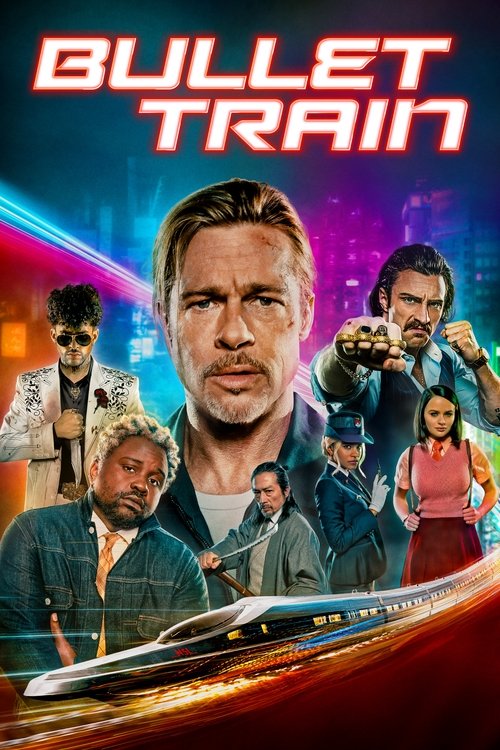
Bullet Train
2022 · David Leitch
For a switch-your-brain-off Friday night with snacks and friends — when you want to laugh at mayhem, not be moved by it. Pure comfort-food action; zero homework required.
What it's about
Ladybug, an assassin convinced he's cursed with the world's worst luck, takes what should be a simple snatch-and-grab: board a Tokyo bullet train, steal a briefcase, get off. Except the train is crawling with other killers — bickering British 'twins,' a poisoner, a vengeful father — whose jobs all turn out to be tangled into one scheme, and nobody's getting off at their stop.
The experience
A two-hour sugar rush: quippy, cartoonishly violent, and structurally playful, with flashbacks and running gags snapping into place like train couplings. It never asks you to take a second of it seriously — the fun is watching chaos escalate in a confined space at 200 mph.
Performances
Brad Pitt coasts on movie-star charm as Ladybug, playing an action lead as a therapy-speak burnout who'd really rather not fight — and Aaron Taylor-Johnson and Brian Tyree Henry nearly walk off with the film as squabbling assassin brothers with a shared Thomas the Tank Engine philosophy.
The craft
Leitch comes from the stunt world, and it shows: the fights are clean, legible, and inventively built around train-car geography — quiet cars, snack trolleys, luggage racks all become weapons. The candy-neon production design and needle-drop soundtrack keep the whole thing humming; it plays great loud.
Why it matters
A flagship for the modern stuntman-turned-director school of action filmmaking, and one of the last big original-ish star vehicles to bet a summer tentpole on Brad Pitt's charisma rather than a franchise.
Snapshot
Bullet Train is a single-location ensemble action-comedy adapted from Kōtarō Isaka's novel Maria Beetle (published in English as Bullet Train), in which a roster of assassins converge aboard a Tokyo–Kyoto express, each pursuing errands that turn out to be knotted into a single scheme of vengeance. It is the fourth solo directorial feature by David Leitch, the former stuntman and stunt coordinator who helped originate the "gun-fu" idiom of the John Wick films, and it functions as a near-pure expression of the house style of 87North, the production company Leitch runs with producer Kelly McCormick. Built around Brad Pitt's deadpan turn as the unlucky assassin Ladybug, the film fuses precise, legible fight choreography with a Tarantino-and-Ritchie-descended mode of chattering, structurally playful crime comedy. It is best understood less as a landmark than as a high-gloss synthesis: a stunt-community sensibility applied to a hyperlink-ensemble narrative, wrapped in a maximalist neon-Japan aesthetic that also made it one of 2022's more contested films on questions of adaptation and casting.
Industry & production
The film was produced by 87North Productions with Sony Pictures distributing, a pairing that reflects the studio system's early-2020s appetite for star-driven original action that could be sold on craft and cast rather than on IP franchising. 87North had by 2022 established itself as the pre-eminent supplier of choreography-forward action (the John Wick orbit, Atomic Blonde, Nobody, Deadpool 2), and Bullet Train represents the company operating at scale with an A-list lead. The screenplay is credited to Zak Olkewicz, adapting Isaka's novel.
Production notably did not take place in Japan. The bullet-train interiors and the film's stylized cityscapes were largely realized on soundstages and sets in the Los Angeles area, with extensive use of built train carriages and controlled environments — a choice that gave the filmmakers the repeatable, rigged spaces that intricate stunt work demands, while also contributing to the film's deliberately artificial, storybook register. The precise budget and final box-office figures are widely reported but I will not cite specific numbers here to avoid error; the record consistently describes it as a mid-to-large budget studio release that performed respectably theatrically in a still-recovering post-pandemic market.
The production drew significant public debate over casting. A story rooted in a Japanese novel and set entirely in Japan was headlined by a predominantly non-Japanese cast, prompting accusations of whitewashing. Isaka, the source author, publicly took a comparatively relaxed position, indicating that he did not conceive his characters as strongly ethnically fixed and was untroubled by the adaptation's latitude — a response that itself became part of the film's reception discourse rather than settling it.
Technology
Bullet Train is a conventionally photographed digital production rather than a technical innovator, and it does not appear to have pioneered new tools; its interest lies in how mature technologies were marshaled for a confined-space action picture. The controlled soundstage environment allowed motion-controlled and rigged camera work, section-by-section train sets that could be struck and re-lit, and heavy but largely invisible visual-effects augmentation to extend the train, the passing landscape, and the eventual large-scale derailment climax into a scale impossible to stage practically. Digital effects also enabled the film's more cartoonish flourishes — animated inserts, an anthropomorphized children's-mascot motif, and stylized on-screen graphics. The film sits comfortably in the lineage of the digital-hybrid action cinema Leitch's teams had refined across the preceding decade, where practical stunt performance is the spine and VFX supplies extension and cleanup rather than spectacle-from-scratch.
Technique
Cinematography
Photography is by Jonathan Sela, Leitch's regular cinematographer (Atomic Blonde, Deadpool 2, and earlier John Wick work), and the film bears his signature: saturated, motivated color — neon magentas, greens, and sodium ambers washing the carriages — set against the necessarily cramped geometry of a train corridor. Sela and Leitch treat the confined space as an asset, using the long, narrow sightlines of the carriage aisles as natural framing devices and staging violence in tight quarters where the camera can follow a body's full arc. The look is glossy and heightened rather than naturalistic, consistent with the film's comic-book tonality, and the lighting frequently signals character and compartment as much as it establishes realism.
Editing
Editing is by Elísabet Ronaldsdóttir, another core Leitch collaborator (Atomic Blonde, Deadpool 2, John Wick). Her work here is central to the film's identity, because Bullet Train is both an action film that prizes spatial clarity and a comedy built on nonlinear, digressive structure. The picture's frequent flashbacks, chapter-style character introductions, rewound reveals, and interlocking backstories are an editorial construction as much as a screenwriting one — the film repeatedly withholds and then re-cuts information to convert coincidence into designed fate. Crucially, the action cutting resists the incoherent quick-cut style the stunt community defines itself against: fights are edited to preserve legibility, letting choreography read.
Mise-en-scène / staging
The single-location premise concentrates all staging into the train, and the production design turns that constraint into a series of distinct micro-worlds — a quiet car, a bar car, a first-class compartment — each with its own palette and props that later pay off as weapons or clues. Recurring motifs (a briefcase, a toy mascot, a poisonous snake, a lucky-unlucky "Ladybug" conceit) are planted in the staging and reincorporated, a mode of comic bricolage in which every visible object is potentially load-bearing. The choreography, developed out of 87North's stunt culture, is staged for readability within the narrow space, favoring sustained exchanges over fragmented impacts.
Sound
The score is by Dominic Lewis, complemented by a prominent needle-drop soundtrack that leans on Japanese-language covers of familiar Western pop songs — a device that reinforces the film's playful, translated-and-remixed relationship to its Japanese setting. Music is used ironically and rhythmically, scoring violence against incongruous pop in the Tarantino tradition. Sound design exploits the enclosed acoustics of the train and the recurring mechanical pulse of the journey itself.
Performance
Performances are pitched toward comic archetype. Brad Pitt plays Ladybug in a loose, self-deprecating register, the therapy-quoting fatalist whose bad luck drives the plot; the role is widely read as a knowing, comedic deployment of his star persona. The film's most praised dynamic is the double act of Aaron Taylor-Johnson (Tangerine) and Brian Tyree Henry (Lemon) as bickering "twin" enforcers, whose banter — including Henry's running fixation on the children's program Thomas & Friends — supplies much of the film's warmth. Joey King plays the deceptively girlish schemer the Prince; Andrew Koji and Hiroyuki Sanada anchor the film's genuine emotional thread as an estranged son and father; Michael Shannon presides as the villain White Death; and the cast is rounded by Bad Bunny, Zazie Beetz, Sandra Bullock (as Ladybug's unseen handler), and marquee cameos including Channing Tatum and an uncredited turn by Ryan Reynolds.
Narrative & dramatic mode
The film operates in the "hyperlink" or converging-ensemble mode: multiple protagonists with separate objectives are revealed to be entangled in one design, with dramatic pleasure coming from the audience assembling the whole before the characters do. It is heavily nonlinear, using flashbacks and title-carded character introductions to reframe events and stage reversals. Tonally it is a comedy first, action second — a dramatic mode in which lethal stakes are continually undercut by banter, irony, and slapstick reversal, and in which the governing theme is less character growth than the machinery of fate. Ladybug's insistence on doing "one peaceful job" is the engine of a fundamentally deterministic plot in which every accident turns out to have been arranged.
Genre & cycle
Bullet Train belongs to the ensemble-assassin crime-comedy cycle whose lineage runs through Quentin Tarantino's Pulp Fiction and Kill Bill, Guy Ritchie's Lock, Stock and Snatch, Doug Liman's Go, and Joe Carnahan's Smokin' Aces — films in which a large cast of colorful killers, chapter structures, and comic violence are the defining features. It also sits inside the more recent choreography-driven action cycle that 87North and the John Wick films catalyzed in the 2010s. The film's specific innovation within these cycles is largely one of concentration: it compresses the multi-strand assassin comedy into a single moving location, marrying the Ritchie/Tarantino ensemble structure to the John Wick school's clean, sustained fight staging.
Authorship & method
As author, David Leitch brings the defining perspective of a filmmaker who came up through stunt work and second-unit directing before co-directing the first John Wick (uncredited) and moving into solo features (Atomic Blonde, Deadpool 2, Fast & Furious Presents: Hobbs & Shaw). His method centers physical performance, legible geography, and stunt-team craft as the basis of an action film, with comedy layered over kinetic set pieces. Bullet Train is notable as a "reunion" project assembling his recurring department heads — cinematographer Jonathan Sela, editor Elísabet Ronaldsdóttir — under the 87North banner he shares with producer Kelly McCormick, making it one of the clearest statements of that company's authorial signature. Composer Dominic Lewis supplies the musical voice, and Zak Olkewicz adapts Isaka's novel into the film's chaptered, digressive screenplay. The overall authorship is best described as a producer-director house style as much as a single auteur vision: the film is legibly a Leitch/87North product.
Movement / national cinema
The film is a Hollywood studio production and does not belong to a national-cinema movement per se, but it is unusually preoccupied with Japan as an aesthetic surface. It stages an American, English-language action comedy inside a heavily stylized, tourist-poster image of Japan — bullet trains, neon, convenience-store snacks, pop-culture iconography — without being shot there and without a predominantly Japanese cast. That gap is precisely what generated the film's cultural debate, and it situates Bullet Train within a longer Hollywood tradition of appropriating Japanese settings and genre motifs (from the samurai-Western exchange through to the neon-Tokyo imaginary of films like Black Rain and Kill Bill). The presence of Hiroyuki Sanada and Andrew Koji, and the film's father-son storyline, provide its most sincere engagement with the source culture amid an otherwise translated, remixed image of it.
Era / period
Bullet Train is a product of the early-2020s post-pandemic theatrical moment, when studios were testing whether star-driven, non-franchise action could still draw audiences back to cinemas. It reflects that era's craft consensus — clean, choreography-first action as an art-form after a decade of John Wick influence — and its industrial reality, in which a specialist production company (87North) had become a brand of its own. The film's tone, its irony toward violence, and its pop-cultural referentiality are characteristic of a mainstream 2020s action cinema comfortable with self-awareness and comedy. Its casting controversy, likewise, is very much of its period, arriving amid heightened attention to representation and adaptation in Hollywood.
Themes
The film's dominant theme is fate versus agency: Ladybug's fatalistic, therapy-inflected worldview ("bad luck") is literalized by a plot in which apparent coincidences are revealed to be engineered, so that free will is repeatedly exposed as design. A second theme is consequence and interconnection — the moral that small actions ripple outward, dramatized structurally as separate missions collapsing into one chain of cause and effect. Family, and specifically fathers and sons, supplies the emotional counterweight, most directly through Kimura and the Elder (Sanada). Running beneath the comedy is a fairly nihilistic view of the assassin's trade as an absurd, self-consuming ecosystem, softened by the film's insistence on luck, redemption, and the possibility of choosing peace.
Reception, canon & influence
Critical reception was mixed-to-favorable and notably divided along a consistent line: praise for its craft, energy, and the Tangerine–Lemon double act, set against complaints of overlength, tonal excess, and a plot more clever than felt. The casting question shadowed much of the coverage, with the whitewashing critique weighed against the source author's own permissive stance. Audience response was generally warmer than the critical consensus, and the film has settled into the culture as an enjoyable, rewatchable star vehicle rather than a canonized work — I'd characterize its critical standing as solidly middlebrow rather than either dismissed or acclaimed.
Its influences run backward to the Tarantino/Ritchie ensemble-crime tradition, to the assassin-convergence comedies (Smokin' Aces, Go), and to Leitch's own John Wick-derived action grammar; more immediately it is a faithful-in-spirit adaptation of Isaka's Maria Beetle, itself part of a loosely connected series of the author's assassin novels. Forward influence is harder to fix so soon, and the record is genuinely thin on any concrete lineage it has spawned; its clearest legacy is as a flagship demonstration of the 87North house style and as evidence that Isaka's fiction could translate to Hollywood — the latter reflected in continued interest in adapting his work. Whether Bullet Train seeds a durable cycle of single-location assassin comedies or remains a well-made one-off is, at this remove, an open question rather than a settled fact.
A Deleuzian reading
Two hired killers are riding the fastest train in Japan, and one of them will not stop talking about *Thomas & Friends*.
The full Deleuzian reading of Bullet Train →
Reception
Critics shrugged at release ('a Tarantino knock-off on rails') but audiences made it one of 2022's rare original-property hits — and streaming turned it into a certified comfort rewatch that people defend far more warmly now than the reviews would suggest.
How Bullet Train was received, from release to now →
How to watch Bullet Train: what to notice on a first viewing
- Watch how the camera holds each carriage's full length in frame. Sela shoots the train's aisles as long, narrow corridors, letting a body's whole fight arc stay visible in one shot. This keeps you oriented in a tiny space no matter how chaotic the fight gets.
- Notice each train car's own color: neon magenta, green, sodium amber. Leitch and Sela give the quiet car, the bar car, and first class each a distinct palette and set of props. The color tells you which micro-world you're in before any character does.
- Listen for Japanese-language covers of familiar Western pop songs. These needle-drops keep surfacing under fight scenes and killings, translating familiar songs into an unfamiliar register. The mismatch between cheerful music and violence is played for laughs, not dread.
- Track the briefcase, the toy mascot, and the poisonous snake. These objects reappear across different cars. Every visible prop in this film is a possible piece of the plot, so nothing on screen is filler.
- Watch Lemon sort strangers into Thomas & Friends characters. Henry plays this deadpan, treating cartoon trains as a real classification system for the people he meets. This running joke, alongside Tangerine's bickering, supplies the film's warmth amid the killing.
The whole guide to watching Bullet Train, with the keys for a rewatch →
Influences: the films it descends from and the films it influenced
- Pulp Fiction (1994) — Establishes the chaptered, out-of-order hitman narrative with on-screen title cards and assassins who banter philosophically mid-job — the exact digressive structure Zak Olkewicz's screenplay chapters onto the train.
- Kill Bill Vol. 1 (2003) — Model for the ironic Japanese-pop needle-drop (here reworked as J-pop covers of Western songs) scoring a Western star slicing through a Tokyo underworld of themed assassins.
- Snatch (2000) — Supplies the freeze-frame character introduction with nickname captions and the comic-crime ensemble whose separate schemes violently collide around a single MacGuffin.
- Go (1999) — Prototypes the hyperlink structure that replays one event from multiple criminals' POVs, deliberately withholding then recutting information for delayed-reveal comedy.
- Smokin' Aces (2006) — The template for competing eccentric, gimmick-branded assassins converging on one confined target, with tone swinging between splatter and farce.
- Ocean's Eleven (2001) — Codifies the withhold-and-recut reveal edit in which a late flashback re-screens an already-seen scene to expose the trick that was hidden the first time.
- John Wick (2014) — Leitch's own foundational grammar of legible, wide-framed action geography and stunt-team choreography shot in sustained takes rather than cut-to-hide.
- Atomic Blonde (2017) — Same Leitch/Jonathan Sela signature of saturated neon color and long-take confined stairwell/corridor brawls, carried directly into the train's tight interiors.
- The Raid (2011) — Pioneers the single-location action film where a fixed vertical structure forces continuous corridor combat, the confinement logic the train car reproduces.
- Speed (1994) — The confined-vehicle thriller that stages an entire escalating plot aboard one unstoppable moving transport, the staging premise Bullet Train literalizes.
- Lucky Number Slevin (2006) — Fate-versus-agency assassin plot built on a withheld master-scheme twist that retroactively recontextualizes every prior encounter — the reveal architecture Bullet Train mirrors.
- Kingsman: The Secret Service (2015) — Carries forward the candy-saturated, ramped, ironically-scored comic-assassin spectacle with whip-pan transitions that Kingsman re-legitimized for mid-budget action.
- Violent Night (2022) — 87North-produced comic-brutal single-location action extending the Chekhov-bricolage principle of turning incidental set-dressing objects into improvised, gag-driven weapons.
- The Fall Guy (2024) — Leitch's later stunt-forward meta-feature that foregrounds the physical-performance and second-unit craft ethos Bullet Train showcases, made explicit as subject matter.
- Free Fire (2016) — Contemporary single-location ensemble shoot-out black comedy that, like Bullet Train, wrings farce from a fixed space and characters improvising with whatever objects are at hand.
- Deadpool 2 (2018) — Same Leitch method of layering self-aware, fourth-wall comic patter over meticulously staged kinetic set pieces, tonally the closest cousin to Ladybug's rueful narration.
- Fast & Furious Presents: Hobbs & Shaw (2019) — Leitch's comic-archetype double-act — two mismatched heavies trading insults between beatdowns — is the direct precursor to the Tangerine–Lemon 'twins' dynamic.
- Nobody (2021) — An 87North house-style flagship sharing the confined-transit brawl (a city bus) and Elísabet Ronaldsdóttir's rhythmic, legible action cutting.
- Kate (2021) — Neon-drenched Tokyo assassin actioner working the same 'Hollywood-neon-Japan' movement — a Western killer navigating a stylized, saturated Japanese underworld.
Similar films
- Snatch (2000) — influence & lineage · same viewing thread
- Kill Bill: Vol. 1 (2003) — influence & lineage
- The Fall Guy (2024) — influence & lineage
- John Wick (2014) — influence & lineage
- Pulp Fiction (1994) — influence & lineage
- Atomic Blonde (2017) — influence & lineage
- Nobody (2021) — influence & lineage
- Ocean's Eleven (2001) — influence & lineage · same viewing thread
All the films related to Bullet Train →
Watch it with: curated runs of related films
- Schemers, Crews, and the Big Score — A run of witty crime pictures where somebody always has an angle — watch these together for intricate plans, colliding crooks, and heists that go gloriously sideways.