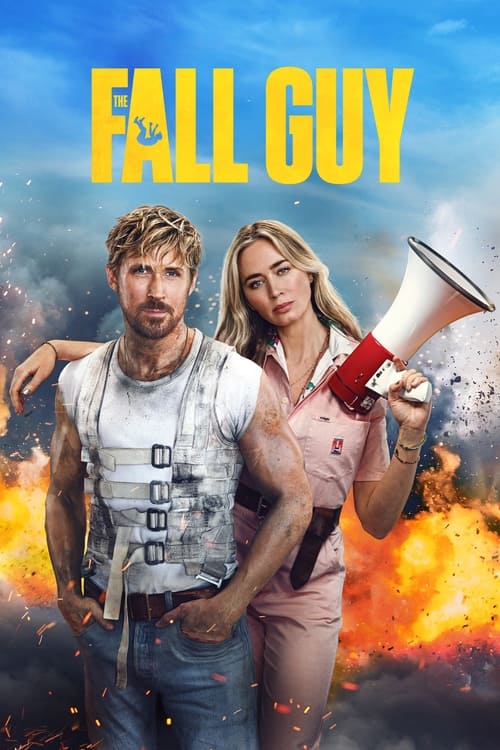
The Fall Guy
2024 · David Leitch
For a light, crowd-pleasing night when you want laughs, chemistry, and spectacular stunt work without anything heavy — the movie-night equivalent of comfort food with a car chase in it.
What it's about
A Hollywood stuntman, easing back to work after an accident nearly ended his career, takes a job on a big-budget sci-fi shoot in Sydney — directed by the ex he never got over. When the movie's star vanishes, he's pulled into tracking him down and untangling a conspiracy, all while still doing his day job of getting set on fire and thrown through windshields.
The experience
Breezy, banter-forward, and openly romantic — an action movie that keeps winking at how action movies get made. The pace is buoyant, the crashes are real, and it plays like a date movie with explosions.
Performances
Ryan Gosling and Emily Blunt run on pure screwball chemistry — Gosling playing wounded machismo for laughs, Blunt giving the romance its spine — and their back-and-forth is the film's real engine.
The craft
Directed by David Leitch, a former stuntman himself, the film is a love letter to the stunt trade made with practical craft: real cannon rolls, real falls, real fire, staged so you can see the work. The script folds movie-set satire into the action, and the physical spectacle genuinely rewards a big screen.
Why it matters
It became a rallying point in the industry conversation about honoring stunt performers — a film arguing, through its very production, that the people who fall and burn for the camera deserve the recognition Hollywood has long withheld.
Snapshot
The Fall Guy is a big-budget action-comedy-romance that doubles as an industrial manifesto: a movie about stunt performers, made by a former stunt performer, arguing through both its plot and its production that the people who fall, burn, and crash for the camera deserve recognition the film industry has historically withheld. Loosely adapted from Glen A. Larson's 1981–1986 ABC television series of the same name — in which Lee Majors played stuntman-turned-bounty-hunter Colt Seavers — the 2024 feature keeps only the premise's skeleton: a working Hollywood stuntman named Colt Seavers is pulled into off-camera trouble. David Leitch, himself a stunt veteran who doubled for Brad Pitt before co-directing John Wick, directs from a screenplay by Drew Pearce. Ryan Gosling plays Colt; Emily Blunt plays Jody Moreno, a camera operator turned first-time director and Colt's estranged love interest. The film is at once a romance, a comic caper, and a self-reflexive tribute to the craft of physical action — a "backstage musical" logic transposed onto the machinery of the modern blockbuster.
Industry & production
The Fall Guy was produced by Universal Pictures in partnership with 87North Productions, the action-focused company Leitch runs with producer Kelly McCormick (his wife and frequent collaborator). 87North had by 2024 established itself as a specialist house for stunt-driven cinema — the John Wick universe (as co-founders of the design lineage), Atomic Blonde, Deadpool 2, Hobbs & Shaw, Nobody, and Bullet Train — and The Fall Guy functions as something close to that company's thesis statement. Principal photography took place largely in and around Sydney, Australia, taking advantage of the country's production incentives and its deep bench of stunt talent.
The picture premiered as the opening-night film at South by Southwest in March 2024 and received a wide theatrical release in early May 2024. Commercially, the record is that it opened below studio and analyst expectations for a film of its scale and star wattage, and it is generally characterized in trade coverage as a disappointment relative to its reported production budget rather than an outright failure; precise budget and gross figures vary across sources, so they are best treated as approximate. Its underperformance became part of a broader 2024 conversation about whether original-adjacent, star-driven mid-to-large studio films could still reliably open, and it complicated — without cleanly answering — that question, given strong reviews and star chemistry that did not translate into blockbuster returns.
The production is inseparable from an off-screen campaign: Leitch, McCormick, and the film's stunt community used the release to press the Academy of Motion Picture Arts and Sciences to create a competitive award recognizing stunt work, a decades-old grievance in the field. The film thus operated simultaneously as entertainment and as advocacy.
Technology
The Fall Guy is technologically notable less for novel image-capture systems than for its commitment to large-scale practical stunt work executed with modern safety and precision engineering. The production's signature achievement was a car "cannon roll" — a stunt in which a nitrogen cannon fires to flip a vehicle end-over-end — that was widely reported to have set a Guinness World Record for the most cannon rolls performed in a car, executed by stunt driver Logan Holladay. The exact figure has been cited consistently in coverage as eight-and-a-half rolls; readers should treat the record claim as reported by the production and Guinness rather than independently audited here.
Beyond that set piece, the film leans on the contemporary toolkit that 87North helped normalize: air rams, ratchets, decelerator rigs, computer-controlled fire burns, and precisely engineered vehicle gags, all shot to foreground the performer rather than to disguise a digital replacement. Where digital tools appear, they tend toward the invisible — wire and rig removal, environment extension, and compositing that stitches practical action into continuous space — an approach consistent with the film's argument that the human fall is the value being sold. This is a deliberate counter-position within a blockbuster ecosystem increasingly reliant on virtual production and CG-augmented action.
Technique
Cinematography
Jonathan Sela, Leitch's regular director of photography (Atomic Blonde, Deadpool 2, Bullet Train), shot the film. His work here is glossy, saturated, and legible — action staged in comprehensible wide framings that let the audience read the geography of a stunt, in pointed contrast to the fragmented "shaky-cam" idiom of much 2000s–2010s action. The film also uses split-screen compositions, a device that both evokes the multi-panel visual grammar of 1970s–80s cinema and television and literalizes its themes of doubling (star and stunt double, on-screen fiction and off-screen reality). The Sydney locations and a movie-within-the-movie sci-fi production ("Metalstorm") give Sela license to move between naturalistic coastal light and heightened, effects-laden spectacle.
Editing
Elísabet Ronaldsdóttir, another core Leitch collaborator (John Wick, Atomic Blonde, Deadpool 2, Bullet Train), cut the film. The editing sustains the 87North house style of clarity — holding on wide masters and coherent cuts so that a punch, a fall, or a roll registers as a real physical event — while managing the film's tonal juggling act between action, screwball romance, and metacomedy. The cutting also handles the reflexive layer, moving between the "real" world of the crew and the fictional footage they are shooting.
Mise-en-scène / staging
Staging is the film's true subject. The action is designed to be shown being made: rigs, safety mats, monitors, and crew are frequently visible or nearby, and set pieces are often framed as productions-within-the-production. This foregrounding of apparatus is a mise-en-scène choice with argumentative force — it insists on the labor behind the illusion. Domestic and romantic scenes are staged with comic timing that borrows from classical Hollywood romance, while the action sequences (a boat chase, fights, the vehicular rolls) are blocked for maximum readability.
Sound
Sound design emphasizes impact and weight — the crunch and torque of metal, the physical thud of bodies — reinforcing the practical ethos. The film also makes prominent, witty use of licensed pop music, most conspicuously Taylor Swift's "All Too Well," deployed as a recurring emotional-comic motif tied to Colt and Jody's relationship, alongside other needle-drops (including KISS's "I Was Made for Lovin' You") that key the film's affectionate 1980s register.
Performance
Gosling calibrates Colt as a wry, bruised, self-deprecating romantic — a performance that trades on his established comic timing and on his 2023 pop-culture ubiquity, and that reads, in part, as a knowing meta-star turn. Blunt gives Jody spine and comic sharpness, and the Gosling–Blunt rapport is broadly cited as the film's strongest asset. Aaron Taylor-Johnson plays the vain movie star Tom Ryder as a satirical foil; Hannah Waddingham (producer Gail Meyer) and Winston Duke (stunt coordinator and Colt's friend Dan Tucker) round out the ensemble with sharp supporting comedy.
Narrative & dramatic mode
The film's dramatic mode is a hybrid: a caper mystery (a missing star, a cover-up) welded to a second-chance romance and framed by a backstage show-business comedy. Its deep structure is the "putting on a show" narrative — the making of the fictional blockbuster "Metalstorm" is the spine along which mystery and romance are threaded, so that professional success and romantic reconciliation resolve together, in the manner of the classical backstage musical. The tone is consistently self-aware, breaking toward direct address and genre commentary, but the film keeps a sincere emotional core rather than collapsing into pure irony — the metacommentary is affectionate, not corrosive.
Genre & cycle
The Fall Guy sits at the intersection of the action-comedy and the Hollywood-on-Hollywood film. Within action, it belongs to the 87North / post–John Wick cycle of "clarity-first," stunt-forward filmmaking that reasserted practical, legible physical action against digitally smeared spectacle. Within the reflexive tradition, it joins the lineage of movies about moviemaking and about the romance of the industry's laborers. It is also an entry in the 2010s–2020s wave of feature adaptations of older television properties, though it treats its source with loose, affectionate license rather than fidelity.
Authorship & method
David Leitch is the film's authorial center, and his biography is the film's argument. A former stunt performer and stunt coordinator who worked as Brad Pitt's double before co-directing the first John Wick (uncredited alongside Chad Stahelski) and then building a solo career (Atomic Blonde, Deadpool 2, Hobbs & Shaw, Bullet Train), Leitch directs from inside the craft the film celebrates. His method — developed with 87North — privileges performer-driven practical action, comprehensible coverage, and tonal blending of violence with comedy.
His key collaborators are largely his established repertory company: cinematographer Jonathan Sela, editor Elísabet Ronaldsdóttir, and producer Kelly McCormick, all recurring across his filmography, which lends the work a consistent visual and rhythmic signature. Screenwriter Drew Pearce (Iron Man 3, Hobbs & Shaw) supplies the reflexive, quip-forward script structure. Composer Dominic Lewis provides the score, working alongside the film's heavy reliance on licensed pop. The stunt team — the film's true ensemble — is foregrounded to a degree unusual for a studio release, consistent with the picture's advocacy.
Movement / national cinema
The Fall Guy is a product of the American studio system, financed and distributed by a Hollywood major, and it is thoroughly about Hollywood as an institution and mythology. Its "movement" affiliation, insofar as it has one, is to the 87North school of contemporary action design rather than to any national-cinema movement. That said, its production is a case study in the globalization of blockbuster manufacture: shot in Australia with Australian crew and stunt talent, it reflects the runaway-production economics and international incentive competition that now shape where American films are physically made.
Era / period
The film is emphatically of the mid-2020s in its industrial anxieties and its cultural texture. It arrives amid post-pandemic uncertainty about theatrical viability, ongoing debate over practical versus digital spectacle, and the aftermath of the 2023 Hollywood labor actions — a moment acutely concerned with who, exactly, does the work of making movies. Its nostalgic surface (an '80s TV source, needle-drops, split-screen) is period pastiche in the service of a very contemporary argument about labor and recognition. Gosling's casting also situates it precisely in the 2023–2024 pop-cultural window defined by his heightened public visibility.
Themes
The film's dominant theme is the invisible labor of illusion — the argument that spectacle depends on real bodies taking real risks, and that this labor is systematically unseen and uncredited. Around that spine cluster several others: doubling and authenticity (the stunt double as the "true" self behind the star's image; the tension between the performed and the real); love as a kind of stunt work — risk, falling, getting back up, the willingness to be hurt; and the romance of moviemaking itself, presented as a demanding but redemptive collective endeavor. The metafictional structure ties these together: to fall for someone and to fall for the camera become the same gesture.
Reception, canon & influence
Critical reception was broadly positive, with reviewers singling out the Gosling–Blunt chemistry, the sincerity and craft of the practical action, and the film's good-humored self-awareness; a recurring reservation was that the plot felt slight or overextended relative to its charm. That warm critical response coexisted with disappointing commercial returns, making the film a frequent reference point in 2024 discussions about the fragility of the star-driven theatrical release.
Influences on the film (backward). Most directly, Glen A. Larson's 1981–1986 television series The Fall Guy supplies the character and premise. More deeply, the film descends from the tradition of movies about stunt work and moviemaking — Hal Needham and Burt Reynolds's Hooper (1978), a stuntman comedy to which The Fall Guy is a clear spiritual heir; Richard Rush's The Stunt Man (1980); and the reflexive Hollywood romance exemplified by Singin' in the Rain (1952), whose backstage-musical structure the film echoes. It also draws on Leitch's own body of work and the broader post–John Wick action aesthetic he helped create.
Legacy and what it shaped (forward). Given its recency, the film's long-term influence is not yet legible, and any claim here should be treated as provisional. Its most concrete legacy is likely industrial rather than aesthetic: The Fall Guy became the highest-profile vehicle for the long-running campaign to establish an Academy Award recognizing stunt work, and the Academy's subsequent move to create a competitive stunt-design category is widely linked in the press to that advocacy. (The precise timeline and first-eligible year of that award should be confirmed against the Academy's own announcements rather than taken from the film's promotion.) As a text, the film stands as a prominent statement of the practical-action, performer-first philosophy — a case study likely to be cited in ongoing debates about stunt labor, credit, and the value of the real within an increasingly digital blockbuster economy.
A Deleuzian reading
A nitrogen cannon fires under a car and the car goes end over end, eight and a half times, across open ground.
The full Deleuzian reading of The Fall Guy →
Reception
Opened summer 2024 to warm reviews and Gosling-Blunt goodwill but underwhelmed at the box office, instantly becoming exhibit A in the 'you say you want original star vehicles, then don't show up' discourse — then found its audience fast on streaming, where it's now treated as the fun one that deserved better.
How The Fall Guy was received, from release to now →
How to watch The Fall Guy: what to notice on a first viewing
- Notice how long each stunt shot runs before cutting. Elisabet Ronaldsdottir holds the wide master until the physics has finished. Most action films hide the double in the half-second before the star's face comes back. Leitch stays past that point. The extra length is the credit, since it proves a real body did the thing you just watched.
- Look for mats, rigs, and crew at the frame's edge. Leitch keeps the apparatus in the shot. Monitors, safety pads, coordinators standing just outside the action, whole set pieces framed as productions being made rather than events happening. Showing the machinery makes the thrill bigger here, which is the opposite of what reflexive movies usually do.
- Watch whether each hit Colt takes is work or attack. A punch, a fall, a burn. Every one could be the job or somebody trying to kill him. Drew Pearce's script keeps both readings alive, so a single beat gets the laugh and the dread. The comedy and the thriller run on one machine, because you cannot tell which story a given blow belongs to.
- Watch the split-screen panels and what each one holds. Sela splits the frame the way 1970s pictures did. Illusion sits in one panel and its mechanism in the other. Star and double, the shoot and the story, side by side. The trick and its workings stay on screen together instead of the film asking you to pick one.
- Listen for the crunch and torque in each crash. The mix stays with metal, weight, and the thud of bodies landing. Alongside it Leitch drops in Taylor Swift and KISS, using pop songs as a running joke about what Colt will not say. The sound insists these impacts have mass, so the jokes never dissolve the physical stakes underneath them.
The whole guide to watching The Fall Guy, with the keys for a rewatch →
Influences: the films it descends from and the films it influenced
- Hooper (1978) — Establishes the stuntman-comedy template The Fall Guy inherits wholesale: an aging stunt performer as romantic-comic lead, the crew shown as the film's real ensemble, and a climactic set-piece built from record-setting practical gags rather than plot.
- The Stunt Man (1980) — Its reflexive plot — a stunt double who can never tell whether the danger on set is real — supplies the doubling-and-authenticity engine and the foregrounded-apparatus device of exposing rigs, cranes, and directors mid-illusion.
- Singin' in the Rain (1952) — Donates the backstage-musical structure: a production-in-crisis romance where the plot's stakes are the making of the movie itself, and a hidden performer secretly does the work the star is credited for.
- Day for Night (1973) — Model for affectionate metafiction that treats a working film crew as a family and dramatizes the invisible labor of illusion — the stitching, faking, and problem-solving behind a finished shot.
- Grand Prix (1966) — Pioneers the multi-panel split-screen and car-mounted legible-wide photography of real vehicles at speed that The Fall Guy quotes to keep practical stunts spatially readable.
- Blow Out (1981) — The De Palma split-screen grammar — simultaneous panels used to hold two truths in one frame — is the compositional debt behind the film's split-screen sequences layering illusion against its mechanism.
- Smokey and the Bandit (1977) — Needham's coordinator-turned-director method — building comedy out of real car jumps, rolls, and chases with the stunt itself as the punchline — is the direct craft precedent for Leitch's practical set-pieces.
- John Wick (2014) — Origin of the 87North house style Leitch carries into the film: performer-driven fights shot in legible wide framing with clarity-first cutting that holds the geography instead of hiding action in cutaways.
- Atomic Blonde (2017) — Leitch's stairwell 'oner' refines the long-take, wide-frame practical fight — visible exertion and continuous space — that the truck-fight and boat stunts here extend.
- Bullet Train (2022) — Immediate stylistic sibling: the same tonal blend of comic banter and choreographed violence, needle-drop scoring, and impact-emphasis sound design worked out with the same 87North team.
- Mad Max: Fury Road (2015) — Contemporary benchmark for the performer-first, real-vehicle spectacle photographed in clean wide masters, and a shared argument that practical stunt craft reads as more thrilling than digital substitution.
- Deadpool 2 (2018) — Leitch's prior exercise in fourth-wall metafiction and quip-forward reflexivity — the winking self-awareness Drew Pearce's script structure sharpens in The Fall Guy.
- Hobbs & Shaw (2019) — Shares screenwriter Drew Pearce's reflexive, banter-driven structure and Leitch's practical set-piece staging, making it the closest scripting-and-staging cousin.
- Nobody (2021) — An 87North production that extends the performer-driven, clarity-first practical action and impact-forward sound design from the same stunt-department pipeline.
- Once Upon a Time in Hollywood (2019) — Parallel elevation of the stunt double to romantic-heroic protagonist, foregrounding stunt labor and the doubling-and-authenticity theme within an affectionate industry portrait.
- Mission: Impossible – Dead Reckoning Part One (2023) — The era's loudest statement of the same practical-action, performer-first philosophy — real stunts marketed as the spectacle — that The Fall Guy turns into its explicit subject.
- The Nice Guys (2016) — Template for the Gosling blunt-comic register and the action-comedy two-hander chemistry, where physical pratfalls and deadpan banter carry the set-pieces.
- Mission: Impossible - The Final Reckoning (2025) — Made by a former stunt coordinator, it foregrounds the practical stunt performer as subject and spectacle, record-setting real gags celebrated as craft — the contemporaneous case for in-camera action as a value worth defending alongside the M:I project.
- Ambulance (2022) — Descendant that foregrounds practical vehicular stunt spectacle shot with mobile drone coverage, extending Ambulance's mid-budget, craft-forward action lineage.
Similar films
- The Nice Guys (2016) — influence & lineage
- John Wick (2014) — influence & lineage
- Bullet Train (2022) — influence & lineage
- Atomic Blonde (2017) — influence & lineage
- Top Gun: Maverick (2022) — same viewing thread
- F1 (2025) — same viewing thread
- Ghostlight (2024) — shared sensibility
- Nightcrawler (2014) — shared sensibility
All the films related to The Fall Guy →
Watch it with: curated runs of related films
- Real Machines, Real Stunts — A run of blockbusters that strap the camera to actual jets, cars, rigs and bodies — watch them together for the vertigo of action done for real.