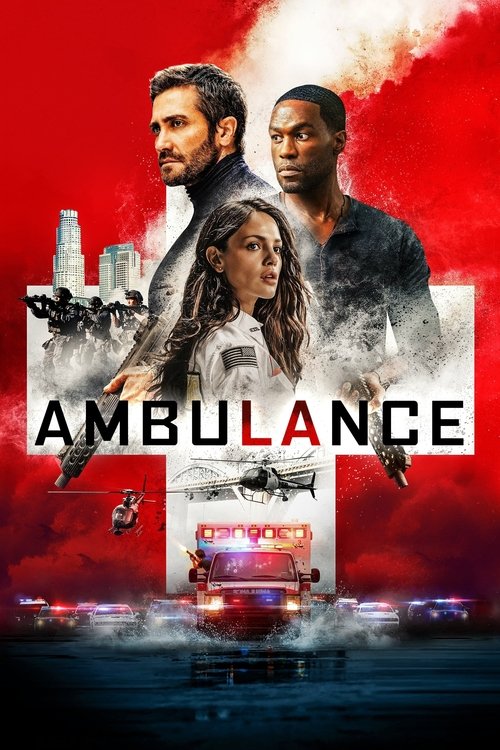
Ambulance
2022 · Michael Bay
For when you want pure velocity — popcorn, big screen, brain in neutral, heart rate up. Comfort food for action fans, zero homework required.
What it's about
A decorated veteran, drowning in his wife's medical bills, asks his adoptive brother — a charismatic career criminal — for a loan and gets an offer instead: one bank job, $32 million, the biggest score in Los Angeles history. When the heist goes sideways, the brothers hijack an ambulance carrying a wounded cop and the paramedic fighting to keep him alive, and the whole city gives chase.
The experience
It's a two-hour adrenaline drip — one long afternoon of pursuit that barely stops to breathe, with drone shots diving off rooftops and Gyllenhaal vibrating at full mania. Loud, fast, ridiculous, and completely aware of it.
Performances
Jake Gyllenhaal goes gloriously unhinged as Danny, all charm curdling into panic, while Yahya Abdul-Mateen II grounds the chaos as the brother with an actual conscience. Eiza González holds the movie's human center as the paramedic doing surgery at 60 miles an hour.
The craft
This is Michael Bay's style boiled down to its essence, shot fast and lean with first-person racing drones that fling the camera down skyscrapers and through freeway traffic in ways conventional rigs simply can't. It's a genuine sensory event — see it big and loud or you're missing half the point.
Why it matters
It became the showcase for FPV drone cinematography in mainstream action filmmaking, and a late-career distillation of Bay's maximalism that even his skeptics grudgingly admired.
Snapshot
Ambulance is a lean, kinetic Los Angeles chase thriller that compresses a single afternoon into 136 minutes of near-continuous pursuit. Two adoptive brothers — combat veteran Will Sharp (Yahya Abdul-Mateen II) and career criminal Danny Sharp (Jake Gyllenhaal) — flee a botched downtown bank robbery by hijacking an ambulance carrying a wounded police officer and a paramedic, Cam Thompson (Eiza González), who must keep the cop alive while the vehicle is chased across the city. Adapted by Chris Fedak from Laurits Munch-Petersen's 2005 Danish film Ambulancen, the picture is notable less for its story than for its method: shot fast and comparatively cheap, it became a showcase for first-person-view (FPV) racing-drone cinematography and for Michael Bay's most distilled, self-aware expression of his maximalist style. Released by Universal in April 2022, it underperformed commercially but drew a more divided, occasionally admiring critical response than much of Bay's late work, with several reviewers framing it as "pure Bay" — the director's idiom stripped to its essentials.
Industry & production
Ambulance sits at an unusual point in Bay's career and in studio economics. After the globe-spanning Netflix production 6 Underground (2019), Bay turned to a deliberately constrained project: a single-city chase financed at a reported budget around $40 million — modest by the standards of a director associated with nine-figure tentpoles. The film was produced by Bradley J. Fischer and Brad Weston's New Republic Pictures with Bay's own Platinum Dunes, and distributed by Universal Pictures.
The defining production fact is its compression. Ambulance was shot during the COVID-19 pandemic on a short schedule — widely reported as roughly 38 days — across real Los Angeles locations rather than backlots and soundstages, exploiting the unusually empty pandemic-era streets and freeways. This speed was both an aesthetic and a budgetary discipline: the contained premise (one vehicle, one route, one day) let Bay extract scale from locations and aerial coverage rather than from expensive set-building or visual-effects spectacle. The result is a film that looks far costlier than its budget, a point Bay and his collaborators emphasized in promotion.
Commercially, the gamble did not pay off in theaters. Opening in April 2022, during a period when adult-skewing action films struggled against a still-recovering exhibition market, Ambulance grossed modestly worldwide — by most accounts falling short of recouping its costs theatrically — and is generally counted a box-office disappointment. Its afterlife, like much of contemporary mid-budget action, came through home and streaming distribution.
Technology
Ambulance is best understood as a technology demonstration disguised as a thriller. Its signature innovation is the systematic, narrative-scale deployment of FPV racing drones — small, agile quadcopters piloted in real time and capable of speeds, dives, and proximity maneuvers impossible for conventional camera drones or crane rigs. Where most films had used such drones for one-off "hero" shots, Bay built sequences around them: cameras plunge down the glass faces of downtown skyscrapers, weave between moving vehicles, sweep around the ambulance at street level, and corkscrew through spaces in single unbroken gestures. The technique gives the film its restless, vertiginous signature — the camera behaving less like an observer than like a participant in the chase.
This was paired with conventional but heavily mobile coverage: car-mounted rigs, helicopter aerials, and handheld work, frequently captured with multiple cameras to feed the film's dense editorial rhythm. The production's pandemic timing and Los Angeles setting were themselves a kind of enabling technology — the emptied city allowed high-speed photography on real arteries. Where the record is thin on the granular specifics of camera bodies and rig manufacturers, the through-line is clear: Ambulance used relatively inexpensive, agile, off-the-shelf-adjacent aerial tools to manufacture a sense of scale that older productions would have bought with money and time.
Technique
Cinematography
The film was photographed by Roberto De Angelis, the Italian cinematographer who had shot 6 Underground for Bay and who shares the director's appetite for saturated color, lens flare, and constant movement. Ambulance leans into a sun-blasted Los Angeles palette — hard daylight, golden-hour warmth, the chrome and asphalt glare of the city — and almost never holds still. De Angelis's images are defined by perpetual motion and dramatic verticality: low angles that monumentalize vehicles and bodies, sweeping circular moves, and the plummeting drone descents that became the film's calling card. The camera is rarely a neutral witness; it banks, dives, and accelerates with the action, producing an aesthetic of barely-contained energy that is unmistakably Bay's while pushed toward a new technological extreme.
Editing
Editing is arguably the film's most important formal element. The cut — credited to Pietro Scalia, Doug Brandt, and Calvin Wimmer — sustains an extraordinarily high cutting rate, layering aerial, vehicular, and handheld coverage into a near-continuous accelerando. Scalia, a two-time Academy Award-winning editor, lends craft to what could be chaos; the achievement of Ambulance is that its relentless pace remains spatially legible more often than not, the geography of the chase holding together even as the rhythm verges on the delirious. The film exemplifies the "intensified continuity" of contemporary action cinema pushed near its limit — many short shots, restless framing, and a momentum that rarely allows the viewer to rest.
Mise-en-scène / staging
Staging is organized almost entirely around a single moving object — the ambulance — and the city it traverses. Bay choreographs the chase as a series of escalating set pieces threaded along an LA route, using freeways, the concrete channels of the Los Angeles River, underpasses, and downtown canyons as a kind of found production design. The interior of the ambulance becomes a pressurized chamber, a confined human space (Will, Cam, the dying officer) set against the open vehicular spectacle outside. This contrast — claustrophobic intimacy inside, expansive velocity outside — is the film's central spatial idea, and it gives the relentless action an anchoring stakes: a life that must be kept beating while the world hurtles past.
Sound
Sound design serves the engine of pursuit: sirens, engines, gunfire, helicopter rotors, and the constant percussion of vehicles, woven tightly with Lorne Balfe's propulsive score. The mix is dense and forward, of a piece with the film's sensory maximalism. Detailed published accounts of the sound team's specific methods are comparatively thin, but the audible strategy is plain — sustained intensity, with the score and effects functioning together as a near-continuous engine of momentum rather than a backdrop punctuated by silence.
Performance
Performance provides the film's ballast. Jake Gyllenhaal's Danny is the standout — a live-wire, motor-mouthed criminal whose escalating panic Gyllenhaal plays at an almost operatic pitch, supplying the manic energy that mirrors the camera's own. Yahya Abdul-Mateen II's Will is the grounded counterweight, a man pulled into crime by desperation and conscience, and the brothers' fraternal bond gives the chase its emotional spine. Eiza González's Cam Thompson supplies the moral and procedural center — a paramedic whose competence under impossible pressure becomes the human thread connecting the spectacle to genuine stakes. The acting is pitched to match the film's scale: large, urgent, and physical.
Narrative & dramatic mode
Ambulance operates in a compressed, near-real-time mode — a "ticking clock" structure in which most of the action unfolds across a single day's pursuit. Its dramatic engine is classical: a desperate man drawn into one last crime to save his family, a charismatic tempter, and a situation that spirals beyond anyone's control. Onto this melodramatic armature the film grafts a relentless action plot. The brothers' relationship — loyalty, resentment, sacrifice — supplies the interior drama, while the wounded officer and the imperiled paramedic raise the moral stakes of the chase: this is not merely a getaway but a question of whether the men can flee without becoming killers. The mode is heightened and emotional, melodrama played at action-cinema volume, with sincerity rather than irony as its default register.
Genre & cycle
The film belongs squarely to the vehicular-chase thriller, a lineage stretching from Bullitt (1968) and The French Connection (1971) through To Live and Die in L.A. (1985) and into the contemporary cycle of kinetic, city-as-arena action films. More specifically, it joins the strain of single-location or single-vehicle pressure-cooker thrillers — its Danish source, Ambulancen, is itself a tight genre exercise. Ambulance also participates in the heist-gone-wrong tradition (the downtown LA bank robbery evokes the genre's high-water mark, Michael Mann's Heat, a comparison the film's setting openly invites). Within Bay's own filmography it represents a return to the contained, character-driven action of his early features (Bad Boys, The Rock) after years of franchise gigantism — a "back to basics" entry in a career defined by escalation.
Authorship & method
Ambulance is, above all, an auteurist statement — Bay's style purified rather than expanded. The director's signatures are all present and intensified: circling cameras, low heroic angles, golden light, rapid cutting, vehicular spectacle, and an unembarrassed emotional directness. Critics frequently described the film as the most concentrated dose of "Bayhem" yet, the director leaning into his own idiom with self-aware relish. Crucially, Bay paired this with the FPV-drone technique, suggesting an authorship still seeking new tools rather than merely repeating old ones.
His key collaborators reinforce the through-line. Cinematographer Roberto De Angelis carried over the visual language of 6 Underground. Composer Lorne Balfe — a prolific contemporary film and game composer working in the Hans Zimmer / Remote Control orbit — supplied a driving, electronic-orchestral score built for momentum. Editor Pietro Scalia, alongside Doug Brandt and Calvin Wimmer, shaped the film's defining cutting rhythm. Screenwriter Chris Fedak adapted Laurits Munch-Petersen and Lars Andreas Pedersen's Danish original, transposing its tight premise to the scale and sprawl of Los Angeles. The collaboration is coherent: a team assembled to translate Bay's velocity into a contained, technologically novel form.
Movement / national cinema
Ambulance is a Hollywood studio production firmly within American commercial action cinema, but it carries a notable transnational lineage. Its source is Scandinavian — Munch-Petersen's Ambulancen belongs to the lean, suspense-driven Danish genre filmmaking of the 2000s — and the remake follows the well-worn path of Hollywood importing and inflating a tight European thriller premise. The film is also distinctly a Los Angeles picture, using the city not as anonymous backdrop but as a named, mapped arena; in this it belongs to the long tradition of LA crime cinema. It reflects, too, a moment in transnational craft: an Italian cinematographer, a Scottish-born composer, and a globalized action idiom serving an American studio release.
Era / period
The film is a product of the early 2020s on several axes. Materially, it was made during the COVID-19 pandemic, and that condition is legible in its production logic — a contained premise, an emptied city, a fast and economical shoot. Industrially, it embodies the precarious position of the mid-budget, original-premise (if adapted) action film in an era dominated by franchises and streaming; its theatrical underperformance is itself a period symptom. Technologically, it captures the exact moment when FPV racing drones, previously a hobbyist and short-form tool, became viable for sustained narrative cinematography — Ambulance is among the most prominent early features to build its visual identity around them. It is, in short, a 2022 film in its means as much as its release date.
Themes
Beneath the velocity, Ambulance is organized around a small cluster of insistent themes. The most central is the American healthcare crisis as engine of crime: Will turns to robbery to pay for his wife's medical care, and the film's irony — that the entire catastrophe is set in motion by the cost of medicine, and unfolds inside an ambulance — gives its spectacle a sardonic social undertow. Brotherhood and loyalty form the emotional core: the adoptive bond between Will and Danny, and the competing pulls of family obligation and moral line-drawing. The film is also preoccupied with the veteran's predicament — a decorated soldier failed by the society he served — and with duty and care, embodied by the paramedic whose professional commitment to keeping a stranger alive becomes the story's moral counterweight to the brothers' criminality. These themes are handled broadly rather than subtly, but they lend the chase a genuine, if heightened, human stake.
Reception, canon & influence
Critical reception was mixed but, by the standards of Bay's recent output, comparatively warm and notably engaged. A significant strand of criticism treated the film as the apotheosis of Bay's style — exhausting to some, exhilarating to others — and several reviewers singled out Gyllenhaal's unhinged performance and the audacity of the drone cinematography for praise. Detractors found it overlong, frenetic to the point of incoherence, and tonally uneven. The consensus that emerged was of a film that delivers exactly what it promises with unusual purity: a relentless, technically bravura chase movie that asks to be judged on its own maximalist terms. Commercially it disappointed, and it has not entered any canon of "great" action films, but it has acquired a minor reputation as a connoisseur's object — the clearest single distillation of its director's method.
Its influences run backward to the chase-thriller canon (Bullitt, The French Connection, Heat), to the single-vehicle pressure thriller, and most directly to its Danish source. Its forward legacy is most concrete in craft: Ambulance is repeatedly cited as a landmark in the mainstreaming of FPV-drone cinematography, helping to legitimize racing drones as a tool for narrative features and influencing how subsequent action productions stage and shoot vehicular sequences. Where its dramatic and commercial footprint is modest, its technical footprint is real — a film whose most lasting influence may be on how the camera itself is allowed to move.
A Deleuzian reading
The camera drops off the lip of a downtown tower and falls — straight down the glass, accelerating past forty stories of reflected sky before it banks at street level and threads itself between two moving cars.
The full Deleuzian reading of Ambulance →
Reception
Shrugged off in theaters in spring 2022 with a soft box office and decent-but-mixed reviews, it was almost immediately adopted by streaming audiences and film Twitter as lean, back-to-basics Bayhem — one of the fastest flop-to-fave turnarounds of the decade.
How Ambulance was received, from release to now →
Influences: the films it descends from and the films it influenced
- Bullitt (1968) — Established the modern car-chase grammar Ambulance descends from — real streets, in-car mounts, and momentum cut from the vehicle's actual movement rather than rear-projection.
- The French Connection (1971) — Pioneered the documentary-grit pursuit shot from low, embedded camera positions and cut for raw kinetic disorientation — the chase-as-pure-velocity logic Ambulance amplifies to maximalism.
- Heat (1995) — Direct LA-crime-cinema ancestor: the downtown heist-gone-wrong staged across real city geography, with cops-and-thieves blocked as opposing forces moving through an expansive urban grid.
- Speed (1994) — The single-vehicle real-time pressure thriller template — a ticking-clock premise welded to one moving object that cannot stop, exactly the confined-vs-expansive engine of Ambulance.
- Ambulancen (Ambulance) (2005) — The Danish source film: supplies the tight brothers-trapped-in-a-stolen-ambulance-with-a-hostage premise that Fedak transposed and scaled to Los Angeles sprawl.
- The Rock (1996) — Bay's own foundational text — circling hero cameras, low golden-hour angles, and operatic-pitch performance that Ambulance purifies into undiluted 'Bayhem.'
- Bad Boys II (2003) — Earlier Bay vehicular-chase maximalism — extended freeway carnage cut at a punishing rate with cameras whip-panning around moving cars, the intensified-continuity rhythm Ambulance inherits.
- Transformers: Dark of the Moon (2011) — Refined Bay's perpetual-motion coverage of large objects in collision, the swooping aerial-to-ground camera moves later handed to FPV drones in Ambulance.
- 6 Underground (2019) — Immediate stylistic precursor: cinematographer Roberto De Angelis's hyper-mobile, lens-flared visual language and drone-adjacent camera acrobatics carry directly into Ambulance.
- Children of Men (2006) — Sibling in the single-take in-vehicle action set-piece — the rig-mounted camera roaming freely around a moving car's interior that legitimized the impossible-vantage shots Bay pushes via drone.
- Birdman (2014) — Sibling in seamless impossible-camera choreography — the unbroken-motion aesthetic that primed audiences for the gravity-defying, wall-piercing FPV passages of Ambulance.
- Mad Max: Fury Road (2015) — Sibling vehicular-chase-thriller built almost entirely as one extended real-time pursuit, with centered single-moving-object framing and maximalist sound that parallels Ambulance's structure.
Similar films
- Baby Driver (2017) — influence & lineage
- Emily the Criminal (2022) — same viewing thread
- Crime 101 (2026) — same viewing thread
- Hard Boiled (1992) — shared sensibility
- 13 Hours: The Secret Soldiers of Benghazi (2016) — shared sensibility
- Warfare (2025) — shared sensibility
- Who Killed Captain Alex? (2010) — shared sensibility
- The Rip (2026) — shared sensibility
All the films related to Ambulance →
Watch it with: curated runs of related films
- The Walls Close In — A run of lean 2020s crime thrillers where an ordinary person gets pulled past the point of no return and the pressure keeps ratcheting.