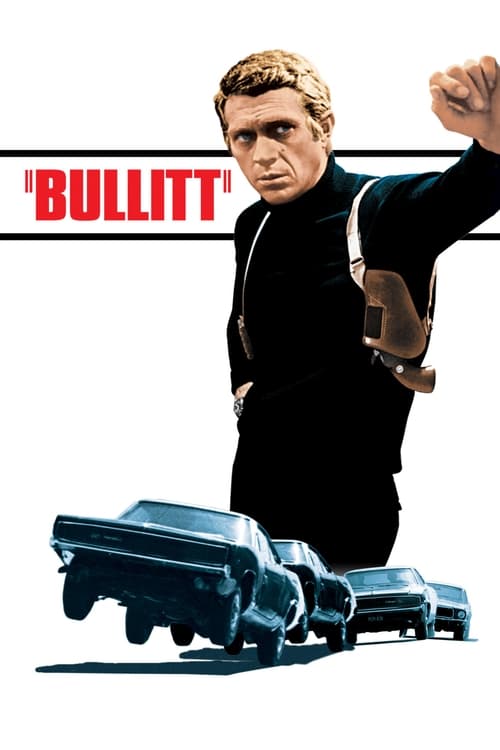
Bullitt
1968 · Peter Yates
For when you want to feel effortlessly cool — a lean, no-nonsense thriller for a night when slick modern action feels too loud and you'd rather ride shotgun with someone who never raises his voice.
What it's about
A San Francisco police lieutenant is handed a job that looks simple: keep a mob witness safe for a weekend so an ambitious senator can parade him before a Senate subcommittee. When hired guns find their way into the picture, the assignment curdles, and Frank Bullitt starts quietly pulling threads through a maze of double-crosses — hospitals, airports, hotel corridors — while the politician who set him up leans on him from above. It's a cop story about doing the work while powerful men play politics with it.
The experience
Cool, terse, and almost eerily unhurried — long stretches of watching a professional simply work, punctuated by bursts of violence and one car chase that still makes your stomach drop. It plays it so straight that the tension sneaks up on you.
Performances
Steve McQueen at his most minimal and magnetic — he barely talks, and you can't look at anyone else. Robert Vaughn is perfectly oily as the senator who thinks cops are furniture.
The craft
The famous ten-minute chase over the hills of San Francisco — real streets, real speed, cameras mounted low in the cars — rewrote what screen driving could feel like, and it still rewards the biggest screen and loudest speakers you have. Around it, Peter Yates shoots the city like a documentary and lets Lalo Schifrin's jazz score do the talking the hero won't.
Why it matters
It set the benchmark every car chase since has been measured against, and its stripped-down, procedural cool reshaped the American crime picture heading into the 1970s.
Snapshot
Bullitt is the film that fused the cool of a movie star with the grain of a real city and, in doing so, helped reset the tempo of the American crime picture. Steve McQueen plays Frank Bullitt, a San Francisco police lieutenant assigned to guard a mob witness ahead of a Senate subcommittee hearing; when the witness is gunned down on his watch, Bullitt quietly works the case in defiance of the ambitious politician, Walter Chalmers (Robert Vaughn), who tried to use him. The plot is a serviceable double-cross thriller, but the film's reputation rests elsewhere — on its near-wordless procedural texture, its location realism, Lalo Schifrin's jazz score, McQueen's minimalist performance, and above all a roughly ten-minute car chase through the streets of San Francisco that became one of the most imitated sequences in cinema. Directed by the Englishman Peter Yates in his first American assignment and produced by McQueen's own Solar Productions, Bullitt sits at the hinge between the studio era and New Hollywood: a star vehicle that behaves like a European location film.
Industry & production
Bullitt was a Solar Productions project — McQueen's company — released through Warner Bros.–Seven Arts in October 1968. It is a clear instance of the late-1960s shift toward star- and talent-driven production, in which a bankable actor leveraged his clout into creative control. McQueen, fresh from The Thomas Crown Affair (1968), wanted a contemporary, location-based picture, and he wanted it to feel authentic to police work rather than glamorous.
The source was Robert L. Pike's novel Mute Witness (Pike being a pen name of Robert L. Fish), set in New York; the adaptation relocated the story to San Francisco, a choice that proved central to the film's identity. The screenplay is credited to Alan R. Trustman and Harry Kleiner. Trustman had also written The Thomas Crown Affair, which is how he came into McQueen's orbit.
The decisive industry move was hiring Peter Yates to direct. McQueen reportedly chose him on the strength of the British heist film Robbery (1967), which contained an extended, kinetic car-chase opening — exactly the sensibility Bullitt would need. Yates brought a documentary-influenced British realism to an American genre that, in the studio system, had often been shot on backlots and process screens. Shooting on real San Francisco streets, in real hospitals and hotels, was both an aesthetic and a logistical commitment, and the production worked closely with the city to stage the chase on public roads.
Technology
The film's technological signature is its commitment to real, in-camera capture rather than studio fakery. The car chase was shot largely with cameras mounted directly on the vehicles and in camera cars, and the actors and stunt drivers performed the action at genuine speed on actual streets, rather than against rear-projection. This was a meaningful break from the process-shot tradition still common in 1968.
The hero cars are now part of automotive folklore: a Highland Green 1968 Ford Mustang GT 390 fastback for Bullitt, pursued by a black 1968 Dodge Charger R/T. Multiple examples of each were used and modified for the demands of stunt driving (reinforced suspensions and so on). The decision to record the chase's sound from the cars themselves — engines, tires, gear changes — rather than scoring it, was as much a technological-aesthetic choice as a creative one, and it depended on the location-recording approach the production embraced throughout.
Technique
Cinematography
William A. Fraker — who in the same year shot Roman Polanski's Rosemary's Baby — gives Bullitt a cool, naturalistic palette and a willingness to let scenes play in available or low light. The film favors real interiors and exteriors, with the fog, hills, and hard geometry of San Francisco as a recurring graphic element. Fraker's camera is patient in the procedural passages and aggressively kinetic in the chase, where mounted and handheld setups put the viewer inside the cars. The overall look helped codify a documentary-inflected realism that would define the urban crime films of the following decade.
Editing
The editing, by Frank P. Keller, won the Academy Award for Best Film Editing — the film's signal industry honor. The chase is the showpiece: built from in-car and pursuit footage, it uses escalating rhythm, the famous bouncing descents of San Francisco's hills, and abrupt cuts to generate momentum. The sequence is also notorious among cinephiles for its continuity quirks — most famously the green Volkswagen that appears to be passed repeatedly, and hubcaps that fly off the Charger more times than a single car has wheels — artifacts of assembling a long action set-piece from many discontinuous takes. That these are remembered fondly rather than as failures is a testament to how completely the sequence's energy overrides literal logic. Beyond the chase, Keller's cutting is notable for its restraint, letting procedural scenes breathe.
Mise-en-scène / staging
Yates stages the film with a procedural calm punctuated by sudden violence. Much of Bullitt consists of watching a competent man work — driving, waiting, reading a crime scene, navigating a hospital corridor — and the staging treats these as inherently interesting. Real locations do much of the dramatic work: the emergency room, the hotel where the witness is shot, the airport finale across active runways. The famous final foot-chase through San Francisco International Airport, ending in gunfire near the tarmac, exemplifies the film's preference for staging climaxes in functioning, unglamorous public spaces.
Sound
Sound is one of Bullitt's most influential elements, and the film was nominated for an Academy Award in the sound category. The chase plays essentially without music — driven entirely by the roar of the V8 engines, downshifts, squealing tires, and the percussive bottoming-out of the suspensions on the hills. By withholding Schifrin's score at the climactic moment and letting mechanical sound carry the tension, the film achieved a visceral realism that scored chases rarely match, and it established a template later filmmakers consciously followed.
Performance
McQueen's Bullitt is the definitive expression of his screen persona: laconic, watchful, physically precise, communicating through gesture and stillness rather than dialogue. He underplays relentlessly, which makes the eruptions of action register harder. Around him, Robert Vaughn supplies oily political ambition as Chalmers, the antagonist who is bureaucratic rather than criminal; Jacqueline Bisset plays Bullitt's girlfriend, the film's conscience and its one sustained note of moral unease about what police work does to a person; Don Gordon is his loyal partner; Simon Oakland and Norman Fell fill out the department; and a young Robert Duvall appears briefly but memorably as a cab driver. The supporting playing is uniformly grounded, reinforcing the film's realist contract.
Narrative & dramatic mode
Narratively, Bullitt is a lean police thriller organized around a witness, a betrayal, and a hidden identity — the man in protective custody is not quite who the authorities believe, and the case turns on that deception. But the film is far more interested in mode than in mechanics. It operates in a procedural-realist register, accumulating detail about how an investigation actually proceeds and trusting the audience to keep up with deliberately under-explained plotting. Dialogue is sparse; motive is implied; the emotional throughline is Bullitt's growing alienation from a system that treats people as instruments — embodied by Chalmers, who would sacrifice the truth for a headline. The film's coolness is itself the argument: competence and integrity persist in a world of compromise, but at a personal cost the final, ambiguous beats refuse to resolve cleanly.
Genre & cycle
Bullitt belongs to the police thriller / urban crime cycle, but it arrives at a transitional moment and helps redefine the form. It largely abandons the studio-bound, morally tidy police drama in favor of location realism, institutional cynicism, and a protagonist whose authority is provisional. In this it anticipates the wave of gritty cop films of the early 1970s — The French Connection (1971), Dirty Harry (1971), and their successors — and it is frequently cited as a progenitor of the modern car-chase film as a genre attraction in its own right. It is also a star vehicle in the classical sense, engineered around McQueen's image, which makes it a hybrid of old-Hollywood star packaging and new realist sensibility.
Authorship & method
The authorship of Bullitt is genuinely collaborative, with McQueen as the gravitational center. As star and producer (through Solar), he shaped the project's tone and its insistence on authenticity. Peter Yates, the director, imported a British, documentary-tinged approach to American genre material and managed the enormous logistical feat of the location chase; Bullitt launched his American career. William A. Fraker (cinematography) supplied the naturalistic, location-driven look. Frank P. Keller (editing) shaped the film's rhythm and built the Oscar-winning chase. Lalo Schifrin (composer) contributed a cool, jazz-inflected score whose strategic absence in the chase is as important as its presence elsewhere; Schifrin would go on to score Dirty Harry and was already known for the Mission: Impossible theme. The screenplay by Alan R. Trustman and Harry Kleiner provided the deliberately spare scaffolding. Crucially, the chase also bears the authorship of its stunt professionals — coordinator Carey Loftin, driver Bill Hickman (who piloted the Charger), and Bud Ekins among them — with McQueen performing some of the driving himself. The exact division of who drove which shots has been debated over the years; the prudent statement is that the sequence was a team achievement combining McQueen and professional stunt drivers.
Movement / national cinema
Bullitt is an American studio release, but its method reflects a transatlantic exchange. Yates and the British realist tradition — and, more broadly, the influence of European location shooting and the new freedoms of 1960s cinema — fed into a Hollywood that was loosening under the collapse of the old studio order. The film is best understood as proto–New Hollywood: produced through a star's independent company, shot on real streets, skeptical of institutions, and stylistically indebted to documentary and European practice without being an art film. It helped demonstrate that a mainstream genre picture could absorb those values commercially.
Era / period
Released in 1968 — a year of acute political turmoil in the United States — Bullitt registers the era's distrust of authority and its appetite for realism over gloss. Its portrait of a self-serving politician willing to manipulate the machinery of justice, and of a cop who keeps faith with the work rather than the system, speaks to a broader late-1960s skepticism. Technologically and industrially it sits at the threshold between the studio era and the director/star-driven 1970s. Its San Francisco — fogbound, hilly, modern — is presented without postcard sentimentality, marking the period's turn toward cities as they actually looked.
Themes
The film's central theme is integrity under institutional pressure: Bullitt's quiet refusal to be used. Surrounding it are the cost of professionalism (Bisset's character voices the toll that proximity to violence and death exacts on the man she loves), the gap between public spectacle and private truth (Chalmers wants a televised victory; Bullitt wants the facts), and a pervasive moral ambiguity in which the "system" is as much an obstacle as the criminals. The film also meditates, almost wordlessly, on competence as a value in itself — the dignity of doing a difficult job well — and on alienation, leaving its hero, in the closing image, isolated and unresolved rather than triumphant.
Reception, canon & influence
Bullitt was a commercial success on release and has only grown in stature; it won the Academy Award for Film Editing and received a nomination for Sound, and it endures as one of McQueen's signature films and a touchstone of cool. Contemporary and later criticism has consistently praised its style, its sound design, and the chase while noting that its plot is thin and deliberately opaque — a film admired more for how it moves than for what it tells.
Influences on the film (backward): the most direct is Yates's own Robbery (1967) and its chase, which earned him the job; more broadly, the picture draws on British and European location realism and documentary technique, and on the existing American police-thriller and noir traditions that it strips down and modernizes. Its source novel, Pike's Mute Witness, supplied the bones of the witness-and-double-cross plot.
Legacy (forward): Bullitt is routinely credited with redefining the screen car chase, shifting it toward real-location, real-speed, sound-driven realism — an approach answered and escalated by The French Connection (1971) and echoed across decades of action cinema; McQueen's homage The Driver, the Ronin (1998) chases, and countless others trace lineage here. It helped establish the realist, institutionally cynical urban cop film that flourished in the 1970s. McQueen's Mustang, his wardrobe and accessories, and the character's understated cool became enduring style references, and the Highland Green Mustang itself became a celebrated piece of film and automotive history. The film's name has since been borrowed for a Ford Mustang special edition and invoked whenever a movie wants to claim the mantle of the great practical car chase — a sign of how thoroughly Bullitt fixed the terms of that form.
A Deleuzian reading
Watch the moment just before the chase.
The full Deleuzian reading of Bullitt →
Reception
A solid hit and a critical success in 1968, praised for its documentary-flavored realism — but over the decades it's been almost entirely absorbed into its own car chase, with the rest of the film now discussed as the quiet, procedural stuff around the main event.
How Bullitt was received, from release to now →
Influences: the films it descends from and the films it influenced
- The Great Escape (1963) — Inherits McQueen's do-his-own-stunts practical-action ethos and laconic-cool persona, reincarnating the motorcycle jump as the era's defining real-vehicle car chase.
- The French Connection (1971) — Directly answers and escalates Bullitt's real-location, real-speed, sound-driven chase — documentary handheld and diegetic engine noise pushed to a faster, dirtier extreme.
- Dirty Harry (1971) — Extends the cynical San Francisco cop film and re-hired Lalo Schifrin, carrying forward Bullitt's jazz-inflected scoring and institutional-distrust urban realism.
- The Driver (1978) — A near-silent getaway-driver film that explicitly homages Bullitt's withheld dialogue and music, foregrounding diegetic engine and tire sound during pursuit.
- To Live and Die in L.A. (1985) — Friedkin returns to the practical real-location car chase, staging a wrong-way freeway pursuit in the Bullitt/French Connection tradition of shot-on-the-street danger.
- Ronin (1998) — Stages its chases with real cars at real speed on actual European roads, no process shots — the practical-stunt, in-car-camera ethos Bullitt and Grand Prix established.
- Baby Driver (2017) — Built on practical stunt driving and diegetic engine/tire sound choreographed to the cut, descending from Bullitt's editing-as-rhythm and real-vehicle chase aesthetic.
- Ford v Ferrari (2019) — Lalo Schifrin's score drops out during the chase and William Fraker's telephoto lens work collapses street depth through long-lens compression — the specific cinematographic technique Phedon Papamichael applies to the racetrack, making the GT40's speed legible through background-foreground spatial collapse rather than cutting rate.
- The Friends of Eddie Coyle (1973) — Yates's own template of available-light location shooting and deglamorized police procedure, whose documentary texture he strips of spectacle and reapplies here.
- Jack Reacher (2012) — Established the in-camera, real-streets car chase scored by engine noise alone — the exact sound/sonic-restraint and practical-staging grammar McQuarrie revives for Reacher's nocturnal pursuit.
- Shaft (1971) — Models the location-shot urban thriller built around a laconic masculine-cool hero, with a jazz-funk score (Lalo Schifrin) woven into the cutting rhythm rather than laid over it.
- The Fugitive (1993) — Set the standard for geographically coherent, process-shot-free practical vehicular action that the train-wreck and tunnel set-pieces inherit.
- Lethal Weapon (1987) — The laconic-cop cool paired with a commitment to real, in-camera vehicular stunt work over rear-projection fakery — the practical-stunt ethic the franchise extends.
- Robbery (1967) — Yates's own earlier heist film staged a real-street London car chase whose documentary speed and editing directly won him the Bullitt assignment — the template he then refined.
- The Naked City (1948) — Pioneered the location-shot, semi-documentary police procedural — real streets and ambient grit standing in for studio sets, the realist grammar Bullitt strips down and modernizes.
- The Lineup (1958) — Built a San Francisco police thriller toward a real-location vehicular climax on the city's actual streets and freeways, prefiguring Bullitt's use of SF topography as kinetic stage.
- Grand Prix (1966) — Mounted cameras directly on the cars to capture real-speed motion from inside the vehicle, the in-car/on-car camera technique Bullitt adapts for its chase point-of-view.
- Point Blank (1967) — Established the terse, near-wordless neo-noir antihero moving through procedural cool — the minimalist performance register McQueen's Bullitt occupies.
- Le Samouraï (1967) — Sibling in minimalism: withheld dialogue, withheld score, and procedural calm building tension through behavior and silence rather than exposition.
- The Seven-Ups (1973) — Bullitt/French Connection producer directs his own NYC chase using stunt driver Bill Hickman — the same practical-driver authorship lineage applied with real-street choreography.
- The Getaway (1972) — Carries McQueen's minimalist, competence-driven star persona into a procedural crime film, extending the understated-cool performance Bullitt fixed.
- Drive (2011) — Revives the minimalist driver hero with strategically withheld music and long passages of procedural calm broken by sudden kinetic violence — Bullitt's sound-and-silence logic.
- Mad Max: Fury Road (2015) — Privileges practical vehicular stunts and real on-camera collisions over digital fakery, the most maximal heir to Bullitt's insistence on authentic, physically-performed car action.
- The Italian Job (1969) — Yates's San Francisco pursuit established the year prior that a car chase could be a self-justifying, intercut set piece; John Trumper extends that intercutting into comic Mini choreography.
- Ambulance (2022) — Established the modern car-chase grammar Ambulance descends from — real streets, in-car mounts, and momentum cut from the vehicle's actual movement rather than rear-projection.
Similar films
- Ronin (1998) — influence & lineage
- The Driver (1978) — influence & lineage
- The Getaway (1972) — influence & lineage
- Dirty Harry (1971) — influence & lineage
- The French Connection (1971) — influence & lineage
- Le Samouraï (1967) — influence & lineage
- Point Blank (1967) — influence & lineage
- The Thomas Crown Affair (1968) — shared sensibility