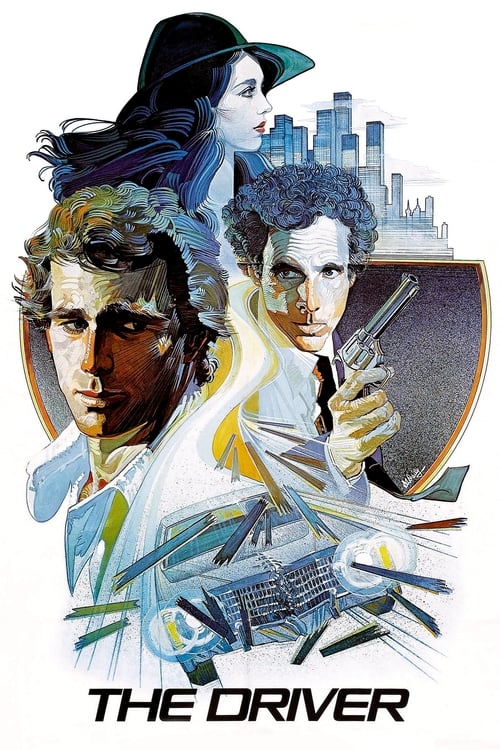
The Driver
1978 · Walter Hill
For a late night when you want something stripped-down and hypnotic — minimal talk, maximum style, engines instead of exposition. More cool-headed trance than white-knuckle thriller; a challenge if you need characters to open up, a gift if you don't.
What it's about
In nocturnal Los Angeles, a getaway driver so good he's never been caught takes jobs on his own cold terms — until a swaggering detective makes catching him a personal crusade, rigging a set-up robbery with a gang of informants as bait. Between them stands a poker-faced gambler who may be the driver's only alibi. Nobody in the film has a name; everybody has a role, and the whole thing plays out as a duel of professionals.
The experience
Lean, quiet, and coiled — long stretches of near-silence broken by car chases you feel in your chest. It's cool to the touch by design: no backstories, no speeches, just pressure steadily applied.
Performances
Ryan O'Neal weaponizes his blankness as the near-wordless Driver, while Bruce Dern is all gleeful, needling talk as the detective — the film runs on the friction between his noise and O'Neal's silence. Isabelle Adjani gives the Player an unreadable, watchful poise.
The craft
Walter Hill strips the crime picture to its skeleton: terse dialogue, empty streets, parking garages and train yards shot like abstract spaces, spare jazz on the score. The chases are precision work — real cars, real geography, the sound of engines and tire-scream doing what dialogue won't. Good speakers earn their keep here.
Why it matters
Its nameless-professional cool became a template that later crime and getaway films openly borrowed from — the pared-down wheelman archetype starts here, and it marked Hill as a genre stylist of the first rank.
Snapshot
The Driver is Walter Hill's second feature, a deliberately stripped-down crime thriller that reduces the getaway-car picture to its existential skeleton. Its characters carry no proper names — they are credited only as the Driver (Ryan O'Neal), the Detective (Bruce Dern), the Player (Isabelle Adjani), and the Connection (Ronee Blakley) — a gesture that announces the film's central ambition: to treat genre figures as archetypes rather than psychologized individuals. The plot is a duel of professionals. A near-silent wheelman who has never been caught becomes the obsession of a voluble, gloating detective, who entraps a gang into a set-up robbery to convict him. Around this spine Hill builds a nocturnal Los Angeles of empty streets, parking structures, train yards, and hotel rooms, scored to spare jazz and punctuated by some of the most precisely staged car chases of the decade. Commercially muted in the United States on release, the film became a touchstone for later filmmakers and is now widely regarded as a key text of minimalist, code-of-honor crime cinema — a bridge between Jean-Pierre Melville's French policiers and the neon existentialism of much later work such as Drive.
Industry & production
The Driver emerged from the tail end of the New Hollywood era, produced by Lawrence Gordon, Hill's frequent collaborator and producing partner, and financed through the orbit of EMI Films with distribution by 20th Century-Fox. Hill had come up as a screenwriter — most notably scripting Sam Peckinpah's The Getaway (1972) and co-writing Hickey & Boggs (1972) — before directing Hard Times (1975) with Charles Bronson. The Driver was his chance to direct his own original screenplay, and it bears the marks of a writer-director pursuing a personal aesthetic program rather than a studio formula.
Casting Ryan O'Neal as the Driver was a calculated act of counter-typing. O'Neal was then best known for romantic and comedic roles (Love Story, What's Up, Doc?, Paper Moon), and Hill used that smooth, unthreatening surface against the grain, asking the actor to empty himself of affect. Bruce Dern, by contrast, was cast for his capacity to fill silence — a garrulous, needling antagonist. The presence of Isabelle Adjani, an internationally prominent French actress, reinforces the film's European inflection, though her role is more function than character. The production was modestly budgeted by the standards of the period; precise figures and box-office returns are not something I will assert here beyond the well-established fact that the film underperformed in its domestic theatrical run and found a warmer reception, and a durable critical afterlife, abroad — particularly in France, where its Melvillean lineage was legible.
Technology
The Driver was a conventional late-1970s 35mm photochemical production, shot on color negative and finished optically; its technological interest lies less in novel equipment than in the demands of its action set pieces. The car chases were executed practically, with real vehicles, real stunt drivers, and in-camera collisions — the standard of the era before digital augmentation, and a discipline that gives the sequences their weight and consequence. Hill and his cinematographer worked extensively at night, which placed real pressure on film stock sensitivity and lighting: the look depends on available and supplemented light sources — sodium-vapor streetlamps, headlights, signage — rendered on emulsions that demanded careful exposure. I won't claim a specific aspect ratio or lens package as fact, but the film's compositions are unmistakably widescreen, exploiting horizontal space to isolate figures and vehicles within the urban frame. The mounting of cameras on and around cars for the chase work — low angles, hood mounts, tracking rigs — represents the period's craft of vehicular cinematography at a high level.
Technique
Cinematography
The photography is credited to Philip H. Lathrop, a veteran whose résumé spanned studio classicism and modern thrillers. His work here is cool, controlled, and architectural. Los Angeles is photographed as a near-depopulated nightscape — wet asphalt, fluorescent interiors, the geometric repetition of parking garages and rail yards. The palette favors desaturated blues, blacks, and the sickly amber of street lighting, with figures often small within wide compositions, dwarfed by infrastructure. The camera tends toward stillness in dialogue scenes, holding on faces and letting Dern's verbal energy play against O'Neal's stoneface, then unleashes kinetic, ground-level movement in the chases. This contrast — static observation versus controlled velocity — is the film's visual signature.
Editing
The editing, credited to Tina Hirsch and Robert K. Lambert, is central to the film's effect. The chase sequences are cut for legible spatial cause-and-effect rather than abstract sensation: the viewer generally understands where cars are in relation to one another, what the Driver is attempting, and why a maneuver succeeds or fails. This clarity is the point — the editing dramatizes competence, turning driving into a readable display of mastery. Away from the action, the cutting is patient and withholding, matching the screenplay's refusal of exposition. Information is rationed; scenes end before they resolve. The rhythm enforces the film's reticence.
Mise-en-scène / staging
Hill stages the film as a series of confrontations in stripped, functional spaces — interrogation rooms, a bus station, hotel corridors, a deserted warehouse. Production design is deliberately anonymous and timeless, avoiding period-specific clutter that would date or sentimentalize the world. The famous garage sequence, in which the Driver methodically wrecks a car to demonstrate his skill to skeptical clients, is a model of staging as character revelation: the action is the dialogue. Throughout, Hill blocks his figures with a formal precision that recalls the genre tableaux of European crime cinema — bodies arranged as types within a frame, gestures economical and purposeful.
Sound
The soundscape is spare and pointed. The score by Michael Small — a composer associated with the paranoid thrillers of the decade (Klute, The Parallax View) — is restrained and jazz-inflected, used selectively rather than wall-to-wall. Much of the film's tension lives in its sound effects: engines, tire squeal, the mechanical report of a car striking concrete. Silence is an instrument here, framing the Driver's quiet against the Detective's chatter and lending the chases a documentary physicality. The mix privileges the texture of metal, rubber, and night air.
Performance
The performance scheme is built on a calculated asymmetry. Ryan O'Neal plays the Driver as a closed surface — minimal dialogue, minimal expression, a professional reduced to function and watchfulness. The role asks for restraint to the point of opacity, and O'Neal's against-type casting makes that blankness read as discipline rather than absence. Bruce Dern is the engine of personality: his Detective is boastful, theatrical, and contemptuous, addressing the Driver as "Cowboy" and treating the manhunt as a personal sport. Isabelle Adjani's Player is enigmatic and watchful, more cipher than confidante, while Ronee Blakley supplies a note of vulnerability as the Connection. The ensemble works precisely because it subordinates psychology to archetype.
Narrative & dramatic mode
The film operates in a mode of extreme narrative economy. There is almost no backstory, no motive beyond professional pride, and no interiority offered through dialogue. The dramatic engine is a contest of competences: the Driver's flawless craft against the Detective's obsessive cunning, mediated by the trap the Detective constructs. Hill withholds the conventional satisfactions of the crime film — the elaborate heist, the moral arc, the romance — in favor of an abstract duel. This austerity links the film to a European art-cinema sensibility grafted onto American genre material. The result can feel cold, even hermetic; that chill is intentional, an argument that genre figures need no humanizing apparatus to command attention. The Player's role as a false alibi the Driver hires to mislead the Detective adds a layer of gamesmanship, foregrounding performance and deception as the film's true subjects.
Genre & cycle
The Driver belongs to the lineage of the getaway/heist thriller and the broader category of the "professional" crime film, but it pares those forms down to near-allegory. It sits within the 1970s neo-noir cycle, sharing that movement's nocturnal urban malaise and moral ambivalence, while rejecting noir's typical voice-over confession and doomed romance. More precisely, it is an American transposition of the French policier tradition — the cool, ritualized crime cinema codified by Jean-Pierre Melville. Within Hill's own developing body of work it inaugurates a recurring fascination with closed worlds governed by professional codes, a thread that runs through The Warriors (1979), The Long Riders (1980), and beyond. It also belongs to the rich 1970s cycle of car-centric pictures, but distinguishes itself by treating the automobile as an instrument of craft rather than a vehicle for spectacle alone.
Authorship & method
The Driver is a defining statement of Walter Hill's authorial method: genre stripped to its mythic essentials, archetypes over individuals, action as characterization, and a fascination with men who live by codes. Hill has often described his films in mythological and Western terms, and the anonymous, function-named figures of The Driver make that program explicit. As both writer and director he controls the film's reticence at the level of script and staging alike.
The key collaborators shape the execution decisively. Cinematographer Philip H. Lathrop supplies the architectural, cool-toned nightscape that grounds the abstraction in a tactile Los Angeles. Composer Michael Small contributes a restrained score whose paranoid-thriller pedigree suits the film's watchful tension. Editors Tina Hirsch and Robert K. Lambert give the chases their legibility and the dialogue scenes their withholding patience. Producer Lawrence Gordon provided the production framework within which Hill could pursue an uncommercially austere vision. Together they realize a film whose authorship is unusually unified — a director's aesthetic thesis carried through every department.
Movement / national cinema
The film is a product of late New Hollywood, that period in which American directors enjoyed unusual latitude to pursue personal, genre-revising work within the studio system. Yet its deepest affiliations are transnational. The Driver is consciously Melvillean — its silent professional, its ritualized procedures, its drained palette and existential cool all descend from French crime cinema, especially Le Samouraï (1967). It thus stands at a crossroads of national traditions: an American genre picture filtered through a European art-cinema sensibility, made legible to French critics in particular as a homage and an extension of their own canon. This cross-pollination is precisely what later gave the film its outsized influence among internationally minded directors.
Era / period
Released in 1978, The Driver arrives near the close of the New Hollywood moment and just before the blockbuster economics of the 1980s reshaped genre filmmaking. It carries the period's appetite for moral ambiguity, downbeat tone, and auteur experimentation, while pointing forward to the leaner, more stylized action cinema that would follow. Its Los Angeles is a recognizably 1970s city — anonymous, nocturnal, infrastructural — but the film's deliberate avoidance of topical detail gives it a curiously placeless, timeless quality that has helped it age well. It belongs to its moment and yet seems to float slightly outside it, which is part of why successive generations have rediscovered it.
Themes
The film's governing theme is professionalism as identity. The Driver is defined entirely by his craft; outside of it he barely exists, and the film proposes that this self-erasure into pure competence is both his power and his cost. Related themes follow: the duel between equally obsessed adversaries, in which cop and criminal mirror one another; the dignity and emptiness of a life lived by a code; and performance and deception as conditions of survival, literalized in the Player's hired alibi and the Detective's elaborate entrapment. There is a persistent existential undertone — the sense of skilled men playing an unwinnable game in an indifferent city — and a meditation on anonymity itself, the characters' namelessness becoming the film's deepest statement about who these people are: functions, not persons.
Reception, canon & influence
On initial release The Driver drew a divided response and modest domestic returns; its austerity and emotional coolness struck some contemporary American critics as remote or thin, while others recognized the precision of its craft. Its reputation has risen steadily and substantially in the decades since, and it is now commonly cited as one of the strongest pure genre films of its era and a foundational entry in minimalist crime cinema. Its critical standing was notably higher abroad, especially in France, where its lineage was immediately apparent.
The influences on the film run primarily through Jean-Pierre Melville — the silent professional, the ritualized procedure, the existential cool of Le Samouraï are the clearest antecedents — alongside the hard-boiled American crime tradition and the action sensibility Hill absorbed working with Sam Peckinpah. The Western's lone-gunfighter archetype, refracted through Hill's mythological reading of genre, also stands behind the figure of the Driver.
The film's legacy forward is considerable and widely acknowledged. Its DNA is visible in the wheelman-as-cipher and neon-noir mode of Nicolas Winding Refn's Drive (2011), which is frequently and explicitly traced back to Hill's film; in the kinetic, music-driven getaway cinema of Edgar Wright's Baby Driver (2017); in the lean professional-on-the-run formula of the Transporter films; and more broadly in the work of directors drawn to stylized, code-bound crime. Hill himself extended its preoccupations across his subsequent career. The Driver endures as the rare genre exercise whose influence has outgrown its original commercial reach — a film admired less for what happens in it than for the rigor and purity with which it happens.
A Deleuzian reading
Skeptical clients want proof.
The full Deleuzian reading of The Driver →
Reception
Dismissed by many American critics in 1978 as cold and affected and a box-office disappointment at home, it fared better in Europe and has since been reappraised as a minimalist crime classic — now routinely cited as one of Walter Hill's best films.
How The Driver was received, from release to now →
Influences: the films it descends from and the films it influenced
- Le Samouraï (1967) — The template Hill strips down: a near-silent professional defined by ritualized procedure and function rather than biography, his cool an existential code rather than a personality.
- Le Cercle Rouge (1970) — Establishes the wordless, patiently-staged heist setpiece in which procedure carries the drama and dialogue is withheld — the 'silence as instrument' Hill inherits directly.
- Bob le Flambeur (1956) — The originating Melvillean gesture of genre pared to ritual and milieu — the gambler-thief as a figure of style and code rather than psychology.
- Point Blank (1967) — Abstracts a crime plot into modernist architecture and an emblematic, near-anonymous avenger, modeling the archetype-over-name approach in an American city setting.
- Bullitt (1968) — Sets the standard for legible chase geography — real streets cut so the spatial logic of pursuit reads cleanly — which Hill makes the film's editing thesis.
- The Getaway (1972) — Hill's own screenplay; the professional-couple-on-the-run formula and the principle of action-as-characterization he absorbed working in Peckinpah's orbit.
- Once Upon a Time in the West (1968) — Supplies the mythic, nameless-gunfighter archetype and the use of held silence and duration as suspense that Hill refracts through neo-noir.
- The Killers (1964) — Terse, business-like professional killers whose flat affect and procedural competence prefigure Hill's treatment of crime as a trade practiced by ciphers.
- The Big Heat (1953) — Hill strips the crime film to formal skeleton — nameless characters, dialogue reduced to function, the detective/criminal dialectic as pure structure — explicitly working in the tradition of Lang's minimum-viable-duration economy; the Girl's role as morally constrained agent operating within a system that limits her options mirrors Debby Marsh without backstory.
- Drive (2011) — Explicitly descends from Hill: the wheelman-as-cipher, the code of the getaway specialist, and a neon-nocturnal Los Angeles rendered as cool abstraction.
- Baby Driver (2017) — Extends the getaway-driver archetype into music-synced kinetic cinema, retaining Hill's premium on legible, real-vehicle chase choreography over CGI.
- Thief (1981) — Contemporaneous expression of the same code-bound professional: a nocturnal, neon-slicked crime world where the protagonist is defined by craft and method, not backstory.
- The Transporter (2002) — Distills Hill's lean professional-on-the-run formula into a rule-following wheelman whose identity is his code of conduct on the job.
- Collateral (2004) — A nocturnal Los Angeles abstracted into watchful cool, with an anonymous professional whose entire being is his methodical competence at a lethal trade.
- The American (2010) — A near-wordless revival of the Melville-via-Hill silent professional, built on reticent staging, withholding patience, and identity defined wholly through ritualized procedure.
- Jack Reacher (2012) — A nameless, minimalist drifter defined by craft competence and sonic restraint, with practical driving sequences — Hill's stripped existential professionalism prefigures Reacher's blank-slate hero.
- The Terminator (1984) — Hill's laconic, affectless lone-driver professionalism is the cited touchstone for Reese's minimalist, mission-fixated characterization.
- The Warriors (1979) — Hill's own immediate precedent: characters named by function, dialogue stripped to operational minimum, performance built from stance and stillness, all staged in night exteriors where the city holds no civilians.
- To Live and Die in L.A. (1985) — Shares the architectural nocturnal-L.A. nightscape and a virtuoso practical car chase staged for spatial legibility in the Bullitt/Hill lineage.
- Ronin (1998) — Professionals known only by function executing procedure, anchored by practical, geographically coherent car chases — the same fusion of Melvillean code and legible action.
Similar films
- Drive (2011) — influence & lineage · same viewing thread
- Bullitt (1968) — influence & lineage
- Ronin (1998) — influence & lineage
- Thief (1981) — influence & lineage
- Baby Driver (2017) — influence & lineage
- Le Samouraï (1967) — influence & lineage
- Le Cercle Rouge (1970) — influence & lineage
- The Getaway (1972) — influence & lineage
All the films related to The Driver →
Watch it with: curated runs of related films
- Undercover and Underworld — A run of cops, criminals, and the moles planted between them — watch these back-to-back for how loyalty curdles into betrayal across one corrupt city after another, from the Boston docks to Hong Kong to Marseille-by-way-of-New-York.