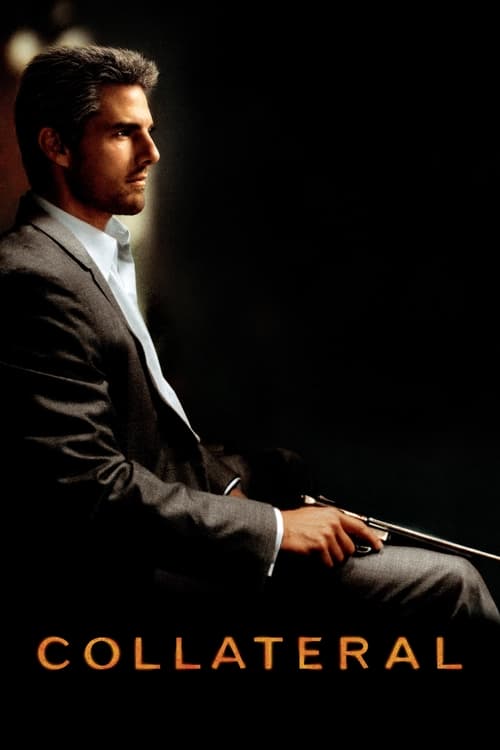
Collateral
2004 · Michael Mann
For when you want a smart, grown-up thriller for a Friday night — gripping without being punishing, with enough on its mind that you'll be talking about Vincent's worldview afterward.
What it's about
Max drives a cab in Los Angeles, quietly nursing a dream of something better, when a sharp-suited, silver-haired fare offers him $600 to be his driver for the night. The passenger is Vincent, a contract killer with five names on his list before dawn, and Max is now his unwilling chauffeur. What follows is one long night across the city — nightclubs, jazz bars, hospital corridors — as the cabbie and the killer are locked together and the stakes keep climbing.
The experience
Sleek, tense, and propulsive, but with room to breathe — the thriller mechanics are threaded through long, charged conversations between two men who get under each other's skin. It builds from simmering dread to a genuinely gripping final stretch.
Performances
Tom Cruise, cast brilliantly against type, makes Vincent a magnetic, gray-haired void of charm and nihilism, and Jamie Foxx matches him beat for beat — his Max earned an Oscar nomination and announced him as a serious dramatic actor.
The craft
Michael Mann shot much of it on early digital video specifically to capture nocturnal LA the way film stock couldn't — sodium-lit streets, glowing skylines, coyotes crossing an empty boulevard — and the result is one of the great portraits of a city at night. The pacing is surgical, the action is staged with Mann's trademark precision, and it rewards a dark room and good speakers.
Why it matters
One of the first major studio films to prove digital cinematography could be an aesthetic choice rather than a compromise, it reshaped how night-set thrillers look and marked a turning point for both of its stars.
Snapshot
Collateral compresses Michael Mann's career-long preoccupations — professionalism, urban isolation, the moral weather of men at work — into a single Los Angeles night. A cab driver named Max (Jamie Foxx) picks up a silver-haired passenger, Vincent (Tom Cruise), who turns out to be a contract killer working through a list of five targets before dawn. The film proceeds as a two-hander confined largely to the front and back seats of a taxi, expanding outward into nightclubs, hospitals, jazz bars, and finally a Metro train. Its lasting significance is twofold: as one of the first major American studio films to shoot extensively on digital video, using the medium specifically to render the nocturnal city in ways celluloid could not; and as the vehicle that recast Tom Cruise against type as a charismatic nihilist while elevating Jamie Foxx, in the same year as Ray, into the front rank of American actors. It is a genre thriller that is equally an essay on anonymity in a horizontal, atomized metropolis.
Industry & production
Collateral was produced by DreamWorks Pictures and Paramount Pictures, with Mann producing alongside Julie Richardson. The screenplay by Stuart Beattie had a long gestation; Beattie has described conceiving the premise as a young man in a Sydney taxi, imagining the stranger in the back seat as a killer. The project circulated in Hollywood for years with various directors and stars reportedly attached at different stages before Mann took it on — the precise roster of earlier attachments is the kind of development-history detail that is reported inconsistently, so it is best treated cautiously rather than stated as fact. What is well established is that Beattie's original conception was relocated firmly to Los Angeles, where the city's sprawl became thematically central.
The casting inverted expectations. Cruise, then among the most reliable leading men in American film, took the antagonist role and submerged his star persona beneath gray hair, a gray suit, and a clipped, affectless professionalism; he is reported to have done observational preparation, including blending into public settings to test whether he could pass unnoticed. Foxx, cast as Max, was shooting Ray in the same period, and 2004 became his breakthrough year: he won the Academy Award for Best Actor for Ray and received a Best Supporting Actor nomination for Collateral. The supporting cast is unusually deep — Jada Pinkett Smith as the prosecutor Annie, Mark Ruffalo as a narcotics detective, Peter Berg, Bruce McGill, Irma P. Hall, Barry Shabaka Henley as the jazz-club proprietor, and Javier Bardem in a brief, memorable turn as the intermediary Felix. The film was a commercial success and broadly well received critically; exact grosses and budget figures are a matter of record but I will not cite specific numbers from memory.
Technology
Collateral is a landmark in the adoption of digital cinematography for theatrical narrative film. Mann and his cinematographers shot the bulk of the night exteriors on digital video rather than 35mm, principally using the Thomson Viper FilmStream camera, with Sony CineAlta high-definition cameras also deployed; portions of the film, including some daytime and interior material, were still captured on film stock. The motivation was not economy but image: digital sensors of the era resolved detail in low light and held the ambient glow of a city — sodium-vapor streetlights, neon, the diffuse skyglow of greater Los Angeles — in a way film emulsion could not without heavy supplemental lighting. The result is a Los Angeles night that looks lived-in and electric rather than studio-lit, with deep but legible shadow and a characteristic desaturated, slightly cool-green palette. The film became an immediate reference point in the industry argument over digital acquisition that would intensify across the following decade, demonstrating that the medium had an aesthetic of its own rather than being merely a cheaper substitute for film.
Technique
Cinematography
The cinematography is credited to Dion Beebe and Paul Cameron; Cameron began the production and Beebe completed it, a transition reflecting the unusual demands of the shoot. (The reported reasons for the change vary in the trade accounts and are not worth stating with false precision.) Whatever the division of labor, the visual achievement is coherent: Los Angeles is photographed as a vast, lateral, depthless field of light. Mann's camera favors long lenses and wide vistas of the basin at night, isolating the cab as a small moving cell within an indifferent grid. Interiors of the taxi are intimate and often handheld or close, holding the two faces in tight two-shots and reverses. The most celebrated images exploit the digital sensor's low-light fidelity — the recurring motif of the city seen through glass, reflections layering interior and exterior, and the famous nocturnal animal encounter on a deserted boulevard where coyotes cross the road in the headlights, a moment of stilled, almost mystical strangeness that the available-light digital capture renders without artifice.
Editing
The film was cut by Jim Miller and Paul Rubell. The editing balances two registers: the patient, dialogue-driven scenes inside the cab, which are allowed to breathe and accumulate tension through performance and pause, and the abrupt, kinetic violence that punctures them. The set-piece in the nightclub late in the film — a crowded, strobing, multi-front shootout — is a model of orienting the viewer within chaos, intercutting Vincent's lethal efficiency, Max's panic, and the converging law enforcement. The cutting rhythm enforces the film's structural logic of a countdown across one compressed night.
Mise-en-scène / staging
Mann stages Collateral around confinement and exposure. The taxi is a pressurized chamber where two strangers are forced into intimacy; much of the film's drama is blocked within a few feet of car interior. Against this, the city is staged as immensity — empty intersections, glass towers, the negative space of a metropolis after midnight. The jazz-club sequence is the film's still center: Vincent and Max share a drink with the proprietor Daniel, and Mann lets the scene unfold as a genuine conversation before it turns, the warmth of the encounter making its outcome colder. The recurring use of glass, reflection, and barrier underscores separation — between people, between Max's fantasy of escape and his reality.
Sound
The sound design renders the city as an ambient presence — traffic, rotors, the hum of light. James Newton Howard composed the score, which Mann integrated with an eclectic selection of source and licensed music characteristic of his films; Mann is known for treating song choices as authorial decisions rather than incidental dressing. The most discussed needle-drop is the driving rock track that accompanies the nightclub massacre, scoring carnage with propulsive momentum. Dialogue is mixed close and intimate inside the cab, heightening the claustrophobic two-hander.
Performance
The film is, finally, a contest of two performances. Cruise plays Vincent as a man of total composure and rehearsed philosophy, his menace residing in calm rather than display; the role weaponizes Cruise's natural charm, making likability itself sinister. Foxx gives Max an arc from passive, deferential dreamer — a cabbie who has told himself his fares are temporary while a decade slides by — to a man forced into agency. The asymmetry is the point: Vincent acts, Max reacts, until Max must finally act for himself. Among the supporting turns, Barry Shabaka Henley's Daniel and Irma P. Hall's hospitalized Ida give the film its human texture, and Bardem's brief Felix supplies a jolt of coiled threat.
Narrative & dramatic mode
Collateral is built on classical unities — one night, essentially one city, a tightly causal chain of events — wedded to the structure of a hit list, which functions as a ticking clock with five discrete beats. The dramatic mode is dialogue-forward existential thriller: long stretches are simply two men arguing about how to live, with the violence arriving as punctuation that raises the philosophical stakes. The central irony is that the assassin becomes the cab driver's reluctant tutor, goading the passive Max toward self-assertion even as he embodies everything Max should reject. The screenplay sustains suspense not only through the question of who will die but through the slow conversion of Max from hostage to antagonist.
Genre & cycle
The film sits at the intersection of the neo-noir, the hitman picture, and the urban night film. It belongs to a lineage of single-night Los Angeles movies and to the noir tradition of an ordinary man drawn into a criminal underworld by chance. Within the hitman cycle, it is distinguished by its refusal of caper mechanics: there is no elaborate heist, only a methodical professional and his moral effect on a bystander. It also extends Mann's own cycle of crime films — Thief, Heat, Miami Vice — in which cops and criminals are mirror professionals defined by their work.
Authorship & method
Collateral is unmistakably a Michael Mann film, and one of the purest distillations of his method. Mann's authorship lies in the convergence of his thematic signature (the lonely professional, the city as existential arena, work as identity) with a relentless commitment to verisimilitude and to technological experiment. His decision to shoot the night on digital is itself an authorial gesture, of a piece with his lifelong interest in capturing reality at the edge of what the medium allows.
Among collaborators: Stuart Beattie supplied the originating premise and screenplay, the long-incubated idea of the stranger in the back seat. Cinematographers Dion Beebe and Paul Cameron executed the digital nightscape; Beebe's work here fed directly into his subsequent collaboration with Mann. Editors Jim Miller and Paul Rubell shaped its rhythm of patience and rupture. Composer James Newton Howard, working with Mann's curatorial ear for source music, gave the film its sonic atmosphere. The ensemble approach to casting — filling small roles with strong character actors — is itself a Mann hallmark.
Movement / national cinema
Collateral is a product of American studio filmmaking at the moment of its digital transition, and it belongs to no formal movement. If it has a tradition, it is the post-classical Hollywood auteur thriller — directors working inside the studio system while pursuing personal aesthetic and thematic obsessions. Its national-cinema identity is emphatically that of Los Angeles cinema, joining a body of films that treat the city not as backdrop but as subject; Mann photographs L.A. as a horizontal, decentered grid, a counter-myth to the vertical iconography of New York. Notably, the originating idea was Australian-born, transplanted by Beattie into an American frame.
Era / period
The film arrived in 2004, at a hinge in the industry's history. The early 2000s were the years in which digital acquisition began its serious challenge to film stock, and Collateral became one of the most visible proofs of concept, anticipating the broader shift that would unfold across the decade. Thematically it is also a film of its moment: a meditation on anonymity, disconnection, and the failure of strangers to truly see one another in a networked yet isolating city — anxieties legible to early-twenty-first-century audiences. Vincent's monologue about a man who dies on the subway and rides for hours unnoticed crystallizes the period's unease about urban indifference.
Themes
The film's governing theme is alienation — the loneliness of the modern city, where millions live in proximity without contact. Against this, Mann sets the theme of authentic action versus drift: Max has narrated his own life as a waiting room, deferring his dreams, while Vincent has organized his around a chilling, self-justifying philosophy of meaninglessness ("millions of galaxies of hundreds of millions of stars, and a speck on one in a blink"). The film stages a debate between fatalism and agency, with Vincent's nihilism functioning as both temptation and warning. Related motifs run throughout: professionalism as identity; improvisation under pressure; seeing and being seen (windows, reflections, surveillance); and the idea that a single night can become the crucible in which a passive man is forged into someone capable of choice. The coyotes crossing the empty road serve as a wordless emblem of the wild indifference at the heart of the city.
Reception, canon & influence
Collateral was received as a major work by a major director, praised for its visual innovation and for its two central performances; Foxx's supporting nomination, in tandem with his Ray win, marked 2004 as his arrival. Critical discussion centered on the digital cinematography and on Cruise's against-type casting, both widely regarded as among the film's chief achievements.
Looking backward, the film draws on the deep traditions of film noir and the urban thriller, on the hitman picture, and on Mann's own prior crime films; its single-night structure echoes a venerable narrative form. Its philosophical dialogue and its portrait of the contract killer as cold professional connect it to a broader screen genealogy of articulate assassins.
Looking forward, Collateral's most consequential legacy is technological and aesthetic: it materially advanced the case for digital cinematography in mainstream filmmaking, and its rendering of low-light urban exteriors influenced how subsequent films and cinematographers approached night photography. Mann himself continued down the digital path in later work, and the film's look — the desaturated, sodium-and-neon nocturne — became a touchstone. It also stands as a key text in the critical reassessment of Mann as one of American cinema's foremost poets of the city and of professional masculinity. Within his filmography it is frequently ranked among his finest achievements, a lean, philosophically charged thriller that uses a genre frame to ask how, and whether, one is truly present in one's own life.
A Deleuzian reading
Two coyotes cross an empty boulevard in the headlights.
The full Deleuzian reading of Collateral →
Reception
A hit with critics and audiences in 2004, it's only grown since — now routinely called a landmark of early digital cinematography and the definitive nocturnal Los Angeles movie, with the 'Mann-hive' treating it as sacred text.
How Collateral was received, from release to now →
Influences: the films it descends from and the films it influenced
- Le Samouraï (1967) — Established the template Cruise's Vincent inherits — the assassin as ascetic ritualist rendered in a drained blue-gray palette, his professionalism expressed through procedure and near-wordless economy rather than menace.
- Taxi Driver (1976) — Pioneered the moving vehicle as a confined frame gliding through a neon-and-sodium nocturnal city, with windshield and window reflections layering the alienated rider against the streetscape — the exact visual grammar of the cab interiors here.
- The Driver (1978) — Defined the laconic genre professional purely by craft and economy of speech, the model for a thriller whose protagonist is characterized through competence at his work rather than backstory.
- Thief (1981) — Mann's own origin point for the rain-slicked neon nocturne and the solitary working professional, treating wet asphalt and streetlight as a reflective painterly surface for the lonely-craftsman protagonist.
- Manhunter (1986) — Established Mann's desaturated, architecturally composed thriller look and his use of curated pop needle-drops scoring procedural set-pieces, both carried directly into Collateral.
- Heat (1995) — Source of the hyper-real gunfire sound design and choreographed urban shootout that the nightclub sequence extends, plus the LA-as-existential-arena framing of professionals defined by their work.
- Star Wars: Episode II — Attack of the Clones (2002) — First major studio feature shot entirely on Sony HD digital, the proof-of-concept for mainstream digital acquisition that Collateral pushed into the far harder domain of low-light night.
- 28 Days Later (2002) — Anthony Dod Mantle's prosumer-digital photography demonstrated that video sensors could carry a theatrical feature and render available-light, low-illumination scenes film couldn't capture cleanly — the aesthetic case Mann built on.
- To Live and Die in L.A. (1985) — Carries forward the nocturnal-L.A.-as-character, pop-scored neon crime aesthetic and the documentary-real treatment of professional violence pioneered in this film's portrait of the city.
- Miami Vice (2006) — Mann and Dion Beebe extend Collateral's HD nightscape into a full digital aesthetic of grainy available-light exteriors and overcast magic-hour skies that conventional film stock could never hold.
- Zodiac (2007) — Shot on the same Thomson Viper FilmStream system, with Harris Savides exploiting its low-light latitude for desaturated nocturnal exteriors — the most direct technological descendant of Collateral's camera choice.
- Public Enemies (2009) — Mann pushes the digital experiment further, applying high-shutter handheld HD immediacy to a period film, continuing the verisimilitude-through-new-technology gesture Collateral began.
- Drive (2011) — Reworks the LA neon nocturne as neo-noir around a near-mute professional driver, scoring violence with synth needle-drops — the Mann-derived marriage of pop source music to nocturnal urban craft.
- Locke (2013) — Confines an entire real-time, single-night feature to a moving car as a professional's life unravels, distilling Collateral's vehicle-as-pressure-chamber two-hander to its purest form.
- Nightcrawler (2014) — Robert Elswit's digital photography of sodium-and-neon nocturnal Los Angeles is explicitly modeled on Collateral, rendering the night city as a glowing low-light canvas for a predatory professional.
- Good Time (2017) — A propulsive single-night urban odyssey shot in saturated neon low light with a relentless synth score, extending Collateral's countdown-structured nocturnal-city design into frantic register.
- The Dark Knight (2008) — Mann's source-plausible digital night-city photography and the philosophical hitman who reveals institutional rot to an unwilling civilian proxy directly prefigure the Joker's function—a figure who does not want money or power but forces the city's systems to expose their own corruption.
- The Man from Nowhere (2010) — Mann's specific steel-blue desaturated nocturnal urban palette — color temperature and digital stock controlled to render city nightscape as morally evacuated blue-gray environment, the direct visual ancestor of Lee's cinematographic register.
- 13 Hours: The Secret Soldiers of Benghazi (2016) — Dion Beebe developed high-ISO digital night photography on this film; Bay hired Beebe specifically to bring that nocturnal visual language — grain, ambient-light sourcing, texture over clarity — to the Benghazi sequences.
- Kaithi (2019) — Digital low-light capture of a city across one continuous night, a driver and a dangerous passenger locked in a car — the direct low-light-nocturnal cinematography debt for Kaithi's look.
- Phone Booth (2002) — A near-real-time, single-location two-hander in which an articulate unseen antagonist dictates a captive's night, the same confinement-and-exposure pressure cooker pitched around forced moral reckoning.
- The American (2010) — A minimalist neo-noir built on the ascetic, near-silent assassin-as-craftsman, extending the articulate-professional-killer genealogy with the same emphasis on procedure over plot.
- Training Day (2001) — Mann extends Training Day's vehicle-as-power-space device into a full film — a taxi cab as the night-long theatrical container for a lethal power asymmetry between driver and passenger — while his available-light digital cinematography of nocturnal Los Angeles geography answers Fiore's 35mm day-arc with its own visual argument.
- Luther: The Fallen Sun (2023) — Turns the night city into the subject itself — a predator moving through sodium-and-fluorescent nocturnal streets, the urban darkness lit as expressive landscape.
- PTU (2003) — Contemporary night-city procedural built on unity of time and place across a single nocturnal shift, ambient-minimalist sound and emptied streets carrying mood in place of incident.
- The End of Violence (1997) — Treats nocturnal digital-video Los Angeles as moral geography, the depopulated city at night rendered as luminous canvas, the same staging instinct as Wenders' Hopperesque night exteriors.
- Carry-On (2024) — A coerced everyman is trapped in a bounded transit space with an against-type-cast villain who runs the night through calm menace, extending the constrained-two-hander-under-instruction dynamic.
Similar films
- Heat (1995) — influence & lineage · often watched together
- Taxi Driver (1976) — influence & lineage · often watched together
- Thief (1981) — influence & lineage · often watched together
- Nightcrawler (2014) — influence & lineage · often watched together
- Drive (2011) — influence & lineage
- Zodiac (2007) — influence & lineage · often watched together
- Manhunter (1986) — influence & lineage · often watched together
- Vanilla Sky (2001) — often watched together
All the films related to Collateral →