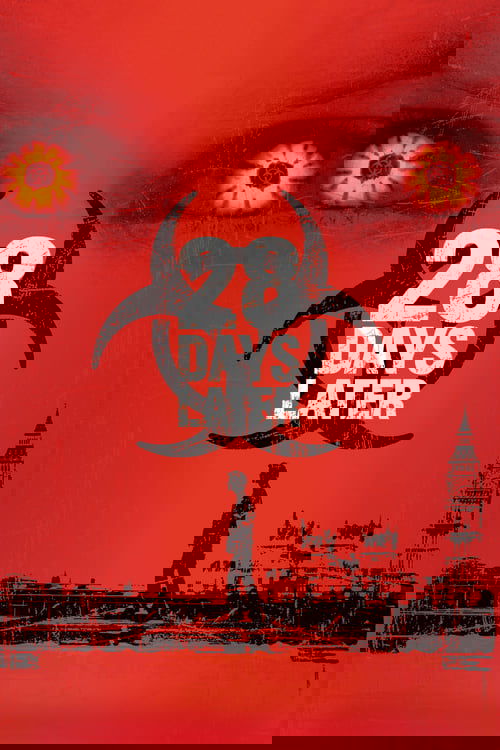
28 Days Later
2002 · Danny Boyle
For when you're craving a real scare with a brain — apocalyptic dread, sprinting horror, and something to think about after. A challenge watch, best late at night with the sound up.
What it's about
A London bicycle courier wakes from a coma to find the city silent and empty, its population wiped out or transformed by a lab-escaped virus that turns the infected into sprinting, rage-crazed attackers. He falls in with a handful of survivors and heads north through a depopulated Britain toward a radio broadcast promising safety.
The experience
Relentless and raw — jittery bursts of terror punctuating stretches of eerie, almost beautiful desolation, with an unexpectedly tender core about the people you'd cling to at the end of the world. It shifts registers late in a way that leaves you rattled about humans, not just monsters.
Performances
Cillian Murphy, in his breakout role, sells both dazed vulnerability and something harder underneath; Brendan Gleeson brings warmth that the film weaponizes, and Naomie Harris is fierce as the survivor who's already learned the new rules.
The craft
Danny Boyle shot it on consumer-grade digital video, and the smeary, grainy urgency became the point — the empty-London sequences are among the most iconic images in modern horror. Alex Garland's lean screenplay and a pounding, mournful score make it hit hard on good speakers.
Why it matters
It reanimated the zombie genre for the twenty-first century — fast infected, viral-outbreak realism, grounded survivors — and its DNA runs through nearly every apocalypse story since, while launching Cillian Murphy internationally.
Snapshot
28 Days Later is the film that reanimated the zombie genre for the twenty-first century and confirmed Danny Boyle's restless versatility after the international success of Trainspotting and the misfire of The Beach. Working from a screenplay by Alex Garland, Boyle stripped the post-apocalyptic horror film down to a lean, urgent survival narrative: a bicycle courier, Jim (Cillian Murphy), wakes from a coma in an abandoned London hospital to find the city — and the country — emptied by a viral epidemic that turns the infected into frenzied, sprinting carriers of rage. Gathering a fragile band of survivors, he moves through a depopulated Britain toward a military broadcast promising sanctuary, only to discover that the soldiers offering refuge represent a horror as grave as the disease. Shot on consumer-grade digital video that gave it a raw, immediate texture utterly unlike the glossy horror of its moment, the film fused the slow-burn dread of British apocalyptic fiction with the kinetic intensity of a new kind of running monster. Made on a modest budget and an unexpected commercial success, it launched the careers of its young cast, helped trigger a global revival of zombie cinema, and stands as one of the most influential horror films of its decade.
Industry & production
28 Days Later was produced by DNA Films, the production company co-founded by Andrew Macdonald and Duncan Kenworthy, with Macdonald — grandson of the screenwriter Emeric Pressburger and longtime collaborator of Boyle since Shallow Grave — producing. It was financed and distributed in a partnership involving Fox Searchlight Pictures, the specialty arm of 20th Century Fox, which had handled Boyle's earlier work; the film was a British production made on a comparatively low budget, a fact central to both its aesthetic and its eventual profitability. The widely reported budget figure is modest by studio standards, and the film's strong commercial performance relative to that outlay made it a notable success, though specific grosses should be checked against authoritative sources rather than asserted from memory.
The project reunited the core creative partnership of Boyle, producer Macdonald, and writer Alex Garland. Garland was a novelist — author of The Beach, which Boyle had adapted in 2000 — making one of his first original screenwriting efforts here; the collaboration would prove durable, continuing through Sunshine (2007) and shaping Garland's own later career as a writer-director. The decision to shoot on digital video was driven partly by economy and partly by aesthetic ambition, and it had concrete logistical consequences: the production was able to capture central London's landmarks — Westminster Bridge, Whitehall, Piccadilly Circus — entirely deserted, by filming in the very early morning and briefly closing streets, an achievement that would have been prohibitively expensive on film with conventional crowd control. These images of an empty metropolis became the film's signature and its most reproduced legacy.
The casting drew on emerging talent. Cillian Murphy, then a little-known Irish stage and screen actor, took the lead role of Jim in what became his breakthrough; Naomie Harris played the resourceful survivor Selena, Brendan Gleeson the warm cab driver Frank, and Megan Burns his daughter Hannah, with Christopher Eccleston as the chillingly pragmatic Major Henry West. The film is also notable for its alternative endings: Boyle shot and considered several conclusions, and the theatrical ending that reached audiences was not the only version, with alternates circulated on home video — a documented instance of the film's open-endedness about its characters' fates.
Technology
The film's defining technical fact is its origin on digital video rather than celluloid. Boyle and cinematographer Anthony Dod Mantle shot principally on the Canon XL1, a prosumer MiniDV camcorder, frequently deploying multiple cameras simultaneously to capture action from many angles at once. This was a radical choice for a theatrically released feature in 2002, when digital acquisition was still associated with low-budget independent and documentary work rather than genre spectacle. The format's limitations — lower resolution, heavier grain and noise in low light, a tendency to smear and pixelate under stress — were embraced rather than disguised, becoming expressive tools. The degraded, video-noisy image lent the apocalypse a documentary immediacy and a feverish, hallucinatory quality, especially in night scenes and moments of violence, where the picture seemed to break down along with the world it depicted. The choice also gave the production enormous mobility and the ability to capture deserted-London footage quickly. Beyond its acquisition format, the film makes no claim to elaborate effects technology; its horror is achieved through performance, editing, light, and the texture of the image itself rather than through digital creature work, and it would be invention to attribute more sophisticated apparatus to it.
Technique
Cinematography
The cinematography is by Anthony Dod Mantle, a key figure in the Dogme 95 movement whose handheld digital work on films such as Festen had already demonstrated the expressive possibilities of consumer video, and whose collaboration with Boyle would continue through Slumdog Millionaire. On 28 Days Later Mantle exploits the DV format's rawness to the full: the camera is mobile, often handheld, intimate with the actors, and unafraid of the grain and chromatic instability the format produces. The celebrated sequence of Jim wandering through a deserted central London is shot with an eerie stillness that contrasts with the format's usual nervousness, the emptiness made monumental. By contrast, the infected attacks are rendered in jagged, strobing, near-abstract bursts of motion and cutting that exploit the camera's tendency to smear, so that violence registers as a sensory assault rather than a legible spectacle. The palette shifts with the narrative: the bleached, overcast grays of empty Britain give way, in the military mansion of the final act, to a darker, more saturated and ominous register. Mantle's work here helped legitimize digital cinematography for serious feature filmmaking and remains a landmark in the medium's history.
Editing
The editing, by Chris Gill, is fundamental to the film's particular intensity. The infected — Boyle's crucial revision of the shambling Romero zombie — move at a sprint, and the attack sequences are cut with a violent, disorienting rapidity, sometimes dropping or repeating frames, that makes the threat feel uncontainable and immediate. This deliberately fragmented, almost subliminal cutting of the violence is set against a more patient rhythm in the film's quieter passages — the long, contemplative survey of empty London, the domestic interludes among the survivors — so that the film alternates between dread-laden calm and explosive panic. The structure tracks Jim's journey in distinct movements: awakening and discovery; the gathering of the survivors; the road north toward the promised sanctuary; and the extended, claustrophobic horror of the soldiers' compound. The editing's willingness to let stretches breathe before detonating them is central to the film's grip.
Mise-en-scène / staging
The film's staging derives enormous power from real, depopulated locations. The empty London of the opening — bridges, motorways, and monuments scrubbed of human presence — is the film's indelible image, an apocalypse rendered through absence rather than rubble or spectacle. Production designer Mark Tildesley furnishes the survivors' world with the detritus of collapse: looted supermarkets, abandoned vehicles, a flat strung with fairy lights as a fragile gesture of domesticity, and finally the requisitioned country mansion where the soldiers have barricaded themselves. The staging repeatedly contrasts spaces of temporary safety with the open, exposed geography of the road. In the final act, the grand house becomes a trap, its faded grandeur the setting for the film's turn from external to human menace; the staging of the soldiers' barracks-like occupation, with its chained captive and its atmosphere of coiled male violence, makes the institutional setting itself threatening. Costume and the survivors' improvised appearance — Selena's machete, Jim's hospital scrubs giving way to scavenged clothes — register their adaptation to a world without order.
Sound
Sound is among the film's most calibrated elements. The opening's eerie urban silence — a great city emptied of traffic and voices — is itself a designed effect, the absence of expected sound producing unease. Against this, the attacks erupt in noise: the guttural, retching shrieks of the infected, the chaos of pursuit. The musical score is by John Murphy, and its centerpiece, the building, repeated guitar-and-strings crescendo associated with the film's climactic violence, became one of the most recognizable and widely reused pieces of film music of its era, frequently borrowed in later trailers and productions. The soundtrack also deploys pre-existing tracks, including Godspeed You! Black Emperor's "East Hastings" over the deserted-London sequence, whose slow apocalyptic build perfectly matches the imagery. The contrast between meditative ambient passages and overwhelming sonic assault mirrors the film's larger oscillation between calm and terror.
Performance
The performances ground the film's horror in human feeling. Cillian Murphy's Jim is the audience's surrogate, moving from bewildered vulnerability — the disoriented man waking into catastrophe — toward a hardened capacity for violence that the film treats with moral ambivalence, his transformation in the final act deliberately echoing the ferocity of the infected. Naomie Harris's Selena is the film's pragmatic conscience, introduced as a ruthless survivor who has accepted that sentiment is fatal, and gradually allowed to recover tenderness. Brendan Gleeson brings warmth and decency as Frank, whose paternal humanity makes his fate especially affecting, while Megan Burns's Hannah supplies the vulnerability the others must protect. Christopher Eccleston's Major West is the film's most disquieting creation: reasonable, articulate, and utterly committed to a monstrous logic of survival, embodying the thesis that organized human cruelty is more frightening than the mindless infected. The ensemble's conviction is what allows the film to function as drama and not merely as shock.
Narrative & dramatic mode
The film's dramatic mode is the survival journey, structured as a passage through escalating zones of danger toward a sanctuary that proves false. It belongs to the venerable tradition of the post-apocalyptic quest, in which a small group moves across a ruined landscape and the real subject becomes the moral disintegration or endurance of the survivors. The narrative is built on a deliberate reversal: for two acts the threat is the infected, but the climax relocates horror into the human — the soldiers who promise rescue intend to enslave the women, and the film's final movement pits Jim against other men, not monsters. This structural turn is the film's thematic engine, recasting the apocalypse as a stage on which human nature, freed from social constraint, reveals itself. The dramatic register mixes intimate character drama — the makeshift family the survivors form — with sequences of pure visceral horror, and the film's emotional power comes from its insistence that tenderness and brutality coexist in the same people. The famously unsettled ending, with its multiple shot versions, leaves the survivors' ultimate fate poised between rescue and oblivion, refusing easy closure.
Genre & cycle
28 Days Later is a horror film, and more specifically a landmark in the zombie and viral-apocalypse cycle, even as Boyle and Garland have at times resisted the "zombie" label on the grounds that the infected are living humans driven mad by a "Rage" virus rather than the reanimated dead. The distinction is real but the lineage is unmistakable: the film descends directly from George A. Romero's Night of the Living Dead and Dawn of the Dead, inheriting their premise of civilizational collapse, their besieged survivor groups, and their use of the apocalypse as social critique. Its decisive innovation was the fast-moving infected — running rather than shuffling — which, alongside the contemporaneous Resident Evil and the remake of Dawn of the Dead that followed, reset the genre's tempo and terror for a new generation. The film also belongs to a distinctly British tradition of apocalyptic and catastrophe fiction, drawing on John Wyndham's The Day of the Triffids (whose opening — a man waking in a hospital to a depopulated world — it closely echoes) and the bleak nuclear-age dramas of postwar British speculative fiction. Within the horror-survival cycle it helped inaugurate the early-2000s zombie renaissance, and its DNA is visible across the genre's subsequent decade.
Authorship & method
28 Days Later is most legible as a Danny Boyle film, bearing his characteristic fusion of kinetic stylistic energy, music-driven sequences, dark social undercurrents, and a sympathy for outsiders thrown together against a hostile world — qualities already evident in Shallow Grave and Trainspotting. Boyle's willingness to embrace a degraded, unfashionable format in pursuit of immediacy reflects an experimental temperament that runs through his career, and his instinct for marrying image to music shapes the film's most memorable passages. The authorship is, however, a genuine collaboration. Alex Garland's screenplay supplied the film's structural intelligence — particularly the pivot from viral to human horror — and its grounding in British apocalyptic literature; the Boyle-Garland partnership is one of the defining creative relationships of recent British cinema. Cinematographer Anthony Dod Mantle was an equal author of the film's look, bringing the Dogme-honed digital aesthetic that made the format expressive rather than merely cheap. Composer John Murphy gave the film its emotional and percussive signature, and editor Chris Gill its violent rhythm. Producer Andrew Macdonald, Boyle's longtime collaborator, was the constant enabling presence. The film's method — multiple consumer cameras, real deserted locations, a small budget turned into an aesthetic virtue — exemplifies a resourceful, improvisatory approach to filmmaking that became part of its legend.
Movement / national cinema
The film is a significant work of early-2000s British cinema and a key example of the creative use of digital video that was transforming low-budget filmmaking internationally at the turn of the millennium. Its cinematographer's Dogme 95 background links it, however obliquely, to the Scandinavian digital-realist movement, whose ethos of handheld immediacy and rejection of gloss it adapts to genre ends. Within British cinema it represents the continuation of the Boyle–Macdonald–DNA Films axis that had reinvigorated the national industry in the 1990s, and it draws deeply on British literary traditions of catastrophe and apocalypse, giving the global zombie genre a distinctly English inflection — the emptied London, the country house, the army's brutal pragmatism standing in for a collapsed social order. As national cinema it demonstrated that a British genre film made cheaply could achieve worldwide impact, helping to sustain the confidence of British independent production in the new century.
Era / period
28 Days Later is a film of the early 2000s, and it registers the anxieties of its moment with unusual acuity. Conceived and released in the period surrounding the September 11 attacks, it taps a pervasive turn-of-the-millennium dread about contagion, social breakdown, and the fragility of order. Its viral premise resonated with contemporary fears of epidemic disease — a resonance that only deepened in later years — and its imagery of biological catastrophe drew on real British anxieties of the era, including the recent foot-and-mouth crisis and ongoing public alarm about animal-to-human disease transmission, evoked in the film's opening with infected primates in an animal-research laboratory. The film's portrait of a military that responds to catastrophe with authoritarian violence and the subjugation of women speaks to early-2000s suspicions of institutional power and the conduct of armed force. Made on digital video at the precise moment the format was becoming viable for theatrical work, it is also a technological artifact of its time, capturing a transitional instant in the history of the moving image.
Themes
The film's governing theme is the proposition that the true horror of apocalypse is human rather than viral — that when social order collapses, organized human cruelty, embodied by Major West's soldiers, is more dangerous than the mindless infected. From this flow several related concerns. There is the theme of "Rage" itself, the virus literalizing the violence latent in human beings; the film repeatedly blurs the line between infected and uninfected, culminating in Jim's own descent into savage violence to save his companions, posing the question of how far survival justifies brutality. There is the theme of the improvised family — strangers forming bonds of love and obligation amid catastrophe — and the tenderness the film locates within horror. There is a sustained meditation on civilization's fragility, the speed with which the institutions and comforts of modern life evaporate, dramatized by the unforgettable emptiness of a great city. The film also engages contemporary anxieties about contagion, scientific hubris (the laboratory origin of the outbreak), and the abuse of military and patriarchal power, with the soldiers' planned enslavement of the women making explicit the gendered dimension of social collapse. Beneath all of it runs an ambivalent humanism: the film is bleak about human nature yet insists, in its survivors' loyalty and its tentative ending, on the persistence of hope.
Reception, canon & influence
28 Days Later was met with strong critical praise and proved a substantial commercial success relative to its modest budget, an outcome that surprised the industry and helped trigger a wave of zombie and viral-apocalypse filmmaking. Critics singled out Boyle's visceral direction, the boldness and atmosphere of the digital cinematography, the freshness of the fast-moving infected, and the strength of the largely unknown cast; the film is now widely regarded as one of the most important horror films of its decade and a touchstone of twenty-first-century genre cinema.
Influences on the film run backward to George A. Romero's Living Dead cycle, the foundational text of modern zombie cinema and the source of its besieged-survivors-and-social-critique template; to John Wyndham's The Day of the Triffids, whose hospital-awakening opening it directly echoes; and to the broader tradition of British apocalyptic and catastrophe fiction. The Dogme 95 movement informed its digital aesthetic, and Boyle's own earlier work supplied its kinetic, music-driven style.
Its influence forward was considerable and rapid. The film is widely credited, alongside the 2004 Dawn of the Dead remake, with reviving the zombie genre commercially and culturally and with popularizing the fast, running infected that became a genre staple. Its viral-rather-than-supernatural framing and its vision of societal collapse helped shape a generation of subsequent work, the influence often cited in connection with later phenomena such as The Walking Dead. John Murphy's climactic theme became one of the most reused pieces of film music of its era, borrowed across numerous later trailers and films. The film spawned a sequel, 28 Weeks Later (2007), directed by Juan Carlos Fresnadillo with Boyle and Garland as producers, extending its world. For Boyle it confirmed a reputation for fearless genre-crossing, and for Cillian Murphy and Naomie Harris it was a career-launching showcase. The film's deserted-London imagery has been endlessly imitated and remains its most iconic visual bequest, and it holds a secure place in the canon of modern horror.
A Deleuzian reading
A man in a hospital gown walks out onto Westminster Bridge and there is nobody there.
The full Deleuzian reading of 28 Days Later →
Reception
A sleeper hit on release — a scrappy DV-shot British horror that became a word-of-mouth phenomenon in its 2003 US run — it's since been canonized as the film that resurrected the zombie genre for the 21st century, with the 2025 release of 28 Years Later cementing its elder-statesman status.
How 28 Days Later was received, from release to now →
Influences: the films it descends from and the films it influenced
- Night of the Living Dead (1968) — Supplies the besieged-survivors-in-confinement structure and the use of the undead horde as social-critique engine that Garland's screenplay inherits wholesale before mutating it.
- The Crazies (1973) — Pioneers the viral-rather-than-supernatural premise — a pathogen that turns ordinary people into violent killers and triggers a brutal military quarantine — the exact framing 28 Days Later adopts over Romero's reanimated dead.
- The Last Man on Earth (1964) — Establishes the depopulated-city tableau — a lone survivor wandering emptied streets — that Boyle restages as his deserted-London imagery.
- The Day of the Triffids (1962) — Provides the hospital-awakening opening — protagonist wakes from bandaged convalescence to find civilization already collapsed — which the film's first reel directly echoes via Wyndham's source.
- Festen (1998) — The first Dogme 95 film, shot by Anthony Dod Mantle, where he honed the consumer-DV handheld aesthetic — degraded, intimate, available-light — that he then weaponized for 28 Days Later's look.
- Trainspotting (1996) — Boyle's own template of music-driven montage, kinetic fragmented cutting, and needle-drop set-pieces marrying image to score — the stylistic DNA reused in the infected-attack sequences.
- Shallow Grave (1994) — Boyle and producer Macdonald's debut establishing the dark social undercurrent and the small group of outsiders turning on each other under pressure — the human-horror pivot Garland later formalizes.
- Dawn of the Dead (1978) — Extends Romero's template to the survivor-ensemble road/refuge journey laced with social satire, the narrative armature 28 Days Later borrows for its trek north to the army blockade.
- Dancer in the Dark (2000) — Took the proof that consumer digital video could carry a serious feature and pushed grainy DV into mainstream auteur cinema, accelerating the analog-to-digital hinge Dancer helped legitimize.
- Julien Donkey-Boy (1999) — Anthony Dod Mantle weaponizes the same degraded-DV palette from Julien for a studio-scale feature, mainstreaming the lesson that prosumer digital's grain and smear could be a chosen aesthetic, not a budget compromise.
- Mifune (1999) — Dod Mantle's digital-handheld, available-light immediacy descends directly from the run-and-gun Dogme shooting style he developed on Festen and Mifune.
- Vanilla Sky (2001) — Extends the depopulated-metropolis image — an empty London echoing Cruise's deserted Times Square — into the era's signature uncanny-city shot of the post-millennial mood.
- 28 Weeks Later (2007) — Direct sequel produced by Boyle and Garland, inheriting the depopulated-London cinematography and Murphy's percussive theme while scaling up the military-containment-collapse beat.
- 28 Years Later (2025) — Boyle and Garland's own return to the world, again built on consumer-grade digital capture (iPhone arrays) reprising the resourceful degraded-format-as-virtue method of the original.
- World War Z (2013) — Inherits and maximalizes the running-infected innovation, rendering the sprinting horde as a single surging swarm — the genre staple 28 Days Later seeded.
- REC (2007) — Extends the viral-infection-as-instant-rage conceit with handheld immediacy, treating the camera as a panicked participant the way Dod Mantle's DV did.
- I Am Legend (2007) — Reprises the depopulated-metropolis spectacle — a lone figure in emptied streets — alongside the same fast, infected (rather than supernatural) antagonists.
- The Walking Dead (2010) — Opens with a protagonist waking alone in an abandoned hospital — a direct lift of 28 Days Later's awakening — and builds its long-form drama on the viral-collapse-and-human-horror framework the film popularized.
- Slumdog Millionaire (2008) — Boyle and Dod Mantle's continued digital-cinematography collaboration, pushing the handheld, run-and-gun consumer-camera immediacy first proven viable on 28 Days Later into an Oscar-winning aesthetic.
- 28 Years Later: The Bone Temple (2026) — The trilogy's origin point: Boyle and Dod Mantle shot the depopulated-London footage on consumer Canon XL-1 MiniDV camcorders, whose degraded low-res texture and the reinvention of the fast 'rage'-infected are the formal DNA this film inherits wholesale.
- The Last King of Scotland (2006) — Dod Mantle shot this entirely on Canon XL1 DV cameras, proving that the rough-grain digital image could carry mainstream narrative genre filmmaking beyond the arthouse and Dogme contexts where it originated, making the hybrid aesthetic commercially legible for LKOS.
- A Quiet Place Part II (2021) — Boyle establishes the post-apocalyptic small-group survival grammar AQP II works within — the emptied landscape as horror setting, the tight family unit navigating a transformed world by avoiding attention — and the editing rhythm that alternates between prolonged tense traversal and explosive close-range violence that drives both films' pacing architecture.
- Collateral (2004) — Anthony Dod Mantle's prosumer-digital photography demonstrated that video sensors could carry a theatrical feature and render available-light, low-illumination scenes film couldn't capture cleanly — the aesthetic case Mann built on.
- The Darkest Hour (2011) — Provides the depopulated-capital-city cinematography — a major metropolis shot empty and silent — that The Darkest Hour transposes to an evacuated Moscow.
- Dawn of the Dead (2004) — Co-credited with reviving the genre commercially, it cements the fast, sprinting infected that 28 Days Later popularized — abandoning the shambling Romero gait for full-speed pursuit.
- Children of Men (2006) — Shares the British-collapse vérité register — degraded, immersive handheld and ruined-Britain location shooting — placing apocalypse in recognizable real spaces rather than sets.
- Outbreak (1995) — Extends Outbreak's quarantined-nation and military-containment imagery — hazmat soldiers, cordoned zones, and the army itself becoming a threat to the survivors it's meant to protect.
- 24 Hour Party People (2002) — Released the same year, it likewise proved DV's viability for an internationally distributed theatrical feature, jointly normalizing digital acquisition in British cinema.
- Antichrist (2009) — Shot by Anthony Dod Mantle: the degraded digital-handheld, available-light texture he pioneers here is the very method he splits against the polished high-frame-rate prologue in Antichrist.
- Resident Evil (2002) — Released the same year, it re-engineers the Romero infected into fast, rage-driven runners — the sprinting-undead reinvention Anderson's franchise would absorb by its sequels.
Similar films
- 28 Years Later: The Bone Temple (2026) — influence & lineage · same viewing thread
- 28 Years Later (2025) — influence & lineage
- 28 Weeks Later (2007) — influence & lineage
- [REC] (2007) — influence & lineage
- Dawn of the Dead (1978) — influence & lineage
- Night of the Living Dead (1968) — influence & lineage
- World War Z (2013) — influence & lineage
- Trainspotting (1996) — influence & lineage
All the films related to 28 Days Later →
Watch it with: curated runs of related films
- Trapped in the Dark — Watch these as a run of survival horror where the place itself — a chained-shut bathroom, a cabin cellar, a lightless cave, an endless fluorescent nowhere, an emptied city — turns into the thing hunting you.