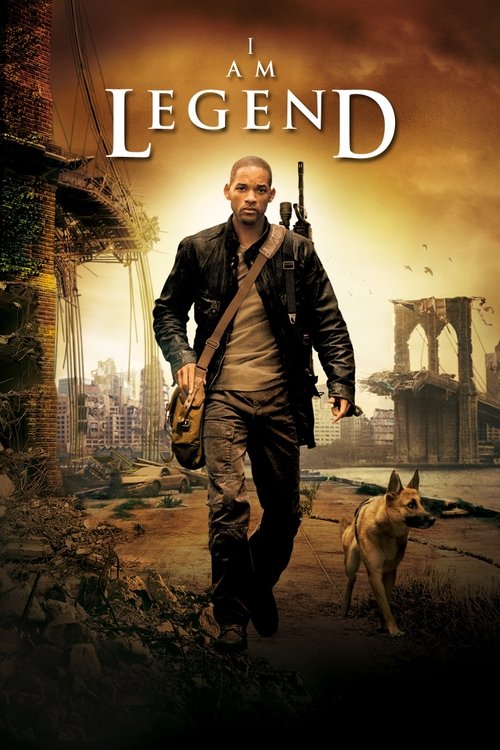
I Am Legend
2007 · Francis Lawrence
For when you want a big, gripping survival movie with an ache in it — apocalypse scale delivered through one person's solitude. Fair warning for dog lovers: this one hits hard.
What it's about
Three years after a man-made virus wiped out most of humanity, military virologist Robert Neville may be the last man alive, holed up in a Manhattan gone silent and overgrown. Immune himself, he keeps a soldier's routine: broadcasting radio messages to any survivors, hunting deer down Fifth Avenue with his dog, and working toward a cure — while barricading himself in every night against the feral, light-fearing creatures the infected have become.
The experience
Eerie and surprisingly lonely for a blockbuster — long stretches are just one man, one dog, and a dead city, punctuated by jolts of real terror after dark. It gets under your skin more through silence and routine than through spectacle.
Performances
Will Smith essentially performs a one-man show for most of the running time, playing charisma curdling into loneliness — talking to mannequins, holding conversations with his German shepherd — and makes cracking sanity feel painfully believable.
The craft
The film's signature achievement is its emptied New York: grass splitting the asphalt of Times Square, deer bounding through intersections — a production feat that still looks staggering on a big screen. The sound design does heavy lifting too, making daytime silence as unnerving as the nighttime attacks.
Why it matters
One of the defining images of 2000s apocalypse cinema — its vision of a wild, vacant Manhattan has been echoed by countless films and games since, and it proved a star could carry a near-solo studio blockbuster.
Snapshot
Francis Lawrence's I Am Legend is a post-apocalyptic survival film set in a depopulated New York City three years after a genetically engineered measles virus has killed most of humanity and transformed the remainder into photosensitive, predatory mutants. Will Smith plays virologist Robert Neville, the sole surviving immune human in Manhattan, who spends his days maintaining military discipline, conducting laboratory experiments on infected test subjects, and hunting deer through overgrown Midtown streets, while his nights are spent barricaded behind UV-reinforced windows. The film is structurally unusual for a studio blockbuster: the first two acts are essentially a one-man chamber drama enacted against a spectacular depopulated cityscape, before the arrival of two survivors — Anna (Alice Braga) and a young boy — reshapes the film's moral and thematic axis in ways that generated sustained critical debate, particularly regarding the theatrical cut's departure from Richard Matheson's source novel.
Industry & production
The novel I Am Legend by Richard Matheson (1954) had already been adapted twice before Lawrence's version — as The Last Man on Earth (Ubaldo Ragona / Sidney Salkow, 1964), with Vincent Price in an Italian co-production, and as The Omega Man (Boris Sagal, 1971), with Charlton Heston in a more action-inflected reading. A Warner Bros. development process for a new adaptation extended across roughly a decade before Lawrence's version was greenlit, with earlier iterations variously attached to Ridley Scott and Arnold Schwarzenegger. The screenplay went through drafts by Mark Protosevich and was ultimately credited to Protosevich and Akiva Goldsman, the latter of whom also served as a producer. Goldsman's involvement as both writer and producer consolidated a strong commercial logic around Will Smith's star vehicle, foregrounding the survival-action elements over Matheson's more ambiguous philosophical interior.
Will Smith's participation was essential to the project's viability at its budget scale — reportedly in the region of $150 million — and the film was constructed around his capacity to sustain extended scenes of near-solitary screen presence. The production filmed extensively on location in New York City, including landmark sequences achieved by closing sections of Manhattan to traffic, most visibly the Brooklyn Bridge and portions of Fifth Avenue and Times Square, typically during early morning hours. These closures, rare in scale for a Hollywood production, gave the film imagery of a genuinely uninhabited city that no amount of pure CG extension could have supplied convincingly on its own: actual New York light, actual pavement, actual architectural grain.
The film was released by Warner Bros. in December 2007 and performed strongly at the box office globally, though specific gross figures should be verified against authoritative tracking sources. It arrived theatrically with an ending that differed substantially from both the novel and a subsequently released alternate cut, a divergence that became central to critical discussion of the film's meaning.
Technology
The most technically ambitious and critically contested element of I Am Legend is the computer-generated Dark Seekers — the infected mutants Neville must evade after dark. The production initially explored heavier prosthetic and practical creature work but moved predominantly toward CGI performance capture for the creatures, a decision whose results divided viewers. The Seekers' fluid, physically exaggerated movement was designed to signal that infection has transformed human musculature and social behavior alike, but the CG rendering, evaluated by post-2007 standards, was already registering as visually unintegrated with the live-action footage for a portion of critics and audiences at release. This is a documented limitation: the creatures read differently in the film's climactic sequences than the largely grounded, intimate drama that precedes them.
By contrast, the environmental CG work — extending the practical New York locations into fully overgrown, wildlife-reclaimed urban spaces, populating backgrounds with deer herds, collapsing elevated roadway sections, dressing streets with years of accumulated organic decay — holds considerably better and is among the film's genuine visual achievements. The work required extensive coordination between Lawrence's location unit and the visual effects pipeline to ensure the composited extensions matched the specific quality of natural light captured on the practical sets.
Technique
Cinematography
Director of photography Andrew Lesnie — who had won an Academy Award for The Lord of the Rings: The Fellowship of the Ring (Jackson, 2001) — shot I Am Legend in anamorphic widescreen, exploiting the format's horizontal expanse to frame Neville as a small figure dwarfed by the reclaimed city. The aesthetic registers the urban wilderness as both magnificent and menacing, with the long horizontal compositions rendering Fifth Avenue's geometry as something geological: permanent structures slowly being reabsorbed into organic systems. Lesnie's handling of the daylight photography is notably cool and clean — high-contrast sunlit sequences that make the city feel open and oddly pleasurable even in its abandonment — while the night and interior photography goes dark and granular, the transition between these registers acting as a physiological signal of safe and unsafe time. The extended predawn sequences, in particular the tense return-to-base drives as sunset approaches, give the film a recurring pulse of deadline-driven dread whose visual grammar is almost entirely temporal rather than dependent on creature reveals.
Editing
Wayne Wahrman's editing sustains the film's unusual structural gambit: an extended first act that accumulates detail about Neville's daily routine — the hunting, the lab work, the video store mannequins he has named and arranged into social tableaux, the taped reruns of morning news broadcasts — without the conventional genre machinery of escalating confrontation. The pace is measured and the cutting non-expository; Wahrman and Lawrence trust the accumulation of behavioral texture to generate tension. The integration of flashback sequences revealing the outbreak's progression is handled with sufficient separation to avoid disrupting the present-tense survival rhythm, and the slow reveal structure — both the cause of the catastrophe and Neville's personal loss — is parceled across the film's runtime with care. The film's tonal rupture in the third act, when it accelerates into genre-conventional action beats, is partly an editing mode shift, and some critics identified this transition as a structural seam.
Mise-en-scène / staging
Lawrence's staging of the populated-city-gone-empty is the film's most distinctive and durable visual contribution. The production design by Naomi Shohan worked through systematic verisimilitude: a convincing picture of three years of unmaintained New York required overgrown sidewalk vegetation, accumulated vehicle abandonment, faded signage, and the intrusion of large mammals — lion and deer sequences are staged against recognizable Midtown landmarks — all of which are assembled with enough specificity to carry conviction. The film's staging of Neville's domestic space, in particular his Washington Square townhouse converted into a fortified laboratory-home with UV barriers, timed lighting, and a perimeter alarm system, reads as a plausible improvised response to his specific situation and serves as an extension of character: this is a man still operating by military protocol, still treating his survival as a mission rather than an existence.
Sound
The sound design deploys silence and ambient environmental texture as primary expressive registers for much of the film's first half — the absence of traffic, voices, and mechanical noise from the city creates an uncanny acoustic environment that the musical score builds upon rather than displaces. James Newton Howard's score works in a restrained register for the quiet, diurnal sections, amplifying toward more insistent orchestral gesture during the nocturnal sequences and action beats. The audio design of the Seekers — their echolocation-inflected clicks and percussive vocalizations — does substantial narrative and atmospheric work independent of the visual CG, and in several sequences the creatures are heard before they are seen, extending the film's repertoire of threat beyond what the visual effects could reliably sustain.
Performance
Will Smith's performance is the film's central structural argument: whether the film works depends almost entirely on whether the audience remains invested in Neville's psychological and emotional state across extended stretches without scene partners. Smith brings a disciplined physical presence — the daily routine sequences read as genuinely inhabited habit rather than expository display — and a controlled affective register that modulates carefully between military competence, deep loneliness, and barely suppressed grief. The scenes involving Sam, his German Shepherd companion, are the film's most emotionally direct, and Smith manages the film's most overtly sentimental material with enough restraint to avoid collapsing it into pathos. His characterization becomes more uncertain in the film's third act, where the screenplay's shift in Neville's arc — from isolated scientist to sacrificial martyr — requires a pivot that the theatrical cut executes less convincingly than the alternate version.
Narrative & dramatic mode
I Am Legend is a survival film constructed around protracted solitude, structured to delay the conventional genre payoff — human contact, confrontation, resolution — long enough to establish Neville's isolation as a psychological and philosophical condition rather than merely a plot circumstance. The film's narrative engine is the question of whether Neville's scientific project (developing a serum from his own immune blood to reverse the infection) is meaningful or delusional, and whether the infected have a social structure and intelligence that categorically complicates his experimental practice. This question, central to Matheson's novel and sharpest in the film's alternate ending, is partially submerged in the theatrical cut, which opts for a more conventionally redemptive resolution in which Neville's sacrifice and the successful serum provide a straightforward foundation myth for the survivor colony at Bethel, Vermont. The alternate ending — in which Neville recognizes that the lead Seeker has come for the female Neville has been holding captive, releases her, and drives away rather than detonating — is substantially closer to Matheson's narrative logic, in which Neville eventually understands that he has become the legend: the terrifying Other to the new civilization that has emerged.
Genre & cycle
The film belongs to the post-apocalyptic survival film, a genre with deep roots in American science fiction cinema and literature, but its immediate industrial and cultural context is the early-to-mid 2000s wave of pandemic and infection narratives that includes 28 Days Later (Boyle, 2002), the Dawn of the Dead remake (Snyder, 2004), and Children of Men (Cuarón, 2006). The "fast infected" conventions developed by Boyle's film — creatures that move with predatory speed and coordination rather than the shambling gait of Romero's zombies — are visible in Lawrence's Dark Seekers, though the film's CG approach to rendering them distances them from the palpable physical threat of Boyle's or Snyder's practically staged infected. I Am Legend also participates in the strand of high-budget, star-centered post-apocalyptic films that would proliferate in the decade following its release, and it belongs to a New York disaster sub-genre — informed by Escape from New York (Carpenter, 1981) among earlier examples — that renders the city's architectural specificity as a landscape of concentrated loss.
Authorship & method
Francis Lawrence moved into features from an extensive music video career, with Constantine (2005) as his debut feature. His music video background is legible in I Am Legend in the film's confidence with large-scale visual spectacle and its attention to the expressive potential of the frame as image — the film is consistently handsome even when it is not dramatically urgent. His directorial method on the film, from available production accounts, involved close attention to the physical texture of the depopulated city and a strong working relationship with Smith around the solo sequences. Lawrence would subsequently direct the final three Hunger Games installments, cementing his position as a reliable director of large-scale speculative genre films.
Andrew Lesnie's contribution has been noted above; his work here extends the sensibility developed across the Jackson Lord of the Rings films — landscapes of grandeur as moral and existential terrain — into an urban register. Akiva Goldsman's screenplay, produced under the complex pressures of a star-driven studio production, has been the most contested creative element in retrospective assessment of the film, particularly regarding the theatrical ending's departure from the source's meaning. Mark Protosevich's original draft reportedly engaged more closely with Matheson's novel; the final result represents a compromise between commercial and literary imperatives that satisfied neither consistently.
Movement / national cinema
I Am Legend is squarely within the Hollywood studio blockbuster tradition, and its New York setting participates in a specifically American cinematic relationship with the city as both secular capital and site of imagined catastrophe. The film's imagery — an empty Times Square, overgrown Central Park margins, lions on Fifth Avenue — can be read in relation to the anxieties that circulated in American culture in the years following September 2001: the city as vulnerable, the urban fabric as provisional, the emergency as always-already latent in metropolitan modernity. The engineered virus origin, a cancer cure that mutated into a lethal pandemic, inflects the catastrophe with contemporary anxieties about biotechnology and unintended consequence, situating the film's imaginative content within post-9/11, post-anthrax, post-SARS American cultural preoccupations without making any of these connections explicit.
Era / period
The film belongs to what can be identified as a sustained mid-2000s renewal of the infection and post-apocalyptic genres in Hollywood and anglophone cinema, a cycle responding in part to heightened cultural awareness of pandemic risk (SARS, avian influenza), bioterrorism as a geopolitical category, and the broader climate of pervasive security anxiety that structured American public culture between 2001 and roughly 2010. Within this period, I Am Legend represents the genre's full assimilation into the prestige-adjacent blockbuster format — a $150-million production with an A-list star in a formally ambitious solo performance piece — as distinct from the lower-budget, more formally radical work of Boyle or Cuarón.
Themes
Isolation as both physical condition and metaphysical state is the film's governing preoccupation: Neville's days are structured around the simulation of normalcy — the video store routine, the conversations with mannequins, the dog companionship, the daily broadcasts — which functions simultaneously as psychological survival strategy and as symptom of the profound deformation that three years of absolute solitude produces. The film is interested in the relationship between scientific rationalism and faith, staging this as the tension between Neville and Anna: where Neville reads his survival as an accident of immunology and his work as a purely biological project, Anna reads it as purpose and divine designation. The theatrical cut endorses Anna's reading through its resolution; the alternate ending is more genuinely agnostic.
The question of who constitutes a monster — implicit in Matheson's novel and explicit in the alternate ending — gives the film its most philosophically durable content. The Dark Seekers, once recognizable as having social bonds, grief, and deliberate action (the lead Seeker's retrieval mission for the female subject), become a civilization whose annihilation by Neville's experimental practice requires reframing. The theatrical cut suppresses this reframing; the alternate ending restores it. Survivor's guilt, parental grief (Neville's flashback family), and the ethics of scientific practice under emergency conditions complete the film's thematic inventory.
Reception, canon & influence
Critical reception at release was mixed-to-positive, with consistent praise for Smith's performance and Lesnie's visual work, qualified enthusiasm for the film's first two acts, and widespread disappointment with the third-act transition and the theatrical ending among critics and viewers familiar with Matheson's novel. The alternate ending, which circulated on home video releases and online discussion forums, became a significant secondary text for the film's critical life and is now frequently cited as the version that more adequately realizes the source material's meaning.
Looking backward, the film's debts are traceable through three clear channels: Matheson's novel itself, which provided the central premise, the protagonist's name and profession, and the crucial philosophical inversion of the legend's identity; the two prior adaptations, whose interpretation history the film implicitly negotiates; and the post-28 Days Later fast-infected cycle, which provided the visual and kinetic vocabulary for the Dark Seekers. The film also draws on the tradition of the single-location or near-single-location survival drama, and more specifically on the post-apocalyptic New York genre.
Looking forward, I Am Legend was influential on the visual language of post-apocalyptic urban spaces in subsequent Hollywood production — the overgrown, reclaimed city became a widely adopted iconographic template across the following decade in films, television, and video games — and its commercial performance contributed to the early-2010s acceleration of large-budget post-apocalyptic production. As a performance vehicle demonstrating that star-driven studio films could be built around extended solo sequences, it remains a point of reference, though the Matheson adaptation debate has become its most durable scholarly discussion. The film was followed by a straightforwardly unrelated spinoff production, I Am Omega (2007), from The Asylum, the exploitation studio specializing in mockbusters, which inadvertently documents the source material's cultural availability and the original film's commercial visibility.
A Deleuzian reading
There's a clock in every daylight shot, even when you can't see one.
The full Deleuzian reading of I Am Legend →
Reception
A massive holiday-season hit in 2007 — Will Smith's star power carried it to record-breaking December box office — but critics dinged the CGI creatures and third act even then, and that verdict has hardened: it's now remembered as a great first hour attached to an ending everyone wishes were different.
How I Am Legend was received, from release to now →
Influences: the films it descends from and the films it influenced
- The Last Man on Earth (1964) — First Matheson adaptation; supplies the exact three-beat daily structure — daylit foraging, laboratory experimentation, barricaded night siege — that Lawrence replicates almost exactly, including the UV-protected home as tactical sanctuary and the protagonist's audio diary as the only sustained human voice in the soundscape.
- The Omega Man (1971) — Charlton Heston's daylit sequences — a lone immune figure driving deserted urban streets, using the city's emptiness as both spectacle and threat — directly model Lawrence's approach to staging Smith in depopulated Manhattan, including the convention of the protagonist's car as mobile safe zone during the infected-contested open city.
- Night of the Living Dead (1968) — Romero's siege architecture — survivors barricaded inside a domestic structure while infected masses test the perimeter, the building's windows and thresholds as the survival boundary — is the genre template I Am Legend inherits for its fortified-domestic-space staging, UV barriers replacing boarded glass as the operative threshold technology.
- Cast Away (2000) — Tom Hanks's extended behavioral-accumulation performance — building character through the choreography of daily survival ritual rather than dialogue or dramatic incident — is the Hollywood precedent for Smith's first-act solitary screen presence; both films stake their commercial viability on a single star's capacity to hold the frame across extended stretches of near-silence.
- 28 Days Later (2002) — Boyle's pre-dawn location shooting of depopulated London — small digital crew filming actual empty streets before commuter hours — established the production methodology Lawrence's unit adapted for Manhattan closures, and the fast, cognitively deranged infected creature template directly shaped the Dark Seekers' behavioral design.
- The Lord of the Rings: The Fellowship of the Ring (2001) — Lawrence hired director of photography Andrew Lesnie specifically because his LOTR anamorphic work had solved the compositional problem of integrating CGI creatures into practical location photography; the performance-capture pipeline developed for Gollum is the direct technical lineage from which the Dark Seekers' production methodology descends.
- Panic Room (2002) — Fincher treats the fortified domestic space as the film's central dramatic and architectural agent — every room's defensive modification becomes narrative — establishing the staging logic I Am Legend adopts for Neville's UV-hardened brownstone, where the building's physical systems (blackout blinds, UV lamps, reinforced doors) function as character in their own right.
- Escape from New York (1981) — Carpenter established the grammar of post-apocalyptic Manhattan as a sealed, lawless geography — familiar architecture made alien by institutional collapse — that I Am Legend inherits for its New York disaster subgenre staging, including the convention of the lone competent figure navigating hostile urban ruins by vehicle through a city retaken by hostile forces.
- Constantine (2005) — Extends Lawrence's authorial method — melancholic lone protagonist, desaturated atmospheric metropolis, practical-digital hybrid creature compositing — into an apocalyptic city.
- Moon (2009) — Sam Rockwell's sustained solitary performance — behavioral accumulation of an isolation-distorted daily routine, psychological deterioration registered through small physical and procedural details — descends from the performance template I Am Legend established for single-star survival drama in a sealed environment, extending it into a clone-identity science fiction context.
- Contagion (2011) — Inherits I Am Legend's pandemic-infection-cycle genre framework — specifically the procedural logic of virologists tracking a pathogen while civilization collapses around institutional response — and distributes Neville's solo virologist role across an ensemble of institutional scientists, retaining the lab-as-last-refuge staging while replacing solitary performance structure with interlocking procedural strands.
- World War Z (2013) — The CGI zombie swarms — infected rendered through flock-simulation algorithms producing fluid, physically implausible massing behavior — directly extend the Dark Seekers' performance-capture creature pipeline, scaling individual creature expressiveness into aggregate crowd dynamics while retaining the same digital production logic of creatures whose movement is unconstrained by practical physical weight.
- A Quiet Place (2018) — Extends I Am Legend's sound/silence-as-primary-register formal device to its logical structural conclusion: silence becomes explicit survival rule rather than atmospheric register, with creature-triggered audio as the primary tension mechanism — completing the formal logic that I Am Legend's night-sequence soundscape had mapped through creature vocalizations independent of their CG visibility.
- Maze Runner: The Death Cure (2018) — Foregrounds the ethics-of-the-cure plague narrative — immunity harvested at a cost — set against ruined-metropolis imagery of engineered spaces reclaimed by decay.
- The Long Walk (2025) — Lawrence's earlier exercise in dystopian austerity around a lone protagonist under systemic doom, the sober controlled-tone subtraction he refines here.
- Children of Men (2006) — Emmanuel Lubezki's location-CG composite work — using natural light on practical locations then extending the frame with digitally degraded infrastructure — is the direct visual precedent for Andrew Lesnie's approach to I Am Legend's daylight sequences; both films treat the photographic specificity of real locations as the anchor that makes CG extension of civilizational collapse believable.
- Cloverfield (2008) — Shares I Am Legend's New York disaster subgenre framework and its location-composite approach to rendering central Manhattan uninhabitable, developed in adjacent production timelines drawing on identical post-9/11 anxiety about catastrophic rupture in the specific geography of the island, with creature-stalked streets as the shared visual proposition.
- The Road (2009) — Javier Aguirresarobe's cinematography shares I Am Legend's daylight-contrast register — cold, desaturated natural light that renders the post-apocalyptic landscape as simultaneously beautiful and terminal — and Nick Cave and Warren Ellis's score deploys silence as a primary compositional register in the same way I Am Legend structures its soundscape around ambient absence rather than underscore.
- Outbreak (1995) — Shares composer James Newton Howard's propulsive orchestral suspense scoring and the engineered-virus-pandemic premise, voicing the same contagion-dread Outbreak fixed in the popular imagination.
- The Hunger Games: Catching Fire (2013) — Lawrence's own classical, composed framing of depopulated dystopian space, scored by James Newton Howard — the same director-composer partnership and visual restraint carried into the franchise.
- 28 Weeks Later (2007) — Same-year companion in CGI-depopulated-capital craft, rendering an emptied metropolis (NYC) with the wide deserted-boulevard compositions 28 Weeks achieves with cleared London.
Similar films
- World War Z (2013) — influence & lineage
- Cloverfield (2008) — influence & lineage
- 28 Days Later (2002) — influence & lineage
- Escape from New York (1981) — influence & lineage
- Children of Men (2006) — influence & lineage
- I, Robot (2004) — shared sensibility
- Unbreakable (2000) — shared sensibility
- The Matrix Revolutions (2003) — shared sensibility
All the films related to I Am Legend →