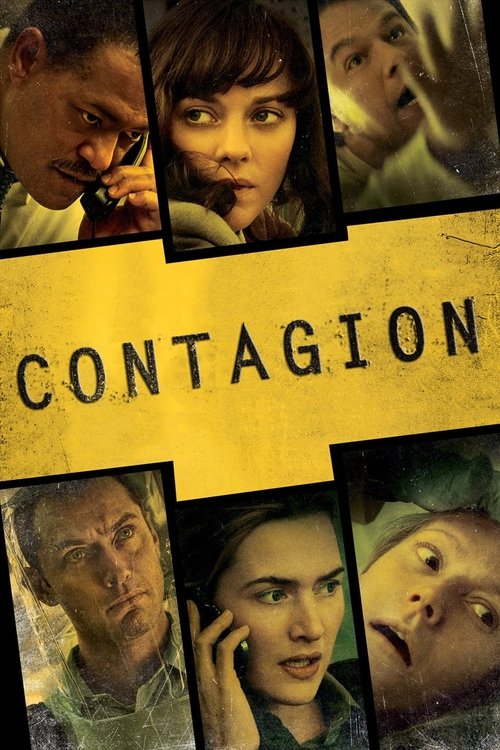
Contagion
2011 · Steven Soderbergh
For when you want smart, grown-up tension rather than jump scares — a gripping watch for a night when realism is scarier than fantasy. Fair warning: it's more unnerving now than when it came out.
What it's about
A traveler comes home from Hong Kong feeling flu-ish, and within days a lethal airborne virus is leaping across continents. The film tracks the outbreak through the people fighting it — CDC investigators, WHO scientists, a father protecting his daughter in Minneapolis, a blogger monetizing the panic — as the world discovers that fear spreads faster than any disease. It's a pandemic told as procedure: contact tracing, quarantines, and the slow grind toward a vaccine.
The experience
Cool, precise, and quietly terrifying — no monster, no heroics, just the dread of doorknobs and handshakes. It makes you hyper-aware of everything you touch for a week.
Performances
The starry ensemble — Matt Damon, Kate Winslet, Laurence Fishburne, Jennifer Ehle, Jude Law among them — plays it all at a deliberately human scale, and the film gets real power from watching famous faces be exactly as vulnerable as everyone else.
The craft
Soderbergh shoots and cuts it like a global investigation, hopping cities with on-screen population counts and letting an icy electronic score drive the momentum. The restraint is the craft: it renders catastrophe through offices, labs, and empty airports instead of spectacle, and the discipline pays off in dread.
Why it matters
Praised by scientists for its accuracy on release, it became eerily prophetic a decade later, when the COVID-19 pandemic sent millions back to it as the rare disaster film that got the details right.
Snapshot
Contagion is Steven Soderbergh's clinical, multi-strand chronicle of a novel airborne virus (the fictional MEV-1) that leaps from a bat-to-pig spillover in Hong Kong into a global pandemic, killing tens of millions within months. Working from an original screenplay by Scott Z. Burns, Soderbergh assembles a marquee ensemble — Matt Damon, Kate Winslet, Jude Law, Marion Cotillard, Laurence Fishburne, Gwyneth Paltrow, Jennifer Ehle, Bryan Cranston, Elliott Gould — and disperses them across a network narrative that spans Atlanta's CDC, Geneva's WHO, Minneapolis, Hong Kong, Chicago, and rural quarantine zones. The film's signature is its refusal of disaster-movie spectacle: it treats epidemiology as procedure, tracing R-naught calculations, contact-tracing, fomite transmission, and the slow grind of vaccine development with the unglamorous patience of a workplace drama. Its lasting cultural notoriety is almost accidental — in 2020 it became one of the most-streamed catalog titles in the world, retroactively reframed as an uncanny rehearsal for COVID-19. But its real achievement is structural and tonal: a cool, distributed portrait of how institutions, supply chains, rumor, and individual fear behave under systemic stress.
Industry & production
Contagion was produced for Warner Bros. by Participant Media, Imagenation Abu Dhabi, and Soderbergh's frequent collaborators Gregory Jacobs, Stacey Sher, and Michael Shamberg, on a reported mid-range budget (commonly cited around $60 million) that is modest given its star wattage and international scope. That economy was possible largely because of Soderbergh's working method: shooting digitally, operating his own camera, and compressing schedules through lean crews. The film was shot across 2010 in Hong Kong, Atlanta, Chicago, San Francisco and elsewhere, and released by Warner Bros. in September 2011, where it opened strongly for an adult-skewing ensemble drama and proved a solid commercial performer without being a blockbuster. (Precise grosses vary by source; the record is consistent that it recouped comfortably.)
The production is notable for the seriousness of its scientific scaffolding. Participant Media, whose remit is socially engaged filmmaking, supported extensive consultation with epidemiologists and public-health officials. Columbia University virologist W. Ian Lipkin served as a principal scientific advisor, helping design MEV-1 as a plausible chimera modeled on the Nipah and paramyxovirus families, and lending verisimilitude to the lab sequences. Soderbergh and Burns also drew on the institutional cultures of the CDC and WHO, and the film is unusually fluent in the bureaucratic texture of outbreak response — the jurisdictional friction, the press-management calculus, the rationing of scarce resources. This grounding is the film's production-design and screenwriting bedrock as much as any set.
Technology
Contagion is a landmark of Soderbergh's commitment to digital cinematography. He shot it on RED digital cameras (the RED One MX generation), of which he was among the most prominent early-adopter auteurs, valuing the format's small footprint, available-light sensitivity, and the speed it afforded a director who likes to operate himself. The digital workflow is inseparable from the film's aesthetic: the clean, slightly clinical resolution suits a story about pathogens invisible to the eye, and the camera's low-light latitude lets Soderbergh work in real interiors — labs, offices, hospital corridors — without heavy lighting setups. Digital capture also enabled the film's rigorous color separation in the grade, where Soderbergh (a hands-on colorist) assigns distinct palettes to different cities and strands. The film stands, alongside Che and the later Haywire and Side Effects, as part of Soderbergh's running argument that digital had matured into a serious authorial instrument rather than a budget compromise.
Technique
Cinematography
Soderbergh shot the film himself under his standing cinematographer pseudonym "Peter Andrews." The visual scheme is built on temperature and surface. Different geographies are color-coded — warmer ambers and sickly yellow-greens for some locations, steely blues and clinical whites for institutional spaces — so the cross-cutting reads legibly even as the narrative fragments. The camera favors a faintly detached, observational distance: handheld but rarely frantic, often framing characters through glass, across desks, or behind barriers that literalize separation and containment. A recurring grammar of insert shots — a hand on a railing, a credit-card touchpad, a bowl of bar peanuts, a smeared elevator button — converts the everyday world into a map of transmission vectors, training the viewer to watch surfaces the way an epidemiologist does. This is point-of-view filmmaking achieved through editing and lens choice rather than literal subjectivity.
Editing
Cut by Stephen Mirrione — Soderbergh's editor on Traffic, Ocean's films and much else — the picture is a model of legible parallel construction. Like Traffic, it sustains multiple simultaneous storylines, but here the organizing device is epidemiological time: on-screen titles ("Day 2," "Day 21," "Day 135") and population counters give the cutting a forensic backbone, so the audience always knows where it stands on the curve. Mirrione's editing is brisk and elliptical, trusting viewers to infer connective tissue, and it withholds conventional climaxes. The most famous cut is the film's chronological sleight of hand: it opens on "Day 2," and only in its final movement flashes back to "Day 1," revealing the precise chain of bat, pig, chef, and handshake that began the outbreak — a structural punchline that reframes the entire film as a reconstruction of origins.
Mise-en-scène / staging
The film's staging dramatizes systems rather than rooms. Production design favors the unremarkable authenticity of conference rooms, biosafety labs, mobile field hospitals improvised in gymnasiums, and the depopulating public spaces of a society shutting down. Crowds thin, shelves empty, trash accumulates — environmental storytelling charts social collapse without expository dialogue. Costuming runs from rumpled bureaucratic ordinariness to the escalating ritual of PPE: the gradual appearance of masks, gowns, and full biohazard suits marks the timeline as eloquently as any title card. Soderbergh repeatedly stages human contact — handshakes, embraces, shared glasses — as quietly ominous, weaponizing intimacy itself.
Sound
Cliff Martinez, Soderbergh's longtime musical collaborator (from Sex, Lies, and Videotape through Solaris and The Limey), supplies a pulsing, propulsive electronic score built on synthesizers and arpeggiated ostinatos. The music behaves less like emotional underlining than like a clock or a heartbeat — an anxious, forward-driving tick that conveys the relentlessness of exponential spread. It supplies the urgency the restrained visuals deliberately withhold, and its cool synthetic textures match the digital, machine-age coldness of the imagery. Sound design otherwise leans toward sparse realism: the clatter of labs, the hush of locked-down streets, the ambient drone of institutions running on adrenaline.
Performance
The ensemble is calibrated to the film's anti-melodramatic register. Performances are clipped, professional, and de-glamorized; stars are deployed against type and, in Gwyneth Paltrow's case, killed off within the opening minutes as patient zero — a casting shock that announces the film's refusal of protection-by-stardom. Matt Damon's bereaved, immune everyman supplies the picture's only sustained domestic emotion; Kate Winslet's field epidemiologist and Jennifer Ehle's lab researcher embody quiet institutional heroism; Laurence Fishburne's CDC official carries the moral weight of leadership under impossible constraints. Jude Law's conspiracy-blogger Alan Krumwiede is the deliberate sour note — a self-promoting misinformation entrepreneur whose "forsythia" snake-oil subplot is the film's most prescient strand. The acting's collective restraint is itself a statement: catastrophe handled by tired, fallible competent people.
Narrative & dramatic mode
Contagion is a network narrative (or "hyperlink film") in the lineage of Traffic, Syriana (also written by an associated sensibility) and Babel: multiple loosely linked storylines that together render a system too large for any single protagonist to contain. Its dramatic mode is procedural realism — the pleasures and tensions are those of process, of watching expertise applied against an indifferent biological adversary. It deliberately frustrates the genre's usual catharsis: there is no lone scientist who saves the world in a third-act sprint, no villain to defeat, no triumphant cure delivered in time for the survivors. Resolution arrives statistically and bureaucratically — vaccine production scaled by lottery birthdate, immunity bracelets, a society limping toward equilibrium. The film's emotional architecture is distributed and cumulative rather than focused, asking viewers to hold an entire social organism in mind at once.
Genre & cycle
The film sits at the intersection of the outbreak/contagion thriller and the disaster film, but it pointedly strips both of their conventions. Against the action-driven outbreak template of Outbreak (1995) or the body-horror of zombie-plague cinema, Contagion offers a cerebral, documentary-inflected procedural closer in spirit to Robert Wise's The Andromeda Strain (1971) or Elia Kazan's noir-procedural Panic in the Streets (1950). Within Soderbergh's own filmography it belongs to his "system" cycle — films that anatomize institutions and networks (Traffic, The Informant!, the Ocean's heists as procedural mechanism). It also helped consolidate a 2010s appetite for grounded, science-literate genre filmmaking that prizes plausibility over spectacle.
Authorship & method
Contagion is a quintessential Soderbergh artifact: he directs, photographs (as "Peter Andrews"), and color-grades, exercising near-total visual authorship while orchestrating a large ensemble with detached precision. His method here — digital capture, self-operated camera, lean and fast shooting, rigorous post-production control — exemplifies the model of efficient auteurism he spent his career refining and would push further into his "retirement" experiments (the iPhone-shot Unsane, the live-assembled Mosaic). The screenplay is the work of Scott Z. Burns, who had collaborated with Soderbergh on The Informant! and would again on The Laundromat and Side Effects; Burns's research-driven, systems-minded writing is the film's intellectual engine, and his interest in misinformation and institutional failure anticipates his later work. The other essential authors are editor Stephen Mirrione, whose parallel-narrative architecture makes the film legible, and composer Cliff Martinez, whose electronic pulse supplies its nervous system. Scientific advisor W. Ian Lipkin functions almost as a co-author of the film's credibility. The collaboration is unusually tight-knit — a repertory of trusted craftspeople that lets Soderbergh work at speed without sacrificing control.
Movement / national cinema
Contagion is a product of American studio cinema operating in a globalized, transnational mode — financed partly by Abu Dhabi capital, shot across continents, and narratively committed to a borderless view of disease and response. It belongs to no formal movement, but it can be read within the post-2000 American independent-to-studio crossover that Soderbergh personified: a sensibility forged in 1990s indie filmmaking (he was a Sundance/Cannes breakout with Sex, Lies, and Videotape) applied to mainstream resources. Its internationalism — Hong Kong, Geneva, multiple American cities, dialogue in several languages — reflects a self-consciously global imagination of catastrophe appropriate to its subject.
Era / period
Released in 2011, the film is a creature of the post-2008 anxiety era and the immediate memory of recent real-world outbreaks — SARS (2003), avian and swine flu (H5N1, the 2009 H1N1 pandemic). Those scares supplied both its scientific template and its sociological one: the film's depiction of panic-buying, rumor economies, and strained public-health infrastructure draws on a decade of near-misses. Its treatment of an online conspiracy entrepreneur also captures the early-2010s emergence of blogging and social media as forces capable of outrunning official information — a strikingly forward-looking concern. Technologically and stylistically it marks the moment digital cinema came fully into its own in prestige American filmmaking.
Themes
The film's central theme is interdependence and its perils: the same networks of travel, trade, and contact that bind a globalized world also make it catastrophically permeable. It is preoccupied with the invisible — the unseen pathogen, the unseen labor of institutions, the unfelt early stages of spread — and trains the viewer to perceive systems normally taken for granted. A second major theme is the contagion of information: the film explicitly parallels biological transmission with the spread of fear, rumor, and disinformation, arguing through Krumwiede's storyline that panic and falsehood propagate faster than any virus. It examines institutional competence and its limits — the quiet heroism of public servants set against bureaucratic friction, resource scarcity, and political pressure — and it refuses easy moralism, showing good people making compromised choices (Fishburne's character tipping off a loved one). Underneath runs a meditation on social trust as the true substance that holds civilization together, and on how quickly it frays. The film is finally less about a disease than about the social body's response to one.
Reception, canon & influence
On release, Contagion was widely and warmly reviewed, praised for its intelligence, its restraint, its ensemble, and its refusal of cheap thrills, though some critics found its very coolness emotionally distancing — a deliberate trade-off the film makes openly. It was a commercial success in the adult-drama register and consolidated Soderbergh's reputation as American cinema's most rigorous procedural stylist.
Its influences run backward to the prestige paranoia procedurals of the 1970s — The Andromeda Strain, All the President's Men's methodical realism, the disaster-ensemble template of the era — and to Kazan's Panic in the Streets; more immediately to Soderbergh's own Traffic, whose multi-strand, color-coded, systems-level structure Contagion directly reprises for a new subject. The science-fact grounding owes a debt to the public-health and virology literature its consultants supplied.
Its forward influence is unusually literal. Contagion became a touchstone for the depiction of pandemics, admired within public-health and science-communication communities for its accuracy, and frequently cited by epidemiologists as a rare responsible Hollywood portrait of their work. Then, in early 2020, the COVID-19 pandemic transformed the film's reception entirely: it surged to the top of streaming and rental charts worldwide, was discussed as an eerily accurate forecast (its handshake-as-vector imagery, its misinformation subplot, its social-distancing and supply-collapse scenes all reading as documentary), and its cast and advisors were enlisted in real public-service messaging about the actual outbreak. Few films have had their cultural meaning so thoroughly rewritten by subsequent events. As a result Contagion now occupies a secure place in the canon of the outbreak film — arguably its definitive serious entry — and stands as a high-water mark of Soderbergh's digital-era authorship and of the systems-thinking, procedurally realist mode he did so much to define.
A Deleuzian reading
Start with the bowl of peanuts on the bar.
The full Deleuzian reading of Contagion →
Reception
In 2011 it was received as a chilly, well-made procedural — respectable mid-tier Soderbergh. Then March 2020 hit, it rocketed up the rental charts, and it was reappraised almost overnight as the most eerily prescient studio film of its era.
How Contagion was received, from release to now →
Influences: the films it descends from and the films it influenced
- Panic in the Streets (1950) — Establishes the public-health-officer-as-detective procedural, staging a city-wide plague containment as a location-shot, ticking-clock manhunt traced through institutional channels — the template Contagion's CDC/WHO contact-tracing reprises.
- The Andromeda Strain (1971) — Makes the scientific method itself the suspense engine via an instrumentation-dense, sterile lab procedural with decontamination corridors and on-screen data readouts — the visual grammar Contagion adopts for its BSL labs (and the film's named influence).
- All the President's Men (1976) — Models the de-dramatized process-realism in which tension accretes from methodical fact-gathering and institutional procedure rather than action set-pieces — the patient procedural register Contagion inherits.
- Nashville (1975) — Pioneers the large de-glamorized ensemble whose overlapping, equal-weighted strands portray a whole social system instead of a single hero — the network-narrative architecture Contagion runs on.
- Traffic (2000) — The direct precursor: a color-coded multi-strand network narrative on a systems-level subject, self-photographed by Soderbergh as 'Peter Andrews' and cut by Stephen Mirrione, whose method Contagion transplants wholesale onto epidemiology.
- The Limey (1999) — Soderbergh's elliptical, time-fractured cutting that trusts the viewer to assemble chronology — the nonlinear-editing instinct behind Contagion's timeline jumps and its closing Day-1 origin reveal.
- Solaris (2002) — Cements the Soderbergh–Cliff Martinez collaboration around a cool, pulsing electronic-ambient score and desaturated grading — the sonic and chromatic palette Contagion's nervous-system score extends.
- Z (1969) — The politically charged procedural thriller that generates momentum from investigation and institutional failure rendered in quasi-documentary texture — the procedural-realist propulsion Contagion channels.
- Outbreak (1995) — Supplies the Hollywood outbreak-thriller template — vector tracing, CDC mobilization, escalating containment — that Contagion deliberately strips of melodrama and heroics to pursue clinical realism.
- I Am Legend (2007) — Inherits I Am Legend's pandemic-infection-cycle genre framework — specifically the procedural logic of virologists tracking a pathogen while civilization collapses around institutional response — and distributes Neville's solo virologist role across an ensemble of institutional scientists, retaining the lab-as-last-refuge staging while replacing solitary performance structure with interlocking procedural strands.
- Side Effects (2013) — Reunites the Soderbergh/Scott Z. Burns/Martinez repertory to turn the same cool digital-procedural lens on the pharmaceutical industry — institutional intrigue shot and graded by Soderbergh himself.
- The Knick (2014) — Soderbergh self-shoots and color-grades a medical procedural while scoring period surgery with Cliff Martinez's anachronistic electronic pulse — the efficient total-authorship method Contagion crystallized.
- The Laundromat (2019) — Soderbergh and Burns build a systems-explainer network narrative with on-screen titles and direct-address chapters dramatizing institutional corruption — the didactic procedural toolkit pushed further.
- Unsane (2018) — The iPhone-shot, self-operated, fast-and-lean experiment that takes Contagion's efficient digital-capture auteurism to its logical extreme.
- Thirteen Lives (2022) — Ensemble procedural distributing crisis response across multiple institutions, nations, and professional types in parallel-cut structure, making collective competence itself — not any individual — the dramatic subject, which Thirteen Lives extends to a bi-national rescue.
- Crisis (2021) — Donates the desaturated, sterile institutional palette and clinical procedural cross-cutting across labs, agencies, and civilians during a public-health crisis.
- World War Z (2013) — Supplies the epidemiological-procedural structure of a globe-trotting investigator racing patient-zero across labeled cities, mirrored in WWZ's UN-investigator narrative.
- 21 Grams (2003) — Showcases Stephen Mirrione's fractured cross-cut editing of interwoven fates — the same editor's parallel-construction craft that makes Contagion's simultaneous strands legible.
- Syriana (2005) — Traffic's screenwriter Stephen Gaghan extends the color-coded geopolitical network narrative to the oil industry — the systems-thinking procedural mode Contagion shares at the level of structure.
- Babel (2006) — A globe-spanning network narrative cross-cut by Mirrione that traces one event's ripples across continents — the transnational parallel architecture Contagion deploys for a virus.
- Drive (2011) — Released the same year with Cliff Martinez's synth-driven, propulsive electronic score — the composer's tonal signature that supplies both films their unease beneath a cool surface.
- The Report (2019) — Burns's own screenwriting method here — dramatizing how a complex bureaucratic apparatus actually functions — paired with Soderbergh's cool, systems-level procedural detachment that recurs as producer on The Report.
- Shin Godzilla (2016) — Ensemble institutional procedural using clinical location/name supertitles to track a multi-agency emergency response, dramatizing crisis as coordination logistics.
Similar films
- Outbreak (1995) — influence & lineage
- The Andromeda Strain (1971) — influence & lineage
- United 93 (2006) — shared sensibility
- [REC] (2007) — shared sensibility
- Train to Busan (2016) — shared sensibility
- World War Z (2013) — shared sensibility
- Disclosure Day (2026) — shared sensibility
- Colony (2026) — shared sensibility