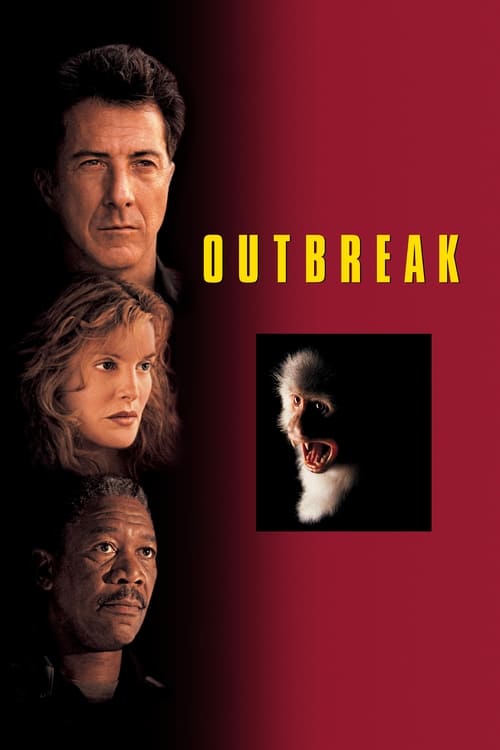
Outbreak
1995 · Wolfgang Petersen
For when you want a tense, meat-and-potatoes '90s thriller — big stars, big stakes, no homework required. Comfort-food suspense with just enough real-world shiver to keep it interesting.
What it's about
A lethal airborne virus travels from an African jungle to a small Northern California town, and army virologist Colonel Sam Daniels has days to trace its source before it goes national. The town is quarantined, the military weighs catastrophic options to contain the spread, and Daniels finds himself fighting his own chain of command as hard as the disease. It's a race between a cure and a cover-up.
The experience
A slick, fast, sweaty-palmed studio thriller — helicopter chases, ticking clocks, and one genuinely chilling sequence following a single cough through a crowded movie theater. It's pulpy rather than profound, and it knows exactly how to keep you leaning forward.
Performances
Dustin Hoffman brings jittery, fast-talking conviction to a role that could have been pure formula, backed by a stacked cast including Rene Russo, Morgan Freeman, and Donald Sutherland.
The craft
Wolfgang Petersen directs with the confident momentum of a filmmaker at the top of his studio game, fusing medical-procedural detail with disaster-movie spectacle. The airborne-contagion sequences are staged with genuine visual wit — the camera following the invisible threat itself — and the aerial action still plays big and loud.
Why it matters
Arriving amid the mid-'90s panic over emerging viruses, it became the defining Hollywood pandemic movie of its decade — and found a strange second life decades later when real events sent audiences back to it.
Snapshot
Outbreak is a high-gloss Hollywood disease thriller in which a hemorrhagic fever virus, carried from a Zairean jungle to a small Northern California town, threatens to become a national pandemic — and the U.S. military weighs incinerating the town to contain it. Directed by Wolfgang Petersen at the peak of his American studio career and headlined by Dustin Hoffman, the film fuses the procedural texture of the medical-detective story with the ticking-clock momentum of the disaster movie and the paranoid architecture of the military-conspiracy thriller. Released by Warner Bros. in March 1995, it arrived in the middle of a genuine cultural fever over emerging viruses, and it remains the most widely seen dramatization of that anxiety from the decade. Its lasting interest is twofold: as a precise time capsule of mid-1990s pandemic dread, and as a study in how a major studio packages biological catastrophe as star-driven spectacle, complete with helicopter chases and a redemptive personal melodrama bolted onto an epidemiological emergency.
Industry & production
Outbreak emerged from a competitive Hollywood scramble over "killer virus" material in the early 1990s. The non-fiction touchstone of that moment was Richard Preston's reporting on Ebola and Marburg, expanded into the 1994 bestseller The Hot Zone. A rival project based directly on Preston's book was in development with high-profile talent attached — variously associated with Ridley Scott as director and Robert Redford and Jodie Foster as stars — and the public record is consistent that this "Hot Zone" production collapsed amid disputes while Warner Bros. pushed its own fictionalized treatment to the screen first. Outbreak is therefore best understood not as an adaptation but as a parallel, original screenplay (by Laurence Dworet, a physician, and Robert Roy Pool) that capitalized on the same zeitgeist.
The film was a substantial studio production: a top-tier ensemble (Hoffman, Rene Russo, Morgan Freeman, Cuba Gooding Jr., Kevin Spacey, Donald Sutherland, Patrick Dempsey), location and stage work that included extensive sets for the fictional Army biocontainment facility USAMRIID and the quarantined town of Cedar Creek, and large-scale military hardware sequences. Petersen, a German director who had broken through internationally with Das Boot (1981) and consolidated his Hollywood standing with In the Line of Fire (1993), was a logical choice for material requiring both confined-space tension and large-canvas action. Beyond noting that the film performed solidly enough to be considered a commercial success of its season, I will not assign specific budget or gross figures, as I cannot verify exact numbers here.
Technology
Outbreak is a pre-digital-saturation production whose effects are predominantly practical, and this grounds much of its credibility. The microscopic — the virus itself — is rendered through a mix of optical/animated representations of viral particles and laboratory imagery, but the film's signature effects are physical: hazmat "spacesuits," airlocks and decontamination showers, and the staged biohazard laboratory environments at graduated containment levels. The production's commitment to the iconography of Biosafety Level 4 work — pressurized suits, double-gloving, chemical sprays — is the technological heart of the film, and its plausibility-by-accumulation does as much as any plot device to generate dread.
The action climax depends on aviation work, notably helicopter flying for the pursuit sequence and the staging of a planned firebombing run by a military aircraft. These are largely achieved with real aircraft, models, and pyrotechnics rather than the digital compositing that would dominate later in the decade. The film sits at a transitional technological moment: contemporary with the early CGI breakthroughs of the period but choosing, for its core illusions, the tactile realism that suits a thriller premised on contamination one cannot see.
Technique
Cinematography
The film was photographed by Michael Ballhaus, the German-born cinematographer celebrated for his long collaboration with Rainer Werner Fassbinder and his subsequent American work with Martin Scorsese. Ballhaus brings a controlled, mobile classicism rather than showy stylization. The containment-lab interiors trade on cool, clinical light and the visual obstruction of suit visors and plastic sheeting, while the town and exterior sequences open into a brighter, more conventional studio realism. Ballhaus's fluent camera — his fondness for circling and tracking movement is part of his signature — keeps the procedural scenes kinetic, and the aerial photography of the helicopter sequence supplies the wide-screen scale the third act demands. The throughline is legibility under pressure: the imagery is engineered to keep complex spatial and medical information clear even as tension mounts.
Editing
Outbreak is built on cross-cutting. The script intercuts at least three registers — the field investigators tracing the virus, the bureaucratic-military command structure debating containment, and the human community of Cedar Creek being engulfed — and the editing's job is to escalate all three toward convergence. The film leans on the disaster-movie grammar of mounting case counts, contamination "chains," and countdowns; editorially, the rhythm tightens steadily from the deliberate pace of early detective work to the rapid intercutting of the airborne climax. The picture is credited to experienced editors of the era, and the cutting prioritizes momentum and clarity over experimentation — appropriate to a film whose suspense depends on the audience always understanding exactly how close the catastrophe is.
Mise-en-scène / staging
The film's production design organizes the world into nested zones of safety and danger — a spatial logic that is its strongest formal idea. Containment is staged as a series of thresholds: airlocks, decon chambers, quarantine perimeters, roadblocks ringing the town, and finally the imagined firebreak of total destruction. Costuming reinforces this: the hazmat suit is the film's defining visual object, both protection and dehumanizing barrier, and the recurrent business of suited figures moving through sterile corridors gives the picture its texture. The town of Cedar Creek is staged as an ordinary American community — the better to make its sealing-off feel like a violation. The escalating military presence, from quiet surveillance to armed cordon to the threat of aerial bombardment, is visually tracked through the increasing hardware filling the frame.
Sound
Sound design carries much of the film's unease, because the threat is invisible. Breathing inside the suits, the hiss of airlocks and ventilation, the alarms of breached containment, and the ambient hum of laboratory machinery build a sonic vocabulary of enclosure. A pivotal sequence dramatizes airborne transmission inside a movie theater, where the film uses sound and staging to make a single cough an event of horror. Against this, the helicopter and aircraft sequences supply conventional action-movie sonic scale.
Performance
Hoffman anchors the film as Col. Sam Daniels, an Army virologist, in a register of harried competence and moral urgency; the role asks him to be the audience's expert surrogate and its conscience. Rene Russo plays his estranged colleague and ex-wife, a CDC scientist, and the film grafts a reconciliation arc onto the crisis — a melodramatic convention the performances must sell against the procedural backdrop. Morgan Freeman and Donald Sutherland embody the military command's competing impulses, Freeman as the conflicted superior and Sutherland as the harder, more ruthless general, giving the film its internal political antagonism. Kevin Spacey and Cuba Gooding Jr. round out the field team. The ensemble's gravity is part of the film's strategy: serious actors lend plausibility to escalating implausibilities.
Narrative & dramatic mode
The screenplay operates in two modes simultaneously. The first half is essentially a detective procedural — identify the pathogen, trace its vector (a monkey, the animal host), reconstruct the chain of transmission — and it derives suspense from epidemiological deduction. The second half pivots into a conspiracy-and-action thriller: the revelation that elements of the military have a prior, secret history with the virus and would rather destroy the town (and its evidence) than risk exposure. This structural turn — from "can we understand the disease?" to "will the institutions meant to protect us instead sacrifice us?" — is the film's dramatic engine, and it is also its most debated feature, since the personal heroics required to avert the firebombing strain against the realism of the early scenes. The mode, finally, is reassurance through individual agency: a systemic catastrophe is resolved by the courage and competence of a few protagonists.
Genre & cycle
Outbreak belongs to several overlapping traditions. Most directly it is a medical/contagion thriller, with antecedents in Robert Wise's The Andromeda Strain (1971) — the prior gold standard for clinical, procedural treatment of a biological threat — and in Elia Kazan's Panic in the Streets (1950), an early noir of urban contagion and the race to contain it. It is equally a 1990s disaster movie, sharing that cycle's ensemble cast, mounting body count, and spectacle-driven climax. And it is a post–Cold War conspiracy thriller, in which the enemy is partly an institution of the American state. It sits squarely within a mid-decade cluster of pandemic-and-bioweapon anxiety in popular culture, and it became the most prominent screen expression of that cycle.
Authorship & method
Petersen's authorship is visible in the film's central preoccupation: competent professionals under extreme pressure inside sealed, hierarchical systems. The submarine of Das Boot, the presidential detail of In the Line of Fire, and the containment labs of Outbreak are variations on a recurring Petersen space — confined, rule-bound, life-and-death — and on his recurring interest in duty, command, and the ethics of the chain of command. He is a classical, craftsman-director rather than a stylist, prioritizing momentum, clarity, and star performance.
His key collaborators shape the result. Cinematographer Michael Ballhaus brings European pedigree and a fluid, legible camera. Composer James Newton Howard — among the most prolific and versatile of Hollywood's contemporary scorers — supplies a propulsive, suspense-driven orchestral score that drives the escalation. The screenplay by Laurence Dworet and Robert Roy Pool grounds the medical material in Dworet's background as a physician, lending the procedural scenes their convincing vocabulary even as the third act tilts toward thriller convention. The editing team enforces the cross-cut architecture on which the suspense depends.
Movement / national cinema
Outbreak is a mainstream American studio film, but it is illuminating to read it through its German-émigré authorship. Petersen and Ballhaus both came to Hollywood from the postwar German film world — Petersen from the generation that followed the New German Cinema, Ballhaus from the heart of it as Fassbinder's cinematographer — and both became conspicuously successful practitioners of high-end American genre filmmaking. The film is thus a document of a particular transatlantic career path: European technical formation placed in the service of Hollywood spectacle. It belongs to no avant-garde or national-cinema movement of its own; it is, rather, an exemplary product of the globalized Hollywood studio system of the 1990s.
Era / period
The film is inseparable from its precise historical moment. The early-to-mid 1990s saw a surge of public attention to emerging infectious diseases — Ebola outbreaks in Africa, the popularization of "hot agents" and Biosafety Level 4 science, and a broader sense that globalization and air travel had made the world newly porous to contagion. Outbreak dramatizes the era's specific fear: that a virus from a distant rainforest could, via a single infected vector, reach an ordinary American town within days. It also reflects post–Cold War unease about what the national-security apparatus might be concealing, transposing suspicion from foreign adversaries onto the bioweapons legacy of one's own military. The film is, in that sense, a near-perfect snapshot of mid-1990s anxieties.
Themes
The dominant theme is contagion as a test of institutions: the film repeatedly stages the conflict between scientific/public-health imperatives (understand, treat, save) and military/political imperatives (contain, conceal, sacrifice). Bound up with this is the ethics of the unthinkable choice — the proposal to destroy a town of innocents to save the nation — which the film raises as melodrama but which gestures at real utilitarian dilemmas of quarantine and triage. A further theme is the invisibility of the threat and the fragility of the membranes (suits, walls, borders) that hold it at bay, dramatized through the recurring imagery of breach and exposure. Finally, there is the personal redemption arc — estranged partners reunited by shared crisis — which domesticates the global catastrophe into a story about trust and repair.
Reception, canon & influence
Critical reception on release was mixed-to-favorable in a characteristic pattern: reviewers tended to praise the tense, well-mounted first half and the conviction of the cast while faulting the film for abandoning its procedural realism for an implausible action climax centered on personal heroics. The consensus positioned it as an effective, glossy entertainment rather than a serious work of ideas — competent studio filmmaking elevated by its premise and its actors. I am summarizing the broad shape of that response rather than quoting specific reviews, which I cannot verify verbatim here.
The influences on the film are clear: the clinical-procedural lineage of The Andromeda Strain, the contagion-noir of Panic in the Streets, the ensemble-disaster template of the 1970s, and, as cultural context, the wave of viral non-fiction journalism epitomized by Preston's The Hot Zone. Its legacy forward is significant chiefly as the popular touchstone that fixed the visual grammar of the screen pandemic — the hazmat suit, the containment lab, the contact-tracing chain, the quarantined town, the contaminated public space — for a generation of viewers. Later contagion films, most notably Steven Soderbergh's more clinically restrained Contagion (2011), can be read in part as correctives to Outbreak's star-driven, action-thriller approach, pursuing the documentary realism Outbreak abandoned in its second half. The film also recurrently returned to public attention during subsequent real-world disease scares, when it was invoked — accurately and inaccurately — as a cultural reference point for how a pandemic might unfold. Its durable place in the canon is therefore less as a critical landmark than as the definitive 1990s articulation of pandemic dread and the film that taught a mass audience what an "outbreak" looks like.
A Deleuzian reading
A man coughs in a movie theater.
The full Deleuzian reading of Outbreak →
Reception
In 1995 it was a hit but critics shrugged — a starry, silly Hollywood virus thriller. Then COVID hit in 2020 and it rocketed back into Netflix's most-watched, rewatched half as prophecy, half as comfort food.
How Outbreak was received, from release to now →
Influences: the films it descends from and the films it influenced
- The Andromeda Strain (1971) — Establishes the clinical-procedural template Outbreak inherits — sterile underground containment lab, decontamination airlocks, and scientific methodology dramatized as escalating suspense rather than action.
- Contagion (2011) — Direct corrective descendant — adopts Outbreak's multi-strand epidemiological cross-cutting and contact-tracing chain but strips out the star-heroics for documentary clinical restraint.
- Panic in the Streets (1950) — Originates the contagion-noir of a public-health officer racing a 48-hour clock to trace contacts through a city before an outbreak spreads — the contact-tracing-chain structure Outbreak's first half runs on.
- Das Boot (1981) — Petersen's own foundational sealed-hierarchical-space film: claustrophobic sound design of enclosure and competent professionals under command pressure, directly reworked into Outbreak's containment labs and chain-of-command ethics.
- In the Line of Fire (1993) — Petersen sibling that perfects his star-driven procedural-to-thriller pivot — institutional protocol and duty giving way to one heroic protagonist's personal stand, the exact arc Outbreak follows.
- The China Syndrome (1979) — Model for the institutional-cover-up conspiracy turn — a technical procedural about a contained hazard that escalates into a thriller about authorities suppressing the public danger.
- The Cassandra Crossing (1976) — Fuses contagion with the 1970s confined-disaster ensemble — a lethal pathogen plus a military quarantine cordon sealing off the infected, prefiguring Outbreak's hazmat-and-soldiers town lockdown.
- Jaws (1975) — Source of the authorities-deny-the-threat dynamic — officials suppressing a public danger for political convenience while experts fight to force a shutdown, recycled as Outbreak's Pentagon cover-up.
- The Towering Inferno (1974) — Defines the star-ensemble disaster template Outbreak adopts — A-list cast distributed across roles and cross-cut between converging crisis fronts as catastrophe escalates.
- Goodfellas (1990) — Showcase for cinematographer Michael Ballhaus's fluid, legible long-take camerawork — the same European-trained mobile coverage Ballhaus brings to Outbreak's lab and command-center spaces.
- Twelve Monkeys (1995) — Mid-1990s pandemic-dread sibling released the same year, sharing the era's anxiety about an engineered virus escaping containment and overwhelming institutions.
- The Hot Zone (Andromeda lineage via Ebola nonfiction) (1994) — Cultural-source sibling whose hemorrhagic-fever reportage supplied Outbreak's biosafety-level iconography — BSL-4 suits, hot labs, and the African-spillover origin that opens the film.
- 28 Days Later (2002) — Extends Outbreak's quarantined-nation and military-containment imagery — hazmat soldiers, cordoned zones, and the army itself becoming a threat to the survivors it's meant to protect.
- The Crazies (2010) — Inherits Outbreak's military-hazmat lockdown of an infected American town — soldiers in suits, forced quarantine, and a sanitization order against civilians.
Similar films
- Contagion (2011) — influence & lineage
- The Andromeda Strain (1971) — influence & lineage
- 28 Days Later (2002) — influence & lineage
- World War Z (2013) — influence & lineage
- Twelve Monkeys (1995) — influence & lineage
- War of the Worlds (2005) — shared sensibility
- Resident Evil (2002) — shared sensibility
- Twisters (2024) — shared sensibility