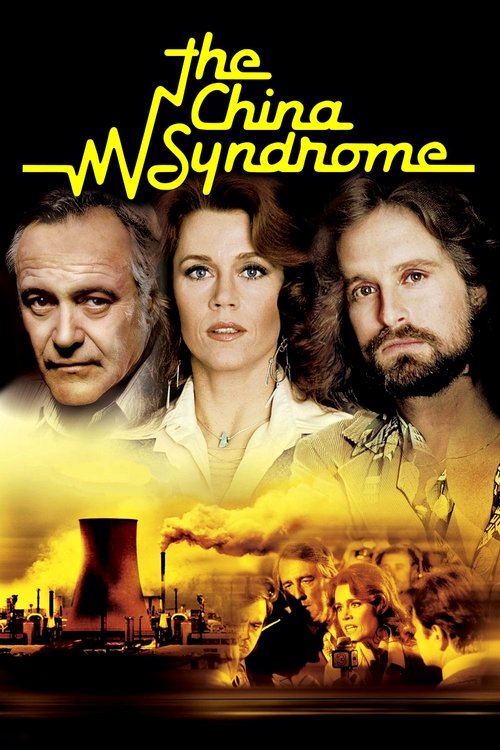
The China Syndrome
1979 · James Bridges
When you're craving a smart, sweaty-palmed thriller about institutions lying — the kind that makes you distrust the evening news for a week. More gripping than grim, but it will leave you thinking.
What it's about
A California TV reporter stuck doing fluff pieces is filming at a nuclear power plant when something goes wrong in the control room — and her cameraman secretly captures it. As she pushes to get the story on air, a veteran plant engineer begins to suspect the near-accident was worse than anyone admits, and both run into a wall of corporate denial and quiet menace.
The experience
A slow-tightening procedural that gets its scares from gauges, silences, and men in suits saying everything is fine. No monsters, no melodrama — just the escalating dread of watching ordinary professionals realize how bad it could get.
Performances
Jack Lemmon is extraordinary as the engineer whose loyalty to the plant cracks under what he knows — a comedy legend playing dead-serious terror. Jane Fonda gives the reporter real spine and ambition, and Michael Douglas brings live-wire energy as her radical cameraman.
The craft
The filmmaking is all discipline: documentary-flat lighting, control-room sequences staged with procedural precision, and — strikingly — almost no music, so the tension comes from ambient sound and faces. It makes technical detail riveting without ever explaining too much.
Why it matters
Twelve days after release, the Three Mile Island accident turned its fiction into headline news — one of the eeriest coincidences in film history, and it made the movie the defining Hollywood statement on nuclear risk and cover-up.
Snapshot
A television reporter and her cameraman witness a near-catastrophic accident at a California nuclear power plant and fight to bring the story to air over the opposition of their network bosses and the plant's corporate owners. Released by Columbia Pictures on March 16, 1979, The China Syndrome entered history twelve days later when the Three Mile Island partial meltdown in Pennsylvania transformed its fiction into prophecy. That coincidence — one of the most remarked-upon in American film history — ensured the film an enduring place in the culture and made it the defining Hollywood statement on nuclear danger and institutional cover-up. Beyond its topicality, however, the film holds up as a precisely crafted procedural thriller in the tradition of 1970s paranoia cinema, driven by three performances of exceptional discipline.
Industry & production
The project originated with documentary filmmaker Mike Gray, whose script traced a scenario grounded in publicly available nuclear safety literature and the emerging whistleblower culture of post-Watergate America. Gray had previously made The Murder of Fred Hampton (1971), giving him a template for institutional violence dressed in bureaucratic normalcy. T.S. Cook, a journalist and screenwriter, worked with Gray on the script before director James Bridges came aboard as a third credited writer and reoriented the material toward a tighter dramatic structure centered on moral awakening.
The key producing force was Michael Douglas, who secured the rights after his Oscar-winning co-production of One Flew Over the Cuckoo's Nest (1975) established his standing in Hollywood. Douglas spent several years attempting to get the project financed in the face of industry reluctance — nuclear power was not yet a proven commercial subject, and the script's explicit criticism of corporate energy interests made studios cautious. Jane Fonda's attachment as star and co-producer, through her IPC Films banner, was decisive in getting Columbia Pictures to commit. Fonda brought both star power and political conviction; her long-standing public activism around corporate accountability and media manipulation meant she was aligned with the material from the outset, not merely cast in it.
The production budget was moderate by the standards of the period. The nuclear control room set, constructed at the studio, drew on consultation with actual plant engineers and was widely noted at the time for its technical authenticity; industry representatives would later claim the film was irresponsible precisely because some of its procedures were too accurate. The plant used as an exterior location was the Rancho Seca Nuclear Generating Station near Sacramento, though principal interior photography was done on constructed sets.
Technology
The China Syndrome arrived in the late-1970s moment when American cinema was absorbing the aesthetics of television journalism into its own visual grammar. The film does not exploit any single breakthrough technology, but it deploys the technology of broadcast news — the videotape camera, the editing suite, the live-truck transmission — as both subject matter and formal influence. The story's climax depends on the material properties of broadcast video: what can be recorded covertly on a shoulder-mounted camera, what quality of image is acceptable for air, and whether a videotape can be physically seized before transmission. These are procedural rather than spectacular concerns, and the film's technological register is consequently muted and realist.
The choice to shoot largely on location or on sets that replicate functional workspaces rather than impressionistic ones connects the film to the 1970s procedural tradition. No major innovations in lens design, film stock, or process cinematography distinguish the production. What the film represents technologically is a sophisticated deployment of existing tools — in particular the handheld camera — in service of a journalistic aesthetic rather than a cinematic one.
Technique
Cinematography
James Crabe's cinematography is the film's most disciplined formal achievement. Crabe largely refuses the expressive visual rhetoric available to him — there are few extreme angles, no aggressive zooms used for dramatic emphasis, and no chiaroscuro lighting that might aestheticize danger. The dominant palette is the institutional beige and fluorescent white of television newsrooms, corporate offices, and nuclear control rooms: environments where the human eye acclimates to visual boredom as a condition of employment. When the plant sequences heat up, Crabe does not suddenly shift registers. The horror is that everything looks the same.
Handheld work is used selectively and with restraint. It codes as documentary authenticity when it appears rather than as agitation, which makes its moments of deployment — particularly during the incident sequences on the reactor floor — feel earned rather than manipulative. The film's most formally striking passage may be Jack Godell's realization, mid-film, that the pumps are vibrating at a resonance frequency that could trigger a recurrence: Crabe holds on the gauges and dials with a stillness that lets the audience understand the threat without editorializing.
Editing
The editing — handled with functional precision rather than stylistic prominence — organizes the film's parallel investigation tracks without calling attention to its own operations. The cross-cutting between the newsroom and the plant never tips into the thriller genre's tendency to artificially accelerate intercutting. The pacing is notably patient by contemporary standards, trusting scene-level performance and dialogue to sustain tension in extended takes. This patience is itself a political gesture: the institutional processes by which decisions are made and suppressed take time, and the editing refuses to compress that time into spectacle.
Mise-en-scène / staging
Bridges stages his scenes with a preference for middle and long shots that keep characters embedded in their institutional environments. Close-ups are deployed with enough economy that when they come — particularly in Lemmon's sequences of private reckoning — they carry real weight. The staging of power relationships is consistently architectural: who stands at the head of which table, who is left outside a closed door, who is visible through a glass partition to be watched without hearing. The corporate spaces of the film are rendered as surveillance environments, and Bridges makes that explicit in the geometry of his framings.
The control room blocking is particularly notable for its fidelity to the logic of actual operational procedure: characters move to specific stations to perform specific tasks, rather than the undifferentiated urgent rushing that typifies Hollywood's rendering of technical emergencies.
Sound
The film's sound design is among its most consequential choices. The China Syndrome uses almost no non-diegetic music score for significant stretches of its running time, particularly in the plant sequences. The sound design foregrounds the ambient noise of the facility itself — the hum of machinery, the crackle of radio communication, the institutional silences that follow the containment of incident. This refusal of scoring in moments that conventional thriller practice would saturate with music forces the audience into an attentive, slightly disoriented relationship with the image. We read the drama without musical instruction.
Where music does appear, it is restrained and diegetic or near-diegetic in character. The effect is to position the viewer in the epistemological situation of the film's journalists: receiving information raw, without editorial framing, and being required to assess its meaning independently.
Performance
Three performances carry the film, and all three operate in a register of suppression rather than expression. Jack Lemmon's Jack Godell is the film's moral center and its most complex characterization: a company man who has organized his identity around professional competence and institutional loyalty, who must confront the fact that both have been instrumentalized against the public interest. Lemmon's performance is one of the finest of his career — the sequence in which Godell locks down the control room and attempts to force a public accounting is a sustained study in a man dismantling his own self-conception in real time. He won the Best Actor prize at the 1979 Cannes Film Festival for this work.
Jane Fonda's Kimberly Wells is equally precise. Bridges and Fonda construct a journalist whose professional limitations are gendered — she has been kept on "soft" assignments, the zoo story, the human interest piece — and whose arc involves claiming credibility against institutional resistance. Fonda does not play the role's feminist dimension in capital letters; the politics are embedded in behavior and in the specific textures of professional condescension Wells receives from male colleagues and bosses.
Michael Douglas as cameraman Richard Adams operates as the film's connective tissue — more reactive than active, a figure whose moral compass is cleaner than Wells's precisely because he has less to lose professionally. His performance is necessarily subordinate to Lemmon and Fonda's, but it is correctly scaled to that function.
Narrative & dramatic mode
The China Syndrome is a procedural thriller with an unusually strong commitment to procedural accuracy. Its narrative logic is investigative: information is gathered, suppressed, gathered again, and the dramatic question is not whether the conspiracy exists but whether it can be exposed before further catastrophe. This places it firmly in the tradition of films that treat institutional process as both subject and suspense engine.
The film's climax — Godell's occupation of the control room and on-camera breakdown — departs from this procedural mode and enters something closer to tragedy: a character destroyed by his own conscience and by the institutional forces he has helped to build. The ending is genuinely dark. Wells's story is not spiked but her victory is hollow; Adams's footage may or may not survive. Godell is killed. The cover-up proceeds. This refusal of consolation connects the film to the broader tonal register of 1970s American cinema.
Genre & cycle
The China Syndrome belongs to the cycle of 1970s American paranoia thrillers — a cycle that includes The Parallax View (1974), Three Days of the Condor (1975), All the President's Men (1976), and Network (1976) — in which American institutions (government, intelligence services, corporations, media) are revealed as systematically corrupt and effective resistance is either impossible or Pyrrhic. The cycle emerged directly from Watergate and Vietnam and represents Hollywood's sustained attempt to process those traumas through genre.
Within that cycle, The China Syndrome is distinctive for its combination of corporate thriller and media critique. Like Network, it places a television newsroom at the center of its investigation of institutional complicity; unlike Network, its mode is realist rather than satirical. The film also inaugurates, or at minimum significantly advances, the nuclear-anxiety thriller as a distinct subgenre, creating a template for the corporate whistleblower narrative that would continue through Silkwood (1983) and beyond.
Authorship & method
James Bridges came to The China Syndrome after The Paper Chase (1973), his debut feature, which similarly focused on institutional pressure and the ethics of professional formation — a law student confronting the violence of the Socratic method. Bridges worked as a writer and director rather than in one capacity alone, and his screenwriting background shows in the film's dialogue, which is unusually precise about professional language and procedure without becoming technical in a way that alienates lay audiences.
Cinematographer James Crabe's collaboration with Bridges reflects a shared commitment to a documentary-influenced visual aesthetic. The film's refusal of expressionism is a directorial-cinematographic compact, not incidental. The score's minimalism similarly reflects a deliberate authorial stance.
Mike Gray and T.S. Cook's contributions to the screenplay grounded the film in actual nuclear safety debates. Gray's documentary instincts ensured that the fictional plant procedures were derived from real ones, giving the film its air of technical authority. Where the record is thin, it is on the question of how extensively Bridges and the producing team consulted with nuclear engineers outside the credited channels — the accounts that circulated at the time were impressionistic rather than documented.
Movement / national cinema
The China Syndrome is an American studio film of the late New Hollywood period, made as the generation of filmmaker-auteurs who had briefly dominated American cinema in the early 1970s was being displaced by blockbuster economics in the wake of Jaws (1975) and Star Wars (1977). The film sits at an awkward juncture: it is in formal terms a 1970s adult drama, with the patience, moral ambiguity, and tonal darkness characteristic of that moment, but it was produced and released in the era of the blockbuster and succeeded commercially in part because of an extraordinary coincidence of timing.
It belongs to no specific cinematic movement but draws on the investigative realism of the Pakula films, the corporate critique of Network, and a strain of naturalistic American performance acting rooted in Method traditions.
Era / period
The film is a product of a specific post-Watergate crisis of American institutional confidence. The years 1974–1979 produced a remarkable concentration of American films premised on the corruption or incompetence of major institutions — government, media, corporations, the nuclear state. The China Syndrome arrives near the end of this cycle, and the Three Mile Island accident that followed its release represents the moment at which the cycle's fantasies collapsed into documented reality. After TMI, the paranoia thriller about institutional nuclear danger ceased to be a genre exercise; it had been confirmed by events. The film's period significance is therefore not only as a document of 1970s anxiety but as the cultural artifact that the world's most famous nuclear incident rendered uncannily prophetic.
Themes
The film's central themes organize around the relation between institutional authority and public accountability. The nuclear plant operates as a concentrated figure for the broader American corporate-governmental complex: technically sophisticated, nominally regulated, organized around the management of public perception rather than the management of actual risk.
Parallel to this is a sustained critique of commercial television's relationship to the news it nominally reports. Kimberly Wells's network suppresses the footage not out of malice but out of institutional interest — the parent company has nuclear power investments — and this structural conflict of interest is presented as banal and systemic rather than the result of individual villainy. The film anticipates by decades the debates around media consolidation and the editorial pressures that financial relationships between media companies and the industries they cover generate.
Gender and professional credibility constitute a third thematic register. Wells's struggle to be taken seriously as a journalist is the film's quietest argument, embedded in the texture of her working relationships rather than in explicit dialogue. The film implies that her gender has shaped her into a different kind of journalist than she might otherwise have become — more adaptive, more practiced at accommodation — and that these qualities are precisely what allow her to navigate the conspiracy when her male colleague's blunter approaches fail.
Reception, canon & influence
Critical reception at release was strong, with particular praise directed at Lemmon's performance. The film received four Academy Award nominations: Best Actor (Lemmon), Best Actress (Fonda), Best Original Screenplay, and Best Art Direction. That none of these nominations converted to wins may reflect the extraordinary competition of that year's ceremony (Kramer vs. Kramer dominated), though the record on the specific voting dynamics is not detailed in accessible sources.
Influences on the film (backward): The debt to All the President's Men (1976) is structural and procedural — the investigative journalism thriller as a genre defined by the accumulation of evidence against institutional resistance. Network (1976) provides the template for the commercial television newsroom as a site of corporate complicity. The Parallax View (1974) and the broader Pakula idiom contribute the visual grammar of institutional space as threat environment. From documentary filmmaking, particularly cinema vérité practice, the film inherits its visual style and its distrust of conventional dramatic scoring.
Legacy and forward influence: The most immediate effect of the film was its contribution — alongside TMI itself — to the collapse of American nuclear power expansion in the late 1970s and 1980s. No new nuclear plants were ordered in the United States in the years following; whether the film was cause or catalyst is impossible to determine, but it was certainly the dominant cultural representation of nuclear risk in that period, and the industry's sustained effort to discredit it suggests they took its influence seriously.
Silkwood (1983), directed by Mike Nichols from a script by Nora Ephron and Alice Arlen, is the film's most direct narrative descendant: another story of a nuclear industry worker who discovers safety violations and is destroyed by institutional retaliation, with Karen Silkwood's actual death providing the tragic resolution that The China Syndrome constructs fictionally. The corporate whistleblower narrative as a Hollywood genre — from Erin Brockovich (2000) to Dark Waters (2019) — has one of its clearest genealogical ancestors here.
In the longer arc of canon formation, The China Syndrome is regularly cited as exemplary of what American studio filmmaking could achieve in the 1970s when commercial and political ambitions aligned: a film that is formally serious, politically engaged, and genuinely popular without compromising either register. Its coincidence with Three Mile Island has paradoxically both secured and slightly distorted its canonical standing — the film is sometimes remembered primarily as a document of prophecy rather than as the accomplished piece of craft it would have been regardless of what happened twelve days after its opening.
A Deleuzian reading
Start with the dials.
The full Deleuzian reading of The China Syndrome →
Reception
On release the nuclear industry attacked it as irresponsible scaremongering — then, twelve days later, the Three Mile Island accident happened, and the film went from 'Hollywood fantasy' to 'eerily prophetic' almost overnight. It's now locked into the 70s paranoia-thriller canon.
How The China Syndrome was received, from release to now →
Influences: the films it descends from and the films it influenced
- Klute (1971) — Fonda's suppression register here — professional competence as armor over disclosed interiority, the character's ethics enacted through behavioral accumulation rather than declaration — is the exact performance mode she imports as Kimberly Wells; Bridges and Fonda explicitly modeled the character's emotional architecture on Bree Daniell's controlled self-concealment under surveillance.
- Medium Cool (1969) — Wexler established the formal grammar of the broadcast cameraman as protagonist whose shoulder-mounted camera is simultaneously a narrative subject and a cinematographic instrument; Crabe's deployment of handheld work inside the reactor sequence — where the camera codes as documentary evidence rather than expressive agitation — directly inherits this double function.
- The Parallax View (1974) — Pakula's wide-angle staging of corporate architecture visually overpowering the investigator-protagonist — most explicit in the Corporation's headquarters sequences — is the direct formal model for Bridges's staging of Godell dwarfed within the plant's control-room geometry, making institutional space itself a visual antagonist that requires no editorial emphasis.
- All the President's Men (1976) — Gordon Willis's anti-cinematic fluorescent institutional palette for the Washington Post newsroom — deliberately refusing warmth or visual drama in scenes of investigative urgency — is the visual template James Crabe applies to the broadcast newsroom, making the workplace environment a participant in the cover-up's normalcy rather than a legible dramatic space.
- Network (1976) — Chayefsky's script established the dramatic architecture of a corporate television network as the site where journalistic truth is overridden by shareholder interest; the specific device of executive management suppressing a broadcast on financial and liability grounds is the structural template for China Syndrome's network-brass storyline.
- The Conversation (1974) — Coppola uses diegetic sound — technical audio that the protagonist understands differently than the audience — as the thriller's primary tension mechanism rather than a composed score; China Syndrome inherits this strategy by making mechanical plant sounds (pump vibrations, pressure differentials, alarm tones) the register of danger that replaces orchestral signaling.
- Z (1969) — Costa-Gavras established the procedural dark ending as a political genre convention in which the institutional apparatus reasserts control over evidence and title cards deliver the ironic coda; China Syndrome's closing freeze-frame of Godell shot dead on live television, followed immediately by the corporate statement, is a direct citation of this structural device.
- Silkwood (1983) — Nichols transplants China Syndrome's whistleblower-in-nuclear-industry template to a documented case, inheriting both the suppression-register performance mode (Streep's Karen Silkwood as a working-class variant of Kimberly Wells's professional restraint under institutional pressure) and the procedural accuracy in depicting contamination-response procedures; the protagonist's fatal car crash as probable corporate silencing directly echoes Godell's death on live television.
- Missing (1982) — Costa-Gavras's American co-production procedural inherits China Syndrome's dark-ending grammar: the systematic destruction of documentary evidence by a corporate-state apparatus, an investigation that proves the cover-up and simultaneously fails to break it, and a final confirmation via real-world title cards that institutional impunity prevailed.
- Safe (1995) — Haynes deploys China Syndrome's institutional-palette grammar — clean fluorescent domestic and medical spaces that normalize environmental danger — and its suppression-register performance mode (Julianne Moore's Carol White as a figure whose body registers threat before her consciousness does), transposing nuclear anxiety into chemical-sensitivity contamination within spaces that look exactly as safe as a nuclear control room looks routine.
- The Insider (1999) — The most structurally direct descendant: Mann maps China Syndrome's plot topology onto tobacco — a whistleblower's evidence, a network's corporate management suppressing its own broadcast journalists from airing it, and the mechanics of legal intimidation as cover-up instruments — while inheriting Crabe's institutional color grammar through Dante Spinotti's cold corporate-office lighting and a score used as sparingly as China Syndrome's diegetic minimalism.
- Michael Clayton (2007) — Gilroy inherits China Syndrome's staging-as-power grammar — architectural subordination of individuals to corporate space, fluorescent boardrooms that visually assert institutional dominance — and extends the suppression-register mode into the corporate fixer figure (Clooney) and the company lawyer in professional collapse (Swinton's Karen Crowder), both of whom enact moral crisis through behavioral restraint rather than exposition, in spaces that look indistinguishable from the plant management offices in Bridges's film.
- September 5 (2024) — Builds the control-room-as-pressure-vessel: a crisis read off banks of monitors and gauges by technicians, with the wall of screens as the primary dramatic surface.
- Dark Waters (2019) — Corporate cover-up of an industrial/environmental hazard exposed by an insider, treating regulatory failure as paranoid-thriller material.
- Erin Brockovich (2000) — Codifies the corporate-coverup-of-a-lethal-hazard structure in which an ordinary protagonist forces suppressed documentation into public view.
- Norma Rae (1979) — Released the same year within the same cycle of late-New-Hollywood labor-and-institution films, Norma Rae deploys an identical performance grammar of suppressed anger confronting corporate institutional power — Field's contained fury in factory confrontations mirrors Lemmon's Godell precisely in that both characters enact their ethics through behavioral accumulation rather than explicit speech — sustained by patient editing that trusts duration over accelerated cutting.
- Blow Out (1981) — De Palma works from the same premise — a recorded broadcast-media artifact as the physical locus of a cover-up — and extends it into formal self-consciousness: where China Syndrome's videotape is simply seized, Blow Out's sound recording is edited, recontextualized, and weaponized, making the broadcast medium itself an instrument of institutional suppression rather than merely its target.
- Absence of Malice (1981) — Pollack extends China Syndrome's examination of institutional newsroom complicity by inverting the dynamic — where China Syndrome's network suppresses a true story, Absence of Malice's journalist publishes a damaging false one — while inheriting the same patient procedural pacing and institutional palette in which editorial decisions inside a recognizable workplace produce irreversible real-world harm.
- Outbreak (1995) — Model for the institutional-cover-up conspiracy turn — a technical procedural about a contained hazard that escalates into a thriller about authorities suppressing the public danger.
Similar films
- All the President's Men (1976) — influence & lineage
- The Parallax View (1974) — influence & lineage
- The Insider (1999) — influence & lineage
- Missing (1982) — influence & lineage
- Silkwood (1983) — influence & lineage
- Klute (1971) — influence & lineage
- Blow Out (1981) — influence & lineage
- Network (1976) — influence & lineage