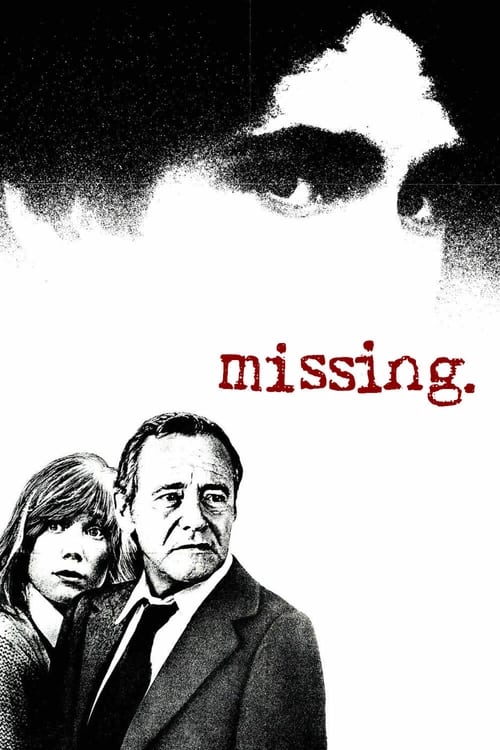
Missing
1982 · Costa-Gavras
For when you want a film with moral weight — a true-story thriller that makes you angry in a useful way. Choose it when you're ready to be gripped and unsettled rather than reassured.
What it's about
In the violent days after a military coup in a South American country, a young American writer vanishes. His father — a conservative, church-going businessman with full faith in his government — flies down to find him, joining forces with his son's wife, a woman he barely knows and doesn't much approve of. As they work their way through morgues, stadiums, and embassy offices, the father's trust in official answers begins to crack. It's based on a true story.
The experience
Gripping and quietly enraging — it plays like a detective story where every door leads to a politer, more chilling lie. The tension comes not from action but from the dawning realization of what the smiling officials aren't saying, and it leaves you shaken.
Performances
Jack Lemmon, cast brilliantly against his comic persona, gives one of the great late-career dramatic performances — a man of certainty being dismantled one condescending briefing at a time — and Sissy Spacek is fierce and wounded as the wife who saw the truth first.
The craft
Costa-Gavras builds dread through procedure: the search unfolds in real locations that feel documentary-true — curfews, gunfire in the distance, stadiums turned into holding pens — while Vangelis's haunting main theme gives grief a melody. The film's discipline never names the country outright, which somehow makes the horror more universal.
Why it matters
It took the top prize at Cannes, drew an official protest from the US State Department, and proved a Hollywood studio film could directly indict American foreign policy — a landmark for political cinema in the mainstream.
Snapshot
Missing is Costa-Gavras's first English-language feature and arguably the most fully achieved synthesis of his career-long project: the political thriller as a vehicle for documented atrocity. Adapted from Thomas Hauser's investigative book The Execution of Charles Horman: An American Sacrifice (1978), the film dramatizes the disappearance of a young American writer in the chaos following a US-supported military coup, and the search conducted by his estranged conservative father, Ed Horman (Jack Lemmon), and his wife Beth (Sissy Spacek). The coup is plainly that of September 1973 in Chile, which overthrew Salvador Allende and installed Augusto Pinochet — yet the film pointedly never names Chile, Allende, Pinochet, or any official by their true office. That elision is both a legal hedge and an aesthetic strategy, universalizing a specific crime into an indictment of US complicity abroad. The film won the Palme d'Or at Cannes (shared with Yılmaz Güney's Yol), a Best Actor prize there for Lemmon, and the Academy Award for Best Adapted Screenplay; it was nominated for Best Picture, Best Actor, and Best Actress. It also drew an official rebuttal from the US State Department and a libel suit — context inseparable from its standing as one of the most consequential political films Hollywood ever financed.
Industry & production
Missing was a major-studio production: financed and released by Universal Pictures, produced by Edward Lewis (a veteran of politically engaged Hollywood, having produced Spartacus and Seven Days in May) together with Mildred Lewis. That a European art-cinema political director of Costa-Gavras's profile was entrusted with American stars and a studio budget marks the film as a product of the early-1980s moment when New Hollywood's appetite for serious adult drama had not yet been fully displaced by the blockbuster. The casting of Jack Lemmon — an Everyman star associated with comedy and middlebrow drama rather than radical politics — was central to the film's strategy and its commercial viability: it placed a reassuring, deeply familiar American face at the center of a story about American culpability.
Production did not take place in Chile, which remained under Pinochet's dictatorship; principal photography was carried out largely in Mexico, with Mexican locations standing in for Santiago. The film's release in early 1982 generated immediate friction with the US government: the State Department issued a multi-page rebuttal disputing the film's portrayal of American officials' conduct. More damagingly, former US Ambassador to Chile Nathaniel Davis and two other named individuals brought a defamation suit against Costa-Gavras and Universal. The litigation reportedly led to the film's withdrawal from circulation for a period; the suit was ultimately dismissed. The precise commercial figures are not something I can state reliably, and I will not invent them — but the film performed respectably for a subtitle-free political drama and far exceeded the reach of Costa-Gavras's earlier French-language work.
Technology
Missing is a conventional 35mm color production of its era, and its technological interest lies less in any apparatus innovation than in two domains. The first is the electronic score by Vangelis, composed at the very height of the Greek musician's analog-synthesizer mastery — the same period that produced Chariots of Fire (1981) and Ridley Scott's Blade Runner (1982). The use of synthesizer textures rather than a traditional orchestral score for a realist political drama was, in 1982, a notably modern choice. The second is the film's reliance on the visual grammar of contemporaneous photojournalism and television news — the grain, framing, and immediacy of the documentary image — which Costa-Gavras and his cinematographer simulate within a fiction-film frame. Beyond these, the film makes no claim to technical novelty; its power is one of construction and performance rather than of tools.
Technique
Cinematography
The cinematography is by Ricardo Aronovich, the Argentine-born cameraman whose credits include Alain Resnais's Providence and work for Louis Malle — a pedigree that brought European modernist sophistication to the project. Aronovich's images alternate between two registers. In the present-tense search, the camera is mobile, handheld where useful, and embedded in crowds, stadiums, morgues, and corridors, lending a reportorial urgency. In the flashback structure — which reconstructs Charles's last days — the palette and light shift to register memory and dread. Across both modes, the framing favors the protagonists' bewilderment: figures dwarfed by institutional space, faces pressed against the indifference of bureaucracy. The much-cited sequences inside the national stadium converted into a detention center, and in the morgue stacked with bodies, derive their force from restrained, almost clinical composition rather than sensational coverage.
Editing
Editing is by Françoise Bonnot, Costa-Gavras's most important and enduring collaborator, who had cut Z (winning an Academy Award for it) and remained central to his cinema. Bonnot's contribution is structural: Missing interweaves the linear forward search with fragmented flashbacks of Charles before his disappearance, withholding the full picture until the accumulation of detail becomes unbearable. This is the architecture of the political thriller as Costa-Gavras and Bonnot perfected it — suspense generated not from whether a crime occurred but from the gradual, evidentiary disclosure of how and by whom. The rhythm is patient by thriller standards, building through interviews, denials, and small revelations rather than action.
Mise-en-scène / staging
The staging dramatizes power through environment: embassy waiting rooms, official offices with their flags and reassurances, the curfew-emptied streets where violence is glimpsed at the edges of the frame. Costa-Gavras repeatedly stages the gap between official language and physical reality — an American official offering bland assurances while, in the world the film shows us, bodies are accumulating. The single most discussed staging choice is the refusal to name the country, which abstracts the locale into a generalized site of US foreign-policy operation while keeping its real referent unmistakable.
Sound
Beyond Vangelis's synthesizer score — whose recurring, melancholic main theme functions as the film's emotional through-line — the sound design works to keep terror ambient and offscreen: distant gunfire, the mechanical authority of military vehicles, the curfew's silence punctured by sudden violence. The contrast between the calm, bureaucratic speech of officials and the soundscape of a city under martial law is one of the film's quiet structural ironies.
Performance
The performances are the film's engine. Jack Lemmon, in what many regard as his finest dramatic work, plays Ed Horman as a man whose patriotic faith is dismantled in real time; his Cannes Best Actor prize recognized a performance built on restraint and slow devastation rather than outburst. Sissy Spacek's Beth is the counterweight — the counterculture daughter-in-law Ed initially distrusts, whose worldview is vindicated by events. The drama's deepest current is the reconciliation of these two Americans, conservative father and bohemian wife, as shared grief and shared discovery collapse their political distance. John Shea, as the absent Charles, anchors the flashbacks with an idealism the film mourns.
Narrative & dramatic mode
Missing operates in the mode Costa-Gavras essentially codified: the fact-based political thriller, in which the conventions of the detective story — a disappearance, a search, the peeling back of cover-ups — are mapped onto real historical atrocity. The narrative is a procedural of inquiry, but its emotional spine is a familial and ideological conversion narrative. Ed Horman begins certain that his government and its institutions will help him; the dramatic arc is his education into the possibility that those same institutions were complicit in his son's death. This double structure — the outward investigation and the inward collapse of belief — gives the film a tragic shape rarely available to the thriller. The flashback fragments function as the buried truth the present-tense narrative is excavating.
Genre & cycle
The film belongs to the political-thriller cycle that Costa-Gavras inaugurated with Z (1969) and extended through The Confession (1970) and State of Siege (1972), the last of which already concerned US involvement in Latin American repression (Uruguay). Missing is the English-language, Hollywood-financed culmination of that cycle. It also sits within a broader early-1980s and 1970s strain of American "paranoid" political cinema — The Parallax View, Three Days of the Condor, All the President's Men — that dramatized institutional conspiracy and the citizen's disillusionment. What distinguishes Missing is that its conspiracy is not fictional invention but documented foreign policy, and that its accusatory finger points squarely at Washington.
Authorship & method
Costa-Gavras (born Konstantinos Gavras, Greek-French) built his authorship on a single, powerful proposition: that the political can be rendered as gripping popular narrative without sacrificing moral seriousness. His method fuses documentary research and journalistic sourcing with the propulsion of genre. For Missing he adapted Hauser's book with screenwriter Donald Stewart; their script won the Academy Award for Best Adapted Screenplay. The collaboration with editor Françoise Bonnot was, as throughout his career, fundamental to the film's evidentiary suspense. The Vangelis score was a departure from any single recurring composer in his earlier work and gave the film a contemporary, mournful signature. Cinematographer Ricardo Aronovich supplied the controlled, reportorial image. The directorial signature lies in the marriage of all these to a clear ethical argument — the conviction, shared with his earlier films, that naming complicity is itself a political act.
Movement / national cinema
Costa-Gavras is a figure of European political cinema — formed in France, working within and against the legacy of the nouvelle vague and the post-1968 politicization of film — rather than of any American movement. Missing is therefore a hybrid object: a European political auteur's sensibility executed with American studio resources and stars. It can be read alongside the engaged "Third Cinema" concerns of Latin American filmmakers who documented the era's dictatorships, though Costa-Gavras approaches that material from the outside, through the lens of US responsibility and an American family's experience. Within US film history it stands as one of the rare studio productions to directly indict American foreign policy.
Era / period
The film is doubly periodized: it depicts September 1973 and its immediate aftermath, and it speaks from 1982 — the early Reagan years, when US support for anti-communist regimes in Latin America was again ascendant policy. That contemporaneity sharpened its provocation; the film was not a safe retrospective on a closed chapter but an intervention in a live debate, which helps explain the vehemence of the official response. Aesthetically it belongs to the tail end of the serious, adult-oriented New Hollywood drama, made just before the industry's center of gravity shifted decisively.
Themes
The film's governing theme is the betrayal of citizen faith by the state — specifically the discovery that a government may treat its own nationals as expendable when they become inconvenient to policy. The book's original subtitle, An American Sacrifice, names this directly. Bound up with it are: the reconciliation of political opposites within a family under the pressure of grief; the chasm between official language and physical reality; American innocence (and arrogance) abroad and its violent correction; and the moral cost of anti-communist Cold War strategy. The film also meditates on knowledge itself — on how truth is buried, denied, and slowly, painfully reassembled by those who refuse to stop looking.
Reception, canon & influence
Critically, Missing was a landmark. Its Cannes Palme d'Or (shared with Yol) and Lemmon's Best Actor award there, followed by four major Academy Award nominations and the screenwriting Oscar, established it as a critical and institutional success of the first order. Reviews widely praised Lemmon's performance and the film's restraint relative to the more openly agitational Z. The State Department rebuttal and the Nathaniel Davis libel suit — later dismissed — paradoxically amplified its cultural footprint, confirming that the film had struck a nerve in the institutions it accused.
Looking backward, the film's influences are clear: Costa-Gavras's own Z and State of Siege supplied the template; the American conspiracy thrillers of the 1970s supplied a Hollywood vernacular for institutional dread; and Hauser's reportage supplied the documented spine. Looking forward, Missing helped legitimize the fact-based political drama as serious studio business and stands as a touchstone for later films treating US involvement in Latin American repression and the disappeared (the desaparecidos), as well as for the broader genre of films dramatizing journalists' and families' confrontations with state cover-up. Its central image — an ordinary, patriotic American father discovering his country's hand in his son's death — has become a reference point for how popular cinema can stage political disillusionment. The historical record on Charles Horman's case itself remained contested for decades, with subsequent declassifications continuing to inform the debate the film provoked; on the specifics of those later disclosures I would defer to the documentary and historical record rather than overstate what the film itself established.
A Deleuzian reading
Somewhere in the middle of *Missing*, a father walks the length of a morgue.
The full Deleuzian reading of Missing →
Reception
A sensation in 1982 — Palme d'Or winner (shared with Yol), four Oscar nominations, and a genuine diplomatic incident, with the US State Department issuing a rebuttal before it even opened. Today it's settled into the political-thriller canon, though it's oddly less name-checked than Costa-Gavras's Z — a Criterion-blessed classic that still feels under-discussed.
How Missing was received, from release to now →
Influences: the films it descends from and the films it influenced
- Z (1969) — With editor Françoise Bonnot, Costa-Gavras forged the evidentiary-suspense cutting that assembles fragments of testimony and flashback into an accusatory montage — the exact editorial template Missing reuses.
- State of Siege (1972) — Supplied the unnamed-Latin-American-country staging and the procedural dramatization of US complicity in regional repression as a tightening genre thriller.
- The Confession (1970) — Established his method of rendering one citizen ground down by a state apparatus through accumulating bureaucratic detail and restraint rather than overt agitation.
- The Battle of Algiers (1966) — Its newsreel-grain handheld camera and docudrama reconstruction of political violence model the reportorial image Aronovich pursues in Missing.
- All the President's Men (1976) — Built the investigative-procedural architecture in which dogged document-gathering against institutional stonewalling, not action, generates the suspense Missing inherits.
- The Parallax View (1974) — Gordon Willis's compositions dwarfing the lone figure inside monumental institutional architecture prefigure Missing's framing of figures swallowed by official space.
- Three Days of the Condor (1975) — Codified the 70s paranoid-conspiracy vernacular of an ordinary innocent discovering that his own government is the lethal threat.
- The Battle of Chile (1977) — Its documentary record of the 1973 coup and its machinery supplies the factual, on-the-ground spine that Missing's docudrama reconstructs in fiction.
- The China Syndrome (1979) — Costa-Gavras's American co-production procedural inherits China Syndrome's dark-ending grammar: the systematic destruction of documentary evidence by a corporate-state apparatus, an investigation that proves the cover-up and simultaneously fails to break it, and a final confirmation via real-world title cards that institutional impunity prevailed.
- Invasion (1969) — Aronovich transfers the Aquilea grammar to an actual coup: unmarked vehicles and cordons framed in wide, flat, mid-distance compositions that keep the occupying force anonymous and architectural instead of dramatizing individual soldiers.
- The Killing Fields (1984) — Carries forward the fact-based docudrama of a Westerner confronting state atrocity and disappearance, anchored by restrained against-type lead performance.
- Salvador (1986) — Drives the American-innocence-abroad disillusionment into a death-squad context, using documented reportage as its narrative scaffold.
- The Official Story (1985) — Extends the desaparecidos theme from inside Latin American cinema, dramatizing a citizen's slow devastating discovery of the state's hand in disappearance.
- JFK (1991) — Escalates the Bonnot-style evidentiary montage into full conspiracy-assembly editing, cutting testimony and reconstruction into prosecutorial argument.
- No (2012) — Returns to Pinochet-era Chile, deploying period reportorial video texture to dramatize resistance to the same regime Missing implicates.
- Syriana (2005) — Inherits the restrained, institution-dwarfs-the-individual political thriller of American complicity abroad, withholding catharsis for procedural dread.
- Spotlight (2015) — Continues the families-and-journalists-versus-institutional-cover-up procedural, generating suspense purely from the accumulation of documentary evidence.
- Argo (2012) — The political thriller as docudrama indictment: period-authentic reconstruction of an American government's complicity in a foreign crisis, using parallel timelines and an institutional paper trail to simultaneously build suspense and make a historical argument — Argo's structure and its nationalist omission problem in miniature.
- A Taxi Driver (2017) — The civilian outside-witness structure: an apolitical character drawn into the machinery of state terror through physical movement across a dangerous city, whose professional identity (the 'innocent abroad') is the dramatic precondition for the audience's surrogate moral awakening — the craft template for Man-seob's arc.
- Argentina 1985 (2022) — Dramatizes the pursuit of truth about Latin American state terror via a protagonist navigating an obstructive official apparatus, favoring behavioral restraint over melodramatic catharsis.
- Four Days in September (1997) — Plants an American star inside a Latin American dictatorship reckoning, anchoring state terror through a sympathetic outsider and a procedural, evidence-gathering structure.
- Sometimes in April (2005) — Dramatizes Western governmental complicity through an official's belated reckoning across two timeframes — the 'what did our government know and permit' structure that drives Peck's US State Department scenes.
- The Year of Living Dangerously (1982) — A Western innocent abroad amid a foreign coup, sustained by ambient offscreen terror and rumor rather than depicted violence — the same atmospheric strategy as Missing.
- Under Fire (1983) — Extends the fact-based confrontation of American journalists with US-backed Latin American repression, foregrounding the witness's complicity in the image.
Similar films
- Z (1969) — influence & lineage · same viewing thread
- The Official Story (1985) — influence & lineage · same viewing thread
- State of Siege (1972) — influence & lineage
- JFK (1991) — influence & lineage
- The Killing Fields (1984) — influence & lineage
- The Secret Agent (2025) — same viewing thread
- I'm Still Here (2024) — same viewing thread
- Twenty Years Later (1984) — same viewing thread
All the films related to Missing →
Watch it with: curated runs of related films
- The Long Shadow of the Coup — A run of films tracing political violence from the mutiny and the massacre through martial law to the decades-long reckoning that follows — watch them near each other and the same machinery of power keeps rhyming across continents and eras.