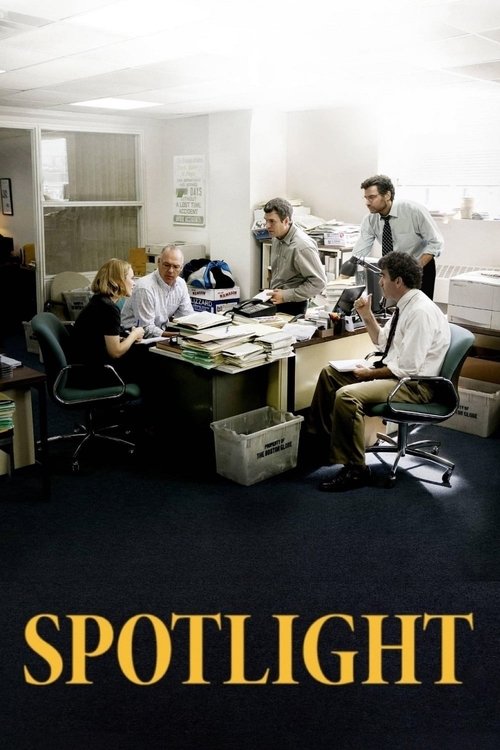
Spotlight
2015 · Tom McCarthy
For when you want a serious, grown-up film that earns your anger — absorbing, sobering, and worth talking about after. It's a challenge to the heart but never a slog; the momentum of the reporting carries you.
What it's about
Boston, 2001. A small investigative team at the Boston Globe — the Spotlight unit — starts pulling on a thread about a priest accused of molesting children, and finds the thread doesn't stop. It follows the reporters and editors as they chase court records, coax wounded survivors into talking, and push against a church, a legal system, and a city that have every reason to look away. The story is true, and the film sticks close to how the work actually got done.
The experience
Quietly gripping rather than flashy — the tension builds through phone calls, spreadsheets, and doors closing in faces, until the scale of what's being uncovered starts to make your stomach drop. It's restrained on the surface and furious underneath, and it leaves you shaken by how ordinary the cover-up looked from inside.
Performances
A true ensemble piece: Michael Keaton's weathered team editor, Mark Ruffalo's coiled, restless reporter, and Rachel McAdams's patient, empathetic interviewer all disappear into working journalists, while Liev Schreiber and Stanley Tucci do a lot with very little. Nobody grandstands, which is exactly the point.
The craft
The Oscar-winning screenplay is a machine of small revelations — every scene advances the investigation, and the film trusts you to keep up. Tom McCarthy directs with deliberate plainness: drab offices, fluorescent light, no swelling manipulation, so that when emotion breaks through it lands hard. It's a film built on writing and acting rather than spectacle, and it plays beautifully anywhere.
Why it matters
Winner of Best Picture, it became the modern benchmark for journalism dramas and renewed public reckoning with abuse in the Catholic Church — proof that a patient procedural could still command the culture.
Snapshot
Spotlight is a procedural drama reconstructing the Boston Globe's Spotlight investigative team and their 2002 exposé of systemic child sexual abuse within the Archdiocese of Boston. Directed by Tom McCarthy and written by McCarthy and Josh Singer, the film is structured as a rigorous accumulative procedural — patient, disciplined, and deliberately restrained in emotional register. It won the Academy Award for Best Picture and Best Original Screenplay at the 88th Academy Awards. Its ensemble cast includes Michael Keaton, Mark Ruffalo, Rachel McAdams, Liev Schreiber, Brian d'Arcy James, John Slattery, Stanley Tucci, and Billy Crudup. The film is widely regarded as one of the finest journalism pictures in American cinema and a landmark of the prestige-drama cycle of the 2010s.
Industry & production
Spotlight was produced by Participant Media, Anonymous Content, and First Look Media, with Open Road Films handling domestic distribution. Participant Media, founded by Jeff Skoll, has a consistent mandate of socially engaged filmmaking — its slate has included An Inconvenient Truth (2006), Syriana (2005), and Lincoln (2012) — and Spotlight fit squarely within that mission. The budget has been widely reported at approximately $20 million, modest for a film that would go on to gross roughly $98 million worldwide.
The production secured substantial access to Boston locations, shooting extensively in and around the actual Globe building on Morrissey Boulevard, as well as courthouses, churches, residential streets, and the institutional topography of greater Boston. The casting of a seasoned ensemble — many coming off major franchise or prestige work — was assembled with actors accepting fees below their customary rates, a testament to the material's appeal to performers invested in the craft. The film premiered at the Venice Film Festival in September 2015, followed by Toronto, before its limited theatrical release in October and wide release in November of that year. The Venice–Toronto–Academy pipeline it rode became a template other prestige films would follow throughout the decade.
McCarthy and Singer spent years in research before production, meeting extensively with the surviving Spotlight team members — Walter "Robby" Robinson, Michael Rezendes, Sacha Pfeiffer, and Matt Carroll — as well as with lawyers and survivors, building the documentary foundation that gives the screenplay its procedural credibility. Singer's background as a Yale Law graduate shaped the script's precision around court filings, sealed records, and the legal architecture protecting the Archdiocese.
Technology
The film was shot digitally, in all probability on the Arri Alexa — the dominant acquisition platform for prestige dramatic features of the mid-2010s — though the public record on precise lens and format configuration is thin. Cinematographer Masanobu Takayanagi calibrated the image toward a flat, desaturated naturalism: fluorescent office interiors, overcast Boston exteriors, no cinematic augmentation of available light. The choice deliberately evokes documentary and news-photography aesthetics — the world looks like it should look rather than how a conventional thriller would render it. The absence of post-production color grading to introduce mood is itself a statement of intent, aligning the film's visual grammar with journalism's claim to unadorned facticity.
Howard Shore, brought in as composer, wrote a deliberately quiet score — sparse piano and string passages that enter and exit without underlining emotional peaks. Many sequences of interview and discovery are left entirely unscored, the sound design carrying the weight of ambient realism alone.
Technique
Cinematography
Takayanagi's approach is defined by discipline and restraint. The camera rarely departs from functional placement: over-the-shoulder compositions in interviews, mid-shots in the newsroom, wide establishing shots of institutional façades. Handheld movement is used selectively and unobtrusively — the camera breathes rather than jolts. Longer focal-length lenses compress depth in public spaces, placing characters within a dense social fabric. The effect is that Boston itself — its neighborhoods, its Catholic geography of churches and schools, its working-class parishes — becomes a volumetric presence rather than a backdrop. Wide shots of empty Catholic properties carry architectural accusation without editorializing. Takayanagi's lighting relies heavily on the practical sources of each location: the film's light is institutional because its subjects inhabit institutions.
Editing
Tom McArdle's editing is tightly functional. The film runs 128 minutes and covers months of reporting; McArdle and McCarthy construct scenes that end at informational sufficiency rather than emotional payoff. Scenes cut when a character has what they came for — a name, a document, a refusal — not when the emotional temperature peaks. This reinforces the film's procedural logic: story as evidence assembled piece by piece. There is no conventional montage deployed to accelerate time; the tempo of the investigation is preserved in individual scenes while the larger shape of months is conveyed through title cards and accumulating paper. McArdle received an Academy Award nomination for Best Film Editing.
Mise-en-scène / staging
The film's staging is consistently oriented toward the mundane texture of institutional life. The newsroom — cluttered with paper, low partitions, fluorescent overhead fixtures — reads as a workspace, not a set. McCarthy stages performance within this environment rather than around it: actors navigate real furniture, document boxes, actual corridors. When reporter Sacha Pfeiffer sits across from a survivor in a small kitchen, the staging is nearly documentary in its spatial logic. The film's most charged scene — Rezendes confronting Robinson about the decision to delay publication — takes place in the middle of that open newsroom, the institutional space amplifying and contextualizing the moral argument.
Production designer Lilly Kilvert furnished the film's environments with period-specific props: pre-smartphone Globe equipment, print directories, filing systems, hand-annotated city maps. The physical presence of paper — stacks of documents, Lexis-Nexis printouts, annotated phone books — is central to the story's dramatic logic. The material conditions of pre-digital investigative journalism are not background but subject.
Sound
Shore's score for Spotlight represents a deliberate departure from his large-scale orchestral work. Where the Lord of the Rings trilogy deploys full symphonic architecture, Spotlight uses primarily solo piano and sparse strings in single-instrument passages. The score arrives late in scenes and withdraws without anchoring emotional beats — a refusal of the instructive function that conventional dramatic scoring performs. The film's ambient sound design does corresponding work: phones, keyboards, the ambient noise of a working newsroom, Boston street sound. Crucially, there is no musical "reveal" moment when the scope of abuse becomes clear. The horror is delivered through accumulation, not punctuation, and sound design honors that principle throughout.
Performance
The ensemble cast operates in a collective mode unusual for films with this scale of star power. No single performer is staged as protagonist; the Spotlight team functions as a unit, and screen time is distributed with uncommon equity. Mark Ruffalo's Rezendes is the most behaviorally active performance — high-energy, slightly unkempt, prone to barely suppressed agitation — and received the film's sole acting Oscar nomination (Best Supporting Actor). Michael Keaton plays Robinson with a contained institutional register, the weight of a man embedded in a system he has partly helped perpetuate. Liev Schreiber's Marty Baron is a remarkable act of restraint: the editor who catalyzes the investigation is portrayed as nearly affectless, his intelligence visible only through silence and precision of word. Rachel McAdams brings warmth and moral directness to Pfeiffer. Stanley Tucci, as victims' attorney Mitchell Garabedian, gives the film's most sharply etched supporting turn — laconic, exhausted, morally certain in his exhaustion. McCarthy has spoken about directing the ensemble by suppressing the actors' instinct toward emotional demonstration: the film's method required that revelations register as information processed rather than feelings performed.
Narrative & dramatic mode
Spotlight is a procedural in the strictest sense: it structures narrative as a sequence of reportorial actions — interviews, document requests, archival research, legal filings, source cultivation — rather than as dramatic confrontation between morally opposed parties. The antagonists — the Archdiocese, the institutional Church, the city's cultural Catholicism — are largely offscreen, present as evasion, redacted documents, and unanswered phones. The narrative mode derives from the logic of journalism itself: the story is assembled from fragments, and comprehension arrives through accumulation.
This mode is unusual in prestige drama, which typically relies on the confrontation scene as its unit of dramatic payoff. Spotlight deliberately defers and finally withholds that confrontation. Cardinal Bernard Law appears briefly and obliquely; no single figure is brought to direct account within the film's timeframe. The dramatic climax is a newsroom conversation about a publication decision — not an arrest, not a confrontation — and the film's final act is not triumph but sobering expansion: the realization that this scandal is not local but systemic and global. The film ends on screen text listing Archdioceses that subsequently reported similar abuse worldwide, closing on moral enormity rather than resolution. It is a structural choice that refuses the audience the psychological relief of closure.
Genre & cycle
Spotlight belongs to the American tradition of the newspaper-procedural film, whose prestige lineage runs from His Girl Friday (1940) and Ace in the Hole (1951) through the politically engaged variants of the 1970s. Its dominant formal ancestor is All the President's Men (1976, dir. Alan J. Pakula), which established the procedural grammar of document-gathering, source cultivation, and institutional resistance as the dramatic vocabulary of the journalism film. McCarthy and Singer have been explicit about this inheritance. Pakula's film likewise avoided the confrontation scene, locating drama in the accumulation of partial knowledge.
Within its immediate cycle, Spotlight appeared alongside a notable cluster of investigative and institutional dramas in the mid-2010s: The Big Short (McKay, 2015), Truth (Vanderbilt, 2015), 99 Homes (Bahrani, 2014). The cycle reflects a period anxiety about institutional failure and accountability — financial, journalistic, religious — that characterized the decade following the 2008 crisis. Participant Media's presence across several of these productions is itself a structural feature of the cycle, not coincidence.
The film also belongs to the narrower genre of works engaging the Catholic Church abuse scandal: Amy Berg's documentary Deliver Us from Evil (2006) preceded it; a subsequent wave of fictional and documentary treatments attest to the ongoing cultural processing of the crisis in the years following Spotlight's release.
Authorship & method
Tom McCarthy began his directing career with intimate, character-driven independent films: The Station Agent (2003), a Sundance prize-winner about an isolated train enthusiast; The Visitor (2008), about an economics professor who discovers undocumented immigrants living in his New York apartment; and Win Win (2011), a moral comedy about a struggling suburban attorney. McCarthy has also maintained a parallel career as a character actor, including a recurring role in The Wire's fifth season — playing a journalist, an irony the press has widely noted in light of Spotlight. He received a story credit on Pixar's Up (2009), attesting to the range of his narrative sensibility. His authorial signature across his work is the patient revelation of moral complexity through behavior rather than argument: characters who are implicated in systems they thought they understood. Spotlight is the largest-scale expression of this recurring theme.
Josh Singer co-wrote the screenplay, bringing a legal background that shaped the script's procedural precision around court filings, canonical law, and the specific legal architecture the Archdiocese used to seal settlement records. Singer subsequently wrote The Post (2017, dir. Spielberg, with Liz Hannah) and First Man (2018, dir. Damien Chazelle), consolidating a career in historical drama centered on institutional accountability.
Masanobu Takayanagi had established his naturalistic aesthetic with Joe Carnahan's The Grey (2011) before bringing his discipline to Spotlight. His work consistently favors available-light realism over cinematic augmentation, and McCarthy's project demanded precisely that restraint.
Tom McArdle, a long-term McCarthy collaborator who also edited Win Win, maintained the film's editorial discipline and received his Academy Award nomination for the precision of his work.
Howard Shore's score represents one of his most self-effacing efforts — a political choice understood by both composer and director as demanded by the subject. Sentimentalizing horror through scoring would have violated the film's fundamental ethical contract with its material.
Movement / national cinema
Spotlight occupies the space between studio production and fully independent filmmaking that characterized serious American drama in the 2010s. It is financed and distributed within studio-adjacent infrastructure (Open Road, Participant) but produced with the ethos — controlled budget, ensemble cast, location shooting, no conventional spectacle — of independent cinema. Its social-realist aesthetic aligns it with a strand of American filmmaking that has historically looked toward European models (Italian neorealism, British social realism, the verité aesthetics of the French New Wave) while remaining grounded in the Hollywood procedural tradition.
The film is intensely, specifically American in its subject: the tension between Catholic institutional power and civic accountability is filtered through Boston's particular history as a heavily Irish-Catholic city in which the Church and civic culture were deeply intertwined across generations. The film maps that geography carefully — the density of Catholic institutions per zip code is visualized literally, on a printed city map — insisting on the local and specific before arriving at claims of universal institutional failure.
Era / period
Spotlight is a product of a mid-2010s moment of American institutional anxiety. The decade following the 2008 financial crisis generated a cycle of prestige films preoccupied with systemic corruption and the inadequacy of accountability mechanisms. The film's production also coincided with the continued global metastasis of the Catholic Church abuse scandal first reported in the United States in 2002; by 2015, investigations were ongoing or newly disclosed in Australia, Ireland, Chile, Germany, and elsewhere. The film's closing screen text made this explicit connection.
The film's relationship to journalism is also period-specific. Spotlight was released at a moment when the future of investigative print journalism was in acute institutional question: newsroom contractions, the collapse of classified advertising, and the migration of readers online had hollowed out the institutional infrastructure that made the original 2002 investigation possible. The film carries an implicit elegiac argument — that long-form institutional investigation requires the institutional support of a newspaper — that read as urgent rather than historical at the time of release.
Themes
Institutional complicity and structural silence: The film's central argument is that the abuse was sustained not only by individual perpetrators but by a system — the Archdiocese, the legal establishment, the civic culture, and notably the Globe itself — that chose not to know. The film's most disturbing implication is that the story could have been published years earlier; the Globe had received prior tips that went unpursued. Spotlight is as much about the conditions that enable silence as about the act of disclosure.
The moral geography of community: Boston's Catholic identity is not incidental to the cover-up's durability but constitutive of it. Survivors stayed silent partly because the Church was their community's social and moral center. The Spotlight reporters themselves are mostly Catholic or culturally Catholic — Pfeiffer's interview scenes with elderly parishioners register this ambivalence precisely — and the film takes seriously the personal reckoning of people reporting on an institution they were raised within.
Journalism as civic institution: The film makes an explicit argument that investigative journalism requires institutional support — editors willing to dedicate reporters to months of work, legal infrastructure to litigate for sealed records, institutional memory to locate prior suppressed tips. The arrival of Marty Baron as an outsider to Boston's cultural Catholicism is the proximate trigger for the investigation, and the film holds him up as evidence that institutional reform often requires someone without inherited loyalties. The argument extends implicitly to the journalism of 2015, in which that institutional infrastructure was diminishing.
The weight of the archive: Documents are the film's dramatic objects. The act of recovering suppressed information from institutional archives — church directories, court-sealed settlement records, annotated maps, canonical law texts — is rendered as both procedural labor and moral act. The paper trail is not metaphor but literal evidence, and its physical accumulation on desk surfaces functions as visual argument about what institutions conceal.
Reception, canon & influence
Critical reception: Spotlight received near-universal critical acclaim on release. Reviewers converged on the comparison to All the President's Men while consistently noting Spotlight's even greater tonal restraint. The ensemble performances — particularly Ruffalo, Keaton, and Schreiber — were widely cited, as was the screenplay's structural discipline. The film holds an exceptionally high approval rating across aggregator platforms, reflecting rare critical consensus. Its Best Picture win at the 88th Academy Awards was interpreted as a statement by the Academy in favor of serious, non-spectacular adult drama at a moment of industry pressure toward franchise dominance.
Influences on the film (backward): All the President's Men (1976) is the primary formal ancestor, and McCarthy and Singer have been explicit about this inheritance: the procedural grammar of source cultivation, documentary breakthrough, and institutional resistance that Pakula codified is directly inherited here. David Fincher's Zodiac (2007) is the more proximate cinematic ancestor in terms of tonal register: Zodiac's methodical, emotionally flat procedural mode — the investigation as obsession that yields no catharsis, no arrest, no closure — was a clear template for Spotlight's refusal of dramatic payoff. The film also draws on the tradition of documentary realism that runs through Italian neorealism and into Frederick Wiseman's institutional documentaries of the 1960s and 1970s, in which the camera functions as an embedded, non-interventionist observer of institutional process. The politically engaged American cinema of the 1970s — The Parallax View (1974), Network (1976) — provides the broader ideological tradition within which the journalism-film genre crystallized.
Legacy / what it shaped (forward): Spotlight's most direct successors in the institutional procedural form are The Post (2017, Spielberg), which Singer also co-wrote and which applies the same grammar to the Pentagon Papers case, and Todd Haynes's Dark Waters (2019), about the DuPont PFAS contamination case, which inherits Spotlight's approach to the slow, unglamorous accumulation of institutional wrongdoing documented through legal and scientific records. Maria Schrader's She Said (2022), reconstructing the New York Times investigation of Harvey Weinstein, is the most structurally faithful successor — following the Spotlight template almost point for point, from the ensemble reporter dynamic to the accumulative interview methodology to the final-act expansion of scope. The film also demonstrated viable commercial economics for modestly budgeted, adult-oriented procedural drama without action or romance, influencing the prestige-drama production calculus of the late 2010s. Beyond cinema, Spotlight is understood to have had measurable real-world impact: its release is credited by journalists and survivors' advocates with contributing to the renewed global attention that prompted further church investigations and disclosures in the years immediately following, a rare instance of a film's influence extending into the institutions it depicted.
A Deleuzian reading
A reporter sits across a kitchen table from a man who was molested as a boy.
The full Deleuzian reading of Spotlight →
Reception
Universally acclaimed on release and crowned Best Picture, it was almost immediately tagged as an 'unflashy' winner — but the years since have flipped that into a defense, with its restraint now widely praised as the whole point.
How Spotlight was received, from release to now →
Influences: the films it descends from and the films it influenced
- All the President's Men (1976) — Gordon Willis's overhead fluorescent lighting in the Post newsroom — flat, functional, unbeautified — and Pakula's procedural grammar of source cultivation, institutional stone-walling, and documentary breakthrough establish the newsroom-as-workspace cinematographic template that Spotlight inherits as its declared primary formal model.
- Zodiac (2007) — Fincher structures the investigation as bureaucratic accumulation without cathartic resolution — the case goes cold, the suspect is never charged — directly modeling Spotlight's refusal of dramatic payoff and its staging of institutional wrongdoing as a process that outlasts individual agency rather than yields to it.
- The Parallax View (1974) — Pakula's model of the journalist-investigator confronting systematic institutional conspiracy that absorbs and neutralizes individual inquiry — the institution always larger than the investigator — establishes the structural dynamic Spotlight inherits, though Pakula's paranoid thriller register is stripped away in favor of procedural restraint.
- Network (1976) — Lumet and Chayefsky's model of institutional critique delivered through professional behavior in functional media workspaces — offices, newsrooms, boardrooms — rather than private melodrama establishes the staging vocabulary of media-industry systemic failure that Spotlight inherits, shorn of its satirical register.
- Serpico (1973) — Lumet stages institutional corruption through accumulative procedural evidence — testimony, documents, hearings — rather than action confrontation, and suppresses Pacino's performance within bureaucratic process, modeling Spotlight's refusal of investigative heroism and its structure of institutional resistance documented rather than dramatized.
- The Insider (1999) — Dante Spinotti's desaturated available-light palette applied to corporate whistleblower proceduralism — long-lens compression of institutional spaces, suppressed ensemble performance registers in functional workspaces — establishes the visual and performance grammar for institutional wrongdoing that Spotlight's cinematographer Eigil Bryld and ensemble directly adopt.
- Welfare (1975) — Wiseman's non-interventionist camera embedded within bureaucratic intake process — observing institutional dysfunction through behavioral accumulation without editorializing, treating paperwork and procedural waiting as primary subjects — models the documentary realism Spotlight translates into scripted fiction.
- Michael Clayton (2007) — Gilroy and Robert Elswit deploy suppressed ensemble performance registers, functional available-light office cinematography, and accumulative revelation of corporate wrongdoing structured through legal and documentary records rather than thriller confrontation — anticipating Spotlight's institutional proceduralism with near-identical formal means.
- Kill the Messenger (2014) — Cuesta applies the same journalism-film procedural grammar — source cultivation, editorial pressure, institutional legal counter-attack — to Gary Webb's CIA drug-trafficking investigation, sharing Spotlight's ensemble newsroom staging and accumulative interview structure while giving the form its darkest variant: the institution destroys the reporter.
- Z (1969) — McCarthy's institutional investigation procedural inherits Z's bureaucratic containment performance register — investigators who suppress emotion while accumulating documentary evidence against a protected institution — and its foregone-conclusion structure, in which the scale of the crime is revealed procedurally rather than dramatically.
- Good Night, and Good Luck. (2005) — McCarthy inherits institutional ambiguity as the journalism procedural's central dramatic engine: the drama is not individual heroism but evidence accumulating inside institutional spaces, with investigative process replacing confrontational affect—the same formal restraint Clooney applies to the Murrow campaign.
- Argo (2012) — Inherits Argo's ensemble-of-competent-professionals grammar: performance-driven blocking without directorial stylization, institutional obstruction as the primary dramatic obstacle, and the investigation itself — the accumulation of documents and interviews — as the thriller action.
- The Post (2017) — Josh Singer co-wrote both films, and The Post directly transplants Spotlight's procedural grammar — accumulative document discovery, institutional editorial resistance, ensemble newsroom staging — onto the Pentagon Papers case, though Spielberg introduces camera movement and score that Spotlight deliberately withholds.
- Dark Waters (2019) — Haynes adopts Spotlight's approach to unglamorous institutional wrongdoing — the DuPont PFAS case documented through legal filings and scientific records rather than confrontational scenes — inheriting its desaturated palette and accumulative procedural structure while extending the form from journalism to environmental litigation.
- The Report (2019) — Burns applies Spotlight's procedural grammar to the Senate Intelligence Committee investigation of CIA torture — accumulative document review, institutional counter-obstruction staged bureaucratically, ensemble of analysts rather than a singular hero — with the same refusal of cathartic justice and functional available-light workspace cinematography.
- Official Secrets (2019) — Hood inherits Spotlight's intersecting ensemble structure — dual tracks of legal defense and journalistic investigation converging on institutional disclosure — applying the same suppressed performance register and functional institutional staging to GCHQ whistleblower Katharine Gun's transatlantic wrongdoing case.
- She Said (2022) — Schrader follows Spotlight's template almost point-for-point in reconstructing the Times Weinstein investigation: dual-reporter ensemble, accumulative interview methodology that expands in final-act scope, and institutional legal obstruction staged as bureaucratic patience rather than dramatic confrontation.
- Chithha (2023) — Models procedural restraint around child sexual abuse that refuses sensational reenactment, keeping victims' shame central and the horror strictly implied.
- Truth (2015) — Released the same awards season, Vanderbilt's procedural applies the same ensemble reporter dynamic, accumulative document-and-source methodology, and institutional editorial resistance to the CBS News/Dan Rather scandal, using equivalent unbeautified newsroom staging and suppressed performance registers throughout.
- The Social Network (2010) — Revives the All the President's Men documentation-procedural in a restrained prestige register, dramatizing institutional reporting through records rather than spectacle.
- Zero Dark Thirty (2012) — McCarthy applies Boal's journalism-as-method procedural architecture — investigative accumulation replacing psychological characterization, sources and documents as narrative grammar — to institutional accountability, sharing Zero Dark Thirty's scoreless momentum and the epistemological model of witnessing without editorializing.
- Molly's Game (2017) — Awards-season prestige drama driven by procedural verbal density rather than visual ambition, in which a group's professional tenacity constitutes the primary dramatic subject — sharing with Molly's Game a position in the 2010s prestige cycle that values screenplay architecture and ensemble performance over directorial signature.
- The Man Standing Next (2020) — Procedural restraint as formal ethics: ambient institutional texture, ensemble naturalism in unglamorous office spaces, and the deliberate refusal of melodramatic scoring at moments of revelation—the formal grammar of letting information carry its own dramatic weight that Woo practices throughout.
- Argentina 1985 (2022) — Ensemble investigative procedure built on deliberate emotional restraint, sparse scoring, and trust in the documentary material rather than dramatized confrontation — the closest contemporary tonal model.
- 12.12: The Day (2023) — McCarthy's investigative procedural renders institutional obstruction through the same formal toolkit 12.12 deploys in a military register: telephone calls that expose hierarchy rather than transmit information, documents that trace authorization chains, and near-real-time compression of institutional process into legible dramatic tension.
- Conclave (2024) — The Catholic institutional secrecy thriller built on procedural nested revelation: dramatic tension accumulated through documents, phone calls, and reluctant testimony rather than physical confrontation, arriving at institutional indictment through editorial accumulation — the identical formal strategy, the identical institution.
- September 5 (2024) — Sustains the ensemble-restraint journalistic procedural, suspense built from documents, verification, and quiet collective labor rather than individual heroics.
- Absence of Malice (1981) — Extends the comprehension-paced editing of investigative reporting and the withhold-and-reveal disclosure of facts, the procedural rhythm Absence of Malice shares with its press-film lineage.
- Moneyball (2011) — Process-journalism drama of institutional investigation built from documents and door-knocking, with ensemble restraint and a deliberately un-triumphal climax in the All the President's Men lineage.
- Philomena (2013) — Independently arrives at the same anti-thriller treatment of Catholic institutional abuse: the drama is document retrieval, refused meetings and clerical politeness, with the camera kept at neutral eye-level and the score withheld from every scene that could have been scored for outrage.
Similar films
- The Post (2017) — influence & lineage
- Michael Clayton (2007) — influence & lineage
- Serpico (1973) — influence & lineage
- The Report (2019) — influence & lineage
- Doubt (2008) — shared sensibility
- Silence (2016) — shared sensibility
- The Hunt (2012) — shared sensibility
- Capote (2005) — shared sensibility
All the films related to Spotlight →