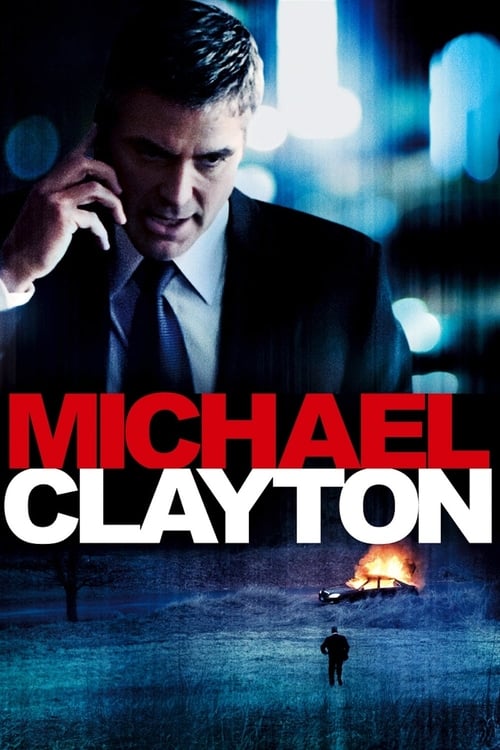
Michael Clayton
2007 · Tony Gilroy
For a serious grown-up movie night when you want tension without explosions — something smart and gripping that respects your attention. Reach for it when you're in the mood to watch a compromised man decide what he's actually worth.
What it's about
George Clooney plays the in-house 'fixer' at a powerful New York law firm — the man who quietly cleans up messes for partners and clients, and knows exactly what that's made of him. When the firm's most brilliant litigator has a very public breakdown in the middle of defending a chemical company against a multibillion-dollar lawsuit, Clayton is sent to contain him — and starts to suspect the case is rotten all the way down.
The experience
A slow-burn thriller that runs on dread and moral pressure instead of chases: hushed conversations, career-long compromises coming due, a knot in your stomach that tightens scene by scene. It's talky in the best way — every line is doing work — and it builds to a payoff that earns the wait.
Performances
Clooney gives one of his best performances as a man hollowed out by his own usefulness; Tom Wilkinson is electric as the litigator whose crack-up might actually be clarity; and Tilda Swinton, who won an Oscar for the role, is unforgettable as a corporate counsel rehearsing herself into ruthlessness.
The craft
Tony Gilroy's directing debut, and his screenplay is a machine — a story told slightly out of order so that ordinary scenes detonate on the second pass. The film deliberately revives the muted, paranoid texture of 1970s American thrillers: unglamorous light, real offices, silence used like a weapon.
Why it matters
Instantly recognized as a modern classic of the legal thriller, it launched Gilroy as a director and became the benchmark people cite when they ask why studios don't make smart mid-budget dramas for adults anymore.
Snapshot
Michael Clayton is a corporate-legal thriller built around moral exhaustion rather than action. George Clooney plays the title character, an in-house "fixer" at a powerful New York law firm whose job is to clean up the indiscretions of partners and clients — a man too compromised to be a lawyer in good standing and too useful to be let go. The plot turns on a multibillion-dollar class-action suit against an agrochemical giant, U/North, and on the breakdown of the firm's brilliant litigator, Arthur Edens (Tom Wilkinson), who comes to believe the company is guilty and resolves to expose it. The film marked the directorial debut of Tony Gilroy, previously known as a screenwriter, and arrived at the close of a decade in which Clooney and his collaborators were deliberately reviving the texture of 1970s American studio drama. It was widely praised on release, earned seven Academy Award nominations, and won one — Best Supporting Actress for Tilda Swinton. Its lasting reputation rests on its tone: cold, adult, procedural, and unusually attentive to the machinery of institutional self-protection.
Industry & production
The film was produced in part through Section Eight, the production company founded by Clooney and Steven Soderbergh, who served as executive producers; Sydney Pollack — who also acts in the film as firm chief Marty Bach — was among the credited producers, and Castle Rock Entertainment and Warner Bros. were attached to the production and release. The project's industrial significance lies less in its budget than in its position within a mid-2000s wave of star-driven "serious" adult dramas that bigger studios were increasingly reluctant to finance. Gilroy has discussed in interviews the difficulty of getting a dialogue-driven film with no conventional action greenlit, and the participation of Clooney as star and Soderbergh and Pollack as producing patrons was decisive in making it viable. I do not have reliable budget or box-office figures to cite precisely and will not invent them; the film is generally understood to have been a modestly budgeted production that performed respectably and exceeded expectations during awards season. Its commercial logic was the prestige model: a relatively contained shoot, a marquee lead, and a release calibrated to year-end critical attention. The casting of Pollack — himself an emblem of exactly the 1970s studio filmmaking the movie evokes — functioned as both performance and authorial signal.
Technology
Michael Clayton was shot photochemically on 35mm film, consistent with the practice of its cinematographer, Robert Elswit, and the period's prestige-drama norms; the digital-origination wave had not yet displaced film for this tier of production. The technological story here is one of restraint rather than novelty. There are no significant visual effects set-pieces; the film's most spectacular event, a car explosion, is staged practically and treated almost anticlimactically. The interest is in how conventional tools — anamorphic-adjacent framing, available and motivated lighting, location shooting in and around New York — are deployed to produce a deglamorized realism. Post-production followed standard photochemical-era finishing. In that sense the film is a useful marker of late-period analog studio practice: it demonstrates how much expressive control was available within entirely traditional means at the moment just before digital capture became dominant in American filmmaking.
Technique
Cinematography
Robert Elswit — best known for his long association with Paul Thomas Anderson, and an Academy Award winner for There Will Be Blood the same year — gives the film a muted, desaturated, fluorescent-inflected palette appropriate to law offices, hotel corridors, and pre-dawn streets. The lighting tends toward the cold and institutional, with greens and steely blues dominating interiors. Compositions favor isolation: characters framed alone in large rooms, separated by glass, by desks, by the geometry of corporate architecture. The camera is largely observational, often handheld but rarely frenetic, prioritizing legibility and a documentary plainness over visual flourish. A recurring and much-noted image — Clayton stepping out of his car at dawn to stand before three horses on a hill — is shot with a stillness that deliberately breaks the film's nervous register, lending the moment an almost numinous weight that the screenplay later cashes in narratively.
Editing
The film was edited by John Gilroy, the director's brother, and the cutting is central to the film's design. Michael Clayton opens near its chronological end — Arthur's feverish, unspooling voice-over monologue, then Clayton's bad night culminating in the car bomb — before a title card sends the story back "four days earlier." The bulk of the film is then a march back toward that opening, an architecture that converts a fairly linear thriller into something closer to a tragedy whose outcome we half-glimpse before we understand it. Within scenes the editing is patient, holding on performance and on silences; the structural audacity is reserved for the macro level. The choice to withhold and then return to the inciting catastrophe gives the procedural middle a current of dread it would otherwise lack.
Mise-en-scène / staging
Gilroy and his designers stage the film in the unglamorous infrastructure of corporate power: glass conference rooms, parking garages, anonymous hotel suites, the back offices where settlements and depositions are managed. The visual world is deliberately drained of warmth, so that the few exterior, natural-light moments register as escapes. Staging emphasizes hierarchy and surveillance — who stands, who sits, who is on which side of a door. Karen Crowder, U/North's general counsel, is repeatedly shown rehearsing her own confident performance in private before delivering it in public, a staging conceit that makes her interior panic the film's quiet engine.
Sound
James Newton Howard's score is spare and tense, favoring sustained, anxious textures over melody, and it withdraws entirely at key moments to let silence and ambient room tone carry the dread. The sound design leans on the hum of offices, traffic, telephones, and the procedural murmur of legal work, grounding the film in a recognizable acoustic reality. The single most important sonic gesture is the opening: Arthur's monologue arrives as disembodied voice-over, an unmoored torrent of language whose meaning we cannot yet place, establishing the film's preoccupation with breakdown and revelation before any plot is legible.
Performance
Clooney's Clayton is a study in controlled depletion — a charismatic man worn nearly featureless by compromise, playing fatigue and self-disgust beneath a competent surface. Tom Wilkinson's Arthur is the film's volatile center, a man whose "madness" is structured as a form of moral clarity; the role demands that mania read simultaneously as illness and as truth-telling, and Wilkinson sustains that ambiguity. Tilda Swinton's Karen Crowder, for which she won the Academy Award for Best Supporting Actress, is the film's revelation: an executive whose ambition curdles into criminality not through villainy but through fear, careerism, and incremental rationalization. Sydney Pollack, as Marty Bach, supplies the worldly, unsentimental authority of an older order. The ensemble's collective register — quiet, adult, unshowy — defines the film's tone.
Narrative & dramatic mode
The dramatic mode is moral thriller crossed with character tragedy. The plot mechanics — a guilty corporation, a damning internal document, a lawyer who knows too much — are the apparatus of the genre, but the film's true subject is conscience inside an institution engineered to suppress it. The non-chronological frame reorients the experience away from "what happens" toward "how it becomes inevitable." Crucially, the film distributes its moral drama across multiple figures rather than a single hero: Arthur acts on conviction and is destroyed; Karen suppresses conviction and is destroyed differently; Clayton, the supposed cynic, is dragged into a reckoning he has spent his career avoiding. The climactic confrontation is a conversation, not a shootout, and the film's catharsis is verbal — a trap sprung with a phone and a recorder. This privileging of language, ethics, and institutional procedure over physical action is the defining feature of its dramatic construction.
Genre & cycle
Michael Clayton belongs to the lineage of the American paranoid and corporate-conspiracy thriller, and to the related cycle of the legal drama, but it is consciously positioned against the genre's more reassuring conventions. Where the courtroom film typically delivers vindication, this film locates its drama outside the courtroom entirely, in settlement negotiations and damage control. It participates in a 2000s revival of the 1970s "paranoid thriller" sensibility — institutions as malign, individuals as expendable, truth as dangerous — and it shares with several films of its moment a skepticism about corporate power sharpened by the era's accounting and pharmaceutical scandals. Its closest generic kin are the conspiracy-and-conscience dramas of the prior decade and the muckraking corporate exposé, though it is more interested in compromise than in heroism.
Authorship & method
The film is Tony Gilroy's directorial debut, and its authorship is inseparable from his prior career as a screenwriter — most prominently on the Bourne films, whose interest in institutional machinery and protagonists trapped inside opaque systems carries over here. Gilroy wrote the original screenplay as well as directing, and the film is fundamentally a writer's film: its power is in structure, dialogue, and the careful calibration of information. His method, by his own account in interviews, prized a literate, character-first construction and resisted the action conventions his name was associated with. His key collaborators form an unusually strong creative spine: cinematographer Robert Elswit, whose deglamorized realism defines the look; editor John Gilroy, whose handling of the film's time scheme is structurally decisive; composer James Newton Howard, whose restrained score sets the tone; and a producing apparatus — Clooney, Soderbergh, and Pollack — whose collective sensibility was explicitly devoted to reviving adult studio drama. Pollack's presence, as both producer and actor, makes the lineage literal.
Movement / national cinema
The film is a work of mainstream American studio cinema, but a specific strain of it: the mid-2000s "New New Hollywood" impulse, centered on Clooney and Soderbergh's circle, to recover the ambitions of the early-1970s American film — its moral seriousness, its tolerance for ambiguity, its unglamorous realism. It is not avant-garde and not independent in any structural sense; it is a studio prestige film that borrows the texture and ethics of an earlier studio era. In national terms it is emphatically American — New York, corporate law, the agrochemical economy — and its concerns are tied to a specifically American anxiety about corporate impunity.
Era / period
Released in 2007, the film sits at a hinge point. Aesthetically it belongs to the tail end of the photochemical era and to the 2000s prestige-drama cycle that the major studios would increasingly abandon to specialty divisions and, later, to streaming. Thematically it is a post-millennial film shaped by the corporate scandals of the early 2000s and a broadly distrustful public mood toward institutions. Its sensibility looks backward to the 1970s while its industrial situation foreshadows the contraction of the mid-budget adult drama as a theatrical category — making the film, in retrospect, something of an endpoint as much as an achievement.
Themes
The governing theme is complicity: the way intelligent people convince themselves that managing a wrong is different from committing one. The film anatomizes the moral economy of the modern corporation and the modern law firm — the conversion of ethics into "matters" to be handled, liabilities to be priced. Conscience here is figured as a kind of madness (Arthur) precisely because the institution treats clarity as dysfunction. Identity and self-knowledge run alongside: Clayton's recurring question of who and what he has become, dramatized through his fractured family life, his gambling debts, and the failed restaurant that has left him exposed. The horses on the hill operate as the film's central image of something outside the transactional world — a moment of grace that interrupts, and ultimately redirects, a life. And money — settlements, debts, severance, the price of silence — is the medium through which every relationship in the film is finally negotiated.
Reception, canon & influence
Critical reception was strongly favorable, with particular praise for the screenplay, the ensemble, and the film's adult restraint; it was widely cited in year-end assessments as a high point of intelligent studio filmmaking. It received seven Academy Award nominations — including Best Picture, Best Director and Best Original Screenplay for Gilroy, Best Actor for Clooney, and acting nominations for Wilkinson and Swinton — and won Best Supporting Actress for Swinton.
Looking backward, the film's influences are clearly the 1970s American paranoid and conspiracy thrillers — the cinema of institutional menace, expendable individuals, and morally compromised protagonists — and the muckraking corporate-exposé tradition; the participation of Sydney Pollack, a major figure of exactly that era, makes the inheritance explicit and self-aware. Looking forward, Michael Clayton helped consolidate Tony Gilroy's authorial identity as a chronicler of individuals trapped inside opaque institutions, a preoccupation he would later extend most fully in his television work in the Star Wars universe with Andor, which revisits many of the same concerns about complicity, bureaucracy, and the cost of conscience on a far larger canvas. More broadly, the film became a touchstone for a certain kind of cold, procedural, conscience-driven thriller, and a frequently cited example — particularly in critical retrospectives — of the mid-budget adult drama whose subsequent disappearance from theatrical cinema has made the film look, in hindsight, both representative of its moment and increasingly rare.
A Deleuzian reading
Dawn, somewhere upstate.
The full Deleuzian reading of Michael Clayton →
Reception
A critical hit on release — seven Oscar nominations and a win for Tilda Swinton — but at the time it read as the 'respectable' entry in the stacked 2007 field behind No Country and There Will Be Blood; since then it's been steadily canonized as the quintessential grown-up thriller, the film people mean when they say 'they don't make these anymore.'
How Michael Clayton was received, from release to now →
Influences: the films it descends from and the films it influenced
- The Parallax View (1974) — Gordon Willis's habit of stranding the lone figure inside vast institutional architecture — dwarfing geometry and negative space as paranoia — is the direct grammar of Elswit's isolation framing here.
- All the President's Men (1976) — Establishes the deglamorized, low-light procedural realism of fluorescent office interiors and patient information-gathering that Elswit's desaturated photochemical look consciously revives.
- Three Days of the Condor (1975) — Pollack's own template of an expendable functionary discovering he is disposable to an opaque agency — a lineage made literal by Pollack serving as both producer and on-screen institutional fixer Marty Bach.
- The Conversation (1974) — Builds dread through a single morally compromised technician's slow realization of his complicity, with sound and silence (not action) carrying the anxiety — the spare-score, interior-paranoia mode Gilroy adopts.
- Network (1976) — Treats the corporation itself as the antagonist and stages the moral reckoning as a sustained verbal aria — the prototype for Arthur Edens's unhinged monologue as the film's eruption of conscience.
- The Verdict (1982) — Anti-courtroom drama whose engine is a depleted, ethically hollowed protagonist redeemed by one act of conscience — the controlled-depletion performance register Clooney plays as the title 'janitor.'
- Chinatown (1974) — Supplies the tragedy architecture in which the investigator's discovery cannot undo a corrupt system that simply absorbs him — the fatalistic structural design John Gilroy's edit threads toward its parking-garage climax.
- Klute (1971) — Pakula and Willis's claustrophobic, shadow-pooled framing of surveillance and unseen menace pioneers the intimate paranoia that Michael Clayton restages in corporate registers.
- The Insider (1999) — Reinvents the corporate-whistleblower film as a hushed, dread-saturated procedural built on internalized, controlled-depletion performances (Crowe, Pacino) rather than melodrama — the contemporary register Clayton shares.
- Syriana (2005) — Same Clooney/Soderbergh producing apparatus and the same mosaic of expendable men inside opaque corporate-geopolitical machinery, told through deliberately withheld information.
- Absolute Power (1997) — Gilroy's script withholds exposition in the Goldman manner—competent professionals navigating institutional betrayal without hand-holding—while Robert Elswit's naturalistic lighting and Gilroy's unhurried crosscutting between corporate procedure and moral reckoning constitute the Goldman-Eastwood institutional thriller carried into a new decade.
- Inside Man (2006) — Extends Inside Man's fixer-as-moral-interlocutor figure to his logical conclusion — Clayton is Frazier taken inside the machine entirely — with Robert Elswit's anamorphic New York photography at the same widescreen spatial register and elite financial criminality protected by institutional apparatus as the structural engine; the film inherits Lee's argument that the legal and banking systems are designed to protect historical crime.
- Duplicity (2009) — Gilroy's immediate follow-up extends his signature calibration of withheld information and corporate-espionage structure, foregrounding the writer's-film architecture over action.
- Margin Call (2011) — Adopts the overnight-crisis-inside-a-glass-tower staging, treating corporate infrastructure and rehearsed, euphemistic boardroom dialogue as the true subject, in Clayton's cold procedural key.
- Spotlight (2015) — Carries forward the muckraking procedural's adult restraint — deglamorized offices, unshowy performances, catharsis from accumulated process rather than spectacle.
- Dark Waters (2019) — A corporate-chemical exposé built on a desaturated palette and a controlled-depletion lead (Ruffalo) ground down by institutional attrition — directly in Clayton's conscience-inside-the-firm mode.
- Andor (2022) — Gilroy's most explicit extension of his authorship — complicity, bureaucracy, and the cost of conscience inside opaque institutions, rendered through the same procedural, dialogue-driven construction on a vastly larger canvas.
- Official Secrets (2019) — Gilroy renders institutional space in a cool-neutral digital palette so tonally desaturated that ethical weight must be carried entirely by performance compression rather than visual affect — the moral-landscape grammar Official Secrets applies to its government-office and law-firm environments, where the color temperature itself argues the case.
- Crisis (2021) — Models the restrained-tension score plus muted naturalist photography around a lone conscience embedded in a malign corporate-legal machine — the institutional-capture thriller in a minor key.
- Relay (2025) — The direct progenitor of Relay's fixer protagonist — a discreet professional cleaning up corporate malfeasance — built on a clean moral architecture beneath the genre machinery, exactly Mackenzie's stated method.
- The Constant Gardener (2005) — Pharma-corporate exposé that withholds its tragedy and reconstructs it through fractured, non-chronological editing keyed to grief — the time-scheme strategy Clayton opens with then circles back to.
- Shooter (2007) — The post-Iraq War corporate-conspiracy revelation thriller: institutional machinery covering up mass harm, complicit power brokers who remain untouchable, and the same cynical acknowledgment that corporate and governmental interests are structurally inseparable — a parallel track through the same political moment using legal rather than ballistic genre mechanics.
- The Town (2010) — Elswit shot both films in consecutive years; his signature moves here—cool desaturated color temperature, surveillance telephoto framing that maintains institutional distance from subjects trapped in systemic machinery—are the visual grammar The Town inherits directly, making the two films consecutive chapters in Elswit's prestige-crime visual development.
- The Social Network (2010) — Extends the Pakula corporate-legal procedural into a desaturated, emotionally withheld prestige drama built on affective opacity rather than catharsis.
- The Bourne Supremacy (2004) — Gilroy carries Bourne's terse, morally-awake voice and corporate/institutional skepticism into his own directorial work — the writerly half of the Bourne DNA.
- Clear and Present Danger (1994) — Descendant of the conscience-under-institutional-pressure thriller built on dramatic irony and a discovery plot, where the protagonist's weapon is documentation and the climax is moral exposure, not violence.
- The Bourne Legacy (2012) — Gilroy's directorial debut supplies Legacy's exact DNA: talky procedural pacing, the corporate/agency fixer managing liability and deniability, and the bureaucrat-antagonist (Norton echoing Tilda Swinton) rehearsing scandal-containment in clipped boardroom exposition.
- Rebel Ridge (2024) — Wrings sustained suspense from procedure, negotiation, and the controlled withholding of information against a corrupt institution — the restraint-over-spectacle thriller architecture Rebel Ridge adopts for policing and forfeiture.
- The Report (2019) — Shares the desaturated corporate-thriller palette and the figure of the conscientious operator navigating an apparatus whose first instinct is self-preservation over truth.
- Absence of Malice (1981) — Inherits the cerebral legal-versus-moral structure and the protagonist's quiet, strategically-banked anger resolved in tense two-person table confrontations rather than spectacle.
Similar films
- Margin Call (2011) — influence & lineage · same viewing thread
- The Insider (1999) — influence & lineage
- Syriana (2005) — influence & lineage
- The Verdict (1982) — influence & lineage
- Spotlight (2015) — influence & lineage
- The Constant Gardener (2005) — influence & lineage
- Taxi Driver (1976) — same viewing thread
- The Dark Knight (2008) — shared sensibility
All the films related to Michael Clayton →
Watch it with: curated runs of related films
- The American Male Comes Apart — A run of self-made men — brokers, founders, dealers, drifters — hollowed out by the very thing they chase, each film pressing the same nerve where ambition curdles into alienation and violence.