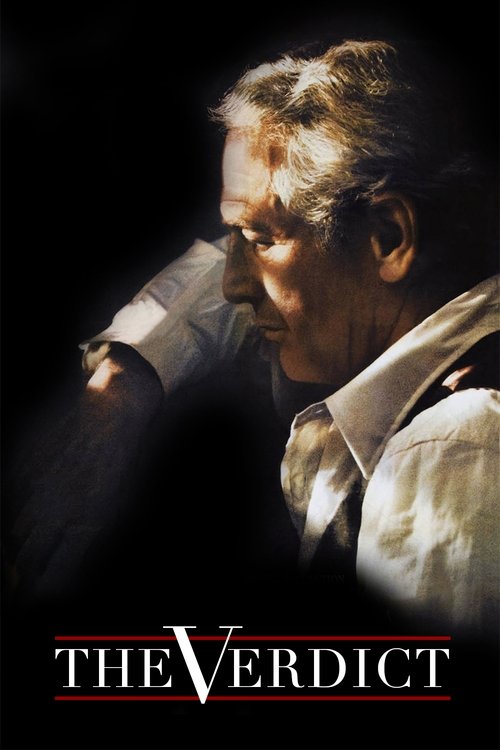
The Verdict
1982 · Sidney Lumet
For when you want a grown-up drama about redemption — something patient and morally serious that leaves you feeling steadier than when you sat down. Comfort viewing for people who like their comfort earned.
What it's about
Frank Galvin is a Boston lawyer at the bottom: drinking through his days, chasing ambulance cases, living off the ruins of a once-promising career. A friend hands him an easy medical-malpractice suit — a young woman left in a coma, a settlement everyone expects him to take quietly. Instead, against all advice and his own obvious limitations, Galvin decides the case deserves a trial.
The experience
Slow-burning, sober, and quietly gripping — less a legal thriller than a character study that happens to end up in a courtroom. It builds real suspense out of watching a broken man try to do one thing right, and it earns every beat.
Performances
Paul Newman gives one of the great late-career performances — playing Galvin's shame and flickering self-respect with almost no vanity — and James Mason is silkily formidable as the opposing counsel.
The craft
Sidney Lumet's unshowy, precise direction meets a David Mamet screenplay whose clipped dialogue turns every exchange into a small contest. The film looks wintry and worn — dark wood, dim bars, cold Boston light — a visual world that matches the man at its center.
Why it matters
Nominated for five Academy Awards including Best Picture and Best Actor, it stands as one of the defining courtroom dramas — the template countless legal films still measure themselves against.
Snapshot
The Verdict is a courtroom drama of disgrace and recovery: Frank Galvin, a Boston personal-injury lawyer drowning in alcohol and failure, is handed a medical-malpractice suit expected to settle quietly, and instead gambles everything on a trial he is plainly ill-equipped to win. Directed by Sidney Lumet from a David Mamet screenplay adapted from Barry Reed's 1980 novel, the film pairs two of American cinema's most distinctive temperaments — Lumet's procedural realism and moral seriousness, Mamet's clipped, rhythmic dialogue — around a career-summarizing performance by Paul Newman. Released by 20th Century-Fox in December 1982, it drew five Academy Award nominations (Picture, Director, Actor, Supporting Actor for James Mason, and Adapted Screenplay) and won none, swept aside by Gandhi. It endures as one of the defining legal dramas of the American screen and a touchstone of the "redemption through one last case" archetype.
Industry & production
The film originated with the producing team of Richard D. Zanuck and David Brown, the partnership behind Jaws and The Sting, who acquired Barry Reed's novel. The screenplay's path to the screen was unusually contentious and is one of the better-documented production histories of the period. Zanuck and Brown commissioned David Mamet — then early in his screen career, fresh from The Postman Always Rings Twice (1981) — but, dissatisfied with his draft, they brought in other writers, including Jay Presson Allen, and cycled through directorial and star attachments. Robert Redford was at one stage involved as a potential lead and reportedly pressed for a more conventionally sympathetic Galvin; directors including Arthur Hiller and James Bridges circulated around the project. The knot was untied when Sidney Lumet came aboard: by his own account, he read the accumulated drafts and elected to return to Mamet's original screenplay, which he found the most honest and dramatically uncompromising. That decision restored the film's spine — a flawed protagonist whose redemption is neither tidy nor guaranteed.
Lumet was, by 1982, among the most reliable and efficient directors in American film, famous for bringing pictures in on schedule and under budget through exhaustive pre-production and rehearsal. The shoot drew on Boston locations and New York interiors, marshaling a cast of stage-trained heavyweights. Newman, having been nominated repeatedly without a win, took the role at a point where it read as both a character study and a statement about persistence. The supporting ensemble — James Mason as the silken opposing counsel Ed Concannon, Jack Warden as Galvin's friend and mentor Mickey Morrissey, Charlotte Rampling as the enigmatic Laura, Milo O'Shea as the antagonistic Judge Hoyle, and a young Lindsay Crouse in a single pivotal scene as a nurse — reflected Lumet's preference for theatrical actors who could sustain long takes.
Technology
The Verdict is a conventional 35mm production for its moment, made with the standard tools of early-1980s studio filmmaking; its technological interest lies less in novelty than in disciplined craft. There is no record of experimental processes here. What distinguishes the film technically is its controlled photochemical color palette — a deliberately darkened, warm-shadowed image achieved through lighting, art direction, and laboratory timing rather than any new apparatus. Lumet, in his book Making Movies, describes building the film's look around a restricted range of browns and golds, a strategy executed in-camera and in the grade. The film thus belongs to a tradition of "painterly" naturalism pursued through traditional means.
Technique
Cinematography
The photography is by Andrzej Bartkowiak, the Polish-born cinematographer who became Lumet's regular collaborator across this period (Prince of the City, Daniel, The Morning After, and others). Their shared visual scheme for The Verdict is one of the film's signatures: a muted, autumnal, deliberately underlit world of wood-paneled bars, churches, hospital corridors, and law offices, photographed to evoke Old Master painting. Lumet has said he and Bartkowiak studied a darkened, Caravaggesque palette, wanting figures to emerge from shadow and the overall image to feel as if it belonged to an earlier, weightier era — a visual correlative for Galvin's exhaustion and the moral gravity of the case. The camera tends to observe rather than editorialize; compositions are frequently still, frontal, and patient, reserving emphasis for the rare moment of movement.
Editing
Editing by Peter C. Frank serves the film's deliberate, accumulating tempo. Lumet structures the picture around sustained scenes that build pressure through duration rather than fragmentation — the courtroom testimony, the discovery of the surprise witness, Galvin's collapses and recoveries — and the cutting honors that, holding shots long enough for performance to register and releasing tension only when the drama dictates. The film's celebrated final summation is shaped substantially by editorial restraint, allowing Newman's quiet delivery to play out with minimal intervention.
Mise-en-scène / staging
Lumet's theatrical instincts govern the staging. He blocks scenes for the long take and the meaningful entrance, trusting actors to carry extended exchanges. The famous opening establishes Galvin almost wordlessly — pinball, drink, and the cold solicitation of grieving strangers at funerals — character delivered through behavior and environment rather than exposition. Interiors are dressed to feel lived-in and institutional: the dim bar that functions as Galvin's office, the hushed authority of the Catholic hospital, the intimidating expanse of Concannon's firm with its small army of associates. The geography of power is staged spatially — Concannon's resources visibly dwarfing Galvin's solitude.
Sound
Johnny Mandel's score is sparing and elegiac, used selectively to underscore rather than drive emotion, in keeping with Lumet's restraint. The sound design favors the quiet — the scrape of a chair, the echo of courtroom acoustics, the muffled register of a man alone — so that the dialogue, Mamet's most prized element, remains foregrounded. Silence is itself a tool, particularly in Galvin's moments of private despair.
Performance
This is, above all, an actor's film. Newman's Galvin is built from accumulated small defeats — the tremor of the morning drink, the flicker of returning self-respect, the terror beneath the closing argument — and the performance is widely regarded as among his greatest, earning an Oscar nomination he lost to Ben Kingsley. Mason's Concannon is a masterclass in unruffled menace, his civility making the imbalance of the contest more chilling. Warden grounds the film in weary loyalty; O'Shea makes the judge an instrument of casual injustice; Rampling lends Laura a wounded opacity that pays off in the narrative's central betrayal; and Crouse, in essentially one scene as nurse Kaitlin Costello, delivers the testimony on which the case — and the film's moral arithmetic — finally turns.
Narrative & dramatic mode
The film operates in the realist-tragic register of the redemption drama, structured as a classical trial narrative with a degraded hero who must reconstruct his competence and conscience in real time. Mamet's screenplay withholds easy reassurance: Galvin repeatedly stumbles, refuses a settlement that would have served his clients materially if not justly, loses his key expert witness, and is betrayed intimately by Laura, who proves to be a paid informant for the defense. The dramatic engine is moral rather than merely procedural — the question is not only whether Galvin can win but whether he deserves to, and whether the legal system will permit justice at all. The resolution is pointedly understated: a jury's verdict, and a final image of Galvin alone, the phone ringing, declining to answer — recovery acknowledged but not sentimentalized.
Genre & cycle
The Verdict belongs to the American courtroom drama, a genre with deep roots (12 Angry Men, itself a Lumet landmark; Anatomy of a Murder; To Kill a Mockingbird), and it stands at the head of a renewed cycle of prestige legal pictures that would flourish through the late 1980s and 1990s. It also belongs to the "washed-up professional gets one last shot" tradition that runs through American film, and to Lumet's own informal cycle of institutional dramas examining law, police, and the machinery of justice. Its DNA is visible in the subsequent wave of star-driven legal thrillers and in the courtroom-as-moral-arena template later associated with John Grisham adaptations, though The Verdict is graver and less plot-mechanical than most of its descendants.
Authorship & method
The film is a meeting of two strong authors. Sidney Lumet brought his career-long preoccupations — individual conscience against corrupt or indifferent institutions, the dignity and fallibility of working professionals, the city as moral environment — along with his actor-first, rehearsal-intensive, efficient method. David Mamet, the screenwriter, contributed a spare, percussive dialogue idiom and an unsentimental view of his protagonist; his insistence on Galvin's genuine brokenness gives the film its edge, and Lumet's choice to film Mamet's draft over the softened alternatives was decisive. Among key collaborators: cinematographer Andrzej Bartkowiak, architect of the darkened painterly look; composer Johnny Mandel, supplying restrained elegiac scoring; editor Peter C. Frank, sustaining the film's patient rhythm; and producers Richard D. Zanuck and David Brown, whose persistence carried the project through its troubled development. Lumet's own account in Making Movies remains the fullest authorial document of the film's visual and dramatic intentions.
Movement / national cinema
The film is a product of mainstream American studio cinema, but Lumet occupies a particular niche within it: a New York–based, theatrically trained filmmaker who, from the 1950s through the early 1980s, pursued socially serious, performance-driven realism at a remove from Hollywood gloss. The Verdict is firmly in that East Coast, naturalist tradition — closer in spirit to the live-television drama and the New York stage from which Lumet emerged than to contemporaneous West Coast spectacle. It is not part of any avant-garde movement; its distinction is the persistence of an older humanist seriousness into the blockbuster era.
Era / period
Arriving in 1982, The Verdict sits at a hinge in American film history — the high-concept, effects-driven blockbuster was ascendant, and the adult, character-centered drama that had defined the New Hollywood 1970s was contracting. The film reads almost as a holdover from that earlier moment: a slow, talky, morally weighted picture made by veterans for adult audiences, released into a marketplace increasingly oriented toward youth and spectacle. Its five Oscar nominations affirm the prestige such films still commanded, even as their commercial space narrowed.
Themes
The governing themes are redemption, justice versus the law, and individual conscience against institutional power. Galvin's arc dramatizes the difference between legal procedure and moral truth — the system, embodied by the hostile judge, the wealthy defense, the complicit Church, and Laura's betrayal, is arrayed to suppress an honest verdict. The film interrogates faith and worth: whether a ruined man can recover self-respect, whether ordinary jurors can be trusted to do justice, whether anyone is, in the words of the summation, capable of acting as "the law." Alcoholism, shame, loneliness, and the dignity of the powerless (the comatose victim, her working-class family, the immigrant nurse) thread throughout. Crucially, the film locates redemption not in winning but in the refusal to settle — in choosing the harder, riskier path toward truth.
Reception, canon & influence
Critically, The Verdict was received as a serious, accomplished drama and a high point for its principals, with particular praise for Newman's performance and for Lumet's controlled direction; its haul of five major Oscar nominations (Picture, Director, Actor, Supporting Actor, Adapted Screenplay) registered the industry's esteem, though it won none in a year dominated by Gandhi. The reputation of Newman's Galvin has only grown, frequently cited among his finest screen work and a key entry in the long campaign that led to his honorary Oscar and his eventual competitive win for The Color of Money (1986).
Influences on the film (backward): It draws on the courtroom-drama tradition Lumet himself had shaped with 12 Angry Men, on the moral seriousness of mid-century social realism, and — by Lumet's own statement — on the chiaroscuro of Old Master painting for its visual scheme. Mamet's contribution is continuous with his stage work's interrogation of American self-deception and verbal power.
Legacy (forward): The Verdict became a reference point for the prestige legal drama and helped set the template for the star-driven courtroom film of the following two decades, including the cycle of John Grisham adaptations and numerous "redemption through one last case" narratives. Its final summation is among the most studied closing-argument scenes in American film, regularly excerpted in discussions of screen rhetoric and frequently shown in legal-education contexts as a meditation on jurors' moral responsibility. The Lumet–Bartkowiak visual approach influenced subsequent naturalistic dramas pursuing a darkened, painterly look. More broadly, the film stands as a late, durable demonstration that the patient adult drama, anchored by performance and conscience, could still achieve both critical canonization and lasting cultural presence at the threshold of the blockbuster age.
A Deleuzian reading
A man plays pinball alone in a dark bar, drinks before noon, and later walks into a stranger's funeral to press his business card on the widow.
The full Deleuzian reading of The Verdict →
Reception
A five-time Oscar nominee that went home empty-handed the year Gandhi swept everything — and four decades on, it's The Verdict that gets rewatched, routinely called peak Paul Newman and one of the last great grown-up studio dramas.
How The Verdict was received, from release to now →
Influences: the films it descends from and the films it influenced
- 12 Angry Men (1957) — Lumet's own template for spatial-power-geography blocking, where a figure's physical position in a single room encodes shifting moral authority, plus the dramatization of jurors' moral responsibility as the case's true subject.
- The Hustler (1961) — Fixes Paul Newman's signature register of the broken charmer seeking redemption that Galvin directly extends, shot in a chiaroscuro lensing of a man in decline.
- On the Waterfront (1954) — Supplies the Method, stage-trained ensemble naturalism and the lone-conscience-against-a-corrupt-institution moral architecture Lumet builds Galvin's arc on.
- Anatomy of a Murder (1959) — Models the unglamorous procedural courtroom realism and the justice-versus-law ambiguity that refuses tidy moral comfort.
- The Godfather (1972) — Gordon Willis's deliberately underexposed 'painterly' chiaroscuro is the direct precedent for Bartkowiak's darkened Old-Master interior scheme.
- Serpico (1973) — Establishes Lumet's recurring structure of a lone professional's conscience against an institution that closes ranks, with the city itself as moral environment.
- Dog Day Afternoon (1975) — Lumet's actor-first, rehearsal-intensive long-take naturalism that lets sustained performance dictate the scene's rhythm rather than cutting.
- Witness for the Prosecution (1957) — Treats the courtroom as a theater of rhetoric and the summation as a constructed set-piece, the lineage The Verdict's closing argument culminates.
- House of Games (1987) — Mamet carries his spare, percussive dialogue idiom and unsentimental view of self-deceiving protagonists from screenwriting into his own direction.
- Glengarry Glen Ross (1992) — Mamet's verbal-power-as-violence idiom delivered by a stage-trained ensemble in chiaroscuro interiors, the screen extension of his Verdict method.
- A Few Good Men (1992) — Builds its dramatic payload on the studied climactic-summation rhetoric that The Verdict's closing argument standardized.
- The Firm (1993) — Anchors the Grisham legal cycle in the star-driven 'lawyer against a corrupt system' template The Verdict set for prestige courtroom film.
- Philadelphia (1993) — Extends the prestige courtroom drama of moral conscience structured around one redemptive case anchored by a star performance.
- Michael Clayton (2007) — A broken lawyer's redemption-through-one-last-case against a corporate institution, in the muted warm palette and lone-conscience framing The Verdict pioneered.
- Dark Waters (2019) — Desaturated naturalist look married to the dogged 'one case against an indifferent institution' structure descended from Galvin's lone stand.
- Primal Fear (1996) — Lumet establishes the morally compromised defense attorney — whose professional showmanship is inseparable from his personal vanity — as the legal thriller's protagonist through procedural accumulation of case detail as dramatic engine; Mamet's dialogue of feint and counter-feint in examination sequences establishes the cross-examination-as-parry rhythm that Hoblit's editing inherits.
- Molly's Game (2017) — Lumet's courtroom two-hander methodology: spatial antagonism between two characters in close proximity, power redistributed through blocking and eyeline cuts rather than camera movement, each line of dialogue reconfiguring the room's power geometry — the formal grammar of the Chastain/Elba interrogation sequences.
- My Cousin Vinny (1992) — The disreputable underdog attorney assembling a real, winnable case from overlooked evidence, with a single expert's testimony as the hinge — Vinny is its comic inversion, same competence-plot architecture.
- Runaway Jury (2003) — Models the lone-underdog-attorney-versus-institutional-machine courtroom drama, supplying the moral framework Runaway Jury inverts by making its 'heroes' beat corruption with corruption.
- The Devil's Advocate (1997) — Bartkowiak's own Lumet grammar — sourced amber practicals, wood-and-brass legal interiors, long lenses in real institutional rooms — imported wholesale as the documentary ground against which the supernatural is made to register.
- Network (1976) — Lumet directing a percussive, verbally dense Chayefsky screenplay that interrogates American self-deception, prefiguring his handling of Mamet's spare idiom.
- The Insider (1999) — Conscience-versus-institution prestige drama sustained on a muted controlled palette and the patient adult rhythm anchored by performance.
- Absence of Malice (1981) — A direct sibling released months later: Newman again channeling banked anger into a legal-versus-moral drama built on hushed two-handers and naturalistic available-light realism.
Similar films
- 12 Angry Men (1957) — influence & lineage · same viewing thread
- A Few Good Men (1992) — influence & lineage
- Serpico (1973) — influence & lineage
- Michael Clayton (2007) — influence & lineage
- Dog Day Afternoon (1975) — influence & lineage
- House of Games (1987) — influence & lineage
- Glengarry Glen Ross (1992) — influence & lineage
- On the Waterfront (1954) — influence & lineage
All the films related to The Verdict →
Watch it with: curated runs of related films
- Judgment and Mercy — Watch these together for the way each puts a life on the scales — a jury room, a death-row block, a slave plantation, a gunfighter's conscience — and asks what mercy costs the people handing down the verdict.