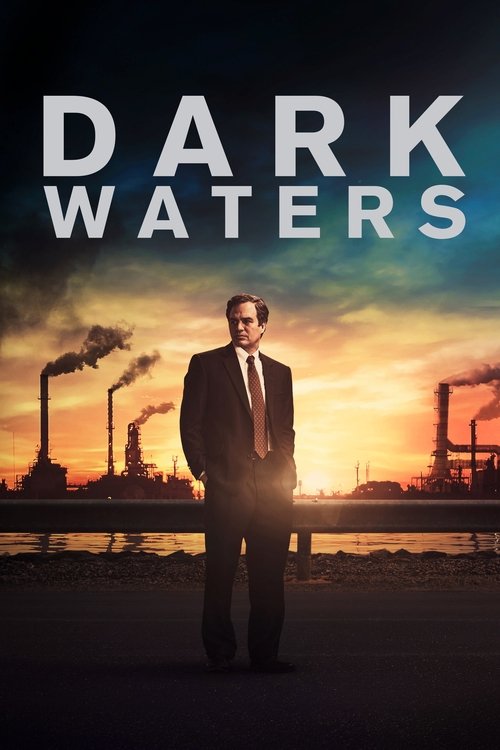
Dark Waters
2019 · Todd Haynes
For when you want to be gripped and outraged in equal measure — a serious, absorbing evening that makes you feel smarter and angrier by the end. Choose it when you're up for a challenge with a purpose, not a pick-me-up.
What it's about
Robert Bilott is a corporate defense attorney — the kind who protects chemical companies — when a West Virginia farmer shows up at his Cincinnati office insisting that something in the water is killing his cattle. Pulling that thread leads Bilott into a decades-deep paper trail implicating one of the world's largest corporations in poisoning an entire community's drinking water. Based on a true story, the film follows the case across years as it consumes his career, strains his family, and grinds against a legal system built to exhaust anyone who challenges it.
The experience
Cold, patient, and quietly furious — less a courtroom thriller than a slow-building horror story told through documents and lab results. It works by accumulation, and the unease follows you out of the room, especially once you realize what it says about your own tap water.
Performances
Mark Ruffalo plays Bilott with deliberate anti-charisma — hunched, mumbling, dogged — a portrait of stubbornness as heroism that trusts you to lean in rather than be dazzled.
The craft
Todd Haynes shoots the procedural like a paranoia film: drab winter light, sickly institutional interiors, a camera that makes parking garages and file rooms feel menacing. The restraint is the point — no triumphant speeches, just the grind of evidence — and the muted palette gives the whole thing a contaminated feel.
Why it matters
It brought the PFOA/'forever chemicals' scandal to a mass audience and pushed the corporate whistleblower drama toward something bleaker and more honest about how long justice actually takes.
Snapshot
Dark Waters is Todd Haynes's fact-based legal procedural about Robert Bilott, a corporate-defense attorney at the Cincinnati firm Taft Stettinius & Hollister who, beginning in the late 1990s, turned against his own client base to pursue the chemical giant DuPont over its decades-long contamination of drinking water with perfluorooctanoic acid (PFOA, known industrially as C8). Adapted from Nathaniel Rich's 2016 New York Times Magazine article "The Lawyer Who Became DuPont's Worst Nightmare," the film follows Bilott (Mark Ruffalo) from a West Virginia farmer's plea about dying cattle to the assembly of an epidemiological case touching tens of thousands of residents around Parkersburg, West Virginia. On its surface a star-driven issue drama in the lineage of Erin Brockovich and A Civil Action, the film is more interesting as an entry in Haynes's career-long preoccupation with bodies poisoned by their own environments — a theme he first dramatized in Safe (1995). It is among the most formally restrained, least overtly stylized works in his filmography, and that restraint is itself a deliberate artistic choice.
Industry & production
The film originated as a passion project for Ruffalo, who optioned Rich's article and developed it as both star and producer. It was produced by Participant (formerly Participant Media), the company founded by Jeff Skoll with an explicit mandate to back socially engaged narrative film and pair it with advocacy campaigns — the same outfit behind Spotlight, An Inconvenient Truth, and Erin Brockovich-adjacent issue cinema. Crucially, the film was also produced through Christine Vachon's Killer Films, Haynes's longtime production home, which lends the project its connection to American independent cinema even as it operates at studio scale. Ruffalo's own Sweet Relief Films was involved as well. Focus Features distributed.
Haynes was not the originating force; he came aboard a script already in development, which is unusual for a director who has written or co-written most of his features. The screenplay is credited to Mario Correa and Matthew Michael Carnahan, with Correa receiving "story by" and the screenplay shared. The film was shot largely in and around Cincinnati, with location work that grounds it in the Ohio Valley's industrial geography rather than relying on soundstage reconstruction. The production reportedly engaged with the real principals — Bilott published his own memoir, Exposure, around the time of release — though the precise extent of consultation is best treated as a matter the public record documents only in broad strokes. Released in limited engagement in late November 2019 and expanding in December, it performed modestly at the box office; I will not cite specific grosses, as I cannot verify them precisely, but the film was understood as a prestige release rather than a commercial event.
Technology
Dark Waters was photographed digitally, a notable departure from the celluloid textures Haynes and cinematographer Edward Lachman had cultivated on Far from Heaven, Mildred Pierce, and Carol (the last shot on Super 16mm). The digital capture suits the film's clinical, contemporary subject — the cold light of conference rooms, parking structures, and document warehouses — and Lachman exploited it for a desaturated, near-monochrome palette dominated by grays, sickly greens, and institutional fluorescents. Beyond the camera, the film's true "technology" subject is chemical: PFOA is a man-made fluoropolymer additive central to the manufacture of Teflon, and the narrative is in large part a story about an industrial process whose molecular persistence ("forever chemicals" that do not break down in the body or environment) outpaced the regulatory and scientific apparatus meant to govern it. The film dramatizes the gap between corporate laboratory knowledge and public scientific understanding, including the eventual C8 Science Panel epidemiological study of the exposed population — one of the largest such studies ever conducted. The film treats data, internal memos, and discovery documents as its real evidentiary machinery.
Technique
Cinematography
Edward Lachman's work here is an exercise in deliberate drabness. Where his collaborations with Haynes typically luxuriate in saturated Sirkian color or the grain of period stock, Dark Waters is drained of warmth — overcast exteriors, the brownish water of the title, and interiors lit to feel airless and surveilled. Lachman favors a relatively static, observational camera and compositions that isolate Bilott within architecture: glass partitions, long corporate corridors, the boxed geometry of a document room. This visual coldness performs the film's argument, rendering bureaucratic and chemical menace as an atmosphere rather than a spectacle. The look consciously evokes the paranoid thrillers of the 1970s, where institutional spaces themselves become threatening.
Editing
Affonso Gonçalves, Haynes's regular editor since I'm Not There, cuts the film for procedural clarity over kinetic tension. The central challenge of any legal-discovery drama is making the reading of documents and the passage of legal time dramatic; the editing structures the film around escalating revelations and the grinding multi-year duration of the litigation, using time jumps that emphasize attrition — how the case consumes the better part of Bilott's career and health. The rhythm is patient, even austere, refusing the montage-driven uplift of more conventional crusader narratives.
Mise-en-scène / staging
Production designer Hannah Beachler (an Academy Award winner for Black Panther) renders two Americas in tension: the working-class, contaminated landscape of rural West Virginia — the Tennant farm, the dying cattle, the small homes — and the polished, anonymous world of corporate law. The staging repeatedly places Bilott as an intruder between these worlds, a man whose insider knowledge of how corporations defend themselves becomes the instrument of their exposure. Costume work by Christopher Peterson keeps the register naturalistic and slightly unflattering, deglamorizing its movie stars in service of verisimilitude.
Sound
Marcelo Zarvos's score is restrained and tension-building rather than triumphant, leaning on low, anxious textures consistent with the thriller mode. Sound design emphasizes the quiet of offices and the ambient drone of industrial and domestic spaces; the film generally withholds musical catharsis, reinforcing the sense that justice here is slow, partial, and exhausting rather than redemptive.
Performance
Ruffalo's Bilott is the film's anchor and its strategic center: a deliberately un-charismatic, internalized performance built on stooped posture, mounting fatigue, and a kind of dogged moral stubbornness rather than courtroom oratory. It is a portrait of obsession as physical depletion. Anne Hathaway plays his wife, Sarah Barlage Bilott, a former attorney whose role the film works to elevate above the genre's standard "worried spouse," giving her at least one scene of pointed agency. Bill Camp is widely regarded as the film's emotional engine as the farmer Wilbur Tennant, whose blunt rural anger initiates the case. Tim Robbins plays Bilott's firm partner Tom Terp, and the deep supporting cast includes Victor Garber, Mare Winningham, William Jackson Harper, and Bill Pullman as the plaintiffs' trial attorney Harry Deitzler.
Narrative & dramatic mode
The film operates in the mode of the investigative procedural — the patient accumulation of evidence against institutional power — but inflects it with tragedy rather than triumph. Its structure is longitudinal, spanning roughly two decades, and its dramatic arc is less "will he win?" than "what will winning cost, and how little will change?" Haynes resists the genre's usual reassurances: the antagonist is not a single villain but a diffuse system of corporate incentive, regulatory weakness, and public inertia. The film also threads a strand of paranoid thriller — moments where Bilott fears surveillance or physical harm — though it is careful to frame these as the psychological toll of the work rather than to confirm a conventional conspiracy. The dramatic engine is moral exhaustion: the slow erosion of a man, a marriage, and a community against the geological patience of a corporation.
Genre & cycle
Dark Waters belongs squarely to the corporate-whistleblower / environmental-litigation cycle of American cinema, whose touchstones include The China Syndrome (1979), Silkwood (1983), A Civil Action (1998), The Insider (1999), Erin Brockovich (2000), and Michael Clayton (2007). It also draws on the institutional-paranoia thrillers of the 1970s New Hollywood — All the President's Men (1976) above all, with its heroism of document-reading and phone calls. Within this cycle, Dark Waters is distinguished by its refusal of uplift and its grimmer palette, positioning itself closer to the bleak realism of Michael Clayton than the populist warmth of Erin Brockovich. It arrived amid a renewed late-2010s appetite for fact-based institutional dramas (Spotlight, The Post, Vice), several of them likewise from Participant.
Authorship & method
The central authorial puzzle of Dark Waters is why Todd Haynes — the great American stylist of melodrama, the director of Poison, Velvet Goldmine, Far from Heaven, I'm Not There, and Carol — would make a relatively anonymous-looking issue picture. The resolution lies in continuity of theme rather than style. As far back as Safe (1995), Haynes was preoccupied with environmental illness, the toxic ordinariness of modern life, and bodies betrayed by the chemical world; Dark Waters is the literalization, in journalistic register, of that earlier allegory. Haynes has long worked in dialogue with genre — reanimating the Sirkian melodrama, the rock biopic, the woman's picture — and here he treats the conspiracy procedural as another inherited form to be inhabited with discipline.
The authorship is profoundly collaborative and built on long-standing relationships: producer Christine Vachon (Killer Films), cinematographer Edward Lachman, and editor Affonso Gonçalves constitute a recurring Haynes unit, and their presence is what marks the film as his despite the muted surface. The departure is the screenplay, which Haynes did not originate — a reminder that this was substantially Ruffalo's project as actor-producer, with Haynes recruited as the directorial intelligence to elevate the material. The pairing of an activist star and a formalist director is itself the method: Ruffalo supplies the cause and the body, Haynes supplies the cold, controlled framing that keeps the film from tipping into advocacy bombast.
Movement / national cinema
The film sits at the intersection of American independent cinema — via Killer Films, Vachon, and Haynes's roots in the New Queer Cinema of the early 1990s — and the socially conscious, mid-budget studio-prestige tradition stewarded by Participant. It is unmistakably an American picture in subject and texture: it concerns American industry, American regulatory failure, and the specific geography of Appalachia and the Rust Belt. There is no formal "movement" affiliation beyond Haynes's own; rather, the film represents the late-career migration of an art-cinema auteur into the realist mainstream without surrendering authorial control of tone.
Era / period
Though released in 2019, the film is a period piece in slow motion, beginning in 1998 and tracking forward across the 2000s and into the 2010s. Its temporal sprawl is essential to its meaning: the contamination predates the action by decades, and the litigation outlasts most of the film's middle. The film also functions as a document of its moment of release — the late-2010s reckoning with regulatory rollback and environmental deregulation, and the broader public anxiety about "forever chemicals" (PFAS/PFOA) that was entering mainstream awareness precisely as the film appeared. It closes by gesturing toward the ongoing, unresolved nature of the problem rather than sealing it in the past.
Themes
The dominant theme is the persistence of toxicity — chemical, corporate, and moral — and the asymmetry between institutional power and individual conscience. Bodies are central: contaminated cattle, sickened workers and residents, and Bilott's own deteriorating health stand as the physical ledger of corporate cost-shifting. The film interrogates regulatory capture, the way industry can outpace and co-opt the agencies meant to police it, and the structural complicity of professionals — Bilott begins as a defender of the very kind of client he comes to indict. Secondary themes include the corrosive duration of justice (justice delayed as a strategy, not an accident), the strain such crusades place on family and marriage, and class — the gap between an educated lawyer's world and the rural community he serves. Running beneath all of it is the Haynesian motif of the poisoned domestic everyday, the recognition that the ordinary products of modern comfort (here, nonstick cookware) are vectors of harm.
Reception, canon & influence
Dark Waters was received as a solid, sober, and well-acted entry in the issue-drama tradition, with critical consensus generally positive. Reviewers consistently singled out Ruffalo's deglamorized lead performance and Bill Camp's supporting turn, and many noted the irony — and the success — of so flamboyant a stylist as Haynes working in such a restrained register. A recurring critical observation was that the film's form is more conventional than Haynes's signature work; opinions divided on whether this was a limitation or an appropriate act of self-effacement in service of the material. The film notably figured more in cultural and advocacy conversation than in the awards race, consistent with Participant's model of pairing films with public campaigns; here the campaign concerned PFAS contamination and regulation. I will refrain from asserting specific award nominations or box-office figures I cannot verify.
The influences on the film are clear and acknowledged in its very grammar: the document-driven heroism of All the President's Men, the corporate dread of The Insider and Michael Clayton, the environmental-litigation template of A Civil Action and Erin Brockovich, and — most personally — Haynes's own Safe, whose anxieties about chemical illness this film renders as fact. Its forward influence is harder to fix at this distance and the scholarly record remains thin, but the film contributed to a wave of mainstream attention to PFAS "forever chemicals" and stands as a reference point for subsequent environmental documentaries and dramas on the subject. Within Haynes's own canon it occupies an instructive position: proof that his authorship resides in thematic obsession and collaborative craft as much as in surface style, and a late demonstration that the melodramatist of the poisoned home could carry that same wound into the genre of the corporate thriller.
A Deleuzian reading
A man sits on the floor of a windowless room in Cincinnati, surrounded by file boxes, reading.
The full Deleuzian reading of Dark Waters →
Reception
Received in 2019 as a solid but 'surprisingly conventional' detour for Todd Haynes and largely ignored by awards bodies, it's since been reclaimed by cinephiles as one of his most quietly radical films — a corporate-dread movie that only looks anonymous until you notice how Haynes it is.
How Dark Waters was received, from release to now →
Influences: the films it descends from and the films it influenced
- All the President's Men (1976) — Establishes the grammar of heroism-as-paperwork — patient, near-real-time scenes of phone calls, archives, and photocopying — which Dark Waters reproduces in Bilott's box-by-box document-discovery sequences.
- The Parallax View (1974) — Pakula/Gordon Willis paranoia framing — lone figures dwarfed by oppressive deep-focus institutional architecture — that Lachman echoes in DuPont's looming corporate geometry.
- The Insider (1999) — Pioneers the whistleblower thriller built on bodily and domestic cost — corporate retaliation invading the family home — privileging slow-burn dread over action, the register Haynes adopts.
- Michael Clayton (2007) — Supplies the deglamorized corporate-legal milieu and the agrochemical cover-up plot, with a worn-down lawyer-protagonist rather than a triumphant hero.
- A Civil Action (1998) — The environmental-tort template directly: contaminated water and a lawyer financially and personally bankrupted across the litigation's grinding longitudinal timeline.
- Erin Brockovich (2000) — The chemical-contamination class-action template built on door-to-door plaintiff testimony and the patient gathering of physical evidence against a corporate polluter.
- Silkwood (1983) — Deglamorized star (Streep) as a contaminated worker, rendering chemical body-horror in an unglamorous domestic register — the deglamorized-performance model Ruffalo follows.
- Safe (1995) — Haynes's own template of environmental illness invading the suburban home, here literalized from allegory into journalistic fact and shot by Lachman in the same clinical, static, desaturated mode.
- Far from Heaven (2002) — The Haynes–Lachman 'poisoned domestic everyday' — immaculate suburban surfaces photographed as sites of dread — whose controlled visual idiom carries into Dark Waters' restraint.
- Z (1969) — The investigative political-thriller engine — a dogged inquiry assembling testimony and documents to indict institutional power — driving the procedural structure.
- Norma Rae (1979) — The social-issue drama of working-class advocacy against corporate harm, anchored by a star's deglamorized, physically grounded performance — the Participant-model lineage.
- The China Syndrome (1979) — Corporate cover-up of an industrial/environmental hazard exposed by an insider, treating regulatory failure as paranoid-thriller material.
- Carol (2015) — The recurring Haynes unit (Lachman camera, Affonso Gonçalves editing) and its restrained, emotionally withheld, period-precise craft, repurposed here for the thriller.
- The Report (2019) — Released the same year, the lone investigator drowning in redacted documents over years — the same longitudinal, anti-spectacle procedural structure.
- Promised Land (2012) — An actor-producer-driven Participant-style environmental drama (fracking) that pairs a star's cause with restrained, naturalistic staging of corporate harm to a community.
- Official Secrets (2019) — Haynes applies the same observational-restraint cinematography and cool-neutral palette as moral stance — institutional and rural space rendered tonally as landscapes of evasion, ethical weight carried by compressed performance interiority (Ruffalo) — in direct formal parallel to Official Secrets' handling of state surveillance, both films treating desaturation as an argument about power.
- Crisis (2021) — Crisis's closest craft contemporary: a corporate-poisoning legal procedural in a desaturated institutional palette and available light, indicting a respectable company that launders chemical harm.
- Moneyball (2011) — Desaturated corporate procedural assembled from boxes of documents and depositions, driven by institutional skepticism and a grinding, un-heroic accumulation of evidence.
Similar films
- Erin Brockovich (2000) — influence & lineage · same viewing thread
- The Insider (1999) — influence & lineage
- Safe (1995) — influence & lineage
- Michael Clayton (2007) — influence & lineage
- All the President's Men (1976) — influence & lineage
- Spotlight (2015) — influence & lineage
- The Lighthouse (2019) — shared sensibility
- Mudbound (2017) — shared sensibility
All the films related to Dark Waters →
Watch it with: curated runs of related films
- Beating a Rigged Game — A run of fact-based portraits of sharp outsiders who out-hustle the institutions built to keep them out — poker tables, front offices, corporate lawyers, and a class-obsessed sport.