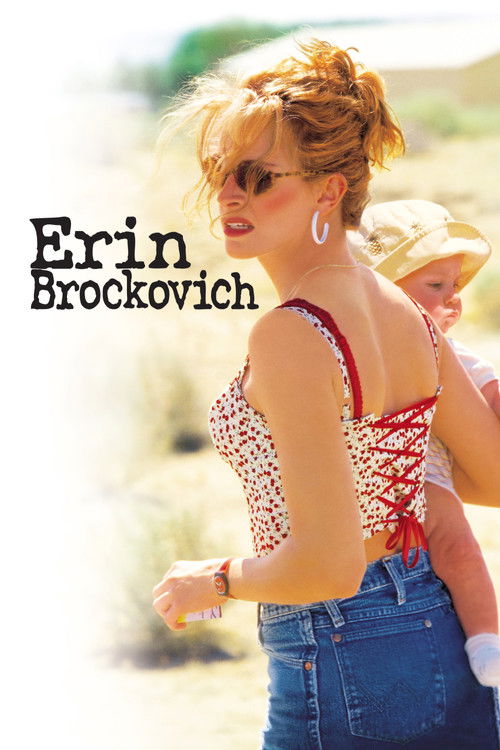
Erin Brockovich
2000 · Steven Soderbergh
For when you want to watch someone the world wrote off win — a satisfying, fired-up night in that leaves you feeling better about people and worse about corporations. Pure comfort with a conscience.
What it's about
Erin Brockovich is a twice-divorced mother of three with no money, no job prospects, and no filter, who talks her way into a filing-clerk job at a small law firm. Buried in real-estate paperwork she finds medical records that shouldn't be there, and starts pulling a thread that leads to a small California town, its poisoned water, and the giant utility company responsible. It becomes the fight of her life — waged in short skirts and profanity against people who keep underestimating her.
The experience
Brisk, funny, and genuinely rousing — a crowd-pleaser with a spine, powered by a heroine you root for from the first scene. The outrage lands, but the film never stops being entertaining about it.
Performances
Julia Roberts gives the performance of her career, an Oscar-winning turn that weaponizes her charm into something sharper — funny, furious, and completely in command. Albert Finney is a joy as her rumpled, exasperated boss, and their sparring gives the film its heart.
The craft
Soderbergh directs the true story with a cool, observational eye that keeps the earnest material from ever going soft, and Susannah Grant's screenplay gives Erin a voice that crackles in every scene. It turns paperwork, depositions, and door-knocking into genuine momentum — a legal procedural that moves like a star vehicle.
Why it matters
A major hit that won Julia Roberts the Academy Award and proved Soderbergh could fuse studio entertainment with real craft, it became the modern template for the ordinary-person-takes-on-the-corporation drama and made its real-life subject a household name.
Snapshot
Erin Brockovich is a fact-based legal and social-problem drama in which an unemployed single mother, hired as a filing clerk out of desperation, uncovers the groundwork of a landmark toxic-tort case against Pacific Gas & Electric over hexavalent chromium (chromium-6) contamination in Hinkley, California. Directed by Steven Soderbergh from a screenplay by Susannah Grant, and built around a career-defining Julia Roberts performance in the title role, the film belongs to the American tradition of the ordinary-citizen-versus-corporation crusade — the lineage of Norma Rae (1979), Silkwood (1983), and A Civil Action (1998). Its distinction lies in how it fuses that earnest genre with Soderbergh's cooler, more observational craft, and in how it made a lawyer's-office procedural into a mainstream popular hit. Released in the same year as Soderbergh's Traffic, it helped make 2000 the pivotal year of his career and earned Roberts the Academy Award for Best Actress.
Industry & production
The project originated at Jersey Films, the production company run by Danny DeVito, Michael Shamberg, and Stacey Sher, which had a track record of socially engaged, star-driven material. The story was drawn from the real Erin Brockovich-Ellis and the case she helped build while working for the small California firm of Masry & Vititoe, whose principal Ed Masry became her partner in the litigation. Susannah Grant, coming off Ever After and work in television, wrote the screenplay, shaping a real and legally intricate case into a character-forward narrative.
The film was a co-financing arrangement between Universal Pictures and Columbia Pictures — a common risk-sharing structure for a mid-budget adult drama with substantial star costs. The central industry fact of the production is Roberts's salary: she was widely reported to be the first actress paid $20 million for a single role, a milestone that made Erin Brockovich a bellwether for the earning power of a female lead at the turn of the millennium. That salary was itself a statement about the film's commercial logic — the picture was, in market terms, a Julia Roberts vehicle as much as a Soderbergh film.
Soderbergh came to the project at a specific inflection point. After the independent breakthrough of sex, lies, and videotape (1989) and a stretch of commercially marginal, formally restless work through the 1990s, he had re-entered the studio mainstream with Out of Sight (1998). Erin Brockovich was his bid at a fully mainstream, crowd-pleasing studio picture, and its success — both commercial and with awards bodies — consolidated his standing. He shot Traffic in close proximity, and both films were nominated for Best Director at the 73rd Academy Awards, a rare double that captured how thoroughly 2000 remade his career.
Technology
Erin Brockovich was made on 35mm film using conventional photochemical processes; it predates Soderbergh's later, well-documented turn toward digital acquisition (a turn that would define much of his subsequent work). The technological interest of the film is therefore not in novel capture but in method: Soderbergh's practice, already forming here, of working with a small crew, available and practical light, and a hands-on approach in which he frequently operated the camera himself. The picture reflects a period when a director could still make a naturalistic, unshowy studio drama entirely within traditional film workflows, with the "technology" that matters being the discipline of restraint rather than any apparatus. The record on the specific equipment package is not something to overstate here.
Technique
Cinematography
Ed Lachman, an American cinematographer with deep roots in both independent and European art cinema, shot the film. The visual approach is deliberately unglamorous and grounded — sun-flattened Southern California exteriors, the beige fluorescence of a small law office, the dusty light of desert towns. Lachman favors a documentary-adjacent naturalism: handheld and loosely framed coverage, a palette that leans toward heat and dust rather than saturated Hollywood gloss, and a refusal to prettify either Erin or the working-class communities at the center of the case. The camera stays close to Roberts, but the compositions resist heroizing her; the imagery earns its emotional payoffs precisely because it withholds cinematic uplift for so long.
Editing
The film was cut by Anne V. Coates, one of the most distinguished editors in film history — the editor of Lawrence of Arabia (1962), then working across a remarkably long career into her seventies. Her contribution is a lesson in classical clarity applied to a talk-heavy, information-dense story. The film must convey legal, medical, and procedural material without stalling, and the editing keeps exposition legible and forward-moving while giving the performances room to breathe. The rhythm is patient in the character scenes and efficient in the case-building, and the accumulation of small discoveries is paced so that the audience feels the investigation gathering weight.
Mise-en-scène / staging
The staging is rooted in the textures of class. Erin's cramped apartment, her scavenged wardrobe, the modest storefront law office, the Hinkley homes, and the corporate spaces are all distinguished through costume, décor, and environment. Costume in particular does heavy narrative work: Erin's revealing, brightly colored outfits are staged as both a genuine expression of character and a running social provocation — a woman insisting on her body and her taste in professional rooms coded to shame her for both. The film's design consistently sets her against institutional beige, dramatizing the collision of a working-class woman with the muted architecture of law and corporate power.
Sound
Thomas Newman composed the score, deploying the spare, textural, faintly Americana-inflected idiom for which he is known — understated piano and atmospheric coloration that support the drama without inflating it. The sound design overall matches the film's naturalism, keeping the register of everyday environments and letting dialogue carry the story. The music tends to underscore emotional turns lightly rather than cue them insistently, in keeping with the film's general resistance to overt manipulation.
Performance
Performance is the film's engine. Julia Roberts remakes her established star persona — the luminous romantic-comedy lead — into a profane, abrasive, tender, and relentless working-class heroine, and the performance was rewarded with the Academy Award for Best Actress along with the corresponding Golden Globe, SAG, and BAFTA honors. Albert Finney, as Ed Masry, provides the essential counterweight: a gruff, skeptical, ultimately loyal foil whose scenes with Roberts give the film its comic and emotional rhythm, and his work earned an Academy Award nomination for Best Supporting Actor. Aaron Eckhart plays George, the biker neighbor and caretaker whose relationship with Erin grounds the personal cost of her work. The real Erin Brockovich appears in a brief cameo (as a waitress), a documentary-style wink characteristic of fact-based dramas.
Narrative & dramatic mode
The film operates in the mode of the investigative crusade narrative crossed with a character study of transformation-through-vocation. Its dramatic architecture is the classical underdog arc: an outsider with no credentials, dismissed by everyone around her, discovers a hidden wrong and, through sheer tenacity and empathy, forces the powerful to answer for it. Susannah Grant's screenplay grafts onto this a second, more intimate line — the personal price Erin pays in her family life and relationship — so that the triumph is shadowed by loss. The storytelling is scrupulously legible about a technically complicated case (contamination, causation, medical clustering, class-action mechanics), translating it into human terms through Erin's face-to-face encounters with the affected families. The dramatic voice is notably profane and comic for a message picture; the humor humanizes what could have been a pious tract.
Genre & cycle
Erin Brockovich sits squarely in the American social-problem film and the "little person versus the corporation" legal drama. Its most direct antecedents are Norma Rae, Silkwood, and A Civil Action, and it shares DNA with the whistleblower cycle exemplified by The Insider (1999). It arrived during a turn-of-the-century wave of fact-based, issue-driven dramas that treated corporate malfeasance and environmental harm as prestige material. Within that cycle, it is the most commercially buoyant entry, in part because it foregrounds a charismatic protagonist and a redemptive arc over procedural bleakness. It also belongs to the broader "based on a true story" prestige genre whose conventions — the closing-title update on real outcomes, the real subject's cameo — it deploys openly.
Authorship & method
The film is a meeting of a star-forward studio commission and an auteur's evolving method. Soderbergh's authorship here is expressed through restraint: he subordinates visual flamboyance to performance and story, operates close to the actors, and trusts naturalistic craft to carry political and emotional weight. This is the "invisible" Soderbergh, distinct from the fractured, self-conscious formalism of The Limey or Traffic, and it demonstrated his range — his ability to make a classical, accessible film without surrendering a director's control of tone.
The key collaborators define the film as much as the direction. Susannah Grant's screenplay supplies the structure, the voice, and the crucial decision to make Erin's personality — not the legal mechanics — the story's center. Ed Lachman's cinematography establishes the sun-bleached naturalism. Anne V. Coates's editing gives the dense material its clarity and momentum. Thomas Newman's score provides emotional undertone without overstatement. And Roberts's performance is, in practical terms, co-authorial: the film is calibrated around her reinvention. Jersey Films' producers shaped the property, and the Universal/Columbia partnership set its commercial frame.
Movement / national cinema
This is mainstream American studio cinema, not a work of a formal movement. Its more interesting lineage is Soderbergh's own position as a figure who bridged the American independent surge of the late 1980s and 1990s (sex, lies, and videotape is often cited as a catalyst for the Sundance-era indie boom) and the studio system. Erin Brockovich represents the moment that bridge fully bore weight — an indie-formed sensibility applied to a studio genre picture. Lachman's European art-cinema pedigree adds a further inflection, importing a naturalist visual grammar into a Hollywood social drama.
Era / period
The film is a document of the turn of the millennium in several senses. Industrially, it marks the peak-era economics of the movie star, crystallized in Roberts's $20-million salary, at a moment before franchise IP fully displaced the star vehicle as the studios' central bet. Culturally, it channels a period appetite for corporate-accountability narratives and environmental-justice stories. And within Soderbergh's career it is inseparable from 2000 as an annus mirabilis: with Traffic released the same year, he became one of the rare directors nominated twice for Best Director in a single Oscar cycle, ultimately winning for Traffic. The film's success also fed a broader turn-of-the-century vogue for fact-based prestige dramas.
Themes
At its core the film is about voice — who is permitted to speak, to be believed, and to matter. Erin is doubly dismissed, as a woman and as a working-class person without credentials, and the drama tracks how competence and empathy override the markers of class and gender that are used to silence her. Environmental justice is the explicit subject: the invisibility of corporate harm, the way contamination is borne by the poor and the rural, and the human cost measured in illness and grief. Bound up with this is a theme of class dignity — the film insists on the intelligence and worth of people the powerful overlook, including its own heroine. A counter-theme runs beneath the triumph: the domestic and personal sacrifice that meaningful work exacts, particularly from a woman balancing vocation and motherhood. Finally, the film examines empathy as method — Erin's effectiveness derives not from expertise but from her capacity to build trust with the affected families, making relationship itself the instrument of justice.
Reception, canon & influence
Critical reception was strongly positive, with near-universal praise directed at Roberts's performance and broad appreciation for Soderbergh's controlled, unshowy direction and Grant's script; some critics noted the film's conventional crusade structure and its softening of a complex real case, but these were minority reservations against a wide consensus of admiration. The awards record confirms its standing: the film received five Academy Award nominations — Best Picture, Best Director (Soderbergh), Best Actress (Roberts, the winner), Best Supporting Actor (Finney), and Best Original Screenplay (Grant) — and Roberts swept the major precursor prizes for Best Actress. It was also a substantial commercial success, ranking among the year's higher-grossing releases; precise figures should be checked against the record rather than asserted here.
Looking backward, the film draws on the social-problem and whistleblower traditions of Norma Rae, Silkwood, The Insider, and A Civil Action, and on the documentary-inflected naturalism that Lachman and Soderbergh brought from independent and European practice. Looking forward, its most durable legacy is twofold. It cemented the viability of the star-driven, fact-based social drama as prestige entertainment and made "Erin Brockovich" itself a cultural shorthand for the citizen-crusader against corporate power — a reference point invoked well beyond film. For Roberts, it permanently expanded the perceived range of a global star and demonstrated the box-office and awards power of a female lead at the top salary tier. For Soderbergh, alongside Traffic, it launched the most productive and prolific phase of his career. And within the genre, it stands as a template many later true-story advocacy dramas have followed, for better and worse — the model of translating a technical injustice into an intimate, character-led popular narrative.
A Deleuzian reading
She is on the floor of a storage room in a bright dress and heels, working through cardboard boxes of someone else's paperwork.
The full Deleuzian reading of Erin Brockovich →
Reception
A big March-2000 hit that won Julia Roberts her Oscar and, with Traffic the same year, marked Soderbergh's astonishing one-two punch; today it's held up as the gold standard of the mid-budget, star-driven adult drama Hollywood supposedly doesn't make anymore.
How Erin Brockovich was received, from release to now →
Influences: the films it descends from and the films it influenced
- Norma Rae (1979) — Supplies the core structural template Erin descends from — a single working-class woman with no institutional power organizes against a corporation, the film built entirely around one Best Actress-caliber performance rather than around legal or procedural mechanics.
- Silkwood (1983) — Establishes the naturalistic, handheld observation of a blue-collar woman uncovering corporate contamination, and Streep's deglamorized, tactile performance model that Roberts's reinvention directly answers.
- The China Syndrome (1979) — Codifies the corporate-coverup-of-a-lethal-hazard structure in which an ordinary protagonist forces suppressed documentation into public view.
- A Civil Action (1998) — The immediate genre predecessor two years earlier: toxic-groundwater tort litigation against a corporate polluter, dramatized from a true case, whose contamination-lawsuit spine Erin refines into a character-led narrative.
- The Insider (1999) — Part of the same 1999–2000 whistleblower cycle, modeling how to dramatize the personal cost of exposing corporate malfeasance as sustained procedural suspense.
- Lawrence of Arabia (1962) — Source of editor Anne V. Coates's pedigree — the command of pace and match-cut clarity she carried forward decades later to give Erin's dense legal material its momentum and legibility.
- sex, lies, and videotape (1989) — Soderbergh's own origin point for performance-close, unshowy direction and the American-indie-to-studio path that the star-vehicle Erin culminates.
- Out of Sight (1998) — The direct Soderbergh–Anne V. Coates collaboration one film earlier, where her elliptical, momentum-first editing rhythm with the director was established.
- My Cousin Vinny (1992) — The unschooled, vernacular outsider whose dress and manner read as disqualifying yet whose ground-level competence wins inside the legal system — costume-as-argument and class-and-region carried into drama.
- North Country (2005) — Directly copies the Erin template: a working-class single mother's class-action crusade engineered as a female-star Best Actress vehicle (Theron), down to the courtroom-vindication climax.
- Michael Clayton (2007) — Extends the corporate-malfeasance drama into a legal-thriller register while keeping the class-inflected, character-led crusader — not the litigation — at its center.
- Dark Waters (2019) — Cinematographer Ed Lachman reprises his desaturated, sun-flattened naturalism on the same environmental-contamination-litigation subject, the clearest visual through-line from Erin.
- Promised Land (2012) — Transplants the citizen-versus-corporate-polluter advocacy structure onto fracking, self-consciously an 'Erin Brockovich for natural gas.'
- Spotlight (2015) — Inherits Erin's restraint — invisible direction subordinated to procedure and ensemble performance — applied to a true-story advocacy investigation of institutional wrongdoing.
- Flash of Genius (2008) — Follows the Erin model of translating a dry technical injustice into an intimate, character-driven David-and-Goliath true story against a corporation.
- Traffic (2000) — Its fractured, self-conscious formalism is the deliberate counterweight to Erin's 'invisible' direction; the two same-year films together launched Soderbergh's most prolific phase and his dual Best Director nominations.
- American Beauty (1999) — Showcases Thomas Newman's contemporaneous signature-scoring method — sparse ostinato piano and percussion textures providing emotional undertone without overstatement, the same idiom he brings to Erin.
Similar films
- Dark Waters (2019) — influence & lineage · same viewing thread
- Traffic (2000) — influence & lineage
- sex, lies, and videotape (1989) — influence & lineage
- Silkwood (1983) — influence & lineage
- Michael Clayton (2007) — influence & lineage
- Molly's Game (2017) — same viewing thread
- There Will Be Blood (2007) — shared sensibility
- Wall Street (1987) — shared sensibility
All the films related to Erin Brockovich →
Watch it with: curated runs of related films
- Beating a Rigged Game — A run of fact-based portraits of sharp outsiders who out-hustle the institutions built to keep them out — poker tables, front offices, corporate lawyers, and a class-obsessed sport.