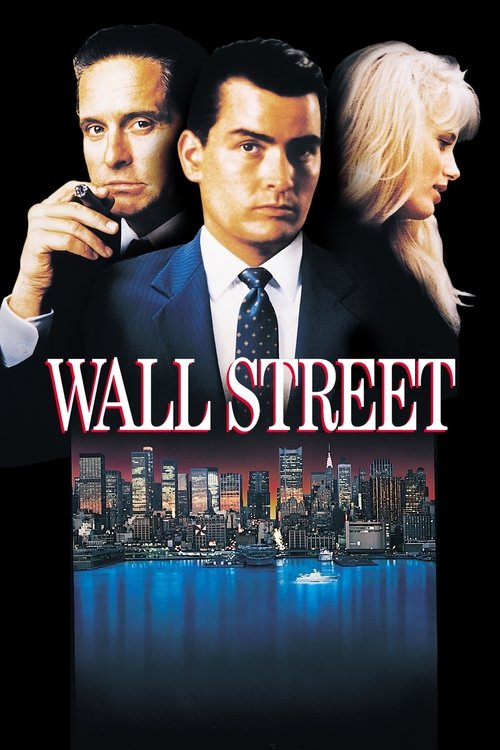
Wall Street
1987 · Oliver Stone
For when you want a slick, quotable rise-and-fall story — ambition, temptation and comeuppance in expensive suits. Comfort-food storytelling with a conscience underneath; great for a night you want to be entertained and left with something to argue about.
What it's about
Bud Fox is a young stockbroker cold-calling his way through lower Manhattan, hungry to get rich fast. He talks his way into the orbit of Gordon Gekko, a corporate raider who treats greed as a philosophy, and starts trading on inside information to keep his new mentor fed. What follows is a Faustian bargain in pinstripes: the deeper Bud gets, the more the deals start costing people he actually knows — including his own father, a unionized airline mechanic.
The experience
Fast, glossy and seductive — it moves at the speed of a ringing trading floor and lets you feel the intoxication of easy money before the moral bill arrives. It's the rare message movie that's genuinely fun to watch, which is exactly its trick.
Performances
Michael Douglas won the Best Actor Oscar as Gordon Gekko, a villain so magnetic that generations of finance guys missed the point and idolized him. Charlie Sheen's eager, corruptible Bud plays perfectly against his real father Martin Sheen as the film's blue-collar moral anchor.
The craft
Oliver Stone shoots the trading floor like a battlefield — restless camera, overlapping phone chatter, deals closing in mid-sentence — so the film has the adrenaline of the world it's condemning. The script is an engine of quotable aggression, with the 'greed is good' speech as its centerpiece.
Why it matters
Released weeks after the 1987 market crash, it became the defining film of the Reagan-era money culture, and Gekko its accidental folk hero. It's still the reference point every film about financial excess gets measured against.
Snapshot
Oliver Stone's Wall Street arrives as a moral fable dressed in the aggressive tailoring of the Reagan decade: a Faustian compact set inside the glass canyons of lower Manhattan, where a hungry young stockbroker named Bud Fox sells his conscience to a corporate raider who wears greed as a philosophy. Released on December 11, 1987 — less than two months after the Black Monday crash that wiped twenty-three percent from the Dow Jones in a single session — the film struck an almost uncanny note of prophecy and diagnosis simultaneously. Gordon Gekko's "greed is good" speech, already written and filmed before the crash, became immediately legible as epitaph rather than celebration. The film is simultaneously a critique of the speculative culture it anatomizes and, in its own electric surface pleasures, a complicit participant in that culture's glamour. That productive contradiction is the engine of its lasting power.
Industry & production
Wall Street was produced by Edward R. Pressman and A. Kitman Ho for 20th Century Fox, with Pressman — a producer who specialized in films of genuine ambition and difficulty — providing the institutional cover for Stone's polemical instincts. Stone co-wrote the screenplay with Stanley Weiser, drawing extensively on personal memory: his father, Louis Stone, had been a stockbroker and ran a small Wall Street firm, and Stone has spoken at length about the world of financial aspiration and anxiety he inhabited as a child. The film is explicitly dedicated to Louis Stone. This autobiographical pressure shapes the film's emotional architecture — Bud Fox's real drama is not the SEC investigation but the shame of having betrayed a working-class father, Carl Fox (played by Martin Sheen, Charlie Sheen's actual father, a casting decision Stone made deliberately for its psychoanalytic resonance).
Stone and Weiser researched the script by spending time with traders, investment bankers, and brokerage analysts. The character of Gordon Gekko was composite rather than singular: Ivan Boesky — whose 1985 commencement address at UC Berkeley's business school included the line "greed is healthy" and who was indicted for insider trading in November 1986 — is the most frequently cited model, but Stone has also pointed to Carl Icahn, Saul Steinberg, and other corporate raiders of the era. The Boesky connection is sufficiently tight that Gekko's speech directly inverts and amplifies Boesky's formulation; whether Stone or Weiser had access to a transcript or simply absorbed the cultural echo is not fully documented in the public record.
Production required extensive cooperation from the New York financial community for location access, including sequences shot on or near the actual floor of the New York Stock Exchange. The pre-digital trading floor — its physical chaos of paper, shouting, and analog tickers — gives the film a period-specific texture that would be impossible to recreate faithfully: it is documentary record as much as dramatic backdrop. Stone was in post-production when the October 19, 1987 crash occurred, and has said the timing sharpened the film's edge without requiring any revision to its argument.
Technology
The film was shot on 35mm, using anamorphic lenses in portions of the film to lend the New York cityscape its monumental scope. No digital intermediary existed at this stage of the industry; the film's look was fixed in photochemical development and optical printing. The period's Steadicam technology is put to significant use, enabling the restless, gliding camera movements that track Bud through trading floors, across office lobbies, and along the precipices of power. This is not Steadicam deployed for invisible continuity but as expressive instrument — the camera's refusal to settle mirrors Bud's perpetual ambition. Practical location photography throughout Manhattan was supplemented by set construction for Gekko's offices and Bud's increasingly opulent apartment, environments that required meticulous period dressing to convey the specific aesthetic of 1980s finance capitalism: the Bloomberg terminals, the paper tape, the suspenders and power ties that signaled a generation's self-mythology.
Technique
Cinematography
Robert Richardson served as director of photography, in his second consecutive collaboration with Stone following Platoon (1986). Richardson's signature at this period is a kinetic intensity that treats the camera as a participant rather than an observer: rapid zooms that compress geography and imply urgency, high-contrast lighting that carves faces into moral geometry, and a willingness to push exposure in ways that make interiors feel overheated, volatilized. The montage sequences depicting Bud's ascent — cross-cutting between trading-floor pandemonium, Gekko issuing commands, stock prices spiking — are edited to an almost subliminal rhythm that Richardson photographs with full-frame exposure, each shot designed to sustain acceleration without losing legibility. The Hamptons sequences, by contrast, are shot in cooler, flatter light, the wealth landscape rendered with a slight remove that acknowledges its foreignness to Bud. Richardson would go on to cement a career at the highest register of American cinematography (JFK, The Aviator, Hugo), and Wall Street is an early demonstration of his ability to subordinate technical bravura to psychological argument.
Editing
The film was edited by Claire Simpson, who had cut Platoon for Stone the year before (winning the Academy Award for that work). Simpson's cutting on Wall Street is calibrated to two distinct registers: the staccato, percussive rhythm of the financial sequences, where cuts follow the beat of transaction and the grammar of urgency, and the more drawn-out, almost classical pacing of the dramatic confrontations — particularly the scenes between Bud and Carl Fox — where breath and silence are admitted into the structure. The intercutting of Gekko's shareholder speech with Bud's dawning understanding of what he has enabled is among the more precisely timed sequences in Stone's filmography, withholding the speech's full context until the emotional damage has been registered.
Mise-en-scène / staging
Stone's staging is organized around the semiotics of space and clothing. Gekko's environments — the corner office with its panoramic Manhattan view, the corporate jet, the Hamptons estate — are coded as the topography of power made material, each space calibrated to dwarf visitors and confirm the occupant's dominion. Bud's environments migrate correspondingly: the cramped phone-bank of his early brokerage days, the Upper East Side apartment he furnishes with Darien's interior-design assistance (a scene of cheerful corruption presented as lifestyle aspiration), and ultimately the sterile marble of the federal investigation. The suspenders, the hair gel, the power ties are not mere period costume but a wardrobe that the film treats as transformation — Bud literally puts on Gekko's world and the film watches what it does to his posture, his walk, his face.
Sound
The sound design amplifies the film's interest in the sonic culture of financial excess: the open-outcry trading floor is rendered as organized noise, a din in which individual human voice must compete with the aggregate roar of capital moving. Dialogue scenes in offices are frequently counterpointed against the ambient hum of technology — printers, terminals, telephones — that refuses silence. Stewart Copeland, formerly the drummer for The Police, composed the original score. Copeland's background in rock percussion inflects the score toward propulsive, syncopated rhythms suited to the film's forward momentum, though the score at times strains for an ironic distance from the material it accompanies that the film itself doesn't always share. The sound design of the film's quieter emotional registers — Carl Fox in hospital, Bud's final confrontation with Gekko in Central Park — relies on abrupt reduction of the surrounding sonic texture, forcing attention to the human voice stripped of institutional support.
Performance
Michael Douglas's performance as Gordon Gekko is the film's dominant fact, and his Academy Award for Best Actor (the first Oscar of his career as an actor) reflects not just the magnetic surface of the performance but its structural complexity. Gekko is not a villain in the conventional sense — he is a believer, and Douglas plays the belief with complete intellectual commitment, making the "greed is good" speech genuinely persuasive in the moment of its delivery. The performance is physically precise: the set of Gekko's jaw, the way he occupies space, the quality of his attention when he turns it on Bud. Charlie Sheen plays Bud as a more reactive, less fully realized character, which is partly scripted limitation and partly a choice that serves the film — Bud is a screen onto which Gekko (and the audience) can project desire. Martin Sheen's Carl Fox anchors the film's moral framework with an economy and emotional directness that the film's louder sequences cannot always match.
Narrative & dramatic mode
Wall Street is structured as a classical rise-and-fall narrative — the form of tragedy applied to American social aspiration — with Bud Fox as its Faust and Gekko as his Mephistopheles. The Shakespearean father-son geometry (Carl Fox / Bud / Gekko forming a triangle in which the surrogate father must be repudiated for the biological one to be honored) drives the climax and shapes Stone's moral verdict. The film is not, despite appearances, ambiguous about this verdict: it stages Gekko's arrest as catharsis and Bud's cooperation with the SEC as partial redemption, even as it acknowledges that neither the system nor Bud escapes structurally undamaged. What gives the film its productive tension is that the dramatic mode — the kinetic pleasure of the rise — is itself corrupting of the didactic intent.
Genre & cycle
Wall Street belongs to the financial thriller subgenre and more broadly to the yuppie cycle of mid-to-late 1980s American cinema — a cycle that included Working Girl (1988), The Secret of My Success (1987), Bright Lights, Big City (1988), and less directly American Psycho (as novel, 1991). These films document, with varying degrees of irony and critique, the aspiration, anxiety, and ethical vacancy of a generation that defined itself through professional advancement and consumption. Stone's film is the cycle's darkest and most politically explicit entry, rooted in his broader project of anatomizing American moral corruption — Wall Street sits between Platoon (1986) and Born on the Fourth of July (1989) as part of a loosely conceived trilogy about the ways American systems devour individual conscience.
Authorship & method
Stone's directorial method in this period was characterized by intensive research, a confrontational relationship with his material, and a willingness to impose rhetorical argument directly on dramatic form. He is not a filmmaker who conceals his intentions: the "greed is good" speech is not merely Gekko's manifesto but Stone's prosecutorial exhibit. Stanley Weiser's contribution to the screenplay — particularly in its more naturalistic dialogue and the texturing of the brokerage environment — has been somewhat eclipsed by Stone's authorial profile, though the script's structural tightness reflects a genuine collaboration. Richardson's cinematography amplifies Stone's impulses rather than tempering them; this is a productive directorial-DP relationship in which shared instincts run the risk of mutual reinforcement. Copeland's score is the collaboration that shows the most tension between intentions.
Movement / national cinema
Wall Street is squarely a product of the American cinema of the Reagan decade — a Hollywood genre film that nonetheless permits itself a degree of explicit political argument unusual in studio production of the period. Stone occupies a position within this national cinema as a filmmaker who uses genre infrastructure to deliver commentary that more formally avant-garde work might have been able to deliver only to smaller audiences. The film's relationship to the New York location — the real trading floors, the actual geography of Manhattan power — aligns it with a tradition of American social realism that the 1970s New Hollywood had cultivated and that Stone inherited without being formally part of.
Era / period
The film is an artifact of the specific moment of Reagan-era deregulation, junk bond capitalism, and the mythology of the self-made financial predator as cultural hero. Ivan Boesky was arrested in November 1986; Michael Milken's investigation was ongoing; leveraged buyouts were restructuring American industry. The film captures a culture at the precise moment of its apogee and its first crack, released as Black Monday was still reverberating through the financial system. This historical specificity is both the film's strength and one limit of its applicability as critique: the mechanisms it depicts belong to a particular moment of American capitalism's evolution, not to an eternal condition.
Themes
The film's central themes are the corruption of ambition, the father as moral compass, the complicity of the witness, and the question of whether the system that produces a Gekko can be reformed from within or only escaped. Greed is examined not as simple villain but as a seduction with its own coherent philosophy — Gekko's argument about the inefficiency of management and the productivity of capital reallocation is not presented as obviously wrong, and the film is sophisticated enough to register that Bud's eventual resistance is enabled partly by the privileges Gekko gave him. Class — the distance between Carl Fox's working-class Queens and Gekko's Hamptons — structures the film's moral geography and gives its ending a specificity that transcends individual corruption.
Reception, canon & influence
Backward (influences on the film): The Godfather's father-son architecture of corruption and conscience is structurally present; Network (1976) precedes it in treating American corporate culture as moral spectacle and providing a model for the great haranguing speech as dramatic set-piece. The literary tradition of the American dream's corruption — Fitzgerald, Dreiser — is explicitly invoked by the film's moral design. Ivan Boesky's actual speech and biography provided raw material. Stone's own Platoon established the moral fable mode that Wall Street continues.
Critical reception: The film was received positively on release, with Douglas's performance drawing near-universal admiration. The Academy Award for Best Actor validated what critics had identified: a performance capable of making a villain legible as a cultural force rather than a cartoon. Some critics noted, even at the time, that the film's aesthetic excitement was in productive tension with its moral argument — that it was more pleasurable as a rise narrative than it was persuasive as a fall.
Forward (the film's legacy): Gordon Gekko entered the cultural vocabulary as one of the defining American screen villains, while paradoxically attracting genuine emulation — Stone has spoken about learning that his film was used as recruitment material by actual brokerage firms, a reception that mirrors Network's parallel irony. The Wolf of Wall Street (2013) is the most direct descendant, sharing Wall Street's ambivalence about the pleasures of the world it anatomizes and pushing that ambivalence considerably further into formal implication. Boiler Room (2000) and Margin Call (2011) engage the moral terrain Stone mapped. The television series Billions operates in the long shadow of Gekko as a cultural type. Stone returned to the character in Wall Street: Money Never Sleeps (2010), a film that largely confirmed through contrast how precisely the original had been calibrated to its historical moment. The "greed is good" speech remains one of the most quoted passages in American cinema and has accumulated, across four decades, a quality of fateful prediction that no one involved in its writing could have fully anticipated.
A Deleuzian reading
Watch Bud Fox at a mirror.
The full Deleuzian reading of Wall Street →
Reception
A hit in 1987 that won Michael Douglas the Best Actor Oscar, it was meant as a cautionary tale about 80s excess — but decades on it's best known for the irony that real traders embraced it, with Stone often noting people told him the film inspired them to go into finance.
How Wall Street was received, from release to now →
Influences: the films it descends from and the films it influenced
- Citizen Kane (1941) — Gregg Toland's deep-focus staging of the tycoon's power interiors — vast spaces that psychologically dwarf their occupant — establishes the grammar Richardson and Stone use to make Gekko's office a projection of dominance; the rise-and-fall structure of an investigation reconstructing a charismatic titan's corruption is Wall Street's direct narrative template.
- The Apartment (1960) — Wilder establishes the device of a young corporate climber who uses a physical space as literal currency in exchange for advancement — a transactional logic Bud Fox replicates when he delivers an insider tip as tribute; LaShelle's widescreen rendering of the corporate floor as a grid of identical desks anticipates Richardson's trading-floor geometry as moral cartography.
- Mean Streets (1973) — Scorsese's use of pre-existing rock tracks cut directly against the action established the grammar of pop score as moral counterpoint — music glamorizing what the narrative indicts — that Stone's rock-percussion score deploys throughout Bud's ascent sequences; Wall Street's soundtrack strategy is structurally identical.
- The Godfather (1972) — Stone deliberately cast biological father-son Martin and Charlie Sheen to literalize the Corleone-derived moral architecture — a son betraying working-class paternal ethics for corrupt patrician power — replicating Coppola's device of making family drama the hidden engine of the crime narrative.
- Network (1976) — Arthur Jensen's 'primal forces of nature' boardroom monologue — a corporate figure delivering capitalism's philosophy as revelation to a terrified protagonist — is the direct formal template for Gekko's 'greed is good' speech; Paddy Chayefsky's rhetoric of systemic seduction shapes Stone and Weiser's scripting of Gekko's oratory.
- All the President's Men (1976) — Gordon Willis staged institutional power as architectural oppression — dark, cavernous spaces where protagonists are dwarfed by the system — establishing the grammar Richardson extends in Wall Street's glass-and-steel corridors, where spatial composition is itself a semiotic argument about hierarchy.
- Scarface (1983) — De Palma's montage of Tony Montana's rise — rapid cuts between product, cash, and status objects over an electronic pop score — is the direct editing grammar Stone and Simpson adapt for Bud Fox's ascent; both films use the Faustian rise-fall arc with a score that glamorizes before it condemns, creating the same productive complicity.
- Platoon (1986) — Richardson and Simpson's collaboration with Stone immediately prior — Richardson's high-contrast kinetic photography and Simpson's percussive cutting — is the direct technical foundation for Wall Street; the moral triangle of a young soldier between two father figures (Barnes/Elias) is the structural template Stone transposes wholesale to Bud Fox between Gekko and Carl Fox.
- Sweet Smell of Success (1957) — The mentor-acolyte corruption pact and quotable predatory aphorism (Gekko/Bud mirroring Hunsecker/Falco) as engine of moral collapse.
- Boiler Room (2000) — Younger makes the debt explicit — characters screen Wall Street and model themselves on Gekko — while replicating Stone's structural template exactly (junior broker seduced by charismatic superior into securities fraud); the boiler room's overlapping telephone soundscape directly extends Stone's open-outcry sound design as moral texture rather than mere backdrop.
- American Psycho (2000) — Harron carries Stone's semiotics of costume to satirical endpoint: the business card scene is a direct formal parody of the power-suit iconography Stone established, and Patrick Bateman is Gordon Gekko stripped of charm — the yuppie-cycle's surface aesthetics turned into evidence of psychic vacancy.
- Margin Call (2011) — Chandor stages financial power through architectural space with rigorous precision — the glass tower as a vertical map of the hierarchy, each floor a rung of moral remove — in direct descent from Stone's semiotics-of-space; the long elevator ride to the executive floor as a spatial argument about culpability is a grammar Richardson and Stone established.
- The Wolf of Wall Street (2013) — Scorsese extends Stone's percussive montage of financial excess to maximalist scale, applying his own rock-track editing grammar to the Faustian stockbroker arc Stone established; Schoonmaker's staccato trading-floor cutting is a direct evolution of Claire Simpson's rhythm, and the charismatic narrator-criminal delivering manifesto-speeches descends from Gekko.
- The Big Short (2015) — McKay and editor Hank Corwin adapt Stone's percussive financial montage, adding Brechtian celebrity interpolations that descend from Stone's didactic strategy of making financial mechanics viscerally legible through editing; both films treat the cut itself as moral judgment on the transaction rather than merely connecting scenes.
- Lord of War (2005) — Builds a film around a seductive amoral salesman of capitalism — the high-gloss glamorization of greed staged so the audience is courted before being morally punctured.
- The Devil's Advocate (1997) — The mentor-protégé corruption arc built around the tempter's set-piece address, with the apartment-and-wardrobe upgrade montage functioning as the visible ledger of the bargain.
- Working Girl (1988) — Nichols's same-year Manhattan financial-world film uses costume transformation as its central dramatic device in precise structural parallel — Tess McGill's wardrobe change from secretary to executive is the working-class inversion of Bud Fox's power-suit transformation — staging Wall Street's glass towers as environments where self-reinvention is simultaneously liberation and corruption.
- Glengarry Glen Ross (1992) — Foley and Mamet stage the sales floor as a Darwinian arena where language is a weapon; Blake's 'always be closing' speech — a manifesto delivered by a charismatic outsider to assembled subordinates — is the working-class cousin of Gekko's boardroom oratory, and both films hinge their moral argument on a single bravura speech that makes the system's logic irresistibly eloquent.
Similar films
- The Wolf of Wall Street (2013) — influence & lineage · same viewing thread
- Margin Call (2011) — influence & lineage · same viewing thread
- Glengarry Glen Ross (1992) — influence & lineage · same viewing thread
- The Big Short (2015) — influence & lineage
- The Godfather (1972) — influence & lineage
- Citizen Kane (1941) — influence & lineage
- Scarface (1983) — influence & lineage
- Network (1976) — influence & lineage
All the films related to Wall Street →
Watch it with: curated runs of related films
- The American Male Comes Apart — A run of self-made men — brokers, founders, dealers, drifters — hollowed out by the very thing they chase, each film pressing the same nerve where ambition curdles into alienation and violence.