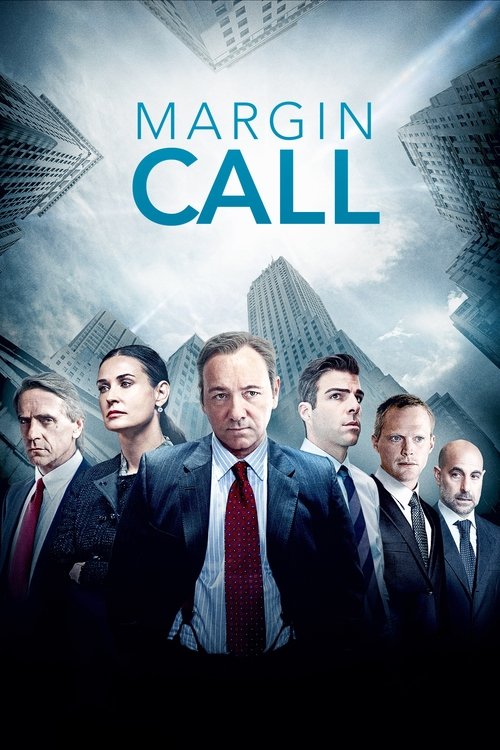
Margin Call
2011 · J.C. Chandor
For when you want a smart, grown-up thriller that grips without a single car chase — something to argue about afterward. More bracing than comforting: it makes the 2008 crash feel personal.
What it's about
On a single sleepless night at a Wall Street investment firm, a junior risk analyst finishes a calculation his just-fired mentor left behind — and realizes the bank's mortgage holdings could sink the entire company. The discovery climbs the corporate ladder floor by floor, from cubicles to the boardroom, until the executives must decide before the markets open what they're willing to do to survive, and to whom.
The experience
Quiet, coiled, and relentlessly tense — a thriller made almost entirely of conversations in glass offices at 3 a.m., where the dread comes from watching smart people slowly understand how bad things are. It's talky in the best way: you lean in, and it leaves you a little sick about how the world actually works.
Performances
A murderers' row in peak form: Jeremy Irons is silkily terrifying as the CEO who wants the math explained 'as you might to a young child, or a golden retriever,' Kevin Spacey gives the firm its conflicted conscience, and Stanley Tucci makes a fired risk manager's quiet bitterness unforgettable.
The craft
J.C. Chandor's debut script is a marvel of compression — 24 hours, one building, and dialogue that makes collateralized debt legible without ever dumbing it down. The cool, fluorescent look of trading floors at night does half the storytelling, and the film trusts silence and faces where other movies would reach for music.
Why it matters
It became the definitive insider drama of the 2008 financial crisis and launched Chandor as a major American filmmaker, earning him an Oscar nomination for the screenplay.
Snapshot
Margin Call is a chamber thriller about the first hours of the 2008 financial collapse, compressing the implosion of a great Wall Street investment bank into a single sleepless night and the following dawn. Written and directed by J.C. Chandor as his feature debut, it observes a fictional, unnamed firm — broadly recognizable as a composite of Lehman Brothers and the other heavily leveraged houses — as a junior risk analyst completes a calculation his recently fired mentor had begun, and discovers that the firm's holdings of mortgage-backed securities have become so volatile that their potential losses exceed the value of the company itself. From that revelation the film escalates upward through the corporate hierarchy in real time, floor by floor and rank by rank, until the decision of what to do reaches the chief executive in a pre-dawn boardroom. What distinguishes Margin Call from the broader cycle of crisis films is its restraint and its ensemble texture: it is a talk-driven, almost theatrical procedural, more interested in the moral postures people adopt under catastrophe than in spectacle or villainy. Made on a small budget over a brief shoot, anchored by a deep cast of established actors, and nominated for the Academy Award for Best Original Screenplay, it stands as one of the most respected dramatizations of the crisis and an unusually assured first feature.
Industry & production
Margin Call is a product of American independent production at a moment when the industry was absorbing the shock of 2008 both as subject and as economic reality. It was produced through Before the Door Pictures, the company founded by actor Zachary Quinto with Neal Dodson and Corey Moosa; Quinto both produced and took the key supporting role of the senior analyst Peter Sullivan, and the project's realization owed much to that producer-actor's commitment to a first-time director's script. The film was financed independently on a notably modest budget — figures reported in the press cluster in the low single-digit millions — and shot on a famously compressed schedule of roughly seventeen days, largely in a single office location in New York. That economy is fundamental to the film's character: a confined, dialogue-driven drama set almost entirely within one building was both an artistic choice and a practical response to limited means.
Casting was the production's decisive advantage. Chandor assembled an ensemble of unusual depth for a debut feature — Kevin Spacey, Jeremy Irons, Paul Bettany, Stanley Tucci, Demi Moore, Simon Baker, Penn Badgley, and Quinto — players willing to work on a small independent for material they evidently valued. The breadth of that cast lent the film an immediate credibility and allowed Chandor to stage the firm as a believable hierarchy, each rung embodied by a recognizable, fully weighted presence. The screenplay carried a personal dimension: Chandor's father had spent a long career at Merrill Lynch, and the writer-director has spoken of growing up around the culture and language of Wall Street, a background that informs the film's confident handling of financial milieu and idiom.
The film premiered at the Sundance Film Festival in January 2011 and screened in competition at the Berlin International Film Festival shortly after. It was released in the United States in October 2011 by Roadside Attractions in partnership with Lionsgate, in a then-still-novel day-and-date strategy that placed the film in theaters and on video-on-demand simultaneously — a distribution model well suited to a talk-heavy adult drama whose audience skewed toward attentive home viewing.
Technology
Margin Call was photographed digitally, a choice consonant with both its budget and its subject. The film's visual world is one of screens, trading terminals, glass towers, and the cold electronic light of a 24-hour financial operation, and digital capture lent itself naturally to the low light levels of a nighttime office and the glow of monitors. The production's technological interest is thematic rather than formal: the catastrophe at the heart of the story is itself a product of technology and abstraction — risk models, mortgage-backed securities, and quantitative formulas so complex that, as the film repeatedly dramatizes, almost no one in the building's chain of command can actually explain them. The running joke and serious point that executives demand the analysis be restated "in plain English," or as if spoken to a child, is the film's commentary on a financial system whose technological sophistication has outrun the comprehension of the people responsible for it. Beyond that thematic engagement, the record indicates no unusual technical apparatus; the film's means are deliberately modest and in service of performance and atmosphere.
Technique
Cinematography
The cinematography is by Frank G. DeMarco, who renders the film's nocturnal corporate world in a palette of glass, steel, and electronic glow. The camera favors the architecture of the modern investment bank — the open trading floor, the executive suites high above the city, the elevators and lobbies that connect the firm's social strata — and uses the building's glazed surfaces and night-time vistas of Manhattan to frame the human drama against the vast, indifferent scale of the financial metropolis. DeMarco's lighting exploits the available sources of an after-hours office: the pallor of overhead fluorescents, the blue of screens, the warmer pools of executive lamplight. As the night wears on toward dawn, the imagery tracks the passage of time, and a recurring motif of the city seen from on high — beautiful, remote, and oblivious — underlines the gulf between the men deciding its fate and the world below. The visual approach is unshowy and observational, holding on faces and letting the framing register status and isolation rather than calling attention to itself.
Editing
The editing, by Pete Beaudreau, sustains the film's real-time momentum across its single-night structure. The cutting is patient where the drama is conversational, holding two-shots and reaction shots to let exchanges play, and it tightens as information ascends the hierarchy and successive executives are summoned in the small hours to confront the firm's exposure. The film's suspense is generated almost entirely through dialogue and the gradual dissemination of a single piece of knowledge, and the editing's task is to make that escalation legible and tense — to render a spreadsheet's implications as a thriller's ticking clock. The rhythm accelerates toward the trading-floor climax of the following morning, when the firm's decision is executed, then settles into a quieter, more elegiac coda. The restraint of the cutting is integral to the film's seriousness; it refuses melodramatic acceleration and trusts the gravity of the situation to carry the tension.
Mise-en-scène / staging
Margin Call's staging is essentially that of a hierarchical chamber drama, and its production design (by John Paino) maps the social geography of an investment bank with care. The film is organized vertically: the action climbs from the trading floor, where analysts and traders work, up through middle management to the executive floor and finally the boardroom, the building's architecture literalizing the chain of responsibility. Costuming and setting distinguish rank precisely — the suits, the offices, the cars, the rooftop of the executive tier against the open-plan exposure of the floor below. Chandor stages many of the key scenes as confrontations between two or three figures in enclosed rooms, and the film's recurrent visual idea is the summoning of one stratum by the next, each character pulled from sleep or routine into the building's emergency. The arrival of the chief executive by helicopter, the late-night boardroom conclave, and the symbolic interludes — a fired risk officer's long career reduced to a security escort and a box of belongings — all use spatial staging to dramatize a system of power and disposability.
Sound
The score by Nathan Larson is spare and brooding, favoring sustained, atmospheric textures that underscore dread without editorializing; the music tends to recede behind the dialogue and surface in the film's quieter, more reflective passages. Sound design renders the ambient hum of the after-hours office — the climate systems, the muted city, the electronic murmur of a building that never fully sleeps — and the contrast between that low constant drone and the charged stillness of the boardroom. As with the rest of the film's technique, the sound is in service of mood and of the primacy of speech: this is a film built on talk, and its soundscape is shaped to keep the spoken word foremost.
Performance
Performance is the film's principal achievement, and its ensemble functions as a study in how different temperaments meet catastrophe. Jeremy Irons, as the chief executive John Tuld, supplies the film's most quotable presence — urbane, ruthless, disarmingly frank about his own ignorance of the instruments that made his fortune, and chillingly clear about the logic of survival. Kevin Spacey, as the sales-floor manager Sam Rogers, carries the film's conscience and its compromise, a man who knows the firm's planned course is indefensible yet executes it, his grief displaced onto a dying dog in a register of misdirected feeling. Paul Bettany's trader Will Emerson voices the cynical, self-justifying worldview of the floor; Stanley Tucci's fired risk officer Eric Dale embodies the institutional memory and human cost the firm discards; Zachary Quinto's analyst is the film's point of entry, the technician who understands the numbers and watches their meaning travel beyond his control. Demi Moore and Simon Baker fill out the executive tier as figures maneuvering for survival and blame. The playing throughout is controlled and unshowy, an ensemble of reactions and silences as much as speeches, and the film's recognition by the Independent Spirit Awards' Robert Altman Award — given for ensemble work — registers the collective nature of the accomplishment.
Narrative & dramatic mode
Margin Call's dramatic mode is the real-time procedural reconceived as moral chamber play. Its structure is a relay: a single piece of knowledge — that the firm's risk exposure has become existential — passes upward through the corporate hierarchy over one night, and each transfer of the information is a scene of confrontation, calculation, and self-justification. There is no conventional antagonist and no violence; the drama is entirely one of decision under pressure, and its suspense derives from the question of what the firm will do once it understands its position. The film withholds easy villainy. Its characters are neither monsters nor innocents but functionaries of varying conscience caught in a logic larger than any of them, and the screenplay's method is to let each articulate his rationale — survival, fiduciary duty, self-preservation, sheer appetite — so that the audience grasps the collective machinery of the crisis rather than blaming an individual. The climactic decision to sell the toxic holdings before the market grasps their worthlessness, knowing it will destroy the firm's relationships and accelerate the broader collapse, is dramatized not as a crime but as a coldly rational act of self-rescue, and the film's lasting force lies in that refusal of melodrama. The coda — a man burying his dog in the dark — translates the institutional catastrophe into a register of private, displaced mourning.
Genre & cycle
The film belongs to the cycle of works reckoning with the 2008 financial crisis, a body of cinema that includes documentary (Inside Job), broad ensemble explanation (The Big Short), and prestige drama (Too Big to Fail), and within that cycle Margin Call occupies the most restrained, dramatically classical position. Generically it fuses the thriller — a ticking-clock structure, a dangerous secret, escalating stakes — with the corporate drama and the chamber play, and its closest formal relatives are talk-driven, single-setting dramas of men under pressure: the boardroom and the after-hours office as theater of decision. The film's confined location, real-time compression, and reliance on dialogue and ensemble link it to a tradition of stage-derived screen drama, even as its subject is utterly contemporary. It also participates in a longer lineage of Wall Street cinema running back through Oliver Stone's Wall Street (1987), but it pointedly rejects that earlier film's flamboyant villainy in favor of a more diffuse, systemic portrait of culpability.
Authorship & method
Margin Call is most legible as the work of J.C. Chandor, and as a debut it announces a distinctive authorial method: an interest in competent professionals confronting existential crisis, rendered through restraint, procedural detail, and a refusal of easy moralizing. Chandor wrote as well as directed, and the screenplay — for which he received an Academy Award nomination for Best Original Screenplay — is the film's foundation, its dialogue carrying the financial milieu with an insider's fluency drawn from the writer-director's own background near the industry. The film's method is economy turned to advantage: a small budget, a short schedule, and a single location concentrated into a chamber piece whose limitations become its form. Chandor's preoccupation with capable people tested to the edge of survival would recur across his subsequent work — the lone sailor of All Is Lost (2013), the businessman navigating corruption in A Most Violent Year (2014) — making Margin Call the opening statement of a coherent body of work.
Among the key collaborators, cinematographer Frank G. DeMarco established the film's cold, glass-and-screen visual world; editor Pete Beaudreau shaped its real-time escalation; and composer Nathan Larson supplied its spare, dread-laden score. Producer-actor Zachary Quinto and his Before the Door Pictures partners were essential enablers, backing a first-time director and helping to attract the ensemble that gives the film its weight. But the authorship is above all a meeting of a precise script and a deep cast: Chandor's writing supplies the architecture, and the ensemble fills it with the contradictions of people behaving rationally inside an irrational system.
Movement / national cinema
Margin Call belongs to American independent cinema of the early 2010s, and specifically to a strand of intelligent, adult, issue-engaged drama that found its audience through festival exposure and the emerging day-and-date theatrical-and-VOD distribution model. It is a New York film in setting and production, drawing its texture from the architecture and rhythms of Lower Manhattan finance, and it reflects a moment when American independent producers were turning the recent national trauma of the financial crisis into serious narrative cinema. The film's modest scale, festival launch at Sundance and Berlin, and reliance on an ensemble of committed actors working below their usual rates are characteristic of the independent sector's capacity to mount substantial drama on slender means.
Era / period
The film is a precise artifact of its historical moment, set in the early hours of the 2008 collapse and released in 2011 into a culture still living through its consequences — the bailouts, the foreclosures, the recession, and, by the time of release, the Occupy Wall Street movement then gathering in the very district the film depicts. Its portrait of the financial industry registers the specific instruments and pathologies of the crisis: the mortgage-backed securities, the excessive leverage, the risk models no one fully understood, and the culture of compensation and self-justification that the post-crash reckoning brought under scrutiny. The film captures, too, the human texture of the period's mass layoffs — the security escort, the deactivated phone, the box of belongings — and the gulf between the executives who survived the collapse and the employees and public who absorbed its costs. It is, in this sense, a period film about the immediate present, dramatizing a turning point whose aftershocks defined the years in which it was made.
Themes
The film's governing theme is moral responsibility within a system designed to diffuse it. Margin Call repeatedly stages the question of culpability and finds no single guilty party, only a chain of individuals each acting rationally within his own incentives, so that catastrophe emerges from the aggregate rather than from any villain — a vision of structural rather than personal evil. Around this orbit several interlocking concerns. There is the theme of comprehension and abstraction: the recurring demand that the analysis be explained "in plain English" dramatizes a financial order so complex that those who profit from it cannot understand it, and the moral hazard that incomprehension licenses. There is the theme of value and worth, both financial and human, captured in the film's preoccupation with what things — securities, careers, lives — are actually worth when the market that priced them vanishes. There is the theme of hierarchy and disposability, the vertical world in which knowledge ascends and consequences descend, and in which loyalty is provisional and survival is the only operative ethic. And there is a persistent strain of melancholy and reckoning — the sense, voiced by Tuld's litany of past crashes, that the cycle is ancient and will recur, and the displaced private grief of the film's coda. Beneath all of it runs an unsentimental anatomy of capitalism under stress, in which conscience survives but cannot alter the outcome.
Reception, canon & influence
Margin Call was met with strong critical acclaim, and the response coalesced around the intelligence and restraint of Chandor's screenplay, the strength of the ensemble, and the film's refusal of melodrama in favor of a measured, systemic portrait of the crisis. Its most prominent honor was the Academy Award nomination for Best Original Screenplay, a notable recognition for a debut feature, and it received the Independent Spirit Award's Robert Altman Award for its ensemble. Critics widely regarded it as among the most credible and dramatically satisfying of the crisis films, praising its insider fluency and its even-handed treatment of culpability. The day-and-date release strategy, then still relatively novel, became part of the film's industry story as an example of how a dialogue-driven adult drama could find a viable audience across theatrical and home platforms.
Influences on the film run backward to the tradition of Wall Street cinema — Oliver Stone's Wall Street above all, against whose flamboyant moralizing Margin Call defines itself — and to the broader lineage of confined, dialogue-driven chamber dramas and real-time thrillers in which a small group of people confront a crisis in a single setting. Its insider authenticity draws on Chandor's own proximity to the financial industry through his family background. The 2008 collapse itself, and the wave of journalism and analysis that followed, supplied the factual ground the film fictionalizes.
Its influence forward is felt first within Chandor's own career, where it inaugurated a body of work concerned with competent individuals under existential pressure, continued in All Is Lost and A Most Violent Year. More broadly, the film became a reference point within the crisis cycle — a model for how the abstractions of high finance could be turned into legible, suspenseful drama without sacrificing complexity — and it is frequently cited alongside the later, very differently styled The Big Short as one of the two essential narrative films about 2008. It also helped demonstrate the viability of the day-and-date independent release for serious adult drama. For Chandor, the film established a directorial reputation out of a single confined production; for the broader culture, it remains a durable, sober dramatization of the morning the financial world began to come apart, and it holds a secure place in the canon of films about the 2008 crisis.
A Deleuzian reading
A young analyst sits alone on an emptied trading floor after midnight, finishing a file his fired mentor pressed on him with two words — be careful — and a chart resolves into a line.
The full Deleuzian reading of Margin Call →
Reception
A tiny Sundance debut that barely made a dent in theaters (its day-and-date VOD release was itself a talking point in 2011), it has steadily climbed to 'best film about the 2008 crash' status — the one finance people themselves keep vouching for as the accurate one.
How Margin Call was received, from release to now →
Influences: the films it descends from and the films it influenced
- Wall Street (1987) — Establishes the trading-floor jargon-as-dialogue and the mentor/protégé seduction Margin Call inherits, while Chandor strips Stone's operatic camera and verdict-delivering speeches to define his film against that flamboyant moralizing.
- Glengarry Glen Ross (1992) — Model for the filmed-play compression of desperate salesmen into nocturnal office space, where quota-pressure monologues and a hierarchy of overheard conversations become the entire engine of suspense.
- 12 Angry Men (1957) — The single-room, near-real-time deliberation where escalating tension is generated purely by talk and shifting alliances — Margin Call's relay structure of persuasion around a table descends directly from it.
- Network (1976) — Chayefsky's boardroom set-piece in which a magnate delivers the cosmology of capital (Ned Beatty's speech) is the template for Tuld's rooftop 'be first, be smarter, or cheat' articulation of systemic logic.
- Fail Safe (1964) — Treats an institutional catastrophe as cold real-time procedure among men in sealed rooms, with no villain and only the machine's logic to blame — the no-antagonist, systemic-culpability frame Margin Call adopts.
- Executive Suite (1954) — The overnight corporate-tower succession drama whose ensemble of executives maneuvers vertically through a single skyscraper prefigures Margin Call's staging of moral rank as literal floors of a building.
- All the President's Men (1976) — Procedural fluency in which institutional jargon and methodical information-gathering carry the suspense, paired with a dread-laden visual restraint that refuses melodramatic underlining.
- Michael Clayton (2007) — The immediate stylistic template: a competent professional's late-night moral reckoning inside corporate rot, rendered in cold glass-and-screen surfaces and procedural restraint with no cartoon villain.
- Conspiracy (2001) — A near-real-time institutional-decision chamber where catastrophe is authorized through euphemism and deference to hierarchy, filming the bureaucratic apparatus enabling mass harm with the same restraint and voice-foregrounded coverage.
- All Is Lost (2013) — Extends Chandor's authorial preoccupation with a competent professional pushed to the edge of survival into a near-wordless solo procedural, the chamber reduced to one man and his failing systems.
- A Most Violent Year (2014) — Continues the method of a capable businessman navigating systemic corruption through restraint and moral ambiguity, refusing the easy verdict in the same authorial register.
- 99 Homes (2014) — Carries the crisis cycle into the foreclosure aftermath using the same systemic-culpability lens and a predator/prey procedural in which a competent operator is implicated by the machine he serves.
- Steve Jobs (2015) — Sorkin's real-time backstage corporate procedural built entirely from rapid relay dialogue moving through confined rooms — the talk-as-suspense, single-event compression that Margin Call helped revive.
- Inside Job (2010) — The documentary that mapped the systemic-culpability architecture of 2008 — the diffuse, no-single-villain accounting of the collapse — which Margin Call fictionalizes into a chamber drama.
- Too Big to Fail (2011) — Contemporaneous dramatization of the same collapse built as real-time boardroom crisis-management among an ensemble confined to rooms, sharing the relay-of-decisions structure.
- Arbitrage (2012) — The same cool, glassy finance-thriller register applied to a moneyed man concealing a hole in the books — a contemporaneous chamber drama of plausible-deniability dialogue.
- Cosmopolis (2012) — Renders finance as pure technological abstraction in a single confined setting (the limo), with language about capital decoupled from any physical referent — the theme/technological-abstraction sibling.
- The Big Short (2015) — The paired essential 2008 narrative film that inverts Margin Call's chamber restraint with fourth-wall breaks and kinetic montage, but shares the core craft problem of making finance abstraction legible and suspenseful.
Similar films
- Wall Street (1987) — influence & lineage · same viewing thread
- Michael Clayton (2007) — influence & lineage · same viewing thread
- Glengarry Glen Ross (1992) — influence & lineage · same viewing thread
- The Big Short (2015) — influence & lineage
- A Most Violent Year (2014) — influence & lineage
- 12 Angry Men (1957) — influence & lineage
- Fail Safe (1964) — influence & lineage
- Killing Them Softly (2012) — same viewing thread
All the films related to Margin Call →
Watch it with: curated runs of related films
- The American Male Comes Apart — A run of self-made men — brokers, founders, dealers, drifters — hollowed out by the very thing they chase, each film pressing the same nerve where ambition curdles into alienation and violence.