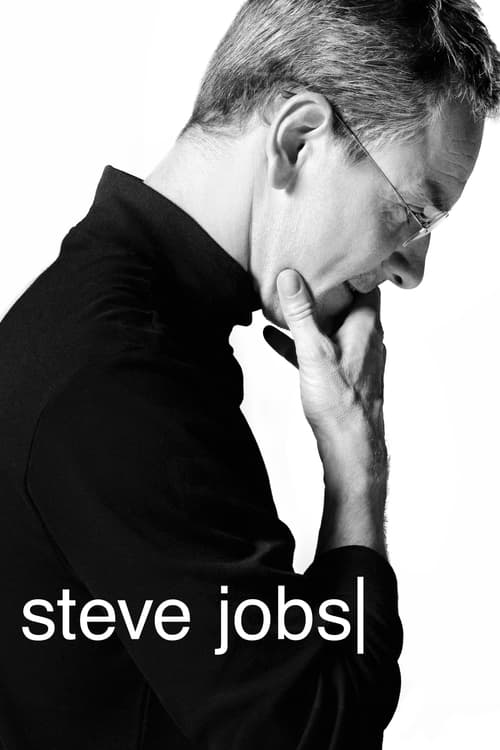
Steve Jobs
2015 · Danny Boyle
When you want to feel smart and swept up at the same time — a film that treats you like you can keep pace. Great for a night when you're craving crackling talk and big personalities rather than action.
What it's about
A portrait of Apple's co-founder told through just three days of his life: the frantic minutes backstage before three product launches, from the 1984 Macintosh to the 1998 iMac. At each one the same people — his loyal marketing chief, his co-founder Steve Wozniak, his ousted CEO, his ex-partner and the daughter he won't acknowledge — corner him to relitigate old wounds while the clock runs down to showtime. It's less a biography than a pressure test of one brilliant, impossible man.
The experience
Fast, dense, and exhilarating — the dialogue comes at you in torrents, and the ticking-clock structure keeps the tension of a thriller even though it's all people arguing in hallways. It's funny, bruising, and by the end unexpectedly moving.
Performances
Michael Fassbender doesn't imitate Jobs so much as burn with his certainty and cruelty, and Kate Winslet, as marketing chief Joanna Hoffman, is the film's conscience — warm, exasperated, and the only person who can stand up to him.
The craft
Aaron Sorkin's screenplay compresses a life into three near-real-time acts, a genuinely daring shape for a biopic, and Danny Boyle keeps it visually alive, giving each era its own distinct texture so you feel time passing in the very grain of the image. It's a film built on rhythm — walk-and-talks, overlapping arguments, and a swelling sense of countdown.
Why it matters
A landmark of the anti-biopic — proof the genre could ditch the cradle-to-grave formula entirely — and one of the defining screenwriting showcases of its decade, earning acting nominations for both leads.
Snapshot
Steve Jobs is Danny Boyle and Aaron Sorkin's formally audacious portrait of Apple's co-founder, structured not as a cradle-to-grave biopic but as three extended backstage sequences, each unfolding in near-real time in the minutes before a public product launch: the 1984 Macintosh unveiling, the 1988 debut of the NeXT Cube, and the 1998 introduction of the iMac. Adapted by Sorkin from Walter Isaacson's authorized 2011 biography, the film deliberately refuses the genre's usual sweep, compressing a life into three confrontational chamber pieces in which roughly the same constellation of people—Jobs's marketing chief Joanna Hoffman, engineer Andy Hertzfeld, co-founder Steve Wozniak, CEO John Sculley, ex-partner Chrisann Brennan, and his daughter Lisa—reappear at each juncture to relitigate love, loyalty, paternity, and credit. Michael Fassbender plays Jobs as a brilliant, abrasive control freak; Kate Winslet, nearly unrecognizable under a Polish-Armenian accent, plays Hoffman as his conscience and foil. The result is a hybrid of stage play, opera, and Sorkin's signature walk-and-talk reporting drama, more interested in the architecture of a personality than in a chronicle of events.
Industry & production
The project had a famously turbulent gestation. Sony Pictures originally developed it, with David Fincher attached to direct and reportedly negotiating over fee and casting before departing; Christian Bale and Leonardo DiCaprio were among the names linked to the title role at various points. When the production migrated to Universal Pictures, Danny Boyle came aboard and Michael Fassbender was cast—a choice questioned at the time because Fassbender bears little physical resemblance to Jobs, a concern the film answers by treating likeness as irrelevant to its theatrical project. Scott Rudin and Mark Gordon produced alongside Boyle's longtime collaborator Christian Colson. The film was shot in San Francisco and the Bay Area in 2015 on a relatively modest budget for a major studio release.
Commercially, the film is generally regarded as a disappointment. After a strong limited opening, its wide expansion underperformed, and it failed to recoup robustly at the box office—an outcome widely attributed to audience fatigue (Ashton Kutcher's Jobs had appeared in 2013 and Alex Gibney's documentary Steve Jobs: The Man in the Machine earlier in 2015), to the demanding, dialogue-dense form, and to ambivalence within the tech world about its portrait. I'd flag that precise grosses vary by source and I won't assert exact figures, but the consensus that it earned far less than expected for a prestige fall release is well established.
Technology
The film's most discussed technical decision is its use of three distinct capture formats, one per act, to give each era a different physical texture. The 1984 Macintosh sequence was shot on 16mm film, yielding a grainier, more intimate look; the 1988 NeXT sequence on 35mm, smoother and more classical; and the 1998 iMac sequence digitally, on the Arri Alexa, clean and contemporary. This escalation through formats mirrors both the chronology and the trajectory of imaging technology itself, so that the medium becomes a kind of time-stamp—an unusually literal marriage of subject and tool given that the film is about the man who helped digitize the world. Beyond this conceit, the production was conventional studio filmmaking; the film is not a technically experimental object so much as one that deploys an experimental formatting scheme atop classical coverage.
Technique
Cinematography
Alwin H. Küchler shot the film, executing the three-format plan as the dominant visual idea. Within that scheme, the camera is restlessly mobile, tracking and circling characters as they stride through corridors, green rooms, and auditorium bowels—the movement underwriting Sorkin's propulsive dialogue. The lighting and palette warm and cool across the acts; the 16mm Macintosh material feels more handmade and embattled, the digital iMac act brighter and more triumphant, matching Jobs's arc from ousted founder to restored messiah. Küchler also stages occasional expressionist flourishes—projected text and imagery, reflective surfaces, the literalization of Jobs's thoughts on auditorium walls—to break the proscenium realism without abandoning it.
Editing
Elliot Graham's editing is central to the film's tempo, sustaining the breathless momentum of Sorkin's overlapping exchanges while managing the considerable challenge of three real-time sequences punctuated by brief flashbacks. The cutting keeps pace with walking characters and rapid verbal volleys, and it threads in archival-style inserts and memory fragments that supply backstory without breaking the present-tense pressure of the countdown to each launch. The film's rhythm is essentially musical, and the editing functions as its meter.
Mise-en-scène / staging
The film is conceived almost as filmed theater. Each act is confined to a single venue in the period leading up to a launch—the original Macintosh debut, the NeXT introduction at a symphony hall, and the iMac reveal—and the drama is built from entrances and exits, as antagonists arrive one by one to confront Jobs in the wings. The recurrence of the same characters across the three acts gives the staging a deliberately stylized, even ritualistic quality that no literal backstage would sustain; the film foregrounds this artificiality rather than hiding it. Boyle and his designers use the architecture of performance spaces—corridors, loading docks, orchestra pits, light booths—as a metaphorical backstage to a life lived as public spectacle.
Sound
Daniel Pemberton's score is a significant contributor, shifting style across the three acts to match their formats and moods—more analog and textural early, more electronic and propulsive later—so that the music, like the cinematography, charts the passage of time. Sound design emphasizes the ambient hum of venues and crowds gathering beyond the doors, the muffled roar of the waiting audience operating as a constant pressure on the intimate conversations. Dialogue, as in all Sorkin work, is the primary sonic element, mixed forward and dense.
Performance
Performance is the film's engine. Fassbender's Jobs is a study in charismatic cruelty and withheld feeling, building across the three acts toward a contested reconciliation; he earned an Academy Award nomination for Best Actor. Winslet's Joanna Hoffman, the only character permitted to talk back and survive, is the film's moral center and won her a Golden Globe and an Oscar nomination for Best Supporting Actress. Jeff Daniels brings gravity to Sculley, Seth Rogen plays Wozniak as the wounded everyman demanding acknowledgment for the Apple II team, and Michael Stuhlbarg's Hertzfeld and Katherine Waterston's Brennan round out the ensemble. Three young actresses play Lisa at successive ages, and the evolving father-daughter relationship carries the film's emotional throughline.
Narrative & dramatic mode
The screenplay's defining choice is its triptych structure: three acts, three launches, real-time confrontation, with the same dramatis personae recurring like motifs in a sonata. Sorkin has openly described the design as operatic and theatrical rather than biographical, and the film acknowledges its own implausibility—that every important person in Jobs's life would corner him in the same forty minutes before each keynote—as a frankly nonrealist convention. Exposition arrives through argument; backstory is delivered as accusation. The dramatic mode is dialectical, each scene a series of duels in which Jobs is challenged and parries, with the cumulative effect of a character cross-examined from every angle. The film is less concerned with what Jobs did than with adjudicating who he was.
Genre & cycle
Steve Jobs sits within the biopic, but pointedly against its conventions, belonging more precisely to a cycle of revisionist, anti-chronological portraits of difficult geniuses—and, within Sorkin's own filmography, to a lineage of institutional dramas about brilliant, abrasive men remaking American life, most obviously The Social Network (2010). It is also part of a brief mid-2010s wave of Steve Jobs media, including the Kutcher Jobs and Gibney's documentary, against which it defined itself by abandoning literal biography altogether. Its theatrical, three-unities-adjacent construction allies it as much with the stage and with opera as with cinema.
Authorship & method
The film is best understood as a collision of two strong authors. Aaron Sorkin's screenplay supplies the architecture, the rhythm, and the worldview: dense overlapping dialogue, the institution-as-arena, the genius interrogated by those he has wounded, and a final movement toward sentiment. Danny Boyle supplies the kinetic visual treatment, the three-format conceit, and a willingness to push toward expressionism—an aesthetic restlessness consistent with his earlier work from Trainspotting (1996) through the Oscar-winning Slumdog Millionaire (2008) and 127 Hours (2010). Cinematographer Alwin H. Küchler executed the era-coded capture scheme; editor Elliot Graham gave the talk its propulsion; composer Daniel Pemberton wrote a score that itself migrates across styles to mark time. The source is Walter Isaacson's biography, though Sorkin treated it as raw material for invention rather than a script to transcribe, compressing and rearranging freely—a method that drew criticism from some who knew Jobs for prioritizing dramatic truth over literal accuracy.
Movement / national cinema
The film belongs to no movement in the art-historical sense; it is a transatlantic studio production—British director and creative personnel working on an American subject for a Hollywood studio—within the contemporary American prestige-drama tradition. If it has a stylistic affiliation, it is to a strain of literate, dialogue-forward American screen drama associated with Sorkin and with directors who treat talk as action. Boyle's British sensibility inflects the visual energy, but the film's idiom is firmly that of the American adult studio picture, a category whose commercial viability the film's underperformance is sometimes cited to illustrate.
Era / period
Set across 1984, 1988, and 1998, the film is a period piece in triplicate, reconstructing three distinct moments in computing and in Jobs's career: the embattled launch of the Macintosh, the wilderness years at NeXT after his ouster from Apple, and the triumphant return culminating in the iMac. The film uses period production design and its escalating capture formats to differentiate the eras, but it is a period film of the recent past rendered as living memory rather than distant history—the technologies it depicts being the direct ancestors of the devices its 2015 audience held in their hands. Made and released at the height of Apple's cultural dominance four years after Jobs's death, it is also inescapably a document of how the 2010s sought to mythologize and interrogate the figure who shaped them.
Themes
The film's central preoccupation is the relationship between creative control and human connection: Jobs's insistence on closed, end-to-end systems—machines that cannot be opened or modified—functions throughout as a metaphor for a man who cannot let others in. Fatherhood is the emotional spine, dramatized through his prolonged denial and eventual acknowledgment of his daughter Lisa, against the counterpoint of the Lisa computer that bore her name. Authorship and credit recur as a wound, most pointedly in Wozniak's repeated demand that the Apple II team be recognized. The film returns again and again to the idea of orchestration—Jobs as a conductor who plays not an instrument but the players, the famous formulation in which he claims his genius lies in directing others rather than building anything himself. Around these run questions of perfectionism as cruelty, vision as tyranny, and whether monstrous behavior can be redeemed by the things it produces.
Reception, canon & influence
Critically, the film was warmly received, praised for Sorkin's writing, Boyle's direction, and especially the performances of Fassbender and Winslet, both of whom were nominated for Academy Awards (Best Actor and Best Supporting Actress respectively); Winslet won the Golden Globe and the BAFTA for her supporting role, and Sorkin won the Golden Globe for his screenplay. Reservations centered on the film's airless theatricality and its loose relationship to the factual record, with some figures from Jobs's life and from Apple disputing its characterizations—a debate the film's own avowedly nonliteral method invited.
Looking backward, the film's most direct influence is Sorkin's own The Social Network, which established the template of the abrasive-tech-genius drama and a willingness to fictionalize a living-memory subject for dramatic ends; its theatrical compression and operatic ambitions look further back to stage tradition and to the "three unities" of classical drama. Isaacson's biography supplied the factual substrate, and the broader 2010s appetite for reckoning with Silicon Valley's founder-myths supplied the cultural occasion.
Looking forward, the film's legacy is more aesthetic and discursive than commercial. Its disappointing box office became a recurring case study in the difficulty of mounting adult, dialogue-driven dramas in a tentpole era, and it is frequently invoked in discussions of the biopic's possibilities—an example of how the form can be broken open into something closer to theater or music. Within the cycle of Jobs portraits, it stands as the most formally ambitious and the most critically esteemed, the version that chose interpretation over reenactment. Its influence on subsequent tech-world dramatizations lies in legitimizing a frankly stylized, structurally radical approach to recent history, even as its market reception cautioned the industry about the genre's limits.
A Deleuzian reading
A man stands in a corridor with a door at the end of it.
The full Deleuzian reading of Steve Jobs →
Reception
A famous box-office flop in 2015 — Universal yanked it from theaters after a disastrous wide expansion despite strong reviews and Oscar nods for Fassbender and Winslet — and it's since been steadily reappraised as one of the great underseen Sorkin scripts.
How Steve Jobs was received, from release to now →
Influences: the films it descends from and the films it influenced
- The Social Network (2010) — Sorkin's own template of the abrasive tech-founder cross-examined by the people he wounded, with adversarial framing (depositions) used to interrogate a living-memory subject.
- A Few Good Men (1992) — Sorkin's signature escalation of verbal sparring toward one explosive, theatrically staged confrontation inside an institution-as-arena.
- Glengarry Glen Ross (1992) — Mamet's wall-to-wall overlapping profane dialogue staged as filmed theater of cornered men, the prose-as-music register Sorkin's backstage scenes inherit.
- Network (1976) — Operatic, oratorical monologue treating a corporation as a moral coliseum, the institutional-arena rhetoric that underwrites Sorkin's worldview.
- Frost/Nixon (2008) — A stage play adapted as filmed theater that builds an entire film toward a single one-on-one verbal duel as its climax.
- Rope (1948) — Real-time compression honoring the classical unities of time and place, confining drama to backstage minutes before an event.
- His Girl Friday (1940) — The rapid-fire, overlapping screwball dialogue rhythm that propels characters through corridors — the cadence Sorkin's walk-and-talk descends from.
- Trainspotting (1996) — Boyle's kinetic expressionism — on-screen text, surreal inserts, restless mobile camera — the visual restlessness he imposes on Sorkin's talk.
- 127 Hours (2010) — Boyle trapping a single figure in one space and energizing it through subjective, multi-format, hallucinatory visual flourish.
- Opening Night (1977) — The pre-curtain backstage rendered as a psychological pressure-chamber, the performer cornered by intimates in the minutes before going on.
- Margin Call (2011) — Sorkin's real-time backstage corporate procedural built entirely from rapid relay dialogue moving through confined rooms — the talk-as-suspense, single-event compression that Margin Call helped revive.
- I'm Not There (2007) — Biography built as a fractured triptych that refuses cradle-to-grave continuity, dramatizing the self through repeated stylized confrontations rather than linear record.
- Vice (2018) — A revisionist biopic that legitimizes a frankly artificial, structurally radical approach to a living-memory power figure over literal reenactment.
- Molly's Game (2017) — Sorkin's directorial extension of his own propulsive, monologue-driven architecture and a flawed protagonist narrated through verbal duels.
- BlackBerry (2023) — A tech-founder drama enabled by the Jobs/Social Network model — the abrasive visionary and his enablers staged as compressed boardroom theater.
- Birdman (2014) — Backstage real-time built around a protagonist pacing corridors before successive performances, scored by a migrating percussion line that marks time.
- Carnage (2011) — A real-time chamber piece compressing escalating conflict into a single theatrical unity of place, dialogue as the entire engine.
- The Big Short (2015) — A stylized, formally disruptive dramatization of recent capitalist history that breaks the biopic/explainer open rather than reenacting it.
- Brexit: The Uncivil War (2019) — Disruptor biopic in the Social Network mold, structured around set-piece confrontations and a charismatic-difficult-visionary lens directly analogous to Brexit's Cummings.
- Capote (2005) — Adopts the narrow-scope biopic Capote modeled — refusing the life-sweep to stage a few charged scenes that expose a difficult creator through conduct alone.
- The Trial of the Chicago 7 (2020) — Shares Sorkin's method of compressing biography into staged verbal duels and a tripartite real-time-confrontation architecture, treating argument rather than action as the engine of scenes.
- Moneyball (2011) — Sorkin's dialogue-forward biopic structured as confrontational backstage set-pieces, dramatizing a systems-thinker's contested vision against his collaborators.
- Soorarai Pottru (2020) — A non-linear founder portrait organized around a series of high-friction confrontations rather than chronological milestones, prioritizing combustible relationships over timeline.
Similar films
- The Social Network (2010) — influence & lineage
- The Big Short (2015) — influence & lineage
- Frost/Nixon (2008) — influence & lineage · same viewing thread
- Oppenheimer (2023) — same viewing thread
- First Man (2018) — same viewing thread
- Lincoln (2012) — same viewing thread
- King Richard (2021) — same viewing thread
- Ex Machina (2015) — shared sensibility
All the films related to Steve Jobs →
Watch it with: curated runs of related films
- Great Men, Grand Reckonings — A run of prestige true stories about singular, obsessive men chasing an epochal achievement — the bomb, the moon, the checkered flag, a nation — and reckoning with what it cost them and everyone around them.