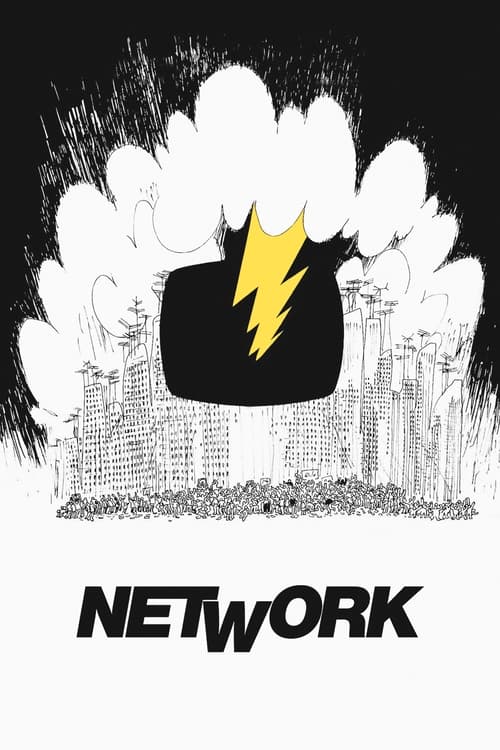
Network
1976 · Sidney Lumet
For when you're mad at the media, the algorithm, or the whole attention economy and want a film that's mad right along with you. It's a talky, grown-up watch that rewards being fully awake — energizing rather than depressing.
What it's about
A veteran network news anchor, told he's being put out to pasture, announces on air that he'll kill himself during his final broadcast — and the ratings spike. Instead of pulling him off the air, an ambitious programming executive turns his on-camera breakdowns into a prime-time phenomenon, while an old-school newsman watches his profession, and his marriage, get swallowed by show business.
The experience
Fast, furious, and savagely funny — the dialogue comes in great torrential monologues you'll want to quote, and the anger underneath is real. It's a satire that keeps landing harder because none of it feels exaggerated anymore.
Performances
Peter Finch's unraveling prophet Howard Beale — 'I'm as mad as hell' — is one of the most famous performances in American film, and Faye Dunaway is electric as the executive who feels ratings the way other people feel love; William Holden brings weary soul as the last honest man in the building.
The craft
Paddy Chayefsky's screenplay is the star — arguably the most celebrated script of 1970s Hollywood, all razor-edged speeches and prophetic fury — and Sidney Lumet directs it with unshowy confidence, letting the film's look grow slicker and colder as television devours everyone in it. A great one to watch with people who like to talk back at the screen.
Why it matters
It predicted reality TV, outrage-as-content, and news-as-entertainment with eerie accuracy, and 'mad as hell' entered the language permanently; it remains the benchmark every media satire gets measured against.
Snapshot
Network is a corrosive satire of American broadcast television, written by Paddy Chayefsky and directed by Sidney Lumet, in which a failing network turns a deranged news anchor into a ratings phenomenon. When the aging Howard Beale (Peter Finch) is fired and threatens on air to shoot himself, his subsequent prophetic rages — crystallized in the rallying cry "I'm as mad as hell, and I'm not going to take this anymore!" — make him a sensation. The network's programming chief, Diana Christensen (Faye Dunaway), recognizes a commodity and reengineers the news division as entertainment, while the veteran newsman Max Schumacher (William Holden) watches his profession and his marriage dissolve. What reads in synopsis as a near-future dystopia plays as a heightened present, and the film's reputation rests on the uncanny accuracy of its forecast: reality programming, the merger of news and spectacle, the cult of the on-screen demagogue. It is among the most quoted and most cited Hollywood films of the 1970s, and one of a small handful of pictures whose satirical premise the subsequent half-century has steadily vindicated.
Industry & production
Network was produced by Howard Gottfried and Paddy Chayefsky's own company in association with Metro-Goldwyn-Mayer, with United Artists handling release — an unusual split arrangement that itself reflected the unsettled studio economics of the mid-1970s. The project was driven by Chayefsky, a writer of singular prestige who had come up in the "golden age" of live television drama in the 1950s (Marty, The Bachelor Party) and who therefore wrote about the medium as an apostate insider rather than an outsider. He retained extraordinary control over the production, reportedly including approval over casting and a firm insistence that not a word of his script be altered — a degree of authority almost unheard of for a screenwriter, and a defining condition of the film's making.
Lumet, a fast, prepared, budget-conscious director schooled like Chayefsky in live New York television, was a natural fit; the two shared a background and a temperament. The film was shot largely in and around New York and Toronto on a modest schedule and budget characteristic of Lumet's efficient working method. Casting reflected both star power and risk: William Holden, an emblem of an older Hollywood, played the conscience of the picture; Faye Dunaway, then at the height of her stardom, took the dangerous role of a woman written as television incarnate. Peter Finch, a respected British-Australian actor, lobbied for the part of Beale. The supporting bench — Robert Duvall, Ned Beatty, Beatrice Straight, Wesley Addy — was deep. The film became both a critical and commercial success on release in 1976, and a major awards contender against a strong field.
Technology
Network is, formally, a film about a technology — television — but its own technical apparatus is conventional 35mm studio filmmaking, deployed with deliberate restraint. The picture's most pointed technological gesture is its layering of video within film: Beale's broadcasts, the studio monitors, the control-room banks of screens, the on-air graphics of "The Howard Beale Show." Lumet and his cinematographer stage much of the drama through the mediating frame of the TV image, so that the audience repeatedly watches characters watching screens. The grammar of broadcast — the countdown, the on-air light, the applause sign, the showbiz set built around a "prophet" — is reproduced with documentary fidelity, and the film's horror derives precisely from how plausible that apparatus looks. The production did not pioneer new camera or recording technology; its innovation is conceptual, treating the television signal as a character and an environment rather than a prop.
Technique
Cinematography
Owen Roizman, one of the defining American cinematographers of the decade (The French Connection, The Exorcist), shot Network, and the film is a study in calibrated visual escalation. Lumet and Roizman designed the look to drift, almost imperceptibly, from naturalism toward the artificial. Lumet described an intention to begin the film in the realistic register of conventional drama and to move, reel by reel, toward the cold, flattened, frontal look of television itself — increasingly composed, increasingly lit like a broadcast, the camera settling into the head-on address of a TV studio by the climax. Early scenes favor the grainy, available-light naturalism associated with 1970s New York filmmaking; later scenes grow more formally lit and symmetrical. The result is a visual argument: as television colonizes the characters' lives, the film's own images become more televisual.
Editing
Alan Heim's editing won wide admiration and shaped the film's rhythm decisively. Chayefsky's screenplay is famously verbose — built on long, aria-like monologues — and the editing's task was to sustain momentum across speeches that other films would have cut to ribbons. Heim and Lumet generally let the great set-pieces play, trusting the writing and the performances, while using crisp cross-cutting in the corporate and control-room sequences to generate pace. The cutting between Beale on air and the reaction of audiences, executives, and monitors builds the sense of a signal radiating outward. Heim's work earned an Academy Award nomination for editing.
Mise-en-scène / staging
Lumet's staging is essentially theatrical, in the best sense inherited from live television: scenes built around sustained two- and three-person confrontations in offices, boardrooms, screening rooms, and studios. The corporate spaces grow progressively more imposing — the boardroom where the network owner Arthur Jensen (Ned Beatty) delivers his cathedral-like sermon on the "primal forces of nature" is lit and arranged like a church, a deliberate elevation of the mise-en-scène to match the rhetoric. The domestic spaces of the Schumacher marriage, by contrast, stay small and lived-in. Lumet blocks his actors to let language dominate, keeping the camera disciplined so that the verbal performances carry the dramatic weight.
Sound
Sound design foregrounds the human voice and the ambient texture of broadcast: studio chatter, the dead air of monitors, applause, the on-air hush. There is comparatively little non-diegetic scoring; the music, composed by Elliot Lawrence, is used sparingly, in keeping with Chayefsky and Lumet's preference for letting dialogue and the sonic environment of television do the work. The most celebrated "sound" in the film is the collective off-screen roar of citizens shouting "I'm as mad as hell" from their windows — a sound the film withholds and then releases for maximum effect.
Performance
Performance is Network's engine, and its ensemble is among the most decorated in American cinema. Peter Finch's Howard Beale modulates between weary dignity and full prophetic delirium without tipping into camp; his "mad as hell" broadcast is a feat of escalating conviction. Faye Dunaway's Diana Christensen is a deliberately schematic creation — a woman who has so internalized television that she narrates her own orgasm in ratings terms — and Dunaway plays the conceit with brittle, glittering precision. William Holden grounds the film in rueful humanity. The single most remarkable feat of compression is Beatrice Straight's, as Holden's wronged wife: a performance of roughly five minutes' screen time that won the Academy Award for Best Supporting Actress, built almost entirely on one scalding monologue. Robert Duvall's predatory Frank Hackett and Ned Beatty's brief, thunderous Jensen complete a cast in which nearly every major part is a self-contained set-piece.
Narrative & dramatic mode
The film's dramatic mode is satire pushed to the edge of the tragic. Chayefsky structures the screenplay around rhetoric: the narrative advances through speeches as much as through events, and several of its turning points are monologues rather than actions. An omniscient, ironic narrator frames the story as a kind of fable or case study, distancing the audience and underscoring the satirical intent. Beneath the satire runs a melodrama of moral decline — Max Schumacher's affair with Diana is the human-scale tragedy that allegorizes the larger corruption of broadcasting. The film escalates relentlessly: each act raises the stakes of Beale's exploitation until the logic of ratings drives the story to its bleak, murderous conclusion. The closing line — that this was "the story of Howard Beale, the first known instance of a man who was killed because he had lousy ratings" — confirms the mode: the film is a tragedy narrated as a punchline.
Genre & cycle
Network belongs to the cycle of disillusioned, institution-skewering American films of the 1970s — the New Hollywood's paranoid and satirical strain, alongside pictures like The Parallax View, Three Days of the Condor, All the President's Men, and Nashville. Within that cycle it is the great media satire, sitting between earlier Hollywood critiques of mass communication (Kazan and Schulberg's A Face in the Crowd, Billy Wilder's Ace in the Hole) and the later wave of television and corporate satires it helped license. Generically it is a hybrid: corporate drama, romantic tragedy, and broad satire welded together by Chayefsky's voice. Its blend of acid comedy and genuine despair makes it difficult to classify, and that instability is part of its lasting force.
Authorship & method
Network is, unusually, a film of dual authorship — the writer's as much as the director's. Paddy Chayefsky is the dominant creative intelligence: the picture is a screenwriter's film in the way few studio movies are, its identity inseparable from his dense, declamatory, morally outraged prose. Sidney Lumet's authorship lies in his discipline and his trust — his decision to serve the script rather than impose a visual signature, to direct actors with precision, and to manage the slow tonal drift from realism to artifice. Lumet was famous as an "actor's director" and a consummate professional who shot quickly and on budget, and Network showcases those virtues. The key collaborators reinforce the approach: Owen Roizman's cinematography executes the realism-to-television design; Alan Heim's editing sustains the long speeches; Elliot Lawrence's restrained score stays out of the way; producer Howard Gottfried protected Chayefsky's vision. The method, in short, was to subordinate every craft department to the integrity of the written word — a near-inversion of auteurist filmmaking that nonetheless produced an unmistakable work.
Movement / national cinema
The film is a product of New Hollywood, the period roughly bracketing 1967–1980 when a generation of directors and writers won unusual creative latitude inside a fracturing studio system. But Network's deeper lineage is the live-television drama of 1950s New York, the "golden age" out of which both Chayefsky and Lumet emerged. That theatrical, language-driven, ensemble-based tradition — anthology dramas broadcast live from Manhattan studios — gives the film its DNA: its faith in the spoken scene, its New York texture, its moral seriousness. Network thus stands at the confluence of two American traditions, the literate small-screen drama of the 1950s and the disillusioned big-screen cinema of the 1970s.
Era / period
Network is a quintessential mid-1970s American film, saturated with the disillusionment of its moment: post-Vietnam, post-Watergate, in the depths of economic malaise and a collapsing faith in institutions. Its rage at corporate consolidation reflects a period anxiety about conglomerates swallowing the press — Jensen's speech about a world of "no nations, no peoples," only "one vast and ecumenical holding company," is a 1970s vision of multinational capital. The specific television landscape it skewers is that of the three-network broadcast era, before cable fragmentation, when a handful of corporations commanded the national attention. That the film's nightmares have outlived their original technological context is the central irony of its afterlife.
Themes
The governing theme is dehumanization by media: the conversion of human suffering, anger, and even revolution into programmable content. Television in Network is not merely a subject but a worldview that consumes those who serve it — Diana cannot love because she has become television; Beale is destroyed because he is, finally, only a rating. Adjacent themes include the corporate annexation of journalism and the surrender of truth to spectacle; the manufacture of populist anger as entertainment, foreseeing the demagogue-as-showman; the loss of the human scale, embodied in the doomed Schumacher marriage and Louise's furious insistence on her own reality; and a near-theological dread of global capital articulated in Jensen's sermon. Above all the film dramatizes a culture's inability to feel anything that has not been mediated — a diagnosis it delivers, self-consciously, through the medium of a movie.
Reception, canon & influence
On release Network was both a commercial success and a critical event, though not without dissent: some reviewers found Chayefsky's torrent of rhetoric overheated or his characters more mouthpiece than human. The awards record is unambiguous. The film won four Academy Awards — Best Actor for Peter Finch, Best Actress for Faye Dunaway, Best Supporting Actress for Beatrice Straight, and Best Original Screenplay for Paddy Chayefsky — and was nominated in further categories including Best Picture, Director, and Cinematography. Finch's award was the first acting Oscar given posthumously, the actor having died shortly before the 1977 ceremony, which lent the victory and the film an additional gravity. Over time the picture's standing has only risen; it is routinely listed among the finest American films, and its screenplay among the greatest ever written, with the American Film Institute and the Writers Guild placing it near the top of their respective canons.
The influences on the film run backward to the live television drama Chayefsky and Lumet practiced in the 1950s, and to earlier screen critiques of mass persuasion — Elia Kazan and Budd Schulberg's A Face in the Crowd (1957), with its TV-made demagogue, and Billy Wilder's Ace in the Hole (1951), with its media exploitation of human misery, are its clearest ancestors. Its legacy forward is enormous and continues to compound. The film effectively named, in advance, the merger of news and entertainment, the rise of reality television, and the elevation of on-air rage into a profit center; "I'm as mad as hell, and I'm not going to take this anymore" entered the language as a slogan of populist grievance. It is invoked perennially in commentary on cable news, infotainment, and media-made political spectacle, and Aaron Sorkin's stage adaptation in the late 2010s confirmed its renewed currency. Network's peculiar distinction is that it has aged not into a period piece but into a documentary — a satire whose every exaggeration the intervening decades have made literal.
A Deleuzian reading
Howard Beale walks onto his own set soaked through, raincoat streaming, and tells the country that a voice in the rain sent him there to preach.
The full Deleuzian reading of Network →
Reception
No flop-to-classic story here — it swept four Oscars in 1977 and was a hit. What changed is the reading: what played as outrageous satire in 1976 is now routinely called prophecy, with every new cable-news or reality-TV low prompting fresh 'Network predicted this' posts.
How Network was received, from release to now →
Influences: the films it descends from and the films it influenced
- Ace in the Hole (1951) — Establishes the cynical-newsman archetype who manufactures human misery into mass spectacle for ratings, the moral engine Chayefsky inherits and corporatizes.
- Sunset Boulevard (1950) — Models the ironic, omniscient narrating voice that frames an entire industry from inside it — the detached commentary device Network adopts for its 'this was the story of Howard Beale' wraparound.
- Marty (1955) — Chayefsky's own live-TV naturalism — vernacular, character-driven dialogue scenes shot intimately — is the writerly grammar Network later inflates into rhetorical aria.
- A Face in the Crowd (1957) — Pioneers the television-manufactured demagogue whose on-air charisma curdles into menace, the direct structural template for Howard Beale's rise as a ratings prophet.
- Sweet Smell of Success (1957) — Weaponizes venomous, hyper-articulate declamatory dialogue spoken by media power-brokers, the verbal-aggression register Chayefsky pushes to operatic extremes.
- 12 Angry Men (1957) — Lumet's chamber-drama staging of theatrical confrontation in confined rooms, with lenses tightening as tension rises, is the spatial discipline he reapplies to Network's boardrooms.
- The Hospital (1971) — Chayefsky's immediately prior screenplay runs the same machine — an institution satirized through a raging, suicidal protagonist delivering sustained monologues — that Network perfects.
- Fail Safe (1964) — Lumet extends his institutional-confinement ensemble method into color, maintaining the same close-up-heavy staging and procedural critique of corporate systems that override individual moral agency; the boardroom sequences directly inherit Fail Safe's grammar of men in rooms unable to arrest the logic of an institutional machine.
- The Manchurian Candidate (1962) — Lumet takes Frankenheimer's screens-within-screens staging — television monitors as the ambient medium of political manufacture embedded in every set — and makes it the film's entire subject, the black-comedy register Frankenheimer applied to McCarthyite politics now applied to the news-as-entertainment industrial apparatus.
- Medium Cool (1969) — Delivers the media-complicity indictment Medium Cool's news-camera critique anticipated, dramatizing television's appetite to broadcast suffering as spectacle.
- It's Always Fair Weather (1955) — Extends the live-broadcast-as-exploitation satire to its endpoint: the on-air breakdown that Fair Weather's TV producer engineers for sentiment becomes a scheduled ratings asset, with the same insider's vocabulary of jargon and pitch.
- Broadcast News (1987) — Dramatizes the very news/entertainment merger Network predicted, staging the on-air tear and the ratings-vs-ethics argument as character conflict rather than satire.
- Talk Radio (1988) — Extends the sustained on-air rage-monologue, holding a broadcaster's provocations in long takes that build to self-immolating spectacle, lifting Beale's device wholesale.
- Quiz Show (1994) — Continues the thesis that television corrupts truth into product, dramatizing the corporate decision to fake content for ratings that Network rendered as prophecy.
- To Die For (1995) — Carries forward the dehumanization-by-media theme through a protagonist whose entire self is organized around getting on television, satire curdling toward tragedy.
- Wag the Dog (1997) — Inherits Chayefsky's rhetoric-driven media satire in which producers literally manufacture reality for broadcast, scene built on cynical declamatory exchanges.
- The Truman Show (1998) — Literalizes Network's reality-TV premonition — a life converted into 24-hour programming run by a network — making the satire's exaggeration into plot mechanism.
- Michael Clayton (2007) — Revives the cathedral-boardroom confrontation and the morally-outraged declamatory aria (Wilkinson's breakdown, Clayton's final speech) as Chayefskian rhetorical set-pieces.
- Fight Club (1999) — Lumet's technique of staging male anti-capitalist rage as charismatic performance — the protagonist's breakdown generating a spectacle that the film simultaneously critiques and delivers — is the structural forerunner of Tyler Durden's ideological seduction of both Fight Club's characters and its audience.
- The China Syndrome (1979) — Chayefsky's script established the dramatic architecture of a corporate television network as the site where journalistic truth is overridden by shareholder interest; the specific device of executive management suppressing a broadcast on financial and liability grounds is the structural template for China Syndrome's network-brass storyline.
- Good Night, and Good Luck. (2005) — Lumet and Paddy Chayefsky establish the anchor's direct-to-camera broadcast address as the pivot point of a media-accountability narrative, and model how institutional sabotage of journalistic integrity—not external censorship—functions as the dramatic subject.
- Being There (1979) — Chayefsky's script and Lumet's staging establish television as a gravitational power center that physically distorts everyone orbiting it — Ashby inherits this staging logic wholesale, with Chance's remote control as the isolated suburban echo of Beale's broadcast pulpit and the physical arrangement of characters around TV screens mirroring Lumet's.
- Wall Street (1987) — Arthur Jensen's 'primal forces of nature' boardroom monologue — a corporate figure delivering capitalism's philosophy as revelation to a terrified protagonist — is the direct formal template for Gekko's 'greed is good' speech; Paddy Chayefsky's rhetoric of systemic seduction shapes Stone and Weiser's scripting of Gekko's oratory.
- The French Connection (1971) — Owen Roizman's grainy, available-light documentary realism is the photographic baseline he then 'drifts' toward televisual artifice within Network.
- Dog Day Afternoon (1975) — Lumet's actor-first, media-circus realism — a live spectacle feeding on a desperate man before cameras — is the companion experiment from the same period and director.
- Nashville (1975) — Builds satire through sprawling ensemble set-pieces where performance-as-public-spectacle exposes a culture, paralleling Network's choral indictment of mass media.
- All the President's Men (1976) — Shares the post-Watergate institutional procedural mode — anatomizing a media organization's machinery through cathedral-scale offices and rhetoric-driven scenes.
- Serpico (1973) — Lumet applies Serpico's institutional-tragedy negative-agency architecture to the television industry—an individual's moral clarity is absorbed, weaponized, and finally destroyed by the institution rather than reforming it—using the same elliptical scene-to-scene compression that accumulates institutional cost through implication, and the same formal conviction that genre satisfactions of rescue or resolution must be withheld to preserve the tragedy's structural integrity.
- Sorry to Bother You (2018) — Model for satirizing a media-corporate machine by escalating its internal logic to literal spectacle (the on-air prophet/ratings stunt), the same 'follow capitalism to its grotesque conclusion' structure Riley uses for WorryFree.
- The Verdict (1982) — Lumet directing a percussive, verbally dense Chayefsky screenplay that interrogates American self-deception, prefiguring his handling of Mamet's spare idiom.
- Absence of Malice (1981) — Chayefsky's model of building a media-ethics film as a sustained dialectical argument carried by talk, which Luedtke's screenplay adopts in its set-piece confrontations about what the press may legally versus morally do.
- Glengarry Glen Ross (1992) — Pioneered the sustained, theatrically-pitched monologue-as-aria indicting corporate rapacity — the direct ancestor of Blake's 'Always Be Closing' set-piece as externalized capitalist menace.
Similar films
- Dog Day Afternoon (1975) — influence & lineage
- 12 Angry Men (1957) — influence & lineage
- Broadcast News (1987) — influence & lineage
- Nashville (1975) — influence & lineage
- All the President's Men (1976) — influence & lineage
- Sweet Smell of Success (1957) — influence & lineage
- M*A*S*H (1970) — shared sensibility
- One Flew Over the Cuckoo's Nest (1975) — shared sensibility
All the films related to Network →
Film essays and courses that include it
- Fade In to Fracture: The Screenplay from Architecture to Anarchy
- The Comedy of Catastrophe: How Dark Cinema Learned to Laugh at the Abyss
- The Fix Is In: Cinema's Anatomy of Corruption, 1939–2007
- The Machinery of Greed: Cinema's Anatomy of Capital
- In Camera: The Institutional Chamber Thriller from Joan to Conclave