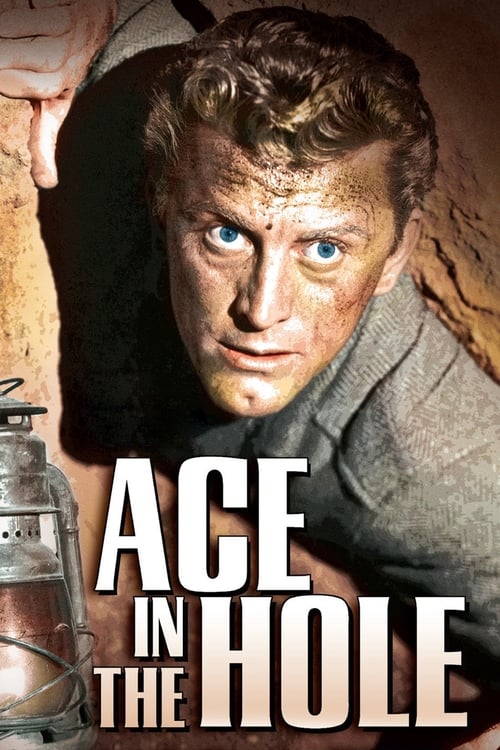
Ace in the Hole
1951 · Billy Wilder
When you're in the mood for something bracing and mean that tells you the truth — a film that scratches the same itch as a great exposé. Not a comfort watch; it's a cold shower you'll be glad you took.
What it's about
Chuck Tatum is a brilliant, self-destructive big-city reporter washed up at a small Albuquerque paper, hungry for the story that will buy his way back east. He finds it when a local man gets trapped in a collapsed cave — and instead of speeding the rescue, Tatum slows it down, stretching one man's misfortune into a national sensation as crowds, vendors, and a literal carnival gather in the desert above.
The experience
Savage, fast-talking, and genuinely shocking in its cynicism even now — you watch through your fingers, half thrilled by Tatum's nerve and half sickened by it. It's darkly funny until it isn't.
Performances
Kirk Douglas is a controlled explosion as Tatum — all jawline, hustle, and self-loathing — in one of the most ferocious performances of Hollywood's golden age.
The craft
Billy Wilder's writing is a machine gun of quotable, acid dialogue, and he stages the growing circus in the desert with a scale that makes the satire physical: you watch a media frenzy literally being built, tent by tent. Stark black-and-white photography gives the whole thing the look of a noir played out under blinding sun.
Why it matters
A flop so bitter the studio retitled it, then a decades-later rediscovery now ranked among the most prophetic American films ever made — it saw 24-hour news, media circuses, and tragedy-as-content coming half a century early.
Snapshot
Ace in the Hole is Billy Wilder's corrosive anatomy of media spectacle, a film so bleak that Paramount renamed it The Big Carnival in a doomed attempt to soften its reception. Kirk Douglas plays Chuck Tatum, a brilliant, ruined newspaperman exiled to a small Albuquerque daily, who stumbles onto a man trapped underground and recognizes not a tragedy but a ticket back to the big time. By engineering a slow rescue, Tatum transforms a private accident into a national carnival — and, in the process, kills the man he claims to be saving. Released to commercial failure and a divided press, the film was largely buried for decades before a sweeping critical reappraisal recast it as one of the most prescient American films ever made about journalism, appetite, and the manufacture of public sensation. It stands today as the purest distillation of Wilder's cynicism, unsoftened by the romantic counterweights that balance Sunset Boulevard or Double Indemnity.
Industry & production
Ace in the Hole occupies a pivotal moment in Wilder's career: it was his first film after the dissolution of his long, immensely productive writing-and-producing partnership with Charles Brackett, which had culminated in Sunset Boulevard (1950). Here Wilder took on the combined role of producer, director, and co-writer for the first time, asserting full authorship over the project. The film was made at Paramount, the studio that had housed Wilder throughout the 1940s.
Much of the picture was shot on location in New Mexico, in the high desert country near Gallup, where the production built the cliff-dwelling site and the sprawling encampment that grows around it. This commitment to location work — unusual for a studio drama of the period — gives the film a parched, sunbaked physical reality that anchors its more theatrical flourishes.
Commercially, the film was a conspicuous failure, one of the rare outright money-losers of Wilder's prime. Paramount's mid-release retitling to The Big Carnival reflected the studio's anxiety that audiences were repelled by a story with no sympathetic center and a hero who is, by any conventional measure, a villain. The film did earn an Academy Award nomination for its screenplay (Best Writing, Story and Screenplay, credited to Wilder, Lesser Samuels, and Walter Newman), but it found neither the box office nor the broad critical embrace of Wilder's preceding hits. That commercial rejection is itself part of the film's legend: a movie about giving the public what it wants was punished by a public that did not want it.
Technology
The film was produced in black-and-white at a moment when Hollywood was beginning to feel the competitive pressure of television and would soon turn to color and widescreen as defensive spectacle. Wilder's choice of monochrome is not merely conventional; the high-contrast desert light, the deep blacks of the cave interior, and the glare of the surrounding plain are integral to the film's moral atmosphere. The production's location shooting depended on relatively mobile equipment and the practical construction of the cliff-dwelling set and the growing tent-and-trailer city, which had to read convincingly as an improvised boomtown.
Thematically, the film is acutely aware of media technology as a force. Wilder stages the apparatus of mid-century news-gathering — telephones, telegraph wires, radio microphones, newsreel cameras, and the printed extra edition — as the machinery that converts a single trapped man into mass entertainment. The film arrived just as live television was demonstrating its power to turn local emergencies into national events, and its vision of an electronically amplified crowd anticipates the broadcast saturation that would define later decades.
Technique
Cinematography
The cinematography is by Charles Lang, one of Hollywood's most distinguished camera artists. Lang renders the New Mexico exteriors with a flat, merciless brightness — open skies, dust, and the eroded face of the cliff dwelling — that strips away any romance from the landscape. Against this, the interior of the cave passage where Leo Minosa lies trapped is shot in claustrophobic darkness, the cramped framing emphasizing the gap between the man's suffering and the festival above. The film's compositions repeatedly set Tatum in dominant foreground positions, physically commanding the frame, while the crowd and the machinery of the carnival multiply behind him in deep focus. The visual logic is one of scale: a single human predicament dwarfed by the spectacle it generates.
Editing
The editing pattern tracks the film's central irony — the steady metastasis of a small story into a vast one. Early scenes in the newspaper office are tight and dialogue-driven; as the rescue drags on, the film cuts with increasing rhythm between the dying man below, the manipulations of Tatum above, and the swelling crowd, building a sense of momentum that runs precisely counter to Leo's diminishing chances. Doane Harrison, Wilder's longtime editorial collaborator and trusted creative lieutenant, served in a supervisory editorial capacity, with Arthur Schmidt credited on the cut; Wilder famously edited in his head as he shot, exposing only the film he intended to use, so the cutting reflects his structural design rather than a search for shape in the editing room.
Mise-en-scène / staging
The film's most celebrated achievement is its staging of the carnival itself. Wilder choreographs the gradual transformation of an empty patch of desert into a full-blown amusement ground — vendors, parked cars, a special train, and ultimately a literal Ferris wheel and midway, complete with a theme song peddled to the gawkers. The growth of this set across the film is the central visual argument: human curiosity and commerce colonizing a tragedy in real time. Inside the newspaper office, the recurring sampler on the wall reading "Tell the Truth" provides a fixed moral rebuke against which Tatum's every action is measured. The contrast between the cramped cave, the cluttered office, and the open carnival ground organizes the film's spatial morality.
Sound
The soundscape moves from the relative quiet of the early scenes toward the gathering din of the crowd — chatter, loudspeakers, hawkers, machinery, and music — until noise itself becomes an indictment. The carnival's jaunty song, sold to the tourists who have come to watch a man die, is among the film's cruelest touches. Hugo Friedhofer's score underpins the drama without sentimentalizing it, working against any easy emotional release. The aural design insists that the spectacle is loud and the suffering is silent.
Performance
Kirk Douglas delivers one of the defining performances of his career as Chuck Tatum — fast-talking, magnetic, and morally bankrupt, a man whose charm is inseparable from his cruelty. Douglas plays Tatum at full intensity, all clenched energy and verbal aggression, daring the audience to be seduced even as it is appalled. Jan Sterling is equally vital as Lorraine, the trapped man's wife, who shares Tatum's contempt for sentiment; her flat, unsentimental hardness is the film's other engine, and the exchanges between the two crackle with mutual recognition. Richard Benedict plays Leo Minosa, the trapped man, whose trusting decency makes him the moral victim of everyone around him, and Porter Hall provides a quiet conscience as the honest editor Jacob Boot. The performances collectively refuse the audience a comfortable figure to identify with.
Narrative & dramatic mode
The film operates as a tragedy of ambition disguised as a newspaper thriller. Its dramatic engine is dramatic irony at scale: the audience watches Tatum deliberately prolong a rescue that he could expedite, knowing that his delay is sealing Leo's fate, while the surrounding crowd believes it is witnessing a heroic vigil. Wilder structures the film as a tightening noose — each of Tatum's manipulations widens the spectacle while narrowing Leo's chances — so that the rising public excitement and the descending human cost are locked in inverse motion. The mode is unrelievedly ironic and finally tragic; there is no redemptive arc, only a reckoning. Tatum's late attempt at conscience comes too late to save anyone, including himself, and the film's resolution offers retribution without uplift.
Genre & cycle
Ace in the Hole belongs to the newspaper-picture tradition that runs through American sound cinema — the wisecracking, ethically slippery reporter is a Hollywood archetype — but Wilder inverts the genre's usual machinery. Where the classic newspaper comedy or melodrama tends to celebrate the reporter's cunning in service of truth, Wilder turns that cunning into an instrument of homicide. The film also draws on the cynical, fatalistic sensibility associated with film noir: the doomed trajectory, the morally compromised protagonist, the femme fatale figure in Lorraine, and the sense of a corrupt world closing in. Yet it resists easy classification, functioning equally as a social-problem film and a satire. It is best understood as part of the broader cycle of late-1940s and early-1950s Hollywood films that turned a skeptical eye on American institutions and mass culture.
Authorship & method
The film is among the most personal of Wilder's works precisely because it was the first he controlled outright. Wilder's method — meticulous scripting in collaboration with co-writers, here Lesser Samuels and Walter Newman, followed by efficient, pre-visualized shooting — produced a film of unusual structural rigor. His authorial signature is everywhere: the bitter wit, the contempt for hypocrisy, the fascination with characters who corrupt themselves through ambition, and the refusal of sentimentality. Compared with the Brackett-era films, Ace in the Hole is harsher and more single-minded, suggesting that some of the balancing warmth of the earlier collaborations may have come from Brackett.
The key collaborators reinforce that vision. Cinematographer Charles Lang supplies the unsparing desert light; composer Hugo Friedhofer scores the drama without softening it; editor Arthur Schmidt, working under Wilder's longtime editorial supervisor Doane Harrison, gives the film its accelerating rhythm; and the screenplay's dialogue, sharp and quotable, is the picture's backbone. Tatum's lines — his appraisal of Lorraine as not a hard-boiled egg but a raw one, his closing self-description as a thousand-dollar-a-day newspaperman available for nothing — carry the film's worldview in compressed, mordant form.
Movement / national cinema
The film is a product of classical Hollywood studio cinema at its technical peak, made within the Paramount system. Yet Wilder's perspective is inseparable from his biography as a Vienna-born, Berlin-trained émigré who fled Europe and brought a continental skepticism to American subjects. Like other émigré directors of his generation, Wilder turned an outsider's eye on American self-mythology, and Ace in the Hole reads as a critique of national appetites — for spectacle, for sensation, for the consoling fiction of heroism — delivered from inside the very industry that manufactures those fictions. It is American filmmaking interrogating American culture through a European-inflected irony.
Era / period
Made at the dawn of the 1950s, the film registers a series of period anxieties: the rise of television and its appetite for live emergency, the growing commercialization of news, and a postwar consumer culture eager for diversion. The instant boomtown that materializes around the cave — complete with paid admission, souvenirs, and a song — is a sardonic portrait of an America in which any event can be packaged and sold. The film's commercial rejection is itself a period document, evidence of how far its pessimism ran ahead of what 1951 audiences would accept from a major studio release. It speaks from the cusp of the broadcast age, before the media saturation it predicts had fully arrived.
Themes
At its core the film is about exploitation: of a trapped man by a reporter, of a tragedy by a crowd, of human suffering by the machinery of news and commerce. It anatomizes the public's complicity in spectacle — the tourists who drive for miles to watch a stranger die are as implicated as the man who engineers the show. Related themes include the corruption of ambition, the commodification of truth (set against that pointed "Tell the Truth" sampler), and the moral vacancy beneath American boosterism. Tatum's arc dramatizes the idea that cynicism, pursued far enough, becomes a kind of murder. The film also interrogates authenticity and performance: nearly every character is staging something, and the genuine victim, Leo, is the one person incapable of performing.
Reception, canon & influence
On release, Ace in the Hole was a commercial disappointment and met a sharply divided press, with some reviewers recoiling from what they saw as its unrelieved misanthropy; Paramount's retitling to The Big Carnival signaled the studio's loss of faith. Its Academy Award nomination for screenwriting was its principal contemporary honor. For years the film remained one of Wilder's least-seen major works, difficult to view and overshadowed by his more celebrated successes.
Its influences run backward to the real-world cave-entrapment sagas that gripped the American press — most famously the 1925 ordeal of Floyd Collins in Kentucky, which the film explicitly invokes, and which had itself been a media sensation — as well as to the broader tradition of the cynical Hollywood newspaper picture. Wilder fused that documentary reality with the fatalism of noir and his own émigré skepticism.
Its forward legacy has grown enormous. Critical opinion reversed decisively over the following decades, aided by renewed availability — notably the Criterion Collection's restoration and release — until the film came to be regarded as one of the great American films about journalism and one of Wilder's finest achievements. It is now routinely cited as astonishingly prophetic of the media circus, the 24-hour news cycle, and reality spectacle, anticipating later films and works that dramatize manufactured media events. Kirk Douglas's Chuck Tatum endures as a benchmark portrayal of the predatory journalist, and the film's central image — a crowd paying to watch a tragedy curated for their entertainment — has only grown more legible with time. What 1951 rejected as unbearably cynical, later generations recognized as clear sight.
A Deleuzian reading
Chuck Tatum walks down into the cave a stalled man and comes back up into the white glare a hungry one.
The full Deleuzian reading of Ace in the Hole →
Reception
A rare Billy Wilder flop in 1951 — critics called it too cynical and audiences stayed away, so much so that Paramount re-released it under a new title. Today it's widely seen as one of Wilder's masterpieces and eerily prophetic about the media circus.
How Ace in the Hole was received, from release to now →
Influences: the films it descends from and the films it influenced
- The Front Page (1931) — Establishes the newspaper-picture template Wilder inherits — the rapid, overlapping wisecrack rhythm and the reporter who will suppress or stage a human tragedy to land the scoop.
- Five Star Final (1931) — Pioneers the circulation-chasing-editor-as-destroyer indictment; its tabloid sensationalism that wrecks ordinary lives is the moral engine Wilder concentrates into Chuck Tatum.
- Nothing Sacred (1937) — Ben Hecht's plot of a reporter inflating a 'dying' human-interest subject into a national spectacle is Ace's direct precursor — the crowd feeding profitably on curated pity.
- Meet John Doe (1941) — Models the manufactured media personality and the cynical journalist engineering mass sentiment, the staged-sincerity-as-circulation device Wilder strips of Capra's redemptive softening.
- Citizen Kane (1941) — Gregg Toland's deep-focus, high-contrast compositions and the yellow-press protagonist who manufactures the very events he reports ('you provide the prose poems, I'll provide the war').
- Greed (1924) — Émigré naturalism shooting human degradation in real desert heat, the unforgiving landscape as moral crucible — a method Wilder revered (and von Stroheim's presence in his Sunset Boulevard confirms the debt).
- Nightmare Alley (1947) — Extends the carnival-as-metaphor into a literal media circus and pushes deception-as-system to its cynical extreme, the same moral architecture where exploitation is the whole social machine.
- Hail the Conquering Hero (1944) — Extends Sturges's portrait of mass enthusiasm indifferent to truth into a full media-circus crowd tableau, the cynical flip side of the small-town welcome.
- Scarlet Street (1945) — Inherits Scarlet Street's willingness to deny the audience any sympathetic figure or comforting resolution, weaponizing noir's bleakness into an unflinching moral indictment with no redemptive off-ramp.
- A Face in the Crowd (1957) — Carries forward the media-manufactures-a-populist-monster thesis and the complicity of the insiders who build him, the crowd dramatized as a manipulable mass.
- Medium Cool (1969) — Radicalizes Ace's central accusation — the cameraman/journalist as complicit in, not neutral to, the suffering he frames for consumption.
- Network (1976) — Chayefsky's satire scales Ace's curated-tragedy-for-ratings logic to the institution itself, where audience appetite for spectacle drives the moral collapse, delivered in equally mordant aphoristic dialogue.
- Natural Born Killers (1994) — Pushes the crowd-paying-to-watch-a-curated-tragedy image to its endpoint — media that fabricates and celebrates the very event it covers as entertainment.
- To Die For (1995) — Reworks the Tatum ambition — a protagonist who will engineer a death for career advancement — in the same key of mordant dramatic irony with the camera as accomplice.
- Mad City (1997) — A near-explicit reworking: a journalist exploits a hostage standoff into a swelling media siege, restaging Ace's growing-carnival set and curated-disaster crowd almost beat for beat.
- The Truman Show (1998) — Realizes Ace's prophecy of a human life curated as mass entertainment for a paying, watching public — the spectacle architecture and crowd-as-spectator made total.
- Nightcrawler (2014) — Lou Bloom is Tatum's direct heir — a predatory stringer who stages and curates footage of others' suffering for ratings, the entrepreneurial-journalist-as-ghoul portrait updated to local TV news.
- No Man's Land (2001) — Originates the trapped-man-as-media-circus device — a victim immobilized in a deadly spot while reporters and officials converge to perform concern — that Tanović reuses to indict the press and the UN around Čera on the mine.
- They Shoot Horses, Don't They? (1969) — The carnival-of-onlookers feeding on a trapped human's suffering, with ironic counterpoint between festive crowd and private agony — direct precedent for spectacle built from another's entrapment.
- The King of Comedy (1982) — Pioneers the deadpan, unsympathetic media protagonist the audience cannot root for, wielding cynicism about a spectacle manufactured for public consumption.
- Stalag 17 (1953) — Wilder's boldest experiment in daring the audience to loathe its lead — a cynic who profits off others' suffering — directly priming the performance/antihero-against-likability strategy Holden then plays as Sefton.
- Double Indemnity (1944) — Wilder/Doane-Harrison noir architecture — a doomed first-person protagonist and fatalistic inverse-motion structure — that Ace repurposes by draining the romance and leaving only the predation.
- Sunset Boulevard (1950) — Wilder's immediately prior film, sharing Doane Harrison's editorial supervision and the corrosive narrator-victim view of an industry that consumes its own.
- Sweet Smell of Success (1957) — Extends the predatory-press-figure portrait (J.J. Hunsecker) with the same mordant, hyper-quotable dialogue and James Wong Howe's high-contrast chiaroscuro as moral lighting.
- High Noon (1952) — Wilder's journalism thriller shares High Noon's formal strategy of using genre suspense mechanics to place the audience in the position of watching a community actively choose civic failure, making both films structural twins operating the same indictment from different genre addresses.
- Absence of Malice (1981) — Wilder's portrait of the recklessly destructive reporter who weaponizes publication establishes the ethical indictment Absence of Malice revives — journalism as harm rather than heroism.
- The Harder They Fall (1956) — Wilder's portrait of a cynical newsman monetizing a human spectacle while the complicit crowd feeds on it shares the commodification-and-complicity exposé engine driving Bogart's press agent.
- Fury (1936) — Inherits Fury's suspicion of spectacle-as-truth, turning the gathered crowd into a media circus and the camera/press into the manufacturer of collective appetite — the mob remade for the age of broadcast.
Similar films
- A Face in the Crowd (1957) — influence & lineage
- Citizen Kane (1941) — influence & lineage
- Sunset Boulevard (1950) — influence & lineage
- Double Indemnity (1944) — influence & lineage
- Sweet Smell of Success (1957) — influence & lineage
- Nightcrawler (2014) — influence & lineage
- Stalag 17 (1953) — shared sensibility
- The Insider (1999) — shared sensibility
All the films related to Ace in the Hole →