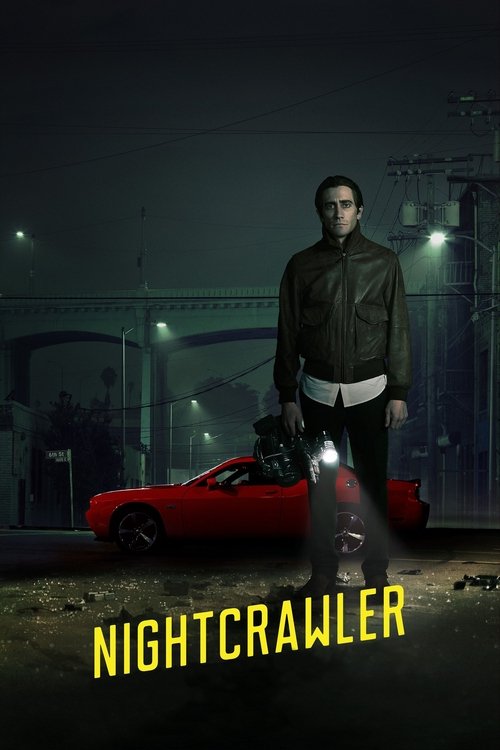
Nightcrawler
2014 · Dan Gilroy
For when you want to be unsettled and can't stop thinking about it — a challenge watch for a night you're in the mood for something sharp, cynical, and conversation-starting.
What it's about
A gaunt, unnervingly articulate drifter in Los Angeles discovers there's money in filming the city's nighttime carnage — car wrecks, shootings, home invasions — and selling the footage to morning news. He turns out to be terrifyingly good at it, in part because nothing in him flinches. As his ambitions grow, so does his willingness to stop merely recording the story.
The experience
Queasy, gripping, and darkly funny in a way that makes you complicit — you watch a predator succeed by every rule of hustle culture, and the film never lets you look away. It's the kind of thriller that leaves a film on your skin.
Performances
Jake Gyllenhaal, visibly hollowed out, gives one of the defining performances of the 2010s — wide-eyed, fluent in self-help business-speak, and completely empty behind the eyes. Rene Russo matches him as the desperate news director who knows exactly what she's buying.
The craft
Nocturnal Los Angeles has rarely looked this seductive — the film glides through neon streets and crime scenes with a sheen that makes the ugliness gorgeous, which is exactly the point. Dan Gilroy's script doubles as a razor-edged satire of local news, and it plays beautifully in the dark with good sound.
Why it matters
An acclaimed directorial debut that instantly entered the canon of great Los Angeles noirs and became the go-to reference for movies about media rot and the sociopathy of hustle culture.
Snapshot
Nightcrawler is a Los Angeles neo-noir about Lou Bloom, a gaunt, autodidactic drifter who discovers that filming the city's car wrecks, shootings, and home invasions can be sold to local television news — and who proves to have exactly the temperament the trade rewards. Written and directed by Dan Gilroy as his feature directorial debut, the film is at once a character study of a high-functioning sociopath, a satire of "if it bleeds, it leads" broadcast journalism, and a perverse Horatio Alger story in which the language of entrepreneurial self-improvement is bent into a manifesto for predation. Jake Gyllenhaal's performance as Bloom — physically hollowed out, verbally fluent in the argot of business-seminar uplift — anchors a film that critics quickly recognized as one of the sharpest American movies of its year about media, capitalism, and the moral vacuum where the two meet. Made cheaply and shot almost entirely on the nocturnal streets of L.A., it has settled into the canon as a defining "L.A. at night" picture and a key text of the 2010s cycle of films about ambition curdled into pathology.
Industry & production
The film was an independent production, financed outside the major studios and distributed in the United States by Open Road Films, the exhibitor-backed distributor then building a mid-budget slate. It was produced through Bold Films, with Jennifer Fox, Tony Gilroy, Jake Gyllenhaal, Michel Litvak, and David Lancaster among the producing principals. Gyllenhaal's involvement as both star and producer was decisive: his commitment helped a first-time director's screenplay reach production, and his deep investment in the lead role shaped the film's economy and tone.
The production is, in the most concrete sense, a family enterprise grafted onto a lean independent shoot. Dan Gilroy wrote and directed; his brother Tony Gilroy (writer-director of Michael Clayton, screenwriter of the Bourne films) produced; their brother John Gilroy edited; and Dan Gilroy's wife, Rene Russo, plays the pivotal role of the news director Nina. This concentration of trusted collaborators around a debut director gave the film an unusual coherence of intent for a low-budget production.
By the standards of contemporary American cinema the budget was modest — widely reported in the range of roughly eight to nine million dollars — and the shoot was correspondingly compressed, completed over about a month of largely night work in Los Angeles. (Exact figures are best confirmed against trade records rather than cited from memory.) The film premiered at the Toronto International Film Festival in September 2014 and opened in the United States on October 31, 2014. It became a critical success and a solid commercial performer relative to its cost, the kind of result that validates the mid-budget, star-driven independent model.
Technology
Nightcrawler is, in part, a film about image-capture technology, and its production reflects the same digital moment it depicts. It was shot digitally rather than on film — a choice well suited to a movie staged almost entirely at night, since modern digital sensors could register the existing illumination of the city (sodium streetlights, neon, headlamps, the glow of screens) with far greater sensitivity than photochemical stock, allowing cinematographer Robert Elswit to work in available and lightly augmented light across real locations. The film is thus an artifact of the early-2010s transition in which digital capture made it newly practical to shoot extended nocturnal sequences on location.
That technological reality is also the film's subject. Lou Bloom's tools — the consumer-grade camcorder he upgrades over the film, the police scanner, the GPS that races him to bleeding bodies, the laptop that uploads and the cash-and-tape economy of local news — are the apparatus of a media ecosystem in which anyone with a camera and no scruples can become a content supplier. The film's diegetic video, the deliberately raw "stringer" footage Bloom shoots, is staged as a second, uglier image-register set against Elswit's polished cinematography, dramatizing the gap between the seductive surface of television news and the brutal acquisition behind it.
Technique
Cinematography
Robert Elswit — an Academy Award winner for There Will Be Blood and Paul Thomas Anderson's longtime collaborator — shot the film, and his photography is central to its identity. Elswit renders nocturnal Los Angeles as a glittering, depopulated grid: a city of empty freeways, fluorescent convenience stores, and distant lights that the film treats as genuinely beautiful even as horrible things happen within it. The camera moves with a smooth, gliding confidence that mirrors Bloom's own predatory ease, and the contrast between the seductive, neon-saturated frame and the squalid content within it is the film's defining visual irony. The work places Nightcrawler in a distinguished lineage of L.A.-nocturne cinematography and is frequently singled out as one of the best-photographed films of its year.
Editing
John Gilroy cut the film, and the editing is tuned to the rhythm of the chase — both Bloom's literal pursuit of crime scenes and his pursuit of advancement. The picture builds toward a sustained car-chase climax assembled with genuine kinetic tension, but the editing is at its most pointed in the smaller cuts: the way Bloom's conversations are paced to let his fluent, rehearsed sentences land with a chill, and the intercutting of broadcast footage with its real, off-camera origins to expose the news machine's editorial dishonesty. The cutting never glamorizes through frenzy; it observes, with a control that keeps the viewer complicit and watching.
Mise-en-scène / staging
The film's staging exploits real Los Angeles geography — its freeways, valleys, news studios, and anonymous residential streets — as a vast nocturnal stage. Interiors are pointed: the cold, bright newsroom; the diner and restaurant scenes where Bloom negotiates with Nina; the increasingly upgraded car that charts his rise. Costume and physical staging track Bloom's ascent from scavenger to entrepreneur, and the production design keeps the world plausible and unglamorous, so that the horror emerges from recognizable banality rather than stylization. A recurring staging strategy places Bloom behind or beside his camera, framing him as an apparatus rather than a man — an observer who, true to the synopsis, steadily crosses into participant.
Sound
James Newton Howard composed the score, and it is one of the film's subtlest provocations. Rather than scoring Bloom as a villain, the music frequently swells into warm, aspirational, almost heroic tones during his triumphs — the sound of a feel-good success story — creating a deliberate dissonance with the monstrousness on screen. This ironic use of uplift sonically reinforces the film's central conceit: that Bloom experiences his own story as an inspirational rise. Sound design otherwise foregrounds the textures of the night city and the crackle of the police scanner that functions as Bloom's siren call.
Performance
Jake Gyllenhaal's Lou Bloom is the film's engine and its most celebrated element. Gyllenhaal reportedly lost a significant amount of weight to play the part, producing a gaunt, hungry, wide-eyed physiognomy often likened to a coyote — a nocturnal scavenger native to the same Los Angeles. The performance pairs that emaciated physicality with a relentless, over-articulate verbal style: Bloom speaks in the fluent, affectless cadences of online business courses and motivational literature, deploying the vocabulary of self-improvement, negotiation, and "win-win" management to rationalize cruelty. The effect is a portrait of evil that is not brooding but cheerful, ambitious, and grimly recognizable. Rene Russo matches him as Nina, the aging, ratings-desperate news director whose professional compromises Bloom exploits and whose vulnerability he coldly leverages; their negotiation scenes are among the film's most disturbing. Riz Ahmed, as Bloom's underpaid assistant Rick, supplies the conscience and the victimhood the narrative requires, and Bill Paxton appears as a rival stringer who represents the road-not-taken of ordinary venality.
Narrative & dramatic mode
The dramatic mode is the ironic success story — a rise narrative whose protagonist's ascent is inseparable from his moral degradation. The film withholds the usual machinery of comeuppance; Bloom is not punished but rewarded, and the screenplay's arc traces a clean upward line from scavenger to business owner. Structurally it is a character study built on escalation: each crime scene Bloom films is more transgressive than the last, each ethical line he crosses (rearranging a body, withholding evidence, ultimately engineering events for the camera) extends his earlier logic rather than breaking from it. The narrative's discomfort comes from its refusal to provide a stable moral outside vantage; Nina is too compromised to judge him, Rick too powerless, and the film's coolly observational stance implicates the viewer's own appetite for the footage. It is, finally, a tragedy with no recognition and no fall — a horror story told in the grammar of the entrepreneurial fable.
Genre & cycle
Nightcrawler sits at the intersection of neo-noir, media satire, and the character-study thriller. As noir it belongs to the long tradition of nocturnal Los Angeles crime cinema; as satire it descends directly from the great American films about the ethics of news and publicity. It also belongs to a distinct 2010s cycle of films about ambition deformed into pathology and about the slick surfaces of contemporary capitalism — a moment that includes the entrepreneurial-monster figure and the neon-soaked L.A.-night aesthetic that Drive (2011) had recently revitalized. Within that cycle Nightcrawler is notable for fusing the art-cinema character study with genre propulsion, refusing both the comfort of moralizing satire and the cool detachment of pure style.
Authorship & method
The film is Dan Gilroy's statement, and an unusually assured one for a debut. Gilroy, an experienced screenwriter (his credits include The Bourne Legacy and Real Steel) turning to direction in middle age, conceived the film around the figure of the L.A. crime stringer and the metaphor of the urban coyote — a predator thriving in the city's margins. His method was collaborative within a tight circle: cinematographer Robert Elswit lent the film its visual sophistication and its lineage to Paul Thomas Anderson's cinema; brother John Gilroy shaped its rhythm in the edit; brother Tony Gilroy produced, bringing the institutional craft of his own thriller work; composer James Newton Howard supplied the ironically uplifting score; and Rene Russo, Gilroy's wife, took the second lead. This concentration of close collaborators gave a first-time director the conditions for a singular, controlled vision. Gyllenhaal's authorship is real as well: as producer and as an actor wholly transforming himself, he was a co-shaper of the film's central conception, and Bloom stands among the defining performances of his career.
Movement / national cinema
The film belongs to no formal movement; it is a work of American independent cinema operating in the realist-thriller register, financed and made outside the studios but with studio-level craft personnel. Its truest affiliation is regional rather than national: it is a Los Angeles film, part of the city's self-portraiture in cinema, joining a body of work that treats L.A.'s geography, light, and mythology of self-invention as subject. Its aesthetic debts — to the polished American genre filmmaking of its cinematographer's milieu and to the neon-noir revival — locate it firmly in mainstream-adjacent American art cinema of the 2010s rather than in any avant-garde or national school.
Era / period
Nightcrawler is acutely a film of the early-to-mid 2010s. Its world is one of precarious gig labor, of the freelancer who must brand himself, network aggressively, and monetize whatever he can capture — a portrait of post-recession entrepreneurial desperation in which Bloom's hustle is the logical extreme of a culture that prizes self-optimization. Its media landscape is the late era of ratings-driven local television news, already being undercut by the same democratized, anyone-with-a-camera logic Bloom embodies, anticipating the fuller arrival of user-generated viral content. And its language — Bloom's seamless absorption of online-course management-speak — captures a specific moment in the diffusion of self-help and start-up rhetoric into everyday speech. The film reads as a diagnosis of its decade's anxieties about work, media, and the entrepreneurial self.
Themes
The governing theme is the moral cost of ambition under capitalism — the way a culture that celebrates initiative, self-reliance, and growth can produce, and reward, a Lou Bloom. Closely bound to this is the critique of news media: the film argues that the demand for fear-driven, sensational footage ("if it bleeds, it leads," skewed toward the violation of affluent suburbanites) creates the market that Bloom merely serves, making the broadcasters and their audience complicit in his crimes. Further themes include the collapse of the boundary between observer and participant — the film's central ethical hinge, in which Bloom stops merely recording reality and begins manufacturing it for the lens; the predatory dynamics of labor, dramatized in his exploitation of Rick and his coercion of Nina; and the hollowing of the language of self-improvement, whose vocabulary of empowerment becomes, in Bloom's mouth, a frictionless instrument of domination. Underlying all of it is a study of the high-functioning sociopath as an American type — not an aberration from the success ethic but its perfect, terrifying fulfillment.
Reception, canon & influence
Critical reception was strongly positive. Reviewers singled out Gyllenhaal's transformation as among the year's finest performances, praised Elswit's nocturnal cinematography, and admired the film's nervy refusal to moralize or to punish its protagonist. The screenplay's satirical precision about news media and entrepreneurial pathology drew particular acclaim. The film's awards profile centered on Dan Gilroy's screenplay, which earned an Academy Award nomination for Best Original Screenplay; Gyllenhaal's omission from the Best Actor field became one of the more widely lamented snubs of that awards season, while the actor and the film accumulated numerous critics'-group and other nominations. (Specific awards tallies are best verified against the record.)
The influences on the film are legible and acknowledged within film culture. It descends from Billy Wilder's Ace in the Hole (1951), the foundational American film about a journalist who manipulates and prolongs a tragedy for professional gain; from Network (1976) and its prophetic satire of television's appetite for spectacle; and from the lonely-predator-in-the-nocturnal-city tradition of Taxi Driver (1976), to which Bloom is frequently compared. Its visual and tonal kinship with the neon Los Angeles of Drive (2011) situates it within the recent noir revival, and the photographic sensibility of the Paul Thomas Anderson school, via Elswit, runs through its images. The spirit of the crime photographer Weegee, who chased L.A. and New York's nighttime catastrophes a lifetime earlier, hovers over the whole conception.
Its forward influence has been felt chiefly as a touchstone: Nightcrawler quickly became a reference point for films and discussions about media ethics, viral spectacle, and the entrepreneurial sociopath, and it cemented a template — the coolly photographed, morally vacated L.A.-night character study — that later filmmakers and critics invoke. For Dan Gilroy it launched a directing career and a continuing collaboration with Gyllenhaal; for Gyllenhaal it marked a decisive turn toward the transformative, risk-taking roles that have defined his subsequent work. In the decade since, the film's prescience about a media economy driven by captured, monetized footage and about a culture that rewards the most ruthless self-marketer has only sharpened its standing, and it is now widely regarded as one of the essential American films of its decade.
A Deleuzian reading
Watch what Lou Bloom does at the third or fourth crime scene, once he's good at this.
The full Deleuzian reading of Nightcrawler →
Reception
Acclaimed on release but largely bypassed by the 2015 Oscars — just one nomination, for Dan Gilroy's screenplay — it has since climbed steadily into modern-classic status, becoming one of the defining 2010s films on Letterboxd.
How Nightcrawler was received, from release to now →
Influences: the films it descends from and the films it influenced
- Ace in the Hole (1951) — Establishes the structural template of a media operator who engineers and prolongs a human catastrophe to feed audience appetite, and the nervy refusal to punish him narratively that Gilroy adopts wholesale.
- Sweet Smell of Success (1957) — James Wong Howe's hard, deep-focus nocturnal-city photography wedded to a predatory media-operator protagonist whose rapid-fire amoral pragmatism prefigures Bloom's entrepreneurial patter.
- Network (1976) — The control-room satire in which ratings logic openly dictates editorial coverage, dramatized through broadcast-suite scenes where news decisions are made on commercial calculus — directly echoed in Russo's newsroom.
- Taxi Driver (1976) — The lonely-predator-prowling-the-nocturnal-city character study, with the protagonist's self-justifying interior voice and a camera that treats the man as an urban apparatus moving through the night.
- The King of Comedy (1982) — The delusional self-marketer who weaponizes the rhetoric of ambition and forced media access to bully his way into the spectacle economy, a sociopathic-striver register Bloom extends.
- To Live and Die in L.A. (1985) — Neon-soaked Los Angeles nocturne plus a kinetic freeway car-chase grammar — wrong-way pursuit, vehicular collision as climax — that Nightcrawler's car-chase finale inherits.
- American Psycho (2000) — The clinically affectless sociopath who recites the boilerplate of business success and self-optimization, the performance mode Gyllenhaal's physical-transformation Bloom carries into the gig economy.
- Collateral (2004) — Pioneering digital-capture cinematography of nocturnal L.A. that uses available sodium-vapor light to render the city's glow — the photographic template Elswit refines into available-light night work.
- There Will Be Blood (2007) — The Elswit/Anderson school of composed, patient widescreen framing around a portrait of ironic capitalist ambition, the visual sophistication Elswit transplants directly into Nightcrawler's images.
- Enemy (2014) — Enemy's establishment of Gyllenhaal as a credible vehicle for extreme artistic risk-taking — emaciated, affectless, performing psychological extremity without conventional star-protection — directly enables Nightcrawler's predatory characterization; Robert Elswit's amber-neon L.A. nightscape extends Enemy's aggressive digital grade into a different urban register while maintaining the same color-temperature logic.
- Quiz Show (1994) — Dramatizes the commodification of truth into televised spectacle and the moral rot beneath manufactured on-screen authenticity, Quiz Show's theme pushed to predatory extreme.
- To Die For (1995) — Direct inheritor of the self-mediating protagonist who speaks entirely in careerist boilerplate — the character's ambition is expressed as vocabulary, and local TV news is again the machine that rewards it with airtime.
- Good Time (2017) — Relentless nocturnal-hustler propulsion in which a sociopath-adjacent striver drags the camera through the city at night, extending the apparatus-following-the-predator staging.
- Velvet Buzzsaw (2019) — Direct Gilroy/Gyllenhaal/Russo reunion that re-applies the coolly photographed, satirically amoral market study — refusal to moralize, capitalism as predator's habitat — to the art world.
- Uncut Gems (2019) — The ironic-success engine of a compulsive capitalist hustler, anxiety-scored and propulsively intercut, descending from Bloom's vision of monetized ambition that rewards the most ruthless self-marketer.
- I Care a Lot (2020) — The coolly photographed entrepreneurial sociopath thriving in capitalism's legal margins, built on the same nervy choice to neither moralize about nor punish its protagonist.
- Spree (2020) — Viral-spectacle satire of a gig-economy striver monetizing self-captured footage of violence, literalizing Nightcrawler's camera-as-apparatus economy of captured, sellable catastrophe.
- The Card Counter (2021) — The Schraderian lonely-man-in-voiceover prowling neon-lit American night, consciously extending the Taxi Driver predator-in-the-city lineage that Nightcrawler revived for the post-recession era.
- Southpaw (2015) — Made Gyllenhaal's radical body recomposition the film's central visual effect and its publicity, establishing the transformation-as-method reputation that Southpaw immediately inverted — thirty pounds of muscle and six-hour daily training in place of starvation.
- Drive (2011) — The neon-noir revival's cool, synth-scored L.A. nocturne and reticent-predator framing that situates Bloom's nightscape within the same contemporary neon-noir movement.
- Joker (2019) — Gilroy's staging of an amoral male protagonist whose pathology the film frames with visual glamour and withholds moral judgment on — the night-camera surveillance aesthetics rhyming with Arthur's experience of being watched — and the urban paranoia genre's structural refusal to assign the protagonist a stable moral position are the direct formal parallels.
- Killing Them Softly (2012) — A neo-noir that reframes predatory crime as pure free-market enterprise, its protagonist mouthing entrepreneurial capitalism — the same crime-as-capitalism thesis Cogan delivers in the closing line.
- To Catch a Killer (2023) — Shares the cold nocturnal digital grade and the unblinking character study of an American outsider whose pathology is observed clinically, without moralizing relief.
- Luther: The Fallen Sun (2023) — Marries the sodium-lit nocturnal city to surveillance-and-media exposure as theme, the camera prowling night-time crime as commodified spectacle.
- Relay (2025) — From the Michael Clayton lineage: a solo operator working the depopulated city at the edge of legality, sustained by a performance of cold interiority — sibling in protagonist construction and evacuated-space staging.
- September 5 (2024) — Pushes the ethics-of-live-witness to its predatory extreme — the camera that captures atrocity for broadcast as the moral center — the same question September 5 asks from inside the newsroom.
- Obsession (2026) — Locks the film to a sociopath's self-justifying drive so we're forced to root for his success, the perpetrator-aligned POV extended into thriller register.
- Citizen Vigilante (2026) — Centers a sociopath who curates his own violent footage for an audience, the media-spectacle-of-self logic that Boll updates to the virality era.
- Spider-Man: Far From Home (2019) — Gyllenhaal's method blueprint: the ingratiating, eerily controlled operator who stages and manufactures reality for the camera, the same modulation from earnest-mentor to unhinged-manipulator he runs as Mysterio.
- Crime 101 (2026) — Robert Elswit shooting night LA on large-sensor digital at speeds film could not reach, so the freeway system and sodium-lit surface streets photograph as continuous illuminated terrain — the same technical premise behind Crime 101's Venice-plus-close-focus-anamorphic night work.
Similar films
- Drive (2011) — influence & lineage
- Taxi Driver (1976) — influence & lineage · often watched together
- Collateral (2004) — influence & lineage · often watched together
- L.A. Confidential (1997) — often watched together
- Zodiac (2007) — often watched together
- Mulholland Drive (2001) — often watched together
- The Nice Guys (2016) — shared sensibility
- Enemy (2014) — shared sensibility