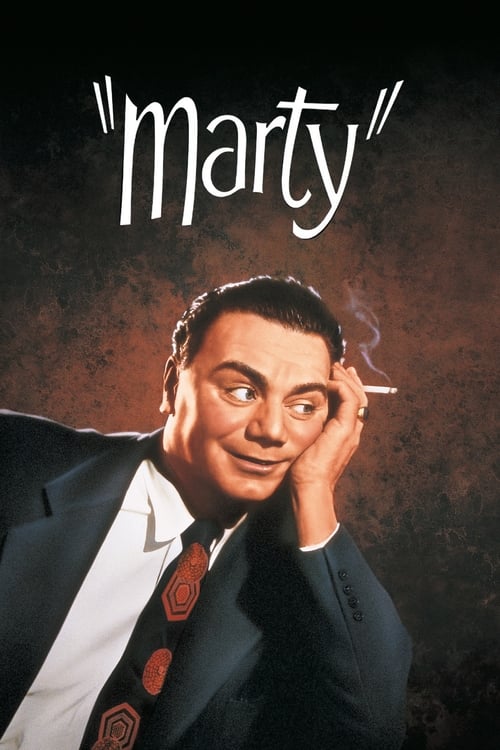
Marty
1955 · Delbert Mann
For when you want to believe in ordinary people finding each other — a tender, unglamorous romance for a quiet night, especially if you've ever felt like the one nobody picks. Pure comfort with an honest heart.
What it's about
Marty is a heavyset, good-natured Bronx butcher, thirty-four and still living with his mother, who's given up on love because he's convinced no one could want him. Then one Saturday night at a dance hall he meets Clara, a shy schoolteacher whose loneliness matches his own — and everyone around him, family and friends alike, starts telling him she's not good enough.
The experience
Warm, plainspoken, and quietly devastating in small doses — it finds real ache and real humor in ordinary conversation, and its kindness sneaks up on you. Short, gentle, and genuinely moving.
Performances
Ernest Borgnine, usually cast as heavies, is astonishingly tender as Marty — his 'whaddaya feel like doin' tonight?' loneliness won him the Oscar. Betsy Blair matches him with a delicate, wounded Clara.
The craft
Paddy Chayefsky's screenplay, adapted from his own live-TV play, made everyday Bronx talk sound like music — the dialogue is the whole show. Delbert Mann's unadorned direction keeps it intimate and true to its small scale, and the modesty is the point.
Why it matters
An unlikely sensation: it won Best Picture, Best Director, Best Actor, and Best Adapted Screenplay, and proved that small, realistic stories from television drama could conquer Hollywood.
Snapshot
Marty is a small, intimate drama about a stout, kind-hearted thirty-four-year-old Bronx butcher (Ernest Borgnine) who has all but surrendered to the conviction that he is too homely and ordinary ever to find love, and who, on a lonely Saturday night at a Manhattan dance hall, meets a plain schoolteacher named Clara (Betsy Blair) whose loneliness mirrors his own. Adapted by Paddy Chayefsky from his own 1953 live-television play, and directed by Delbert Mann in his feature debut, the film is the most celebrated product of the migration of American "live drama" from the television anthology programs of the early 1950s to the cinema. Modestly budgeted and unglamorous by design, it became one of the unlikeliest triumphs in Hollywood history: it won the Academy Award for Best Picture, Best Director, Best Actor, and Best Adapted Screenplay, and it took the top prize at the 1955 Cannes Film Festival. It remains a landmark of mid-century American realism—a film whose subject is precisely the unremarkable life that movies had traditionally ignored, and whose lasting reputation rests on its tender attention to ordinary speech, ordinary disappointment, and ordinary hope.
Industry & production
Marty originated not in the studios but in television. Chayefsky wrote it for The Philco Television Playhouse, where it was broadcast live on NBC in May 1953 with Rod Steiger as Marty and Nancy Marchand as Clara. The teleplay's success made Chayefsky a leading figure of what is now called the Golden Age of live television drama, and the film version emerged from the independent production company of Harold Hecht and Burt Lancaster (the Hecht-Lancaster organization, later Hecht-Hill-Lancaster), releasing through United Artists. Accounts of the production have long emphasized its origins as a deliberately small, low-prestige project—a modestly capitalized picture made by a company better known for Lancaster's star vehicles—whose runaway acclaim took its makers by surprise. I won't cite specific budget or grossing figures from memory, but the film is consistently described in industry histories as inexpensively produced and as a substantial commercial as well as critical success relative to its scale.
The casting carried real risk. Borgnine had been known chiefly for heavies and brutes—most famously the sadistic stockade sergeant "Fatso" Judson in From Here to Eternity—and the role of the gentle, self-deprecating Marty was a sharp departure. Betsy Blair's casting is frequently told as a story of the era's political climate: associated with left-wing causes during the blacklist years, she reportedly faced resistance, and her securing of the part has been attributed to the intervention of her then-husband Gene Kelly and others. Whatever the precise mechanics, the episode situates Marty squarely within the anxieties of 1950s Hollywood even as its content seems far removed from them.
Technology
Marty is not a film of technological innovation, and that plainness is itself a statement. Made in standard black-and-white at the Academy ratio rather than in the color and widescreen processes (CinemaScope, VistaVision) that the studios were aggressively deploying in 1955 to differentiate cinema from television, the film aligns itself visually with the small screen from which it came rather than with the big-screen spectacle the industry was promoting. This was partly an economic decision and partly an aesthetic one: the monochrome, near-newsreel texture and the unenhanced compositions reinforce the film's documentary-leaning realism. Where contemporaries chased scale, Marty embraced the intimate frame and the modest grayscale of everyday life.
Technique
Cinematography
The film was photographed by Joseph LaShelle, an accomplished cinematographer (an Academy Award winner for Laura) whose work here is notably restrained. The visual approach favors unfussy, functional compositions and a semi-documentary use of real Bronx and Manhattan locations—streets, stoops, the butcher shop, the bustling ballroom—intercut with studio interiors. The lighting is generally flat and naturalistic rather than glamorizing; faces are allowed to look plain. The camera tends to observe rather than editorialize, holding on the actors in conversation and letting the drama play out in sustained two-shots. This unshowy style is exactly the point: it withholds the visual flattery of classic Hollywood and presents its characters with an almost clinical honesty that nonetheless reads as compassion.
Editing
Edited by Alan Crosland Jr., the film moves at the unhurried pace of its source material's theatrical roots. Marty is structured around long conversational scenes rather than rapid cutting, and the editing serves the dialogue and performance above all, preserving the rhythms of hesitant, repetitive speech. The most famous instance is the circular exchange between Marty and his friend Angie—"What do you feel like doing tonight?" "I don't know, Angie. What do you feel like doing?"—a passage whose comic and melancholy force depends on letting the emptiness of the dialogue hang unedited. The cutting respects the talk; it does not try to inject false momentum into a story about people with nowhere in particular to go.
Mise-en-scène / staging
The staging carries the strong imprint of live-television technique, which Mann and Chayefsky brought with them from Philco Playhouse. Scenes are built around enclosed, ordinary spaces—the cramped family kitchen, the butcher shop counter, the bar, the dance hall—and blocked so that the everyday environment presses in on the characters. The Bronx working-class milieu is rendered through specific, lived-in detail: the crowded family apartment shared with Marty's mother, the loitering bachelors with nothing to do, the social geography of a neighborhood where marriage is the expected measure of a life. The mise-en-scène encodes the film's central pressure—the weight of family and community expectation—by literally surrounding Marty with the people, rooms, and routines that define and confine him.
Sound
Roy Webb, a veteran composer associated with RKO and with Val Lewton's horror films, supplied the score, which is generally subdued and supportive rather than assertive, in keeping with the film's understated register. The far more significant element of Marty's soundscape is its dialogue. Chayefsky's ear for the textures of ordinary urban speech—its repetitions, evasions, clichés, and sudden plainspoken emotion—is the film's defining auditory signature. The naturalistic delivery, the overlapping family chatter, and the awkward silences of two shy people trying to talk constitute the real "sound design" of the picture: an attempt to put unliterary, recognizable American speech on screen with a fidelity that mainstream cinema had rarely attempted.
Performance
Ernest Borgnine's performance is the heart of the film and won him the Academy Award for Best Actor. He plays Marty without vanity—heavy, shambling, self-mocking about his looks ("I'm a fat, ugly man")—and finds in him a deep, unsentimental tenderness; the transformation of an actor typecast as brutes into this gentle everyman is itself part of the performance's power. Betsy Blair, as Clara, matches him with a finely calibrated portrait of a woman bruised by her own plainness and braced against disappointment; the long sequence in which the two strangers gradually open to each other is built almost entirely on their faces and voices. The supporting playing—Esther Minciotti as Marty's possessive, fearful mother, Joe Mantell as the aimless Angie, Augusta Ciolli as the displaced Aunt Catherine—fills out a credible ethnic working-class family. Borgnine, Blair, Mantell, and the picture's makers earned a sweep of acting and craft recognition that confirmed the ensemble's naturalism.
Narrative & dramatic mode
Marty is a chamber drama of social realism, compressed in time and small in incident. Its dramatic mode is the opposite of plot-driven spectacle: the "events" are a butcher closing his shop, a phone call he can't bring himself to make, a Saturday night dance, a conversation that lasts hours, and the quiet decision, at the end, to defy the people telling him to throw a good thing away. The film's genius—Chayefsky's genius—is to locate genuine dramatic stakes in the most undramatic of materials: whether one lonely man will give himself permission to be happy against the discouragement of his mother and friends, who, threatened in their own ways by his potential happiness, subtly conspire to talk him out of it. The structure is essentially that of the live teleplay: a tight, near-real-time progression through a single weekend, resolving in Marty's small act of self-assertion. The mode is humane, observational, and deliberately anti-melodramatic.
Genre & cycle
The film belongs to a brief but influential cycle: the adaptation, in the mid-1950s, of intimate live-television dramas into feature films. Chayefsky was the central writer of this movement, and Marty its breakthrough; the cycle would continue with other television-derived films (Chayefsky's own The Bachelor Party and The Catered Affair among them, and Reginald Rose's 12 Angry Men). As a genre object, Marty is a romance and a domestic drama, but one purged of conventional glamour—an "anti-romance" in which the lovers are explicitly described as homely and the obstacles are emotional and social rather than contrived. It is sometimes read as an American cousin to the realist currents then emerging internationally, sharing with Italian neorealism an interest in ordinary working people and unstaged-seeming locations, though Marty's machinery remains that of a scripted Hollywood-released studio-adjacent production.
Authorship & method
Marty is most truly an author's film in the person of its screenwriter, Paddy Chayefsky, who adapted his own teleplay and whose distinctive method—dramatizing "the marvelous world of the ordinary," in his own often-quoted formulation about the program he wrote for—defines the picture. Chayefsky would go on to a major screenwriting career culminating in the very different, ferociously satirical Network (1976), but the humane naturalism of Marty is the foundation of his reputation. Delbert Mann, the director, had staged the original television version and likewise made the leap from live TV to features; Marty was his first film and won him the Best Director Oscar. His method here is self-effacing, prioritizing performance, location texture, and the integrity of Chayefsky's dialogue over directorial flourish. The producing partnership of Harold Hecht and Burt Lancaster is part of the authorship too, as the independent unit willing to gamble on so unconventional a property. Among the key technical collaborators, cinematographer Joseph LaShelle lent professional polish to the realist look, composer Roy Webb supplied a discreet score, and editor Alan Crosland Jr. preserved the unhurried, dialogue-led rhythm.
Movement / national cinema
Marty is a distinctly American work, but one positioned at the intersection of two movements. Domestically, it is the emblem of the "Golden Age of Television" drama crossing over into cinema—a movement rooted in New York, in live broadcast, and in a generation of writers (Chayefsky, Rose, Rod Serling, Horton Foote) committed to socially observant realism about contemporary American life. Internationally, the film's recognition at Cannes situated it within a postwar European appetite for cinematic realism; its sympathy for ordinary, unheroic people and its use of real locations invite comparison with neorealist and other realist traditions, even if its production context is wholly American. It is, in short, a New York television sensibility validated by a European festival and the Hollywood establishment at once.
Era / period
The film both depicts and was made in the mid-1950s, and it speaks directly to that moment's social expectations—particularly the intense cultural pressure toward marriage and conventional family formation in postwar America, and the stigma attaching to those, like Marty and Clara, who fall outside it. Made in 1955, it also belongs to a specific industrial juncture: the studios were countering the rise of television with color, widescreen, and spectacle, and Marty's decision to be small, black-and-white, and intimate runs deliberately counter to that tide—importing television's strengths rather than fleeing them. The film thus captures a transitional instant in American media history, when the new medium of television was reshaping what stories cinema might tell.
Themes
At its center Marty is about loneliness and the fear of being unlovable—the conviction, shared by both protagonists, that ordinariness or plainness disqualifies a person from happiness. From this flows the theme of self-worth: Marty's arc is the slow recovery of the right to want a life of his own. The film is acutely concerned with social and familial pressure—the relentless "when are you getting married?" badgering, and, more subtly, the way family and friends who claim to want Marty's happiness in fact resist it because his change threatens their own arrangements (his mother's fear of being displaced like her sister; Angie's fear of losing his only companion). It examines the dignity of ordinary lives, insisting that the inner drama of a Bronx butcher is worthy of serious art. Threaded through these are community and conformity, aging and the fear of being left behind, and finally a quiet affirmation of courage in small choices—Marty's modest, decisive act of picking up the telephone against everyone's advice.
Reception, canon & influence
Marty was received as a revelation: critics praised its honesty, its performances, and its refusal of Hollywood gloss, and the film achieved the rare double of winning both the Academy Award for Best Picture and the top prize at the Cannes Film Festival—a combination matched by only a very small number of films in cinema history. Its four major Oscars (Picture, Director, Actor, Adapted Screenplay) confirmed both Chayefsky and Borgnine as significant figures and demonstrated that a tiny, unglamorous, television-derived drama could conquer the industry's highest honors.
The influences on the film run backward to the live-television drama tradition that produced it and to Chayefsky's commitment to the speech and circumstances of ordinary urban Americans; more broadly it shares the postwar realist impulse to dignify common life that also animated neorealism abroad. Its forward legacy is considerable. Marty validated and accelerated the television-to-film pipeline of the late 1950s and helped legitimize a strain of low-key American realism focused on unglamorous protagonists and everyday emotional stakes—an approach echoed in later character-driven dramas about ordinary working people and lonely outsiders. Its central conceit—that a romance between two people the world deems plain is worthy of a great film—has been frequently cited as a model for unsentimental love stories. The film was selected for preservation in the United States National Film Registry by the Library of Congress as a work of cultural and historical significance, securing its place in the canon. If its reputation has occasionally been read as quaint, the more durable assessment is that Marty permanently widened the range of lives that mainstream cinema was willing to take seriously, and that its quiet humanism—"You don't get to be a good butcher unless you really like meat," and, more to the point, you don't get to be happy unless you let yourself—remains genuinely moving seven decades on.
A Deleuzian reading
Two men stand on a Bronx corner with the whole of a Saturday night in front of them and no idea what to do with it.
The full Deleuzian reading of Marty →
Reception
A shock underdog in 1955 — a tiny, humble TV-play adaptation that swept Best Picture — Marty now lives a double life: perennially name-checked in 'weakest Oscar winners' debates, then defended by everyone who actually watches it and finds it disarmingly tender.
How Marty was received, from release to now →
Influences: the films it descends from and the films it influenced
- Bicycle Thieves (1948) — The neorealist method of building an entire feature from one ordinary working man's small, low-stakes crisis—shot in real streets among non-glamorous faces—is the direct model for Chayefsky's 'marvelous world of the ordinary.'
- Umberto D. (1952) — Its patient, near-real-time observation of a lonely man's quotidian routine and unspoken need for companionship is the structural and tonal blueprint for Marty's compressed weekend study of loneliness.
- Rome, Open City (1945) — Established the semi-documentary look—shooting drama on actual location streets with flat available-light naturalism—that LaShelle adapts for Marty's Bronx exteriors.
- On the Waterfront (1954) — The immediate American precedent for location shooting of working-class New York combined with vernacular, inarticulate dialogue treated as worthy of serious drama.
- A Streetcar Named Desire (1951) — Its Method-rooted naturalistic performance, legitimizing brutish or plain characters as vehicles for interiority, is what licenses Borgnine's against-type emotional transparency.
- The Best Years of Our Lives (1946) — Pioneered the Hollywood prestige picture built on unglamorous postwar ordinary people and their domestic emotional stakes rather than stars and spectacle.
- A Tree Grows in Brooklyn (1945) — Carries forward the unsentimental working-class domestic naturalism and the ensemble-acting-over-plot ethic that Kazan's Group Theatre approach helped legitimize for the screen.
- The Goddess (1958) — Chayefsky's own follow-on screenplay dignifying an ordinary woman's life with the same documentary-detail, vernacular-speech naturalism he forged in Marty.
- Days of Wine and Roses (1962) — A Playhouse 90 teleplay reborn as film, extending Marty's unglamorous-domestic-suffering naturalism and sustained-dialogue intimacy into the next decade.
- Shadows (1959) — American independent cinema's improvisational, location-shot naturalism builds on the permission Marty granted to make ordinary, lonely, inarticulate lives the entire substance of a film.
- Rocky (1976) — Explicitly modeled on Marty—a plain, lonely working-class loner and an unsentimental romance with an overlooked woman—reprising the dignity-of-ordinary-lives template down to the shy-courtship structure.
- Network (1976) — Chayefsky's authorial voice carried to its satirical extreme, but built on the same conviction first proven in Marty that densely written, character-true dialogue can carry a film.
- 12 Angry Men (1957) — Chayefsky's teleplay-to-feature transfer via Mann — same Studio One lineage as Rose's script — proved the live-TV-to-cinema pipeline and New York naturalist ensemble could sustain a theatrical feature.
- Fail Safe (1964) — The live-television-to-theatrical-film pipeline establishes the flat high-key institutional lighting, unglamorous interiors, and behavioral performance-without-affect that Lumet, directing live TV concurrently, carries directly into Fail Safe's fluorescent war rooms and Pentagon corridors.
- A Woman Under the Influence (1974) — Chayefsky's vernacular naturalism dignifying the inner lives of unglamorous working-class people set the precedent for behavioral realism about ordinary marriage rather than melodrama.
- Room at the Top (1958) — Oscar-winning proof that unglamorous romance among ordinary working people was viable prestige cinema, clearing a path for adult class material to win awards.
- Elling (2001) — The teleplay-incubated, performance-led humanist portrait of an ordinary lonely man venturing toward connection — the social-realist care drama mode translated faithfully from script to screen, as Hellstenius/Næss did from stage.
- Long Day's Journey Into Night (1962) — Product of the same live-television teleplay school whose rehearsal-intensive, intimate small-cast realism Lumet imported wholesale into film.
- A Bronx Tale (1993) — Paddy Chayefsky adapting his own teleplay establishes the Bronx Italian-American naturalist mode—ordinary neighborhood speech and social ritual carried from a theatrical source—that Palminteri's self-adapted solo play echoes.
- The Bachelor Party (1957) — The same Chayefsky–Mann team extends Marty's Bronx vernacular and live-TV-derived ensemble naturalism to another night-in-the-life portrait of male loneliness.
- Twelve Angry Men (1957) — Carries the live-television technique Marty proved cinematic—sustained real-time dialogue staged in a confined space by a TV-trained director—into the pipeline Marty opened.
- A Catered Affair (1956) — A Chayefsky teleplay-to-film about a working-class Bronx family, again starring Borgnine, that directly replicates Marty's naturalistic-vernacular family-pressure register.
- Patterns (1956) — A Rod Serling anthology teleplay expanded to feature, sharing Marty's golden-age-TV-drama method of sustained talk-driven scenes about ordinary professional life.
- Edge of the City (1957) — Another TV-director's feature debut applying location social realism and naturalistic working-class dialogue, part of the same late-1950s TV-to-film realist wave Marty triggered.
- Sling Blade (1996) — The small character drama expanded from a teleplay built entirely around one ordinary protagonist's speech rhythms — the monologue-to-feature method Thornton used to grow Karl from a stage piece.
- Mikey and Nicky (1976) — Chayefsky's naturalist vernacular — overlapping, circling, behaviorally observed working-class speech that carries the drama instead of plot — feeds May's closely-written dialogue that only looks improvised.
Similar films
- Rocky (1976) — influence & lineage
- On the Waterfront (1954) — influence & lineage
- Taxi Driver (1976) — shared sensibility
- The Apartment (1960) — shared sensibility
- Million Dollar Baby (2004) — shared sensibility
- Annie Hall (1977) — shared sensibility
- Manchester by the Sea (2016) — shared sensibility
- Kramer vs. Kramer (1979) — shared sensibility